
Learning Outcomes
By the end of this sub-strand, I should be able to:
- Sort objects according to their features.
- Match objects that look alike.
- Arrange objects according to their sizes.
- Make simple patterns using objects.
1.1.1 Sorting Objects
Sorting means putting objects into groups.
We can sort objects according to:
- Colour.
- Size.
- Shape.
- Use.
- Texture.
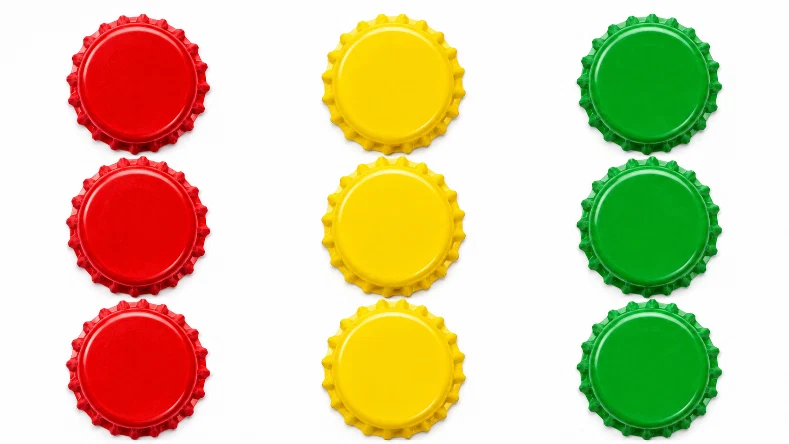
Example 1: Sorting by Colour
We have red, yellow and green bottle tops.
We put all red bottle tops together.
We put all yellow bottle tops together.
We put all green bottle tops together.
Example 2: Sorting by Size
We have three balls:
- A big ball.
- A medium-sized ball.
- A small ball.
We can put the balls into groups according to their sizes.
Example 3: Sorting by Use
We can put spoons and plates in one group because we use them when eating.
We can put pencils and books in another group because we use them when learning.
1.1.2 Matching Objects
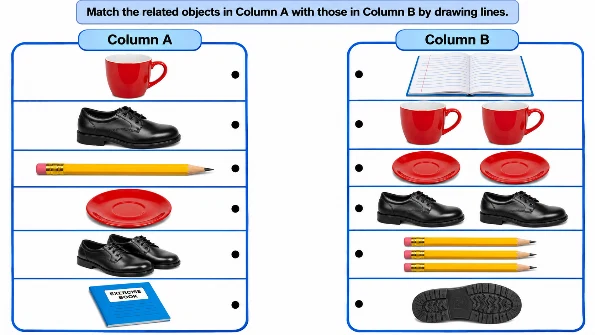
Matching means finding objects that have similar features.
We can match:
- Two objects of the same colour.
- Two objects of the same size.
- Two objects of the same shape.
- Objects that are used together.
Examples
A cup matches a saucer.
A shoe matches another shoe of the same pair.
A red ball matches another red ball.
Activity 1
Look at objects in your classroom.
- Find two objects of the same colour.
- Find two objects of the same shape.
- Find two objects that are used together.
1.1.3 Ordering Objects
Ordering means arranging objects in a particular way.
We can arrange objects:
- From smallest to biggest.
- From biggest to smallest.
- From shortest to longest.
- From longest to shortest.
Example
We have sticks measuring 2 handspans, 4 handspans and 3 handspans.
From shortest to longest:
2 handspans → 3 handspans → 4 handspans.
Activity 2
Collect four safe sticks of different lengths.
Arrange them from the shortest to the longest.
1.1.4 Creating Patterns
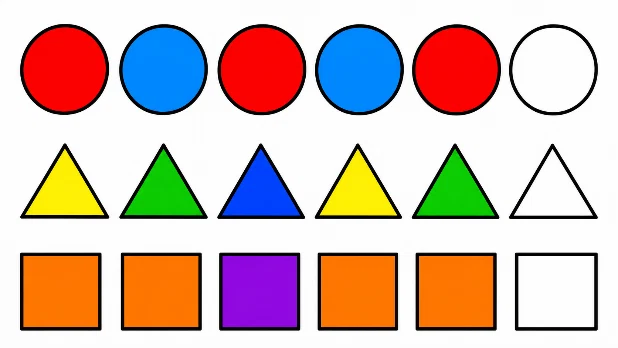
A pattern is an arrangement that follows a rule.
We can create patterns using colours, shapes and sizes.
Example 1: Colour Pattern
Red, Blue, Red, Blue, Red, Blue.
The next colour is Red.
Example 2: Shape Pattern
Circle, Triangle, Circle, Triangle, Circle.
The next shape is Triangle.
Example 3: Size Pattern
Big, Small, Big, Small, Big.
The next size is Small.
Exercise 1.1
- Name three ways of sorting objects.
- Draw two objects of the same shape.
- Arrange these numbers representing sizes from smallest to biggest: 3, 1, 4, 2.
- Complete the pattern: Red, Green, Red, Green, ______.
- Complete the pattern: Big, Small, Big, Small, ______.