
Learning Outcomes
By the end of this sub-strand, I should be able to:
- Count forwards up to 50.
- Count backwards from 30.
- Read and write numbers from 1 to 50.
- Write number names from one to ten.
- Complete number patterns up to 20.
1.2.1 Counting Numbers
We count to find out how many objects we have.
We can count:
- Stones.
- Books.
- Pencils.
- Fruits.
- Bottle tops.
- Fingers.
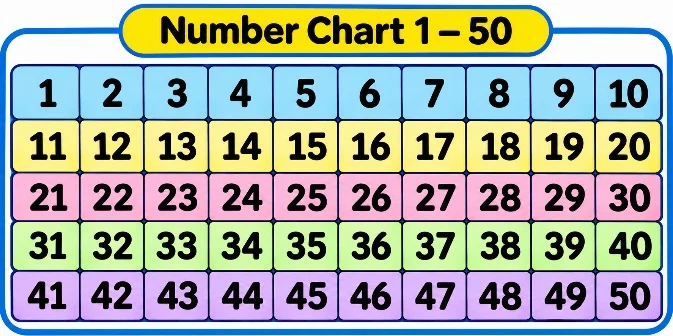
Counting from 1 to 20
1, 2, 3, 4, 5, 6, 7, 8, 9, 10
11, 12, 13, 14, 15, 16, 17, 18, 19, 20.
Counting from 21 to 50
21, 22, 23, 24, 25, 26, 27, 28, 29, 30.
31, 32, 33, 34, 35, 36, 37, 38, 39, 40.
41, 42, 43, 44, 45, 46, 47, 48, 49, 50.
1.2.2 Counting Objects
Example
Count the mangoes.
🥭 🥭 🥭 🥭 🥭
There are 5 mangoes.
Activity 1
Collect ten bottle tops.
Place them on your desk.
Touch one bottle top at a time while counting.
1.2.3 Counting Backwards
Counting backwards means saying numbers from a bigger number to a smaller number.
Examples
10, 9, 8, 7, 6, 5, 4, 3, 2, 1.
20, 19, 18, 17, 16, 15, 14, 13, 12, 11, 10.
30, 29, 28, 27, 26, 25.
Activity 2
Count backwards from 15 to 1.
1.2.4 Number Names
|
Number |
Number Name |
|---|---|
|
1 |
One |
|
2 |
Two |
|
3 |
Three |
|
4 |
Four |
|
5 |
Five |
|
6 |
Six |
|
7 |
Seven |
|
8 |
Eight |
|
9 |
Nine |
|
10 |
Ten |
1.2.5 Number Patterns
Numbers can follow a pattern.
Example 1
1, 2, 3, 4, 5.
The numbers increase by one.
Example 2
2, 4, 6, 8, 10.
The numbers increase by two.
Example 3
5, 6, __, 8, 9.
The missing number is 7.
 Exercise 1.2
- Write numbers from 1 to 20.
- Write numbers backwards from 10 to 1.
- Write these numbers in words: 3, 5, 8, 10.
- Fill in the missing numbers:
- 1, 2, __, 4, 5.
- 10, 11, __, 13, 14.
- 2, 4, __, 8, 10.
- Write the number that comes after 29.
- Write the number that comes before 40.