
Suggested duration in the detailed curriculum: 28 lessons. The summary gives 24 lessons.
1.4.1 Introduction
Living organisms contain chemical substances that form cellular structures and participate in metabolic activities.
These substances are commonly referred to as chemicals of life.
The major groups studied in Grade 10 are carbohydrates, lipids, proteins, enzymes, vitamins, water and mineral salts.
They are essential for growth, energy production, repair, regulation and maintenance of life.
1.4.2 Carbohydrates
Carbohydrates are organic compounds mainly composed of carbon, hydrogen and oxygen.
Many simple carbohydrates have hydrogen and oxygen in a ratio of approximately 2:1, although this is not a universal rule for all carbohydrates.
Classification of Carbohydrates
|
Type |
Description |
Examples |
|---|---|---|
|
Monosaccharides |
Single sugar units |
Glucose, fructose, galactose |
|
Disaccharides |
Two linked monosaccharide units |
Sucrose, maltose, lactose |
|
Polysaccharides |
Long chains of sugar units |
Starch, glycogen, cellulose |
Functions of Carbohydrates
- Provide energy for cellular activities.
- Store energy as starch in plants.
- Store energy as glycogen in animals and fungi.
- Form structural materials such as cellulose in plant cell walls.
- Participate in cell recognition when attached to proteins or lipids.
Sources of Carbohydrates
Examples include maize, rice, potatoes, cassava, bananas, bread and other cereal products.
1.4.3 Lipids
Lipids are a diverse group of organic substances that are generally insoluble in water but soluble in suitable non-polar solvents.
They include fats, oils, phospholipids and steroids.
Functions of Lipids
- Store energy.
- Form important components of cell membranes.
- Provide thermal insulation in some animals.
- Cushion certain internal organs.
- Supply essential fatty acids.
- Contribute to hormone production and signalling.
Sources
Cooking oils, nuts, avocados, seeds, dairy products and animal fats.
1.4.4 Proteins
Proteins are large organic molecules made of amino acids joined by peptide bonds.
They contain carbon, hydrogen, oxygen and nitrogen; some also contain sulfur.
Functions of Proteins
- Growth and repair of tissues.
- Formation of enzymes.
- Formation of some hormones.
- Transport of substances, such as oxygen by haemoglobin.
- Immune defence through antibodies.
- Structural support.
- Movement through contractile proteins.
Sources of Proteins
Beans, peas, eggs, fish, meat, milk, groundnuts and soybeans.
1.4.5 Vitamins
Vitamins are organic substances required in relatively small quantities for normal growth, metabolism and health.
They do not directly provide energy.
Classification
Fat-soluble vitamins: A, D, E and K.
Water-soluble vitamins: B-group vitamins and vitamin C.
|
Vitamin |
Main functions |
Common sources |
Possible deficiency effects |
|---|---|---|---|
|
A |
Vision, epithelial health and immunity |
Carrots, liver, dark-green vegetables |
Night blindness |
|
B₁ |
Energy metabolism and nerve function |
Whole grains, legumes |
Beriberi |
|
B₉ |
DNA synthesis and red blood cell production |
Leafy vegetables, legumes |
Megaloblastic anaemia |
|
B₁₂ |
Nerve function and red blood cell formation |
Animal products, fortified foods |
Anaemia and neurological problems |
|
C |
Collagen formation and antioxidant functions |
Citrus fruits, guavas, vegetables |
Scurvy |
|
D |
Calcium regulation and bone health |
Sunlight exposure, fortified foods, oily fish |
Rickets or osteomalacia |
|
E |
Antioxidant functions |
Vegetable oils, seeds and nuts |
Deficiency is uncommon but can affect nerves |
|
K |
Normal blood clotting |
Leafy vegetables |
Increased bleeding tendency |
1.4.6 Water
Water is an essential inorganic component of living cells.
It acts as a solvent and medium for many biological reactions.
Functions of Water
- Dissolves and transports substances.
- Provides a medium for metabolic reactions.
- Helps regulate temperature.
- Maintains turgidity in plant cells.
- Participates in hydrolysis and other chemical reactions.
- Helps remove metabolic wastes.
- Supports transport in blood and plant vascular tissues.
Properties of Water Important to Life
Polarity: Allows water to dissolve many ionic and polar substances.
High specific heat capacity: Helps organisms resist rapid temperature changes.
High latent heat of vaporisation: Makes evaporation effective for cooling.
Cohesion: Water molecules attract one another, contributing to continuous water columns in xylem.
Adhesion: Water interacts with suitable surfaces, supporting movement through narrow spaces.
1.4.7 Mineral Salts
Mineral salts provide essential mineral elements required for biological functions.
|
Mineral |
Main functions |
Common sources |
|---|---|---|
|
Calcium |
Bones, teeth, cell signalling and blood clotting |
Milk, leafy vegetables |
|
Iron |
Haemoglobin formation |
Meat, legumes, leafy vegetables |
|
Iodine |
Thyroid hormone synthesis |
Iodised salt, seafood |
|
Phosphorus |
ATP, nucleic acids, bones and teeth |
Milk, beans, meat |
|
Potassium |
Nerve function and fluid balance |
Bananas, beans, vegetables |
|
Sodium |
Nerve impulses and fluid balance |
Dietary salt |
|
Magnesium |
Enzyme activity and muscle function |
Nuts, legumes, leafy vegetables |
|
Zinc |
Enzyme function, growth and immunity |
Meat, legumes, seeds |
In plants, magnesium is also an essential component of chlorophyll.
1.4.8 Food Tests
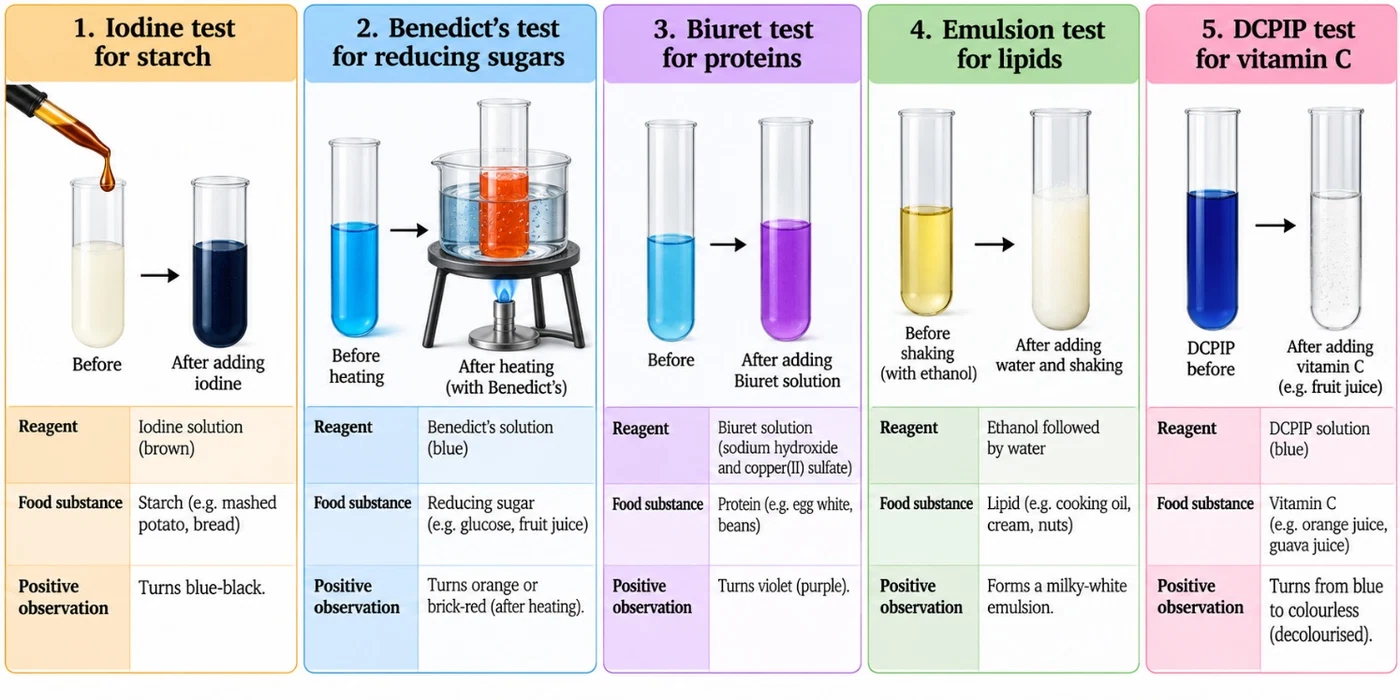
Food tests are laboratory procedures used to detect particular chemical substances in food samples.
A positive test produces an expected observable change, such as a colour change or formation of an emulsion.
A. Test for Starch
Reagent: Iodine solution.
Procedure:
- Place a small food sample in a test tube or spotting tile.
- Add a few drops of iodine solution.
- Observe the colour.
Positive result: Blue-black colour.
Negative result: Iodine remains yellow-brown.
B. Benedict's Test for Reducing Sugars
Reagent: Benedict's solution.
Procedure:
- Place a suitable food solution in a test tube.
- Add Benedict's solution.
- Heat in a hot-water bath under teacher supervision.
- Observe any colour change.
Positive result: A colour change from blue towards green, yellow, orange or brick-red, depending on the amount of reducing sugar and test conditions.
Negative result: Solution remains blue.
C. Test for Non-reducing Sugars
Sucrose is a common non-reducing sugar.
Procedure:
- First test the sample for reducing sugars.
- If negative, hydrolyse a separate portion using dilute acid under supervision.
- Cool and neutralise the solution using an appropriate procedure.
- Repeat Benedict's test.
Positive result after hydrolysis: Indicates that non-reducing sugars may have been present.
D. Biuret Test for Proteins
Reagent: Biuret reagent or the appropriate alkaline copper(II) reagent system.
Procedure:
- Place a food solution in a test tube.
- Add the reagent according to laboratory instructions.
- Mix carefully.
- Observe the colour.
Positive result: Violet or purple.
Negative result: Blue.
E. Ethanol Emulsion Test for Lipids
Procedure:
- Mix a suitable food sample with ethanol.
- Transfer the extract into water.
- Observe the mixture.
Positive result: Cloudy white emulsion.
Negative result: No characteristic milky emulsion.
Safety: Ethanol is flammable. Keep it away from flames and heating equipment.
F. Test for Vitamin C
A common method uses DCPIP solution.
Principle: Vitamin C reduces blue DCPIP, causing it to lose its blue colour.
Procedure:
- Place a measured amount of DCPIP solution in a test tube.
- Add the sample extract gradually while mixing.
- Observe the disappearance of the blue colour.
Positive result: DCPIP becomes colourless under suitable test conditions.
Summary of Food Tests
|
Food substance |
Reagent or method |
Positive observation |
|---|---|---|
|
Starch |
Iodine solution |
Blue-black |
|
Reducing sugar |
Benedict's solution and heat |
Green to brick-red |
|
Protein |
Biuret test |
Violet/purple |
|
Lipid |
Ethanol emulsion test |
Milky-white emulsion |
|
Vitamin C |
DCPIP |
Blue colour disappears |
1.4.9 Enzymes
An enzyme is a biological catalyst that increases the rate of a biochemical reaction without being consumed in the overall reaction.
Most enzymes are proteins, although some RNA molecules also have catalytic activity.
Characteristics of Enzymes
- Increase the rate of chemical reactions.
- Are not consumed by the reactions they catalyse.
- Often show specificity towards particular substrates.
- Have an optimum temperature and pH range.
- May be denatured by extreme conditions.
- Are affected by substrate concentration and enzyme concentration.
- May require cofactors or coenzymes for activity.
Important Terms
Substrate: The substance on which an enzyme acts.
Active site: The region of an enzyme where the substrate binds and catalysis occurs.
Product: The substance formed after the reaction.
Enzyme–substrate complex: A temporary association formed when a substrate binds to an enzyme.
Mechanism of Enzyme Action
An enzyme binds a suitable substrate at its active site, catalyses its conversion into product and releases the product.
Where:
E = Enzyme.
S = Substrate.
ES = Enzyme–substrate complex.
P = Product.
Lock-and-Key Model
This model describes an enzyme's active site as having a shape complementary to its substrate.
Induced-Fit Model
This model recognises that the enzyme's active site may change shape when the substrate binds, improving the interaction.
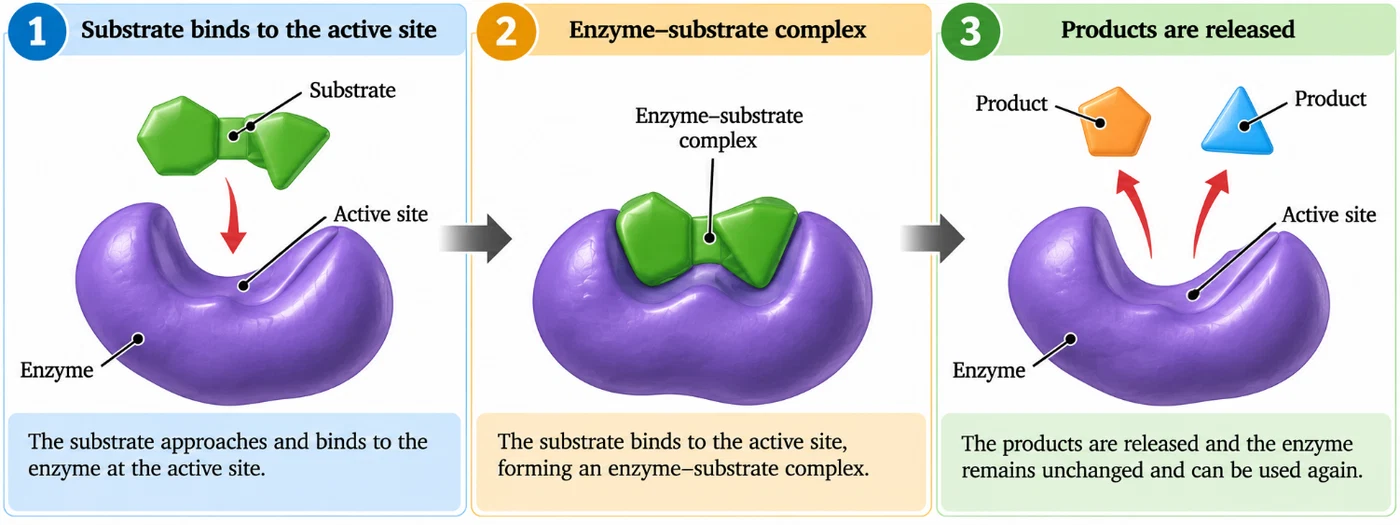
Figure 11: Formation of an enzyme–substrate complex and release of products.
1.4.10 Factors Affecting Enzyme Activity
A. Temperature
At low temperatures, molecular movement is slower and enzyme reactions generally proceed more slowly.
As temperature increases, the reaction rate often increases until an optimum is reached.
Above the optimum, many enzymes lose activity because their structures are disrupted.
B. pH
Each enzyme has a pH range in which it functions effectively.
Extreme pH values can alter the active site and reduce enzyme activity.
C. Substrate Concentration
Increasing substrate concentration initially increases reaction rate when enough enzyme is available.
At sufficiently high substrate concentrations, the enzyme becomes saturated and the reaction rate approaches a maximum.
D. Enzyme Concentration
Increasing enzyme concentration generally increases reaction rate when enough substrate is available.
E. Inhibitors
Inhibitors are substances that reduce enzyme activity.
Some bind to active sites, while others act at different regions of the enzyme.
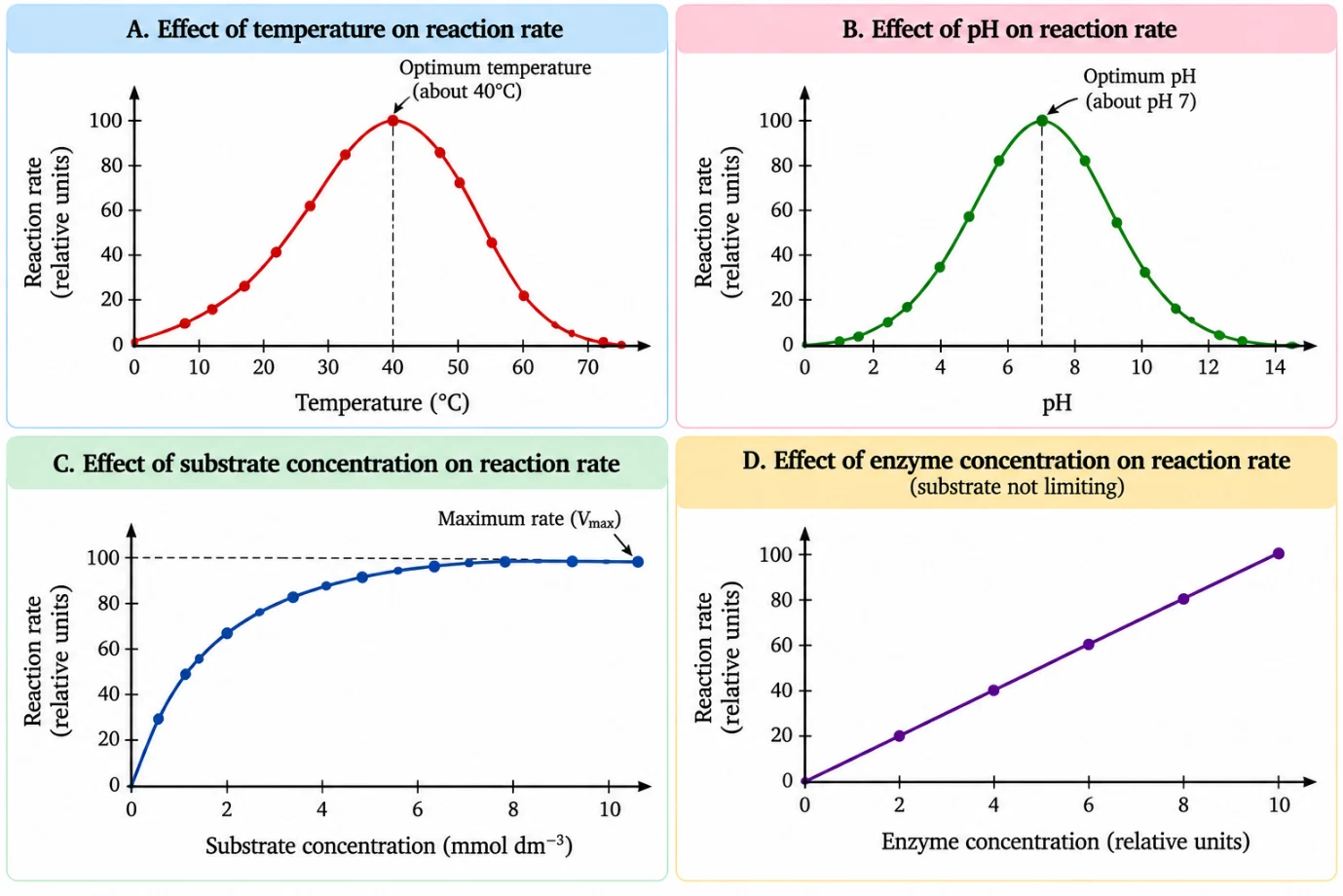
Figure 12: Typical effects of environmental and concentration factors on enzyme activity.
1.4.11 Investigation of Catalase in Living Tissues
Catalase is an enzyme that catalyses the decomposition of hydrogen peroxide into water and oxygen.
Aim
To investigate the presence of catalase in living tissues.
Materials
Fresh potato tissue, teacher-approved dilute hydrogen peroxide solution, test tubes, test-tube rack, measuring cylinder and suitable protective equipment.
Procedure
- Place a small piece of fresh potato tissue in a test tube.
- Add a measured volume of dilute hydrogen peroxide.
- Observe the reaction.
- Record the amount of bubbling or foam produced.
- Repeat using a suitable control sample, such as boiled potato tissue that has cooled.
Expected Observation
Fresh potato tissue generally produces bubbles because catalase breaks down hydrogen peroxide and releases oxygen.
Boiled tissue usually shows much less activity because heating can denature the enzyme.
Conclusion
Catalase is present in living plant tissues and catalyses the breakdown of hydrogen peroxide.
Safety: Use only dilute hydrogen peroxide approved by the teacher. Wear eye protection and avoid contact with skin and eyes.
1.4.12 Food Packaging and Consumer Awareness
Food packaging labels provide information that helps consumers make informed decisions.
Important label information includes:
- Ingredients.
- Nutritional content.
- Allergens.
- Manufacture and expiry or best-before dates.
- Storage instructions.
- Food additives.
- Manufacturer details.
- Net quantity.
Preservatives help slow certain processes that cause food deterioration.
Colourings are used to change or maintain the appearance of food.
Food additives should be assessed according to their identity, permitted use and quantity rather than assumed to be harmful simply because they are additives.
Practical Activity: Examining Food Labels
Collect clean packaging from three food products. Compare their carbohydrate, protein and fat contents, listed additives, storage instructions and date markings.
Prepare a table and discuss which information would influence purchasing decisions.
End-of-Strand 1 Revision
- Explain the functions of carbohydrates, proteins and lipids.
- Differentiate between monosaccharides and polysaccharides.
- Describe the iodine test for starch.
- State the positive observation for the Biuret test.
- Explain why Benedict's test requires heating.
- Describe how vitamin C is detected using DCPIP.
- Define an enzyme.
- Explain enzyme specificity.
- Describe the effect of temperature on enzyme activity.
- Explain the importance of catalase in living tissues.
- Discuss the importance of water in living cells.
- Explain why food labels are important to consumers.