
Introduction
Money plays an important role in the exchange of goods and services.
People use money to purchase food, clothing, transport, education, healthcare and other necessities. Businesses use money to buy materials, pay employees, maintain equipment and finance operations.
Without a generally accepted means of payment, many transactions would be difficult to carry out.
Specific Learning Outcomes
By the end of this sub-strand, learners should be able to identify security features of Kenyan currency, describe the functions of money, explain the demand for money, examine the factors influencing money supply, evaluate ethical practices in financial transactions and appreciate the role of money in everyday life.
Key Inquiry Questions
- Why are demand for and supply of money important in financial management?
- What are the ethical and unethical practices in the use of money?
1.1.1 Meaning of Money
Money is anything generally accepted as a means of payment for goods and services and for settling financial obligations.
Money makes exchange easier because buyers and sellers can use an accepted payment medium without exchanging goods directly.
For example, a farmer may sell vegetables for Kenya shillings and use the money received to purchase books, cooking oil or agricultural tools.
The farmer does not have to find a bookseller willing to exchange books directly for vegetables.
Barter Trade
Barter trade is the direct exchange of goods or services for other goods or services without using money.
For example, a farmer may exchange maize for beans with another farmer.
Difficulties of Barter Trade
Double coincidence of wants: Each trader must possess something the other person wants.
Indivisibility: Some goods cannot be divided conveniently into smaller units of exchange.
Lack of a common measure of value: It may be difficult to agree on the exchange value of different products.
Storage difficulties: Some goods are perishable or expensive to store.
Deferred payments: Future payment arrangements may be difficult when the agreed goods change in quality or value.
Money helps reduce these difficulties.
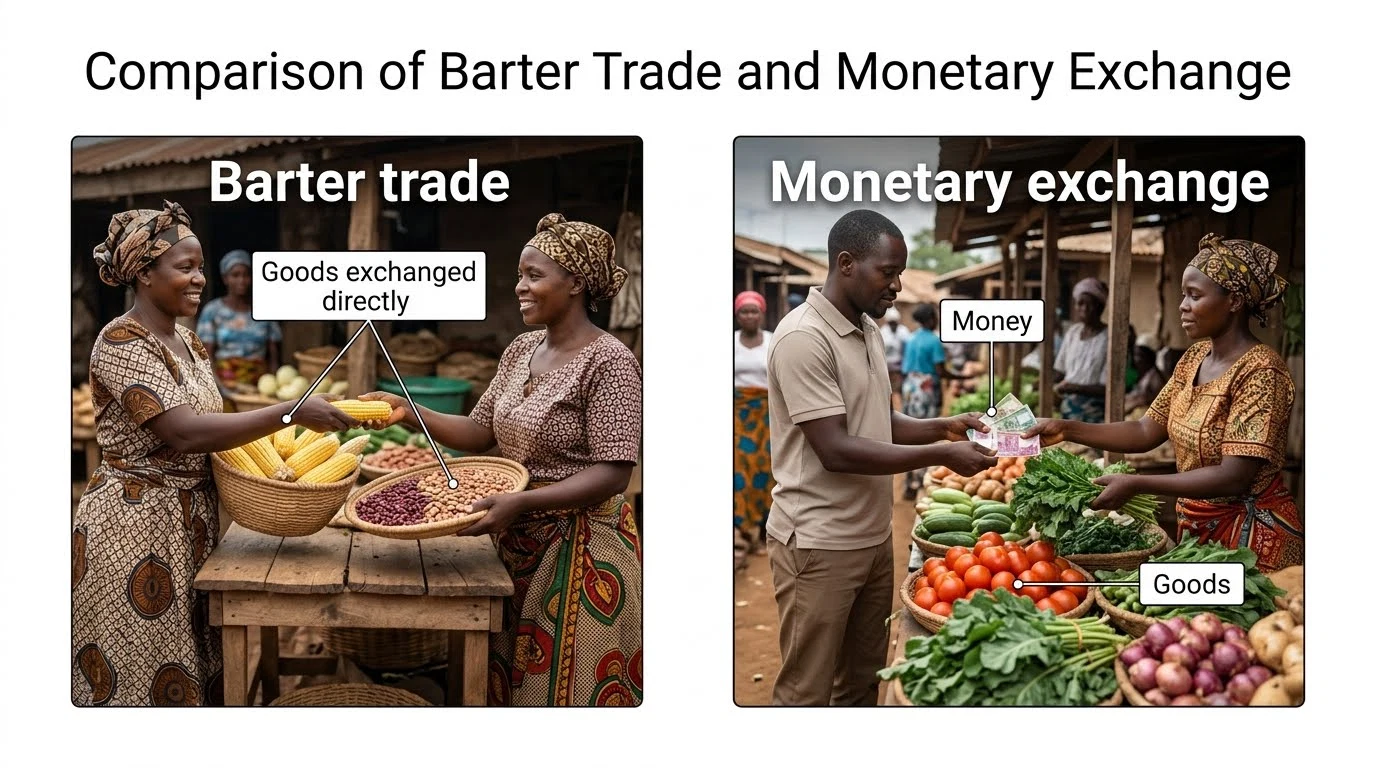 Figure 1.1: Comparison of barter trade and exchange using money.
Figure 1.1 demonstrates how money simplifies transactions by providing a commonly accepted payment medium.
1.1.2 Characteristics of Good Money
For an item to function effectively as money, it should possess several desirable characteristics.
1. General Acceptability
Money should be accepted by people when buying and selling goods and services.
General acceptability makes transactions convenient.
2. Portability
Money should be easy to carry and transfer.
Banknotes, coins and electronic payment systems make it possible to conduct transactions without transporting bulky goods.
3. Durability
Physical money should withstand repeated handling.
Banknotes and coins are designed to remain usable for a reasonable period.
4. Divisibility
Money should be available in denominations that enable both small and large payments.
For example, different denominations of Kenyan currency facilitate transactions of different values.
5. Uniformity
Units of the same denomination should have the same recognised monetary value.
6. Recognisability
People should be able to recognise genuine currency and distinguish it from counterfeit money.
7. Relative Stability in Value
Money should retain sufficient purchasing power to support economic transactions, although inflation and other economic conditions can change its value over time.
8. Controlled Supply
The supply of money must be managed in a way that supports monetary and economic stability.
1.1.3 Forms of Money
Money exists in different forms.
Commodity Money
Commodity money refers to an item that possesses value as a commodity and is used as a medium of exchange.
Historically, commodities such as salt, livestock and certain metals have served this purpose.
Metallic Money
Metallic money consists of coins or other metallic forms used as currency.
Paper Money
Paper money consists of officially issued currency notes.
Bank Deposits
Balances held in suitable bank accounts can be used for transactions through authorised payment methods.
Electronic Money and Digital Payments
Electronic payment systems enable the transfer of monetary value using digital technology.
Examples in Kenya include bank transfers and mobile money services such as M-PESA.
A mobile payment balance or digital banking transaction does not necessarily create a new national currency; it provides a means of storing or transferring monetary value within an authorised system.
1.1.4 Kenyan Currency
The official currency of Kenya is the Kenya shilling (KSh).
It is used as a standard unit for pricing, payments, accounting and financial reporting in Kenya.
The Central Bank of Kenya is responsible for issuing Kenyan currency.
Kenyan currency is available in authorised banknote and coin denominations.
Security Features of Kenyan Currency
Currency security features help people identify genuine banknotes and reduce counterfeiting.
Depending on the banknote series and denomination, these may include:
- Watermarks.
- Security threads.
- Raised printing.
- Distinctive patterns and fine printing.
- Serial numbers.
- Features that change appearance when viewed at different angles.
The precise appearance and location of these features depend on the banknote series.
Aspect Ratio: 16:9.
Figure 1.2: Selected security features used to identify genuine Kenyan currency.
Placement: After the explanation of Kenyan currency security features.
Figure 1.2 should help learners compare the appearance of genuine security features. Visual inspection should be combined with the current guidance provided by the Central Bank of Kenya.
Practical Activity 1.1: Identifying Currency Security Features
Aim: To identify selected security features of genuine Kenyan banknotes.
Materials: Authorised banknote reference photographs, approved learning materials and magnified illustrations.
Procedure:
- Study the reference images.
- Identify the denomination and banknote series.
- Locate the security thread and watermark.
- Examine the raised-printing features shown in the reference.
- Record the observed features.
- Explain how the features help distinguish genuine currency.
Expected Product: A labelled chart of currency security features.
1.1.5 Functions of Money
Money performs several economic functions.
1. Medium of Exchange
Money is used to purchase goods and services.
For example, a learner pays KSh 50 for an exercise book.
Money makes the transaction possible without direct exchange of other goods.
2. Measure of Value
Money provides a common unit for expressing and comparing the prices of goods and services.
For example:
|
Product |
Illustrative price |
|---|---|
|
Exercise book |
KSh 50 |
|
Pen |
KSh 20 |
|
Ruler |
KSh 30 |
A learner can compare the prices because they are expressed in the same monetary unit.
3. Store of Value
Money enables people to retain purchasing power for future use, although inflation may reduce that purchasing power.
For example, a trader may save part of the day's earnings for future business expenses.
4. Standard of Deferred Payment
Money provides a means of expressing obligations that will be settled in the future.
For example, a business may purchase goods on credit and agree to pay KSh 10,000 after 30 days.
5. Transfer of Value
Money allows value to be transferred from one person or location to another.
For example, a parent working in Nairobi may transfer funds to a learner studying in another county.
Aspect Ratio: 16:9.
Figure Caption: Figure 1.3: Functions of money in everyday economic activities.
Placement: After the functions of money.
Figure 1.3 demonstrates how money supports buying, selling, saving, future payments and financial transfers.
1.1.6 Demand for Money
Demand for money refers to the desire to hold money balances for making payments and meeting other financial needs.
People and businesses hold money for different reasons.
Transaction Motive
Money is held to meet regular expenses such as food, transport, rent, wages and materials.
Precautionary Motive
Money is retained to meet unexpected expenses.
For example, a family may maintain emergency savings for urgent repairs or medical costs.
Speculative Motive
Money may be held while people wait for favourable opportunities to purchase financial assets or make investments.
Factors Influencing Demand for Money
Level of income: People with higher incomes may require larger transaction balances.
Prices of goods and services: Higher prices may increase the money required for purchases.
Frequency of payments: The timing of income and expenses influences money balances.
Interest rates: Returns on alternative assets can affect the willingness to hold money.
Economic uncertainty: Greater uncertainty may increase precautionary holdings.
Payment technology: Efficient digital payment arrangements may reduce the need to hold physical cash.
1.1.7 Supply of Money
Money supply refers to the quantity of money in an economy, measured according to a specified definition that may include currency and certain bank deposits.
The amount of money available in the economy is influenced by monetary policy and financial-system activities.
Factors Influencing Money Supply
- Central bank monetary policy.
- Commercial bank lending and deposit creation.
- Reserve and liquidity requirements.
- Interest-rate conditions.
- Demand for credit.
- Financial-system operations and public preferences for cash or deposits.
Demand and Supply of Money in Economic Development
A well-functioning monetary system supports economic activity by enabling payments, saving, borrowing and investment.
However, excessive monetary expansion relative to productive capacity may contribute to inflationary pressures.
Very restrictive monetary conditions may make borrowing difficult and reduce spending or investment.
The relationship between money supply, prices and economic growth is influenced by several economic factors.
1.1.8 Ethical and Unethical Practices in the Use of Money
Ethical Practices
Ethical financial behaviour involves using money honestly, responsibly and lawfully.
Examples include:
- Giving accurate change.
- Keeping proper financial records.
- Paying agreed debts.
- Respecting entrusted funds.
- Reporting financial transactions truthfully.
- Avoiding fraud and corruption.
- Protecting other people's financial information.
Unethical Practices
Unethical practices include theft, bribery, fraud, counterfeiting, misappropriation of funds and dishonest financial reporting.
Such activities may lead to financial losses, loss of public trust and legal consequences.
Case Study
A school club collects KSh 12,000 for an educational visit. The treasurer spends KSh 2,000 on personal purchases without authorisation.
Discussion Questions
- Identify the unethical action.
- Explain the possible consequences.
- Suggest appropriate controls to prevent misuse of club funds.
Suggested Responses: Unauthorised use of funds; financial loss and loss of trust; approved budgets, receipts, supervision and regular financial reporting.
Summary of Sub-strand 1.1
Money facilitates exchange, provides a measure of value, supports saving and enables future payments.
Its usefulness depends on characteristics such as acceptability, durability, portability and recognisability.
Demand for money arises from transaction, precautionary and speculative motives. Money supply is influenced by monetary and banking-system activities.
Integrity and accountability are essential in financial transactions.
Revision Questions
- Define money.
- Explain four limitations of barter trade.
- State six characteristics of good money.
- Explain five functions of money.
- Identify four security features of Kenyan banknotes.
- Explain three motives for holding money.
- State four factors influencing demand for money.
- Describe four factors influencing money supply.
- Explain the importance of ethical conduct in financial transactions.
- Give four examples of unethical practices involving money.