
Suggested duration: 8 lessons
1.1.1 Meaning of Geography
Geography is the study of the Earth and the relationship between people and their environment in terms of place, space and time.
It examines where things are found, why they are found there, how they change and how they affect human life.
For example, Geography helps us understand why tea is widely grown in the Kenyan highlands, why some parts of northern Kenya experience dry conditions and why many settlements develop near transport routes.
1.1.2 Branches of Geography
Geography has two main branches: Physical Geography and Human Geography.
A. Physical Geography
Physical Geography studies natural features and processes on the Earth's surface.
Its areas include:
|
Area |
What it studies |
|---|---|
|
Geomorphology |
Landforms and the processes that shape them |
|
Climatology |
Climate and atmospheric conditions |
|
Hydrology |
Water on and beneath the Earth's surface |
|
Biogeography |
Distribution of plants and animals |
|
Soil Geography |
Soil formation, characteristics and distribution |
Examples in Kenya: Studying Mount Kenya, the Great Rift Valley, Lake Victoria, rainfall patterns and vegetation in the coastal region.
B. Human Geography
Human Geography studies people, their activities and their relationships with the environment.
Its areas include:
|
Area |
What it studies |
|---|---|
|
Population Geography |
Population distribution, growth and movement |
|
Settlement Geography |
Rural and urban settlements |
|
Economic Geography |
Production, distribution and consumption of goods and services |
|
Agricultural Geography |
Farming systems and their distribution |
|
Transport Geography |
Transport networks and movement |
|
Urban Geography |
Towns and cities |
Examples in Kenya: Studying the growth of Nairobi, agricultural activities in Kericho, tourism in Mombasa and transport along the Nairobi–Mombasa corridor.
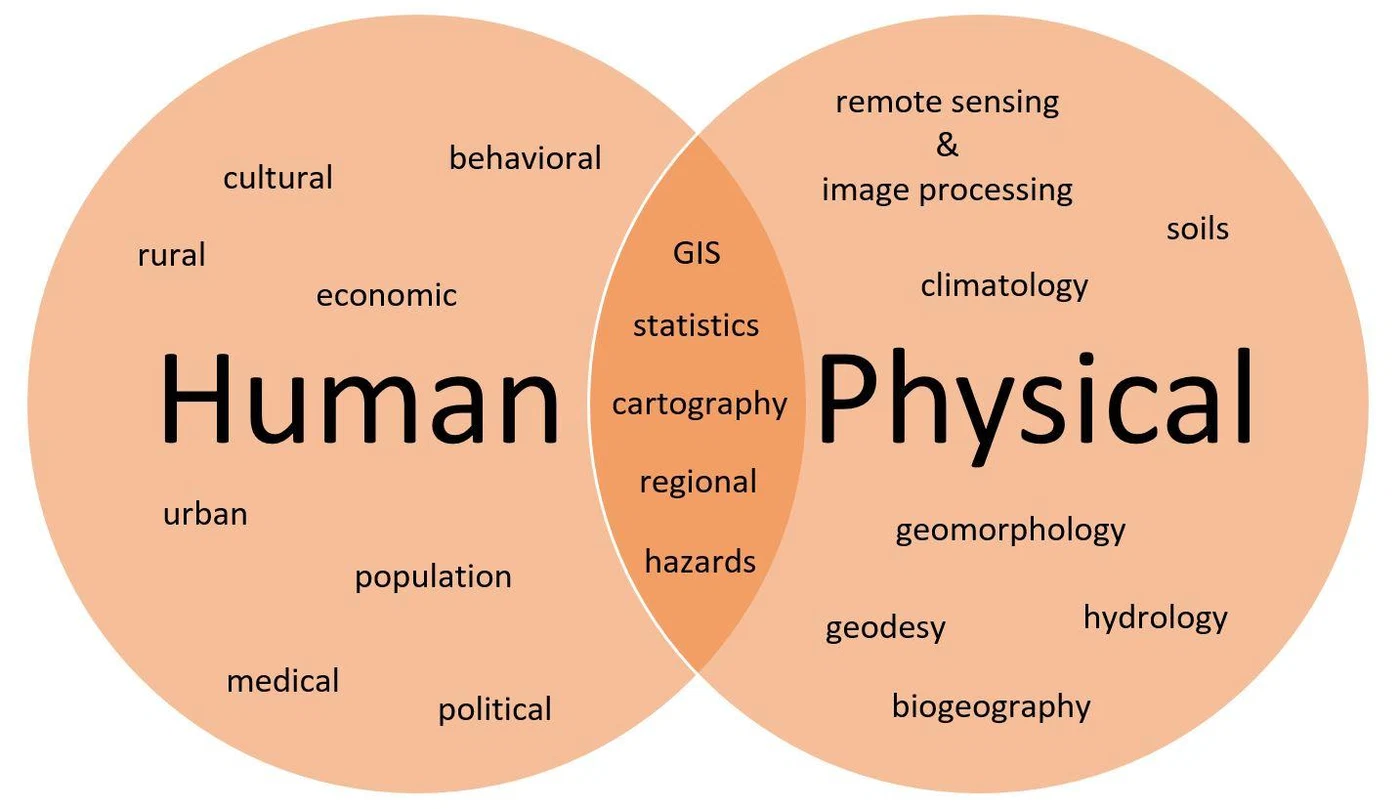
Suggested Figure 1.1: Branches of Geography
commons.wikimedia.org
Illustration reference. For the final notes, use a two-column diagram labelled Physical Geography and Human Geography, showing the main areas of study.
1.1.3 Importance of Studying Geography
Geography is important because it:
- Promotes environmental conservation. Learners understand the need to protect forests, rivers, soils and wildlife.
- Supports agricultural development. Farmers use knowledge of rainfall, soils and temperatures to select suitable crops.
- Improves disaster preparedness. Communities can identify risks associated with floods, droughts, landslides and earthquakes.
- Promotes proper use of natural resources. Geographical knowledge supports responsible mining, farming and water management.
- Supports planning and development. Geographical information helps determine suitable locations for roads, schools, hospitals and industries.
- Develops practical skills. Learners acquire map-reading, data-collection, observation and research skills.
- Promotes international understanding. Geography explains relationships among countries, environments and economies.
- Provides career opportunities. Geography-related professions include surveying, environmental planning and meteorology.
1.1.4 Relationship Between Geography and Other Disciplines
Geography draws knowledge from several other subjects.
|
Discipline |
Relationship with Geography |
|---|---|
|
Biology |
Explains distribution of plants, animals and ecosystems |
|
Chemistry |
Helps explain soil composition, pollution and chemical weathering |
|
Physics |
Explains energy, atmospheric processes and some Earth movements |
|
Mathematics |
Supports calculations, mapping and statistical analysis |
|
History |
Explains past settlement patterns and changes in land use |
|
Economics |
Explains production, trade and resource utilisation |
|
Computer Science |
Supports GIS, digital mapping and data analysis |
|
Agriculture |
Explains farming activities and land productivity |
1.1.5 Careers Related to Geography
Geographical knowledge provides a foundation for careers such as:
- Cartographer — prepares and interprets maps.
- Surveyor — measures and maps land.
- Meteorologist — studies weather and atmospheric conditions.
- Urban and regional planner — plans land use and settlement development.
- GIS specialist — manages and analyses geographical information.
- Environmental officer — supports environmental protection.
- Geologist — studies rocks and the Earth's materials.
- Geography teacher — teaches geographical knowledge and skills.
1.1.6 Factors to Consider When Choosing a Career
A learner should consider personal interests, abilities, educational requirements, employment opportunities, financial resources and the contribution a career can make to society.
Practical Activity 1.1
Title: Investigating Careers Related to Geography
Work in groups and identify five careers related to Geography. For each career, describe its main responsibilities, the skills required and how it benefits society.
Present your findings using a poster or table.
Revision Questions and Direct Answers
1. What is Geography?
The study of the Earth, people and their relationships with the environment.
2. Name the two main branches of Geography.
Physical Geography and Human Geography.
3. State four importance of studying Geography.
Environmental conservation, resource management, disaster preparedness and development planning.
4. Name three disciplines related to Geography.
Biology, Mathematics and Economics.
5. Identify four careers related to Geography.
Cartographer, surveyor, meteorologist and GIS specialist.