
1. Introduction
John the Baptist was a prophet chosen by God to prepare people for the coming of Jesus Christ.
He preached repentance and encouraged people to turn away from sinful behaviour.
He baptised people in the River Jordan as a sign of repentance.
John also introduced Jesus to the people and explained that Jesus was greater than him.
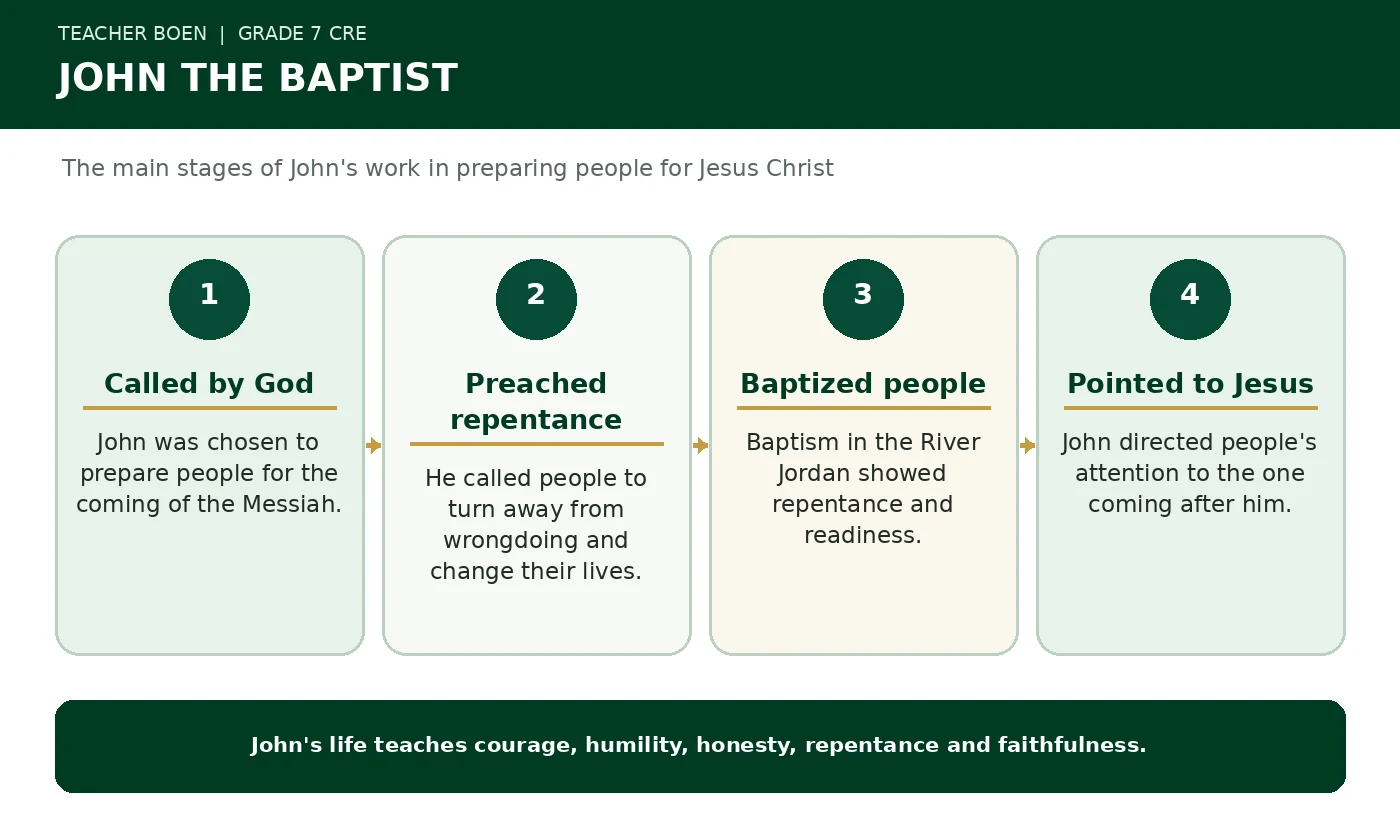
The main stages of John the Baptist's ministry and his role in preparing people for Jesus.
John is described as a precursor to the Messiah because he prepared the way for Jesus Christ.
2. Meaning of important terms
Precursor: A person who comes before another person to prepare the way for their arrival or work.
Annunciation: The announcement of an important birth or event by an angel.
Repentance: A sincere decision to turn away from wrongdoing and change one's behaviour.
Baptism: A Christian religious practice involving water, associated with repentance, faith and commitment to God.
Messiah: The promised Saviour or Anointed One.
Righteousness: Living according to what is morally right and pleasing to God.
3. Annunciation of the birth of John the Baptist
The announcement of John's birth is recorded in Luke 1:5–25.
John's parents were Zechariah and Elizabeth.
They were righteous people who followed God's commandments.
However, they were advanced in age and had no child because Elizabeth was barren.
Zechariah was a priest who served in the temple.
One day, while he was performing his priestly duties, an angel of the Lord appeared to him.
The angel identified himself as Gabriel.
He announced that Elizabeth would give birth to a son.
The child was to be named John.
The angel explained that John would bring joy to many people.
He would be filled with the Holy Spirit even before his birth.
He would prepare the people for the coming of the Lord.
Zechariah doubted the message because he and Elizabeth were old.
As a result, he became unable to speak until the promise was fulfilled.
When Zechariah returned home, Elizabeth conceived.
4. Lessons from the annunciation of John's birth
- God answers prayers according to His will.
- Nothing is impossible with God.
- Christians should trust God's promises.
- God has a purpose for every person.
- Parents should bring up children responsibly.
- People should remain faithful even during difficult situations.
- God's plans may be fulfilled in unexpected ways.
5. Birth of John the Baptist
The birth of John is recorded in Luke 1:57–66.
When Elizabeth's time came, she gave birth to a son.
Her neighbours and relatives rejoiced because God had shown her great mercy.
On the eighth day, the child was taken for circumcision.
The relatives wanted to name him after his father, Zechariah.
However, Elizabeth insisted that he should be called John.
They questioned this because no one in the family had that name.
They then asked Zechariah to confirm the name.
Zechariah requested a writing tablet and wrote, "His name is John."
Immediately, his ability to speak was restored.
He praised God, and the people were amazed by what had happened.
6. Mission of John the Baptist
John was sent to prepare people for the coming of Jesus Christ.
His mission involved the following activities.
A. Preaching repentance
John encouraged people to turn away from sin and live righteous lives.
B. Baptising people
He baptised people in the River Jordan as a sign of repentance.
C. Preparing people for the Messiah
He encouraged people to prepare themselves for the coming of the Lord.
D. Teaching moral responsibility
He taught people to demonstrate repentance through their actions.
E. Introducing Jesus Christ
He identified Jesus as the one who was greater than him.
F. Calling people to justice
He challenged people to act honestly and treat others fairly.
7. How John prepared the way for the Messiah
John prepared the way for Jesus in several ways.
- He announced the coming of the Messiah.
- He encouraged people to repent.
- He baptised people as a sign of repentance.
- He taught people to live morally upright lives.
- He called people to practise justice.
- He introduced Jesus to the people.
- He explained that Jesus was greater than him.
- He encouraged people to accept the message of Jesus.
8. John's description of the Messiah
The description of Jesus by John is recorded in Luke 3:16 and John 1:29–30.
A. Luke 3:16
John explained that someone greater than him was coming.
He said that he was not worthy to untie the sandals of the coming person.
He explained that he baptised with water, but the coming Messiah would baptise with the Holy Spirit and fire.
Lessons:
- Jesus was greater than John.
- Jesus had a special mission from God.
- John recognised his own role in preparing the way.
- Christians should be humble.
- People should recognise the importance of Jesus.
B. John 1:29–30
When John saw Jesus approaching, he described Him as the Lamb of God who takes away the sin of the world.
He also explained that Jesus existed before him in importance and divine purpose.
Meaning of the Lamb of God
The title "Lamb of God" expresses the Christian belief that Jesus would offer Himself for the salvation of humanity.
It connects Jesus with the biblical theme of sacrifice and forgiveness.
9. Message of John the Baptist
John's message is recorded in Luke 3:7–18.
He challenged people to repent and demonstrate genuine changes in their behaviour.
His teachings included the following.
A. Repentance
John warned people against continuing in sinful behaviour.
He encouraged them to change their ways and live according to God's will.
B. Producing good fruits
John explained that genuine repentance should be demonstrated through good actions.
People should not simply claim to be righteous without changing their behaviour.
C. Sharing with the needy
John instructed people who had two coats to share with those who had none.
Those with food were also encouraged to share.
This teaches generosity and concern for others.
D. Honesty in business
John instructed tax collectors not to collect more money than they were required to collect.
This teaches honesty and fairness.
E. Avoiding exploitation
John instructed soldiers not to use their positions to extort money or accuse people falsely.
He encouraged them to be satisfied with their wages.
F. Humility
John did not present himself as the Messiah.
He recognised that someone greater than him was coming.
G. Hope
John encouraged people to prepare for the coming of the Messiah.
His message gave people hope for God's salvation.
10. Values from the teachings of John the Baptist
|
Value |
Meaning |
Application in daily life |
|---|---|---|
|
Honesty |
Telling the truth |
Avoid cheating and lying |
|
Generosity |
Sharing with others |
Help people in need |
|
Humility |
Avoiding pride |
Appreciate other people's contributions |
|
Repentance |
Turning away from wrongdoing |
Admit mistakes and change |
|
Justice |
Treating people fairly |
Avoid discrimination |
|
Self-control |
Managing behaviour |
Resist negative peer pressure |
|
Responsibility |
Being accountable |
Complete assigned duties |
|
Integrity |
Maintaining good moral principles |
Avoid corruption and dishonesty |
11. How learners can apply John's teachings
- Share food and other resources with needy people.
- Avoid cheating during examinations.
- Treat others fairly.
- Admit mistakes and apologise.
- Avoid exploiting other people.
- Respect people regardless of their background.
- Practise honesty in school activities.
- Avoid boasting.
- Help people experiencing difficulties.
- Make responsible decisions.
12. Practical activities
Activity 1: Bible reading
Read Luke 1:5–25 and Luke 1:57–66.
Retell the story of the annunciation and birth of John the Baptist.
Activity 2: Role-play
Act out the announcement of John's birth by the angel Gabriel.
Activity 3: Bible study
Read Luke 3:7–18 and identify the teachings of John the Baptist.
Activity 4: Poem writing
Compose a poem explaining how John prepared the way for Jesus Christ.
Activity 5: Personal reflection
Write five values from John's teachings that you can practise at school and home.
13. Summary
John the Baptist was chosen by God to prepare people for the coming of Jesus Christ.
His birth was announced by the angel Gabriel to Zechariah.
John preached repentance, baptised people and taught moral responsibility.
He introduced Jesus as the Lamb of God and explained that Jesus was greater than him.
His teachings promote honesty, generosity, humility, justice and responsible living.
14. Revision questions and answers
Q1. Who were the parents of John the Baptist?
Zechariah and Elizabeth.
Q2. Which angel announced the birth of John?
Angel Gabriel.
Q3. Where is the announcement of John's birth recorded?
Luke 1:5–25.
Q4. What name was the child given?
John.
Q5. Why was Zechariah unable to speak?
He doubted the angel's announcement about the birth of his son.
Q6. What was the mission of John the Baptist?
To prepare people for the coming of Jesus Christ through preaching repentance and baptising people.
Q7. How did John describe Jesus in John 1:29?
He described Him as the Lamb of God who takes away the sin of the world.
Q8. State five teachings of John the Baptist.
Repentance, generosity, honesty, justice and humility.
Q9. Explain why John is described as a precursor to the Messiah.
He came before Jesus and prepared people to receive Him.
Q10. State five values learners can acquire from John's teachings.
Honesty, generosity, humility, justice and self-control.