
1. Introduction
The birth and childhood of Jesus Christ are important events in Christian history.
Christians believe that Jesus is the Son of God and the promised Messiah.
His birth fulfilled God's plan for the salvation of humanity.
The events surrounding His birth and childhood teach important values such as obedience, humility, faith, love and respect for parents.
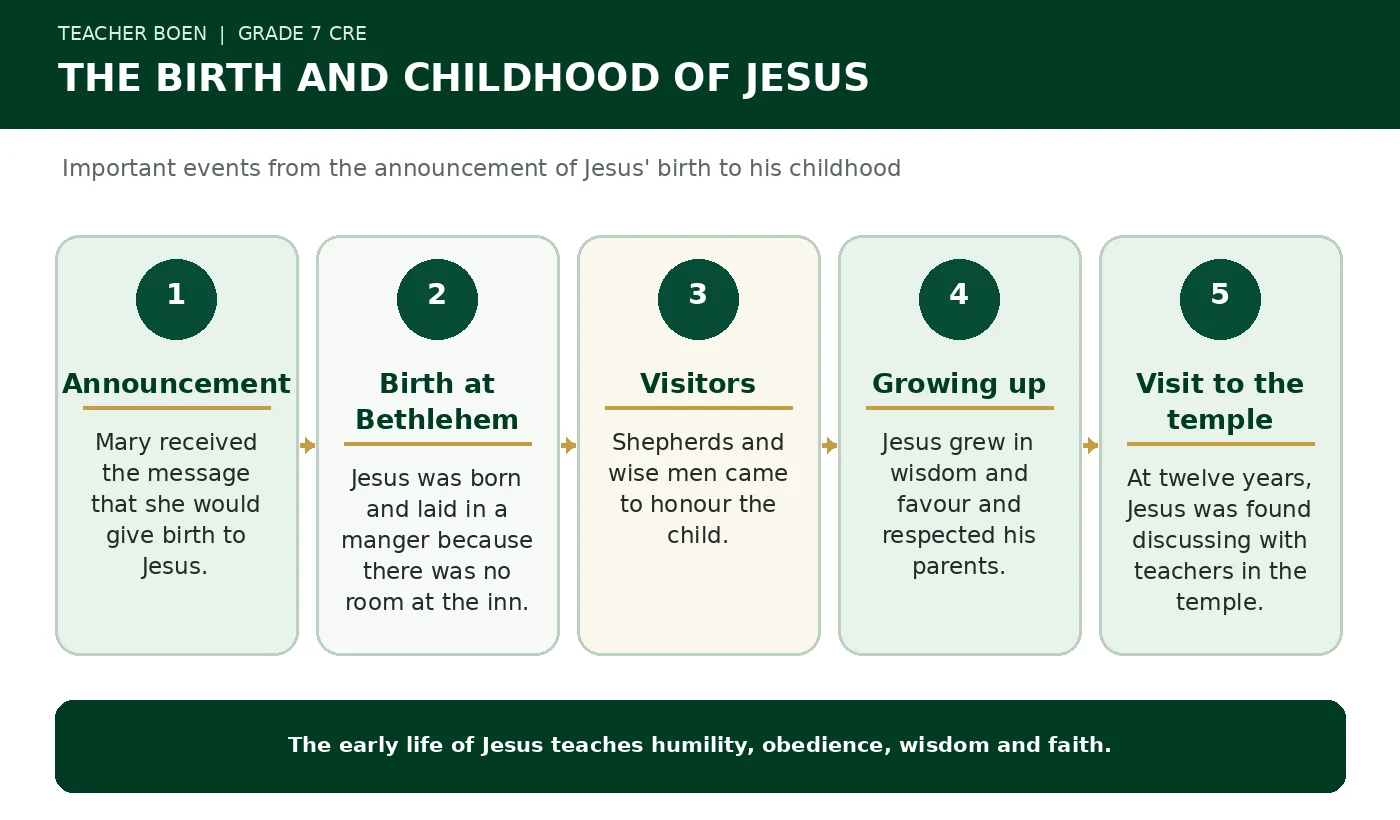
A summary of important events in the birth and childhood of Jesus Christ.
The accounts are mainly found in Matthew 1–2 and Luke 1–2.
2. Meaning of important terms
Annunciation: The announcement by an angel of the coming birth of Jesus.
Incarnation: The Christian belief that God became human in Jesus Christ.
Virgin birth: The Christian teaching that Jesus was conceived by the power of the Holy Spirit and born of Mary.
Dedication: The act of presenting a child to God as an expression of gratitude and commitment.
Saviour: A person who delivers others from danger or suffering.
Nativity: The birth of Jesus Christ.
Passover: A Jewish religious festival commemorating the Israelites' deliverance from slavery in Egypt.
3. Annunciation of the birth of Jesus Christ
The announcement of Jesus' birth is recorded in Luke 1:26–38.
God sent the angel Gabriel to a town in Galilee called Nazareth.
The angel visited a young woman named Mary.
Mary was engaged to Joseph, who belonged to the family of David.
Gabriel greeted Mary and told her that she had found favour with God.
He announced that she would conceive and give birth to a son.
She was instructed to name the child Jesus.
The angel explained that Jesus would be great and would be called the Son of the Most High.
He would receive the throne of David and His kingdom would have no end.
Mary was surprised because she was a virgin.
The angel explained that the Holy Spirit would come upon her and the power of the Most High would overshadow her.
Mary accepted God's message and expressed her willingness to serve Him.
4. Lessons from the annunciation of Jesus' birth
- God fulfils His promises.
- God has a purpose for every person.
- Christians should trust God.
- Humility is an important Christian value.
- People should be willing to obey God's instructions.
- God can accomplish things beyond human understanding.
- Christians should remain faithful during difficult situations.
5. Birth of Jesus Christ
The birth of Jesus is recorded in Luke 2:1–20.
During that period, Caesar Augustus issued a decree that a census should be conducted throughout the Roman Empire.
People were required to travel to their ancestral towns for registration.
Joseph travelled from Nazareth to Bethlehem because he belonged to the family line of David.
Mary accompanied him.
While they were in Bethlehem, the time came for Mary to give birth.
She gave birth to her firstborn son.
She wrapped Him in cloths and placed Him in a manger because there was no suitable guest room available for them.
6. Announcement of the birth of Jesus to the shepherds
That night, shepherds were looking after their flocks in the fields near Bethlehem.
An angel appeared to them, and the glory of the Lord shone around them.
The shepherds became afraid.
The angel reassured them and announced good news of great joy for all people.
The angel explained that a Saviour had been born in the town of David.
The child was Christ the Lord.
The shepherds were given a sign. They would find a baby wrapped in cloths and lying in a manger.
A multitude of heavenly angels appeared, praising God and saying:
"Glory to God in the highest, and on earth peace, goodwill toward men."
After the angels departed, the shepherds went to Bethlehem.
They found Mary, Joseph and the baby lying in a manger.
They spread the message about what they had seen and heard.
7. Visit of the wise men
Matthew 2:1–12 records the visit of the wise men from the East.
They travelled to Jerusalem after seeing a special star.
They asked about the child who had been born King of the Jews.
King Herod became troubled when he heard about this.
He consulted religious leaders, who identified Bethlehem as the place where the Messiah was expected to be born.
The wise men continued their journey and found Jesus with Mary.
They bowed down and worshipped Him.
They presented gifts of:
- Gold.
- Frankincense.
- Myrrh.
The wise men were later warned in a dream not to return to Herod.
They therefore returned to their country by another route.
8. Meaning of the gifts presented to Jesus
The gifts presented by the wise men had special significance.
Gold
Gold was a valuable gift associated with kingship and honour.
It is commonly understood as recognising Jesus' kingship.
Frankincense
Frankincense was a valuable substance used in worship and religious ceremonies.
It is commonly associated with the divine significance of Jesus.
Myrrh
Myrrh was a valuable substance used in perfumes and other preparations.
Christians have traditionally connected it with suffering and death, pointing towards Jesus' future sacrifice.
9. Differences between the visit of the shepherds and the wise men
|
Shepherds |
Wise men |
|---|---|
|
Their visit is recorded in Luke 2:8–20. |
Their visit is recorded in Matthew 2:1–12. |
|
They were looking after sheep. |
They came from the East. |
|
They received the announcement from angels. |
They followed a special star. |
|
They visited Jesus soon after His birth. |
Matthew describes their visit later, after Jesus' birth. |
|
They spread the message about Jesus. |
They presented gifts to Jesus. |
|
They were ordinary working people. |
They were visitors associated with learning and wealth. |
10. Dedication of baby Jesus
The dedication of Jesus is recorded in Luke 2:22–38.
According to Jewish law, Mary and Joseph took baby Jesus to Jerusalem to present Him to the Lord.
They also offered a sacrifice according to the law of Moses.
They offered a pair of doves or two young pigeons.
This was a permitted offering for families who could not afford a lamb.
11. Simeon and baby Jesus
Simeon was a righteous and devout man living in Jerusalem.
The Holy Spirit had revealed to him that he would not die before seeing the Lord's Messiah.
When Mary and Joseph brought Jesus to the temple, Simeon took the child in his arms and praised God.
He recognised Jesus as God's promised salvation.
He also explained that Jesus would be a light for revelation to the Gentiles and glory for Israel.
Simeon blessed the family and spoke to Mary about the future challenges associated with Jesus' mission.
12. Anna and baby Jesus
Anna was a prophetess who spent much of her time in the temple worshipping God through prayer and fasting.
When she saw Jesus, she gave thanks to God.
She spoke about the child to those who were waiting for the redemption of Jerusalem.
13. Importance of the dedication of Jesus
- It demonstrated obedience to God's law.
- It showed that Jesus was recognised as a gift from God.
- It demonstrated the importance of presenting children to God.
- It revealed that some people recognised Jesus as the Messiah.
- It demonstrated the faith of Mary and Joseph.
- It encouraged Christians to thank God for children.
- It provided an example of parental responsibility.
14. Dedication of children in churches today
Many Christian churches have practices through which parents present their children to God.
The practices differ among denominations.
Some churches conduct child dedication services, while others baptise infants.
Common activities during child dedication include:
- Parents bringing their children to church.
- Prayers being offered for the children.
- Religious leaders blessing the children.
- Parents making commitments to raise children according to Christian teachings.
- The congregation promising to support the family.
- Singing songs of thanksgiving.
15. Importance of dedicating children in church today
- It demonstrates gratitude to God for the gift of children.
- It encourages parents to raise children responsibly.
- It strengthens the relationship between families and the church.
- It provides an opportunity for the congregation to pray for children.
- It reminds parents of their responsibilities.
- It encourages children to grow in Christian values.
- It promotes unity among church members.
16. Jesus Christ in the temple at the age of twelve
The story is recorded in Luke 2:41–52.
Every year, Jesus' parents travelled to Jerusalem for the Passover festival.
When Jesus was twelve years old, He accompanied them.
After the festival, Mary and Joseph began their journey home.
They assumed that Jesus was travelling with relatives and friends.
However, after travelling for a day, they discovered that He was missing.
They returned to Jerusalem to search for Him.
After three days, they found Him in the temple.
He was sitting among the teachers, listening to them and asking questions.
Those who heard Him were amazed at His understanding and answers.
Mary questioned Him about why He had remained behind.
Jesus explained that He had to be in His Father's house or about His Father's business.
Mary and Joseph did not fully understand His response.
Jesus then returned to Nazareth with them and was obedient to them.
The passage concludes by explaining that He grew in wisdom, stature and favour with God and people.
17. Lessons from Jesus' childhood in the temple
A. Importance of spiritual growth
Jesus demonstrated interest in learning about God.
B. Respect for parents
Jesus returned to Nazareth and continued to obey Mary and Joseph.
C. Love for God's house
Jesus showed interest in worship and learning in the temple.
D. Wisdom
He demonstrated understanding through His questions and answers.
E. Obedience
Jesus respected His parents and returned home with them.
F. Education
The story shows the importance of listening, asking questions and learning.
G. Balanced development
Jesus grew physically, intellectually, spiritually and socially.
18. Values learnt from the birth and childhood of Jesus
|
Value |
Lesson from Jesus' life |
Application |
|---|---|---|
|
Humility |
Jesus was born in humble circumstances. |
Avoid pride and boasting. |
|
Obedience |
Jesus obeyed His parents. |
Respect parents and teachers. |
|
Faith |
Mary trusted God's message. |
Trust God during difficulties. |
|
Wisdom |
Jesus listened and asked questions. |
Develop a positive attitude towards learning. |
|
Respect |
Jesus respected His parents and teachers. |
Treat others with dignity. |
|
Gratitude |
The shepherds and others praised God. |
Appreciate God's blessings. |
|
Responsibility |
Jesus grew in wisdom and maturity. |
Complete assigned duties. |
|
Worship |
Jesus participated in temple activities. |
Participate in Christian worship. |
|
Love |
Jesus came as God's gift to humanity. |
Show love and kindness to others. |
19. Why Christians celebrate the birth of Jesus Christ
Christians celebrate Christmas to remember the birth of Jesus Christ.
The celebration has several meanings.
- It reminds Christians of God's love for humanity.
- It celebrates the coming of the promised Messiah.
- It reminds believers of God's plan for salvation.
- It encourages sharing and generosity.
- It promotes family unity.
- It encourages Christians to worship and thank God.
- It reminds believers to practise humility and kindness.
20. Practical activities
Activity 1: Bible reading
Read Luke 1:26–38 and Luke 2:1–20.
Retell the events surrounding the annunciation and birth of Jesus.
Activity 2: Group presentation
Prepare a presentation explaining the visit of the shepherds and the wise men.
Activity 3: Comparing dedication practices
Discuss how children are dedicated in different Christian churches today.
Activity 4: Bible study
Read Luke 2:22–38 and identify the roles played by Simeon and Anna.
Activity 5: Storytelling
Read Luke 2:41–52 and retell the story of Jesus in the temple.
21. Summary
The birth of Jesus Christ fulfilled God's plan for the salvation of humanity.
The angel Gabriel announced His birth to Mary.
Jesus was born in Bethlehem and placed in a manger.
Angels announced His birth to shepherds, while wise men later visited and presented gifts.
Mary and Joseph presented Jesus in the temple, where Simeon and Anna recognised Him.
At the age of twelve, Jesus demonstrated wisdom and interest in God's work in the temple.
His early life teaches humility, obedience, faith, wisdom and respect.
22. Revision questions and answers
Q1. Which angel announced the birth of Jesus to Mary?
Angel Gabriel.
Q2. Where is the annunciation of Jesus' birth recorded?
Luke 1:26–38.
Q3. In which town was Jesus born?
Bethlehem.
Q4. Why was Jesus placed in a manger?
Because there was no suitable guest room available for Mary and Joseph.
Q5. Who announced the birth of Jesus to the shepherds?
An angel of the Lord.
Q6. Name the three gifts presented by the wise men.
Gold, frankincense and myrrh.
Q7. Who were Simeon and Anna?
They were faithful people who recognised Jesus as God's promised salvation when He was presented in the temple.
Q8. Where is the dedication of Jesus recorded?
Luke 2:22–38.
Q9. What was Jesus doing when His parents found Him in the temple?
He was sitting among the teachers, listening to them and asking questions.
Q10. State five values learnt from the childhood of Jesus.
Obedience, humility, wisdom, respect and faith.
Q11. Give four reasons why Christians celebrate Christmas.
To remember Jesus' birth, celebrate God's love, recognise the Messiah and promote thanksgiving.