
1. Introduction
Creative Arts and Sports consists of different components that contribute to the development of artistic and physical abilities.
In this sub-strand, learners study:
- Elements of a story.
- Components of physical fitness.
- Musical note values and their rests.
- Pitch and the treble staff.
- Ledger lines.
These components help learners develop storytelling, physical fitness and musical skills.
2. Elements of a Story
A story is an account of real or imaginary events presented in a particular sequence.
Stories are used to entertain, educate, inform and communicate important messages.
A well-organized story has four main elements:
- Character.
- Setting.
- Plot.
- Theme.
A. Character
A character is a person, animal or imaginary figure that takes part in a story.
Characters perform actions and help develop the events of a story.
Types of characters
- Main character: The central person or figure around whom the story develops.
- Supporting character: A character who helps develop the story.
- Antagonist: A character or force that opposes the main character.
Example:
In a story about a young girl who helps her community clean a river, the girl is the main character.
Her friends and community members may be supporting characters.
B. Setting
Setting refers to the place and time in which a story takes place.
It helps the audience understand where and when the events occur.
Examples of settings
- A school.
- A village.
- A forest.
- A hospital.
- A market.
- A city.
Time settings may include morning, evening, daytime or a particular historical period.
C. Plot
Plot refers to the arrangement or sequence of events in a story.
It explains what happens from the beginning to the end.
A story generally has three main stages:
Beginning
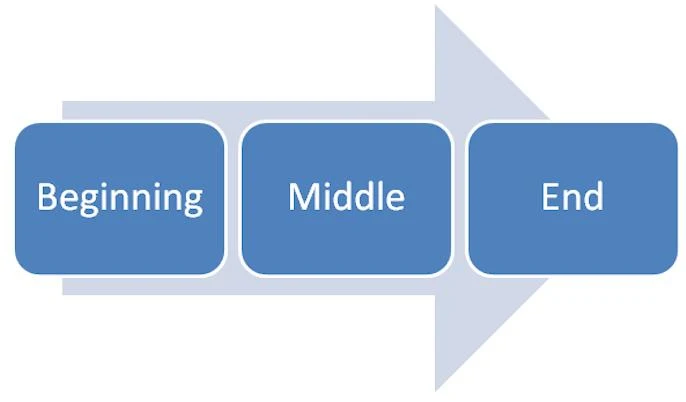
A story usually follows a beginning, middle and end.
This introduces the characters, setting and situation.
Middle
This explains the main events, challenges and actions in the story.
End
This shows how the events are concluded or how the problem is resolved.
D. Theme
A theme is the main message or idea communicated through a story.
It explains what the audience should learn or understand.
Examples of themes
- Honesty.
- Love.
- Friendship.
- Environmental conservation.
- Patriotism.
- Courage.
- Respect.
- Unity.
3. Difference Between Plot and Theme
|
Plot |
Theme |
|---|---|
|
Refers to the sequence of events |
Refers to the main message |
|
Explains what happens |
Explains what the story teaches |
|
Includes beginning, middle and end |
Expresses the central idea |
|
Can involve several events |
May communicate one or more lessons |
4. Components of Physical Fitness
Physical fitness refers to the ability of the body to perform physical activities effectively without becoming excessively tired.
Physical fitness helps learners participate in sports and other daily activities.
The curriculum emphasizes two components:
- Coordination.
- Strength.
A. Coordination
Coordination is the ability to use different parts of the body together smoothly and effectively.
It allows a person to perform movements accurately and in the correct sequence.
Examples of activities that develop coordination
- Skipping a rope.
- Catching a ball.
- Throwing a ball at a target.
- Dancing.
- Dribbling a ball.
- Jumping and landing.
- Performing movement sequences.
Importance of coordination
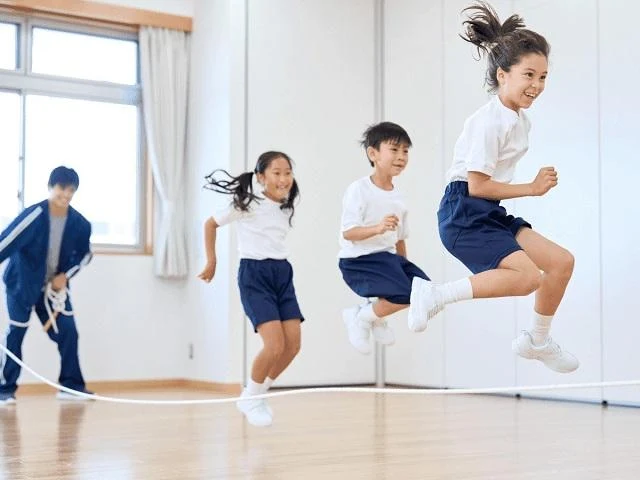


Coordination supports controlled movement in creative and sporting activities.
- Improves movement accuracy.
- Helps learners perform sports skills.
- Develops balance and body control.
- Improves reaction to moving objects.
- Makes physical activities easier to perform.
B. Strength
Strength is the ability of muscles to exert force against resistance.
It enables the body to lift, push, pull, carry and move objects.
Examples of activities that develop strength
- Push-ups.
- Squats.
- Planks.
- Climbing.
- Carrying suitable loads.
- Jumping exercises.
Importance of strength
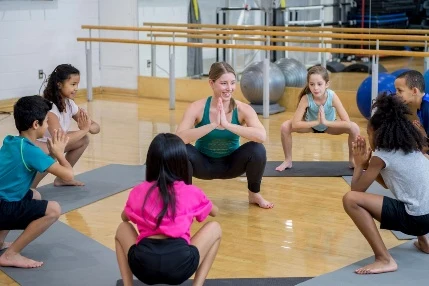
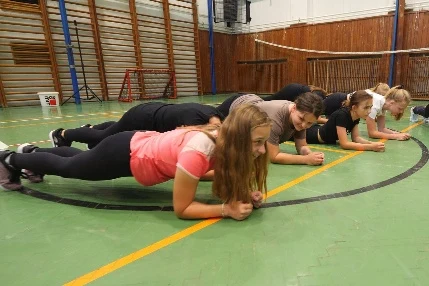
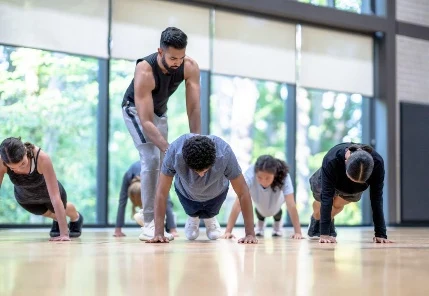
Strength helps the body perform physical activities safely and effectively.
- Helps the body perform physical activities.
- Improves sports performance.
- Supports good posture.
- Helps prevent injuries when developed appropriately.
- Improves the ability to carry and move objects.
5. Musical Notes
A musical note is a symbol used to represent a sound in written music.
Musical notes show how long a sound should last.
The curriculum identifies four important note values:
- Semibreve.
- Minim.
- Crotchet.
- A pair of quavers.
6. Types of Musical Notes and Their Values

Musical note symbols represent different sound durations.
|
Note |
Appearance |
Value in 4/4 time |
|---|---|---|
|
Semibreve |
Hollow note head without a stem |
4 beats |
|
Minim |
Hollow note head with a stem |
2 beats |
|
Crotchet |
Filled note head with a stem |
1 beat |
|
Pair of quavers |
Two filled note heads joined by a beam |
1 beat in total |
A. Semibreve
A semibreve is a musical note that lasts for four beats in 4/4 time.
It has an open or hollow oval-shaped note head without a stem.
B. Minim
A minim lasts for two beats in 4/4 time.
It has a hollow note head and a stem.
C. Crotchet
A crotchet lasts for one beat in 4/4 time.
It has a filled note head and a stem.
D. Pair of quavers
A pair of quavers lasts for one beat in 4/4 time.
Each individual quaver lasts for half a beat.
The two quavers are joined by a beam when written together.
7. Musical Rests
A musical rest is a symbol that indicates a period of silence in music.
Rests are important because music consists of both sounds and silence.
Each musical note has a corresponding rest of equal duration.
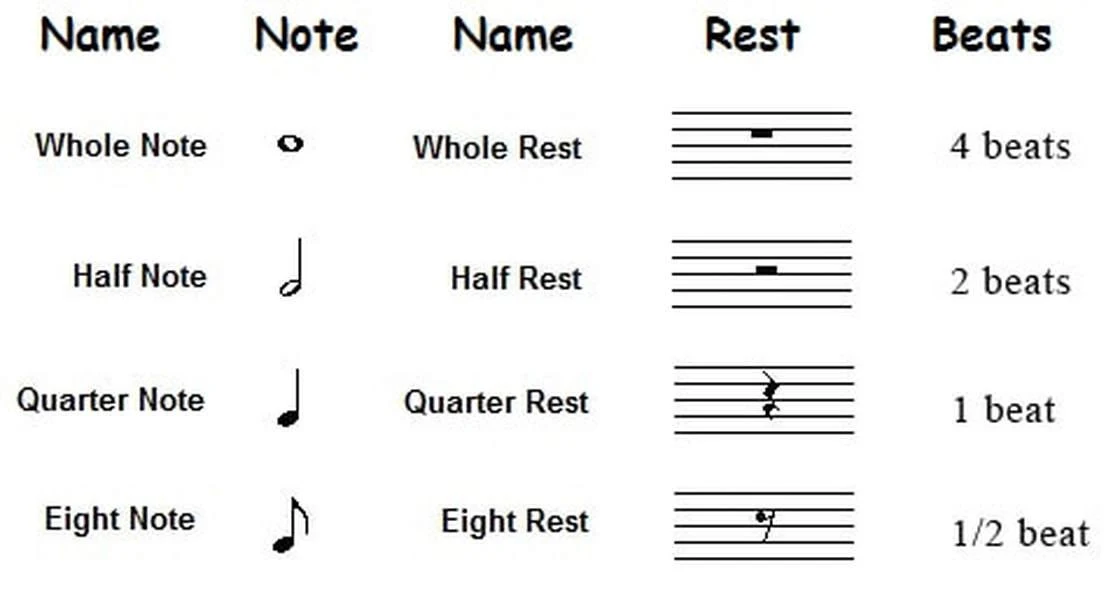
Rests show the duration of silence in written music.
|
Musical note |
Corresponding rest |
Duration |
|---|---|---|
|
Semibreve |
Semibreve rest |
4 beats |
|
Minim |
Minim rest |
2 beats |
|
Crotchet |
Crotchet rest |
1 beat |
|
Quaver |
Quaver rest |
Half a beat |
Importance of musical rests
- Create silence in a musical composition.
- Make rhythmic patterns more interesting.
- Separate musical phrases.
- Help performers maintain correct timing.
- Improve the organization of music.
8. Understanding the Treble Staff
A staff is a group of five horizontal, parallel lines used for writing musical notes.
The treble staff is commonly used for writing music with higher pitches.
The five lines and four spaces represent different musical pitches.
9. Names of the Lines of the Treble Staff
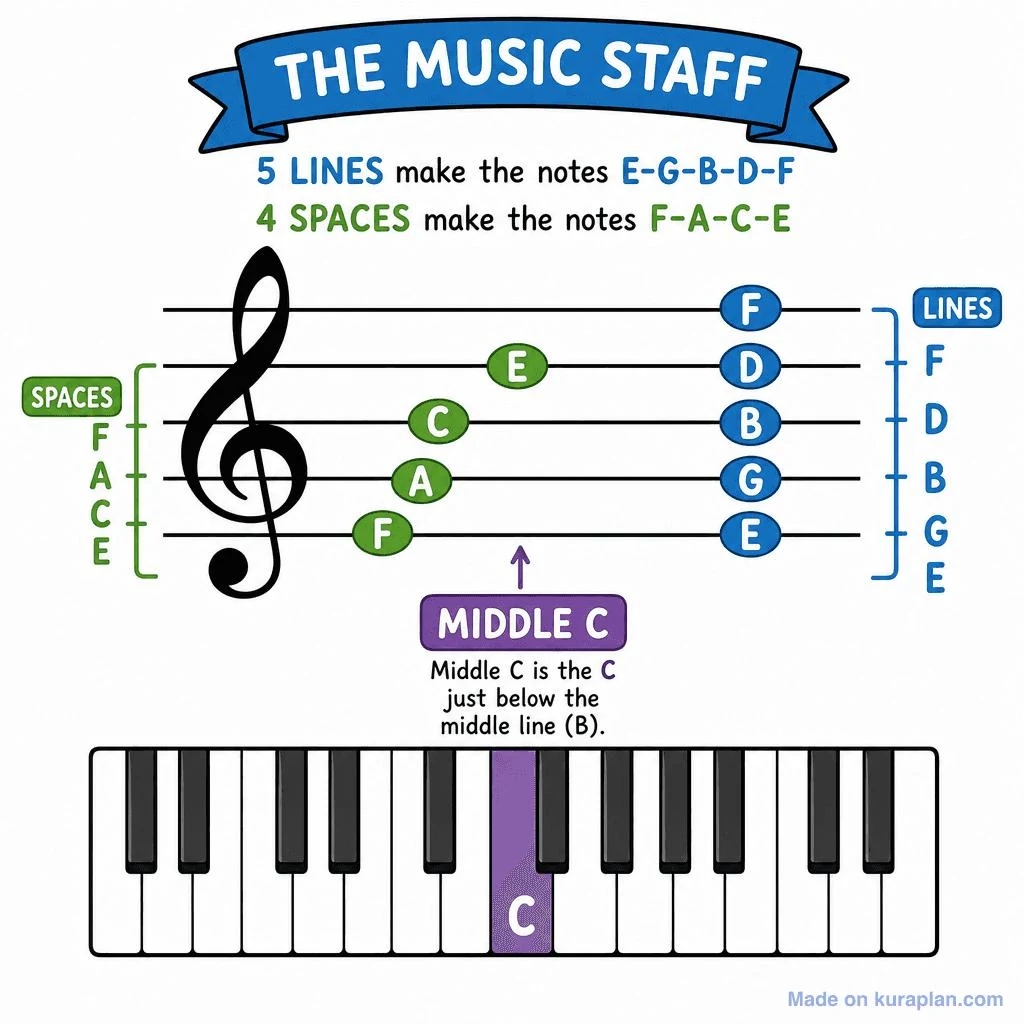
The treble staff provides five lines and four spaces for musical notation.
The five lines are counted from the bottom upwards.
|
Position |
Note |
|---|---|
|
Fifth line, top |
F |
|
Fourth line |
D |
|
Third line |
B |
|
Second line |
G |
|
First line, bottom |
E |
A useful memory aid is:
Every Good Boy Deserves Football.
The first letters represent E, G, B, D and F.
10. Names of the Spaces of the Treble Staff
The four spaces are also counted from the bottom upwards.
|
Position |
Note |
|---|---|
|
Fourth space, top |
E |
|
Third space |
C |
|
Second space |
A |
|
First space, bottom |
F |
A useful memory aid is:
F A C E
11. Ledger Lines
Ledger lines are short horizontal lines added above or below the main musical staff.
They are used when musical notes extend beyond the five lines and four spaces of the staff.
Uses of ledger lines
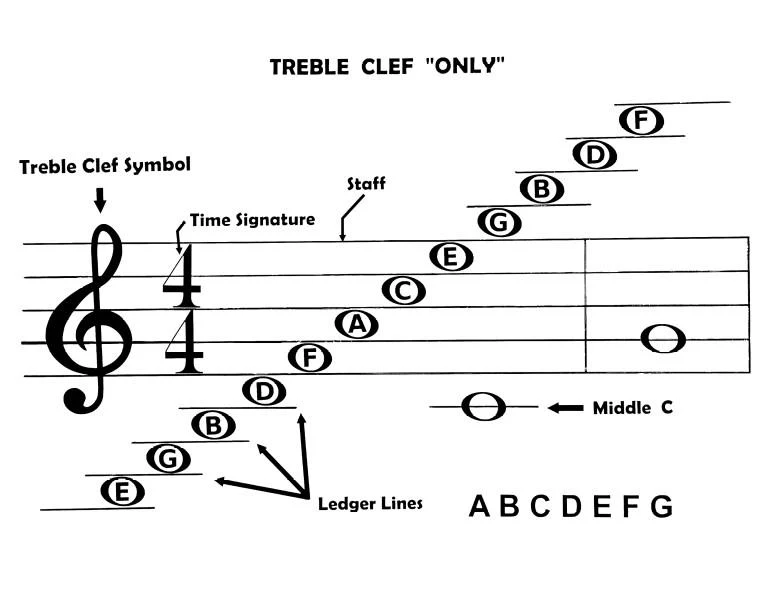
Ledger lines extend the staff for notes above or below its five lines.
- Extend the range of the staff.
- Allow musicians to write higher pitches.
- Allow musicians to write lower pitches.
- Help musicians identify notes outside the main staff.
Example:
Middle C is written on a ledger line below the treble staff.
12. Relationship Between the Treble Staff and Piano Keyboard
The piano keyboard contains white and black keys that produce different pitches.
The white keys represent the natural notes A, B, C, D, E, F and G.
These notes repeat in different octaves across the keyboard.
The treble staff represents the pitches played on musical instruments.
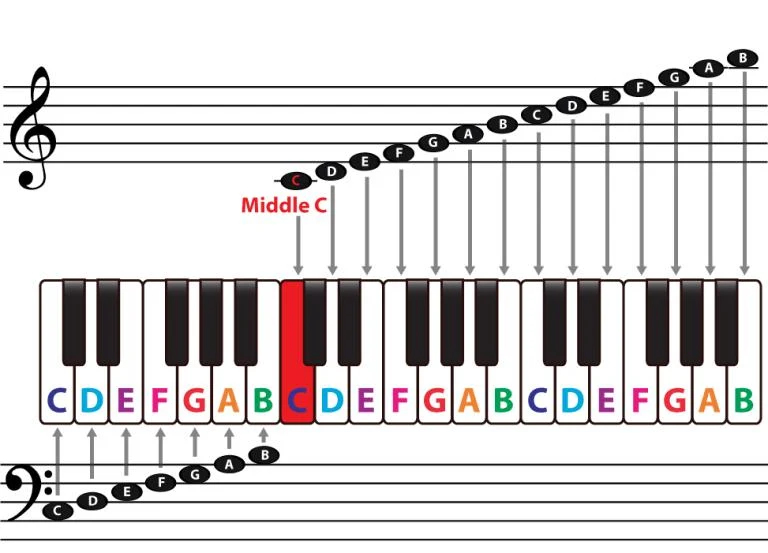
The piano keyboard helps learners locate natural notes.
A musician can use the treble staff to identify which piano keys to play.
13. Grouping Musical Notes in Simple Time
A time signature indicates how musical beats are organized into bars.
It is written at the beginning of a piece of music after the clef and key signature.
The two numbers in a time signature have different meanings.
- The top number shows the number of beats in each bar.
- The bottom number shows the note value that receives one beat.
Examples
2/4 time
This means each bar contains two crotchet beats.
A bar can contain:
- Two crotchets.
- One minim.
- Four quavers.
- One crotchet and two quavers.
4/4 time
This means each bar contains four crotchet beats.
A bar can contain:
- Four crotchets.
- Two minims.
- One semibreve.
- Eight quavers.
Summary
- A story has four main elements: character, setting, plot and theme.
- Coordination and strength are components of physical fitness.
- Musical notes represent sounds of different durations.
- Rests represent silence.
- The treble staff has five lines and four spaces.
- Ledger lines extend the staff.
- Musical notes are grouped according to the time signature.
Revision Questions
- Identify the four elements of a story.
- Differentiate between plot and theme.
- Define coordination and strength.
- State four activities that improve coordination.
- Explain the importance of physical strength.
- Name four musical notes and their values.
- What is a musical rest?
- Identify the five lines of the treble staff.
- Name the four spaces of the treble staff.
- Explain the purpose of ledger lines.
- What does the time signature 2/4 mean?
- How many crotchet beats are found in a bar of 4/4 time?