
Introduction
A dialogue is a written or spoken conversation between two or more people.
Dialogues are used in stories, plays, interviews and everyday communication.
Writing dialogues helps learners develop communication skills, sentence construction, creativity and the ability to present conversations in written form.
A. Features of a dialogue
A good dialogue should have the following features:
1. Characters or speakers
These are the people participating in the conversation.
2. Speaker identification
The reader should understand who is speaking.
3. Natural language
Characters should communicate in a way that suits the situation.
4. Logical flow
The conversation should develop in a meaningful order.
5. Relevant content
The dialogue should focus on the topic.
6. Correct punctuation
Punctuation marks should be used appropriately.
7. Clear purpose
The conversation should communicate information, ideas, feelings or opinions.
B. Format of a dialogue
A dialogue may be written using speaker names followed by their statements.
Example:
Amina: Good morning, Mary.
Mary: Good morning, Amina. How are you?
Amina: I am fine. Have you prepared for the cultural fashion exhibition?
Mary: Yes. I have prepared my traditional dress.
Amina: That is wonderful. Which community does the design represent?
Mary: It represents my community's traditional clothing.
C. Punctuation in dialogues
Punctuation helps readers identify the words spoken by different characters.
Common punctuation marks include:
1. Colon
A colon may be used after the speaker's name when writing a dialogue in script form.
Example:
Mary: Where are you going?
2. Quotation marks
Quotation marks are used to enclose direct speech in prose.
Example:
Mary asked, "Where are you going?"
3. Comma
A comma may separate a speech tag from direct speech.
Example:
"Please help me," said John.
4. Question mark
Used when a speaker asks a question.
Example:
"Have you finished your work?"
5. Full stop
Used at the end of a statement.
Example:
"I will attend the exhibition."
D. Steps in the writing process
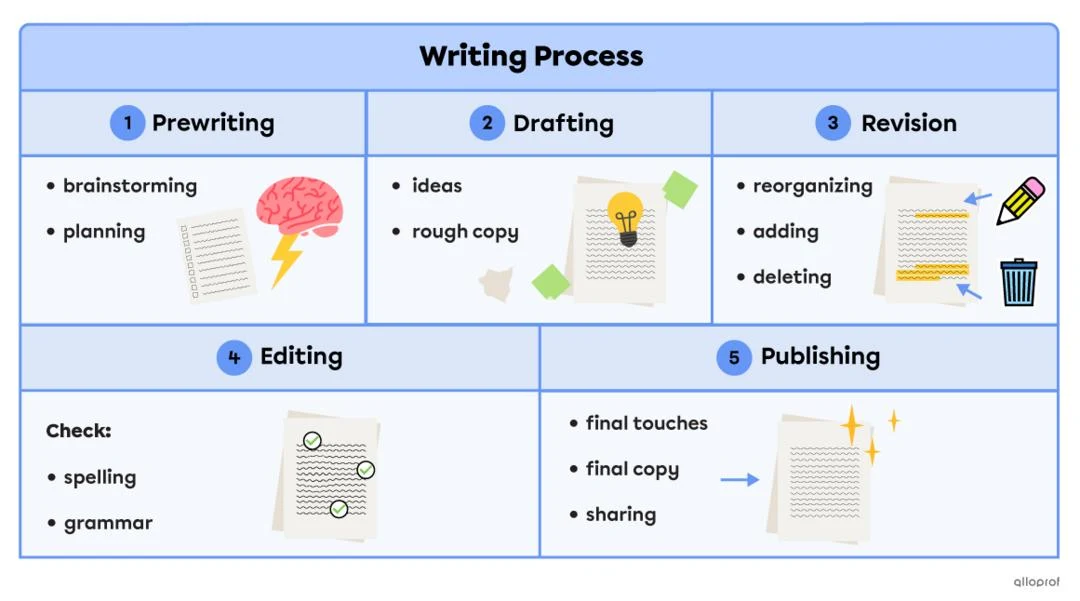
A visual guide shows the stages of the writing process, from planning to final presentation.
Step 1: Planning
Before writing, identify:
- The topic.
- The characters.
- The setting.
- The purpose of the conversation.
- The main points to be discussed.
Step 2: Drafting
Write the first version of the dialogue.
Focus on presenting the conversation in a logical order.
Step 3: Editing
Check for:
- Repetition.
- Grammar mistakes.
- Spelling errors.
- Punctuation errors.
- Unclear statements.
Step 4: Revising
Improve the dialogue by making the conversation clearer, more natural and more interesting.
Step 5: Publishing
Prepare the final version for presentation or sharing.
E. Sample dialogue on traditional fashion
Topic: The Importance of Traditional Fashion
Brian: Good morning, Amina. Have you prepared for our cultural day?
Amina: Good morning, Brian. Yes, I have prepared my traditional clothing.
Brian: That sounds interesting. Why did you choose traditional clothing?
Amina: I chose it because traditional clothing represents our culture and identity.
Brian: I agree. It also helps younger generations understand their heritage.
Amina: That is true. We should preserve our traditional designs.
Brian: How can young people help preserve traditional fashion?
Amina: They can learn about traditional clothing, support local designers and participate in cultural activities.
Brian: That is a good idea. I will also wear traditional clothing during the celebration.
Amina: Excellent! I look forward to seeing you there.
F. Common mistakes in dialogue writing
- Failing to identify the speakers.
- Repeating the same ideas unnecessarily.
- Using incorrect punctuation.
- Writing unnatural conversations.
- Changing the topic without explanation.
- Using inappropriate language.
- Failing to organise ideas logically.
G. Importance of dialogue writing
- Develops communication skills.
- Improves punctuation.
- Develops creativity.
- Improves sentence construction.
- Helps learners understand conversations.
- Develops confidence in expressing ideas.
- Prepares learners for script and story writing.
Summary
A dialogue is a conversation between two or more people. Good dialogue writing requires planning, drafting, editing, revising and publishing. Learners should use appropriate language, identify speakers clearly and punctuate conversations correctly.