
Introduction
Pronunciation is the correct production of sounds when speaking.
Intonation refers to the rise and fall of the voice during speech.
Both pronunciation and intonation are important because they help speakers communicate clearly and express meaning appropriately.
This sub-strand focuses on four consonant sounds:
- /v/
- /f/
- /n/
- /ŋ/
It also covers intonation in yes/no questions and wh-questions.
A. The consonant sound /v/
The /v/ sound is a voiced consonant produced by placing the upper teeth lightly against the lower lip and allowing air to pass while the vocal cords vibrate.
Examples:
- Very.
- Visit.
- Voice.
- Victory.
- Village.
- Van.
- Volleyball.
B. The consonant sound /f/
The /f/ sound is a voiceless consonant produced using the upper teeth and lower lip without vocal cord vibration.
Examples:
- Ferry.
- Football.
- Fish.
- Friend.
- Family.
- Fast.
- Field.
C. Difference between /v/ and /f/
These sounds are produced using similar mouth positions, but they differ in voicing.
|
/v/ |
/f/ |
|---|---|
|
Voiced sound |
Voiceless sound |
|
Very |
Ferry |
|
Vine |
Fine |
|
Vest |
Fest (not a common English word) |
|
Vile |
File |
To feel the difference, place your fingers gently on your throat while pronouncing /v/ and /f/.
You should feel vibration when producing /v/.
D. The consonant sound /n/
The /n/ sound is a voiced nasal consonant.
It is produced by placing the tongue against the ridge behind the upper front teeth while air passes through the nose.
Examples:
- Name.
- Night.
- Number.
- Net.
- Nine.
- Winner.
- Nation.
E. The consonant sound /ŋ/
The /ŋ/ sound is a voiced nasal consonant produced at the back of the mouth, with air passing through the nose.
It is commonly represented by the letters ng.
Examples:
- Sing.
- Ring.
- Long.
- King.
- Being.
- Playing.
F. Difference between /n/ and /ŋ/
|
/n/ |
/ŋ/ |
|---|---|
|
Produced at the front of the mouth. |
Produced at the back of the mouth. |
|
Tongue touches the ridge behind the upper teeth. |
Back of the tongue rises towards the soft palate. |
|
Net |
Sing |
|
Name |
Ring |
|
Thin |
Thing |
G. Practising the target consonant sounds
|
Sound |
Words |
|---|---|
|
/v/ |
Very, visit, victory, village |
|
/f/ |
Ferry, football, fish, fast |
|
/n/ |
Net, name, night, number |
|
/ŋ/ |
Sing, ring, king, long |
H. Meaning of intonation
Intonation is the pattern of rising and falling voice pitch when speaking.
It helps communicate whether a person is asking a question, making a statement or expressing a particular feeling.
I. Intonation in yes/no questions
Yes/no questions are questions that can generally be answered with yes or no.
Examples:
- Are you ready?
- Do you play football?
- Have you completed the exercise?
- Is the match starting?
In many ordinary English conversations, yes/no questions use rising intonation.
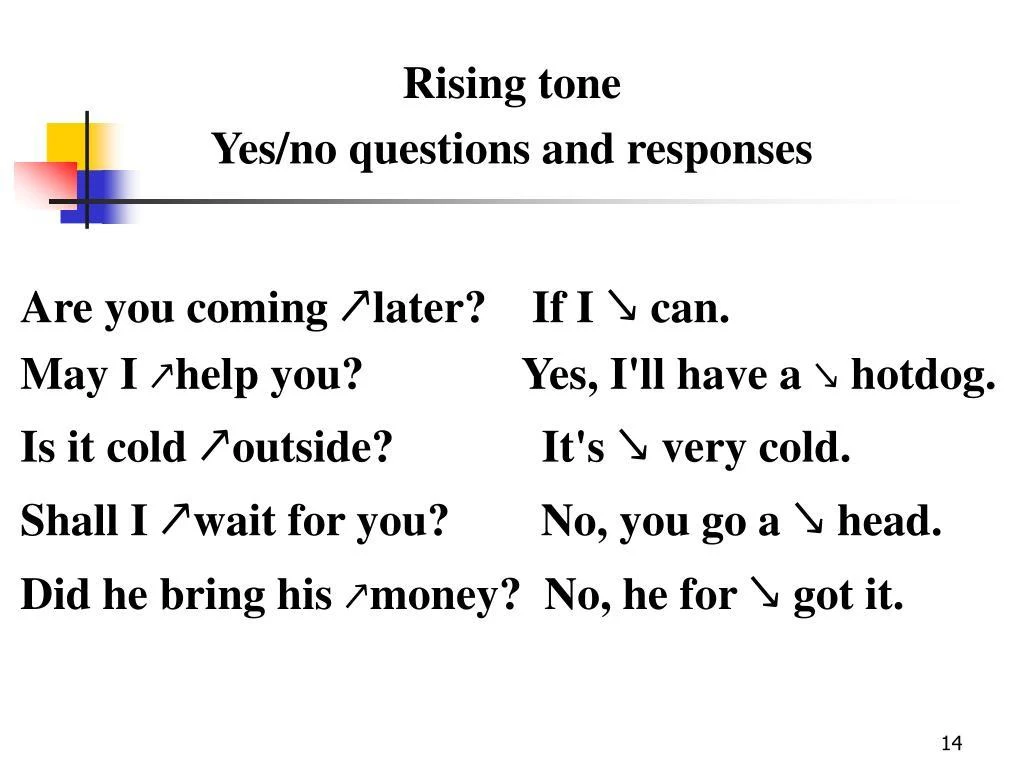
A rising intonation pattern is commonly used in yes/no questions.
The voice rises towards the end of the question.
J. Intonation in WH-questions
WH-questions begin with question words such as:
- What.
- Where.
- When.
- Why.
- Who.
- Whom.
- Which.
- Whose.
- How.
Examples:
- What is your favourite sport?
- Where is the football field?
- When does the competition begin?
- Why are you late?
- Who won the match?
- How do you play the game?
WH-questions commonly use falling intonation.
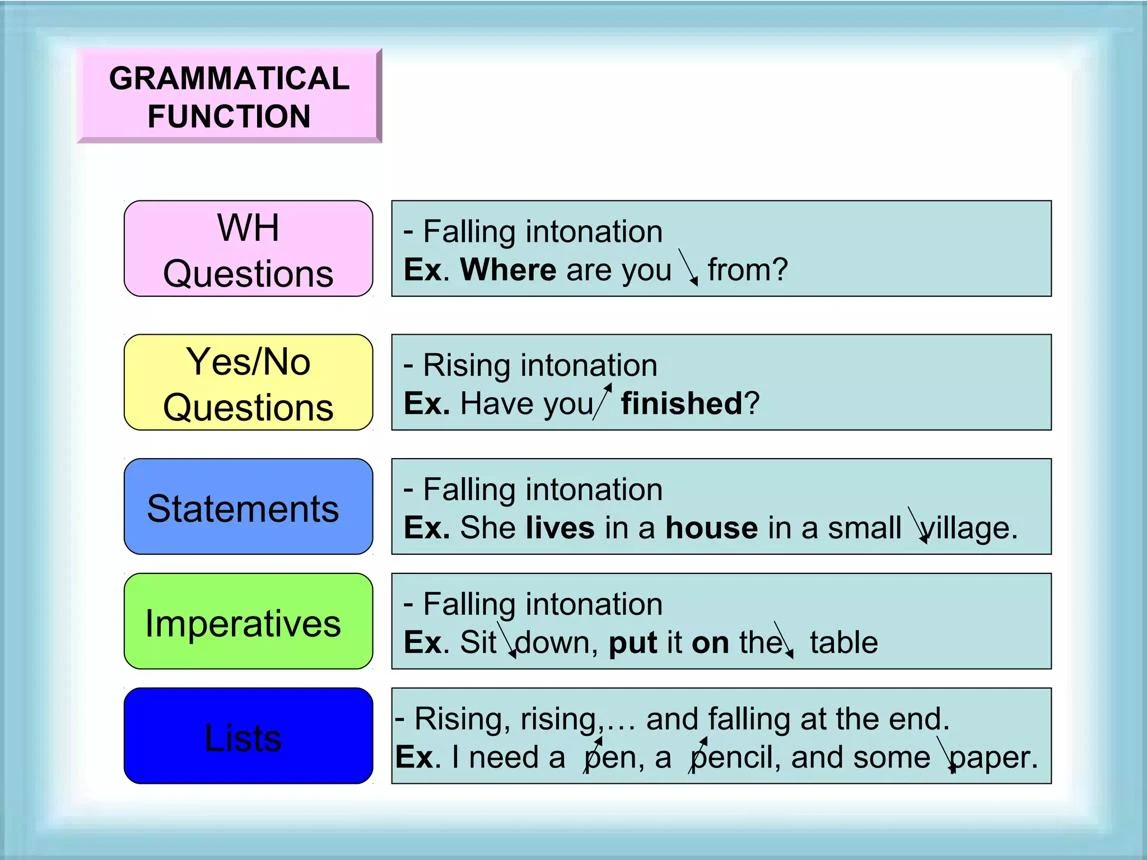
A falling intonation pattern is commonly used in WH-questions.
The voice generally falls towards the end of the question.
K. Differences between yes/no and WH-questions
|
Yes/no questions |
WH-questions |
|---|---|
|
Usually answered with yes or no. |
Require specific information. |
|
Often begin with auxiliary verbs. |
Begin with question words. |
|
Commonly use rising intonation. |
Commonly use falling intonation. |
|
Do you play football? |
Which sport do you play? |
The intonation patterns described are common patterns; actual speech may vary depending on emphasis and context.
L. Importance of correct pronunciation and intonation
- Makes communication clear.
- Helps listeners understand questions.
- Prevents misunderstanding.
- Develops confidence.
- Improves oral presentations.
- Helps communicate feelings.
- Improves listening and speaking skills.
Activities
- Identify words containing /v/, /f/, /n/ and /ŋ/.
- Sort words according to their sounds.
- Practise tongue twisters.
- Listen to recorded conversations.
- Identify yes/no and WH-questions.
- Practise the appropriate intonation.
- Write and perform a short dialogue about outdoor games.
Summary
Correct pronunciation involves producing sounds accurately, while intonation involves the rise and fall of the voice. Learners should practise the four target consonant sounds and distinguish the intonation patterns used in yes/no and WH-questions.