
Learning Outcomes
By the end of this sub-strand, you should be able to:
- Describe methods of soil conservation in the agricultural environment
- Carry out soil conservation activities in your environment
- Demonstrate a caring attitude towards soil conservation
Introduction to Soil Conservation
Soil conservation measures refer to a combination of practices and techniques used to prevent the loss of soil through erosion. Soil erosion is the wearing away and removal of topsoil by natural agents such as water and wind.
Key Definition: Soil conservation is the protection of soil from erosion and maintenance of soil fertility through various management practices.
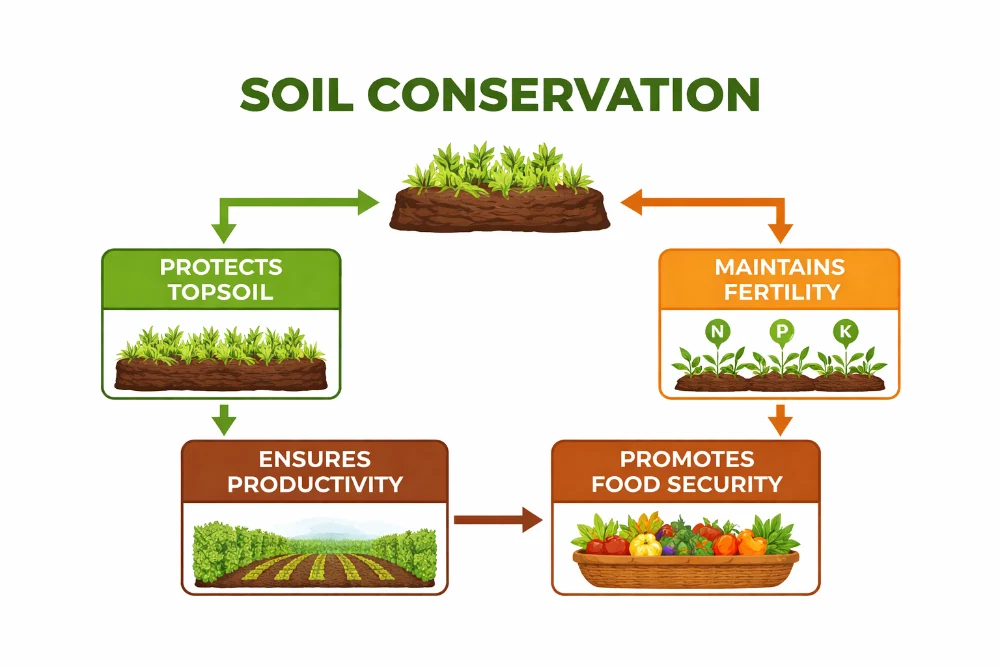
Importance of Soil Conservation
Soil conservation is crucial for the following reasons:
|
Reason |
Explanation |
|---|---|
|
To keep topsoil in its place |
Prevents the fertile upper layer of soil from being washed or blown away |
|
To maintain soil fertility |
Preserves essential nutrients needed for plant growth |
|
To maintain soil productivity |
Ensures the land continues to produce good crop yields |
|
To increase agricultural production |
Healthy soil produces more food |
|
To promote food security |
Consistent food production ensures families and communities have enough to eat |
Methods of Soil Conservation
The main methods of soil conservation in agricultural environments include:
- Strip cropping
- Grassed waterways
- Stone lines
- Trash lines
- Soil bunds
1. Strip Cropping
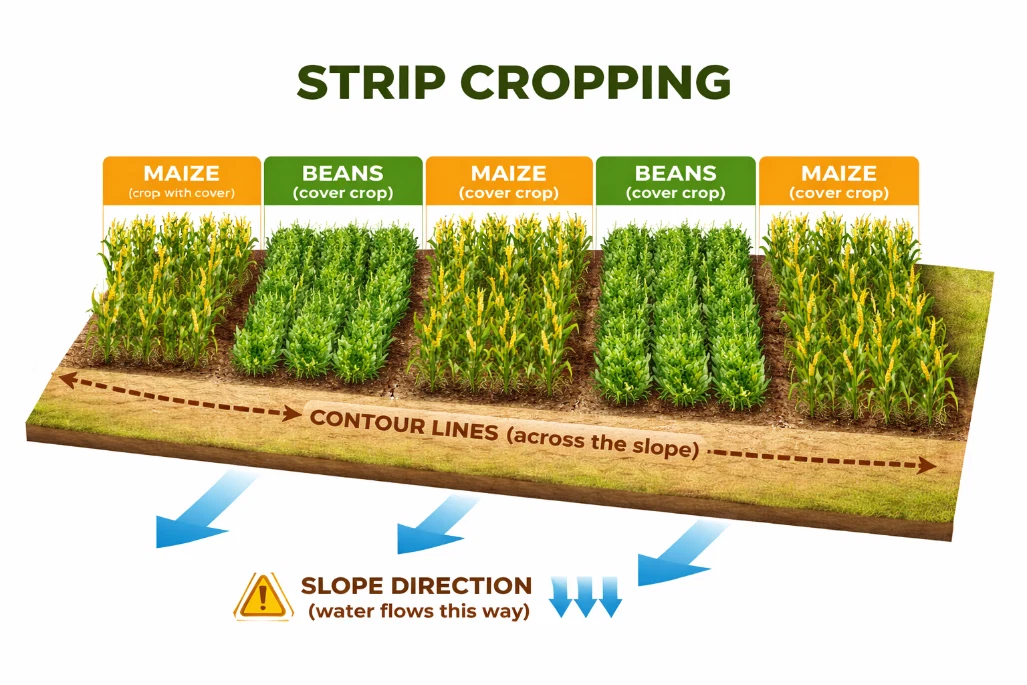
Description:
- Strip cropping involves growing crops in alternating strips
- Crops with little soil cover (e.g., maize, sorghum) are grown in alternating strips with crops that provide good ground cover (e.g., sweet potatoes, beans, cowpeas)
- Permanent vegetation such as grass can also be used as strips between cultivated crops
How it works:
- The strips with good ground cover act as barriers that slow down surface runoff
- When water flows down the slope, it hits the cover crop strips and slows down
- Slower water has less energy to carry soil particles away
- This allows more water to infiltrate (soak) into the soil
2. Grassed Waterways
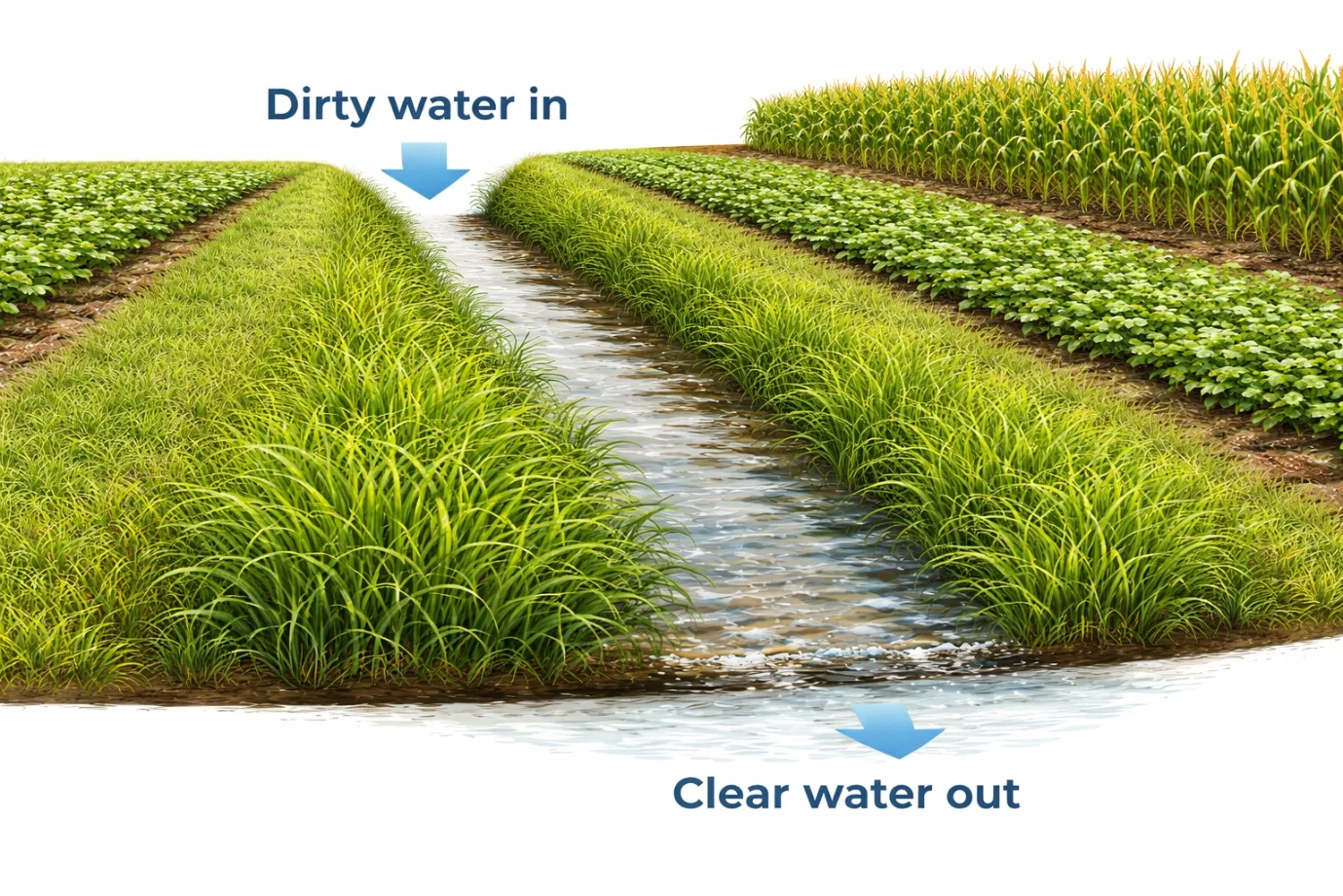 Description:
- Grassed waterways are natural or man-made shallow channels
- They are designed to safely carry excess rainwater away from cultivated fields
- Grass and other vegetation are planted to grow inside these channels
How it works:
- When it rains, excess water (surface runoff) is directed into these channels
- The vegetation (grass) inside the channel slows down the speed of flowing water
- Slower water cannot carry as much soil
- The grass also traps any eroded soil particles, preventing them from being washed away completely
Key Points:
- The channels should be wide and shallow, not deep and narrow
- The grass should be kept short and healthy
- Regular maintenance is required to keep the channel functional
3. Stone Lines
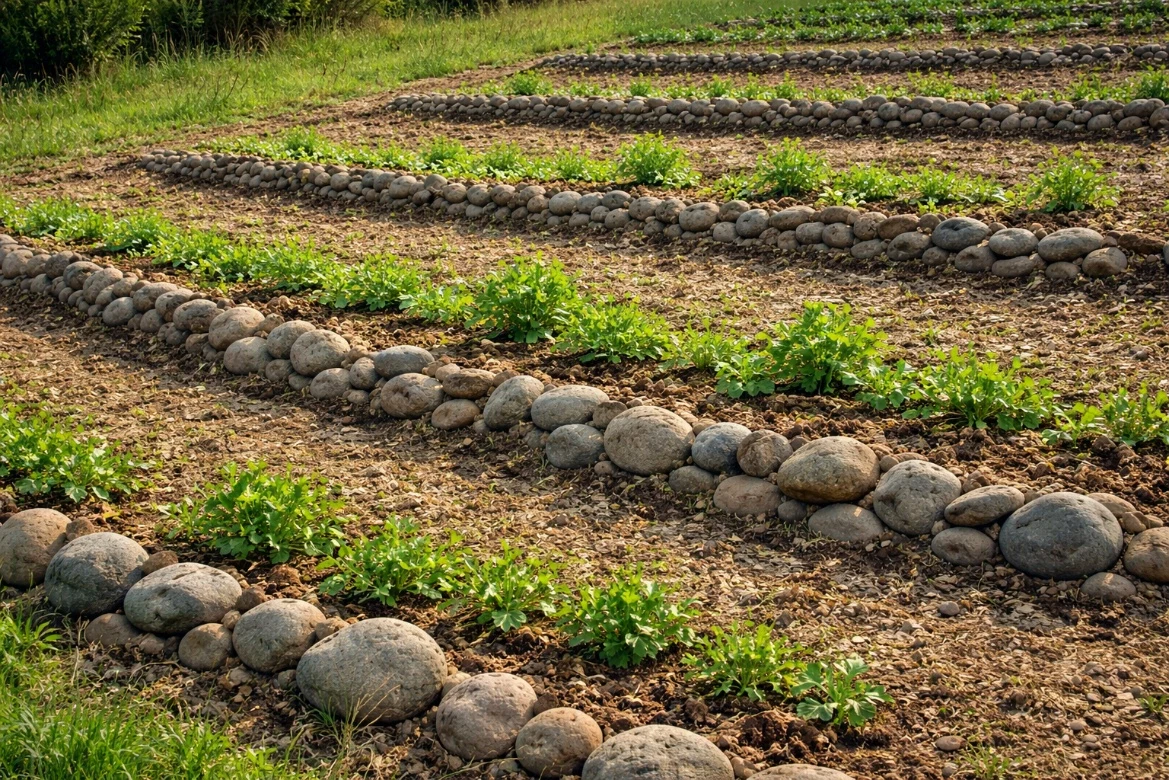
Description:
- Stone lines are rows of stones (of different sizes) heaped together
- They are arranged along the contour (across the slope)
- Stones are placed end to end forming continuous lines across the field
How it works:
- When rainwater flows down the slope, it hits the stone lines
- The stones act as a physical barrier, reducing the speed of runoff
- Slower water allows more time for water to infiltrate (soak) into the soil
- This is especially important in semi-arid (dry) areas where every drop of water counts
Best suited for:
- Gently sloping land
- Areas with readily available stones
- Semi-arid regions where water conservation is critical
Water infiltration is the downward entry of water into the soil from the surface.
4. Trash Lines
Description:
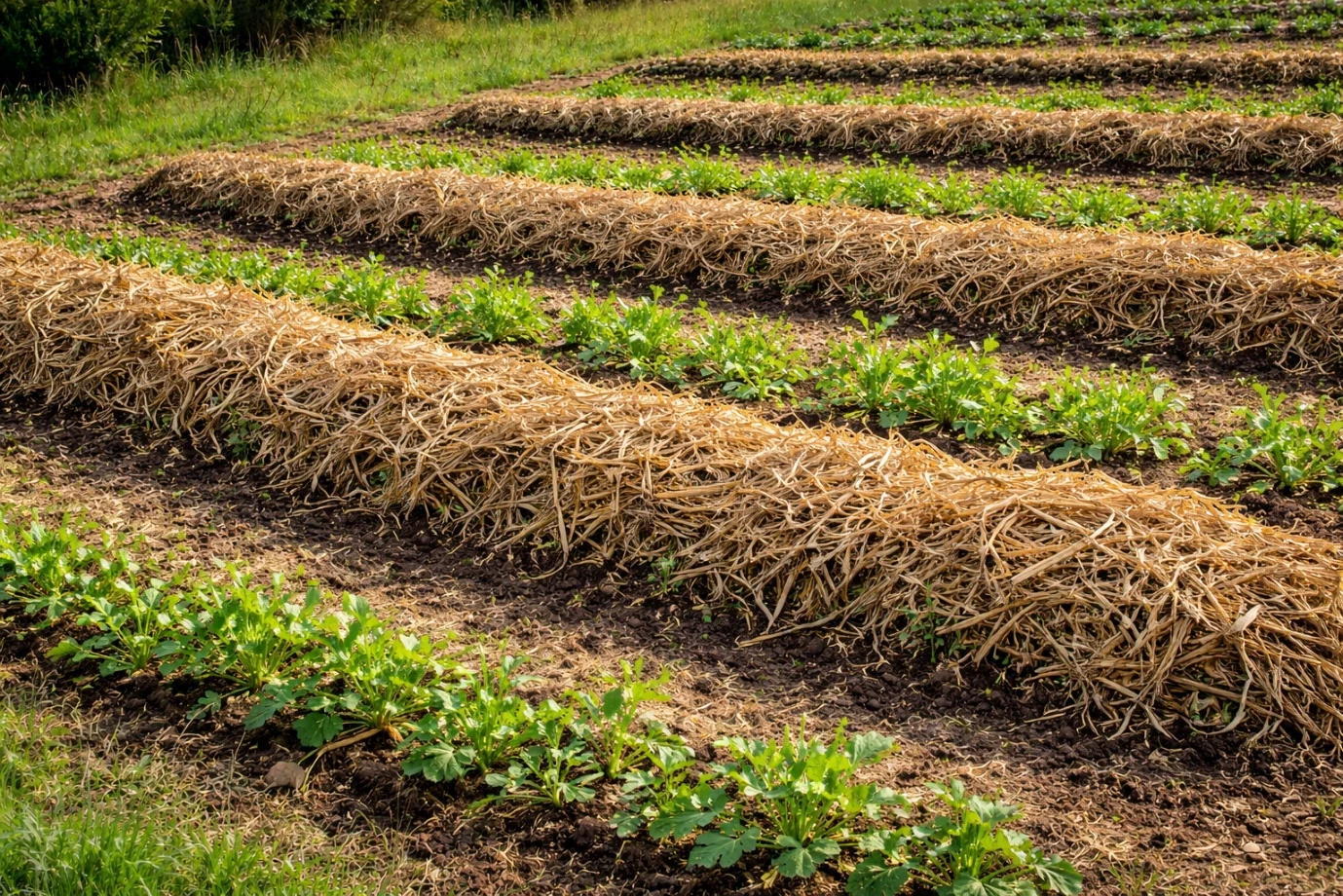
- Trash lines are made from plant materials and crop residues (remains)
- These materials are arranged along the contour in a cultivated field
- Common materials include maize stalks, sorghum stems, bean husks, grass, and leaves
Specifications:
- Width: approximately 1 metre
- Height: approximately 0.5 metre
How it works:
- Trash lines act as physical barriers to surface runoff
- They slow down the speed of flowing water
- Reduced water speed means less soil is carried away
- The trash materials also trap soil particles that are being washed down
- Over time, the trash decomposes and adds organic matter to the soil
Additional Benefits:
- Improves water infiltration into the soil
- Adds nutrients to the soil as materials decompose
- Provides habitat for beneficial soil organisms
- Uses materials that would otherwise be wasted
5. Soil Bunds
 Description:
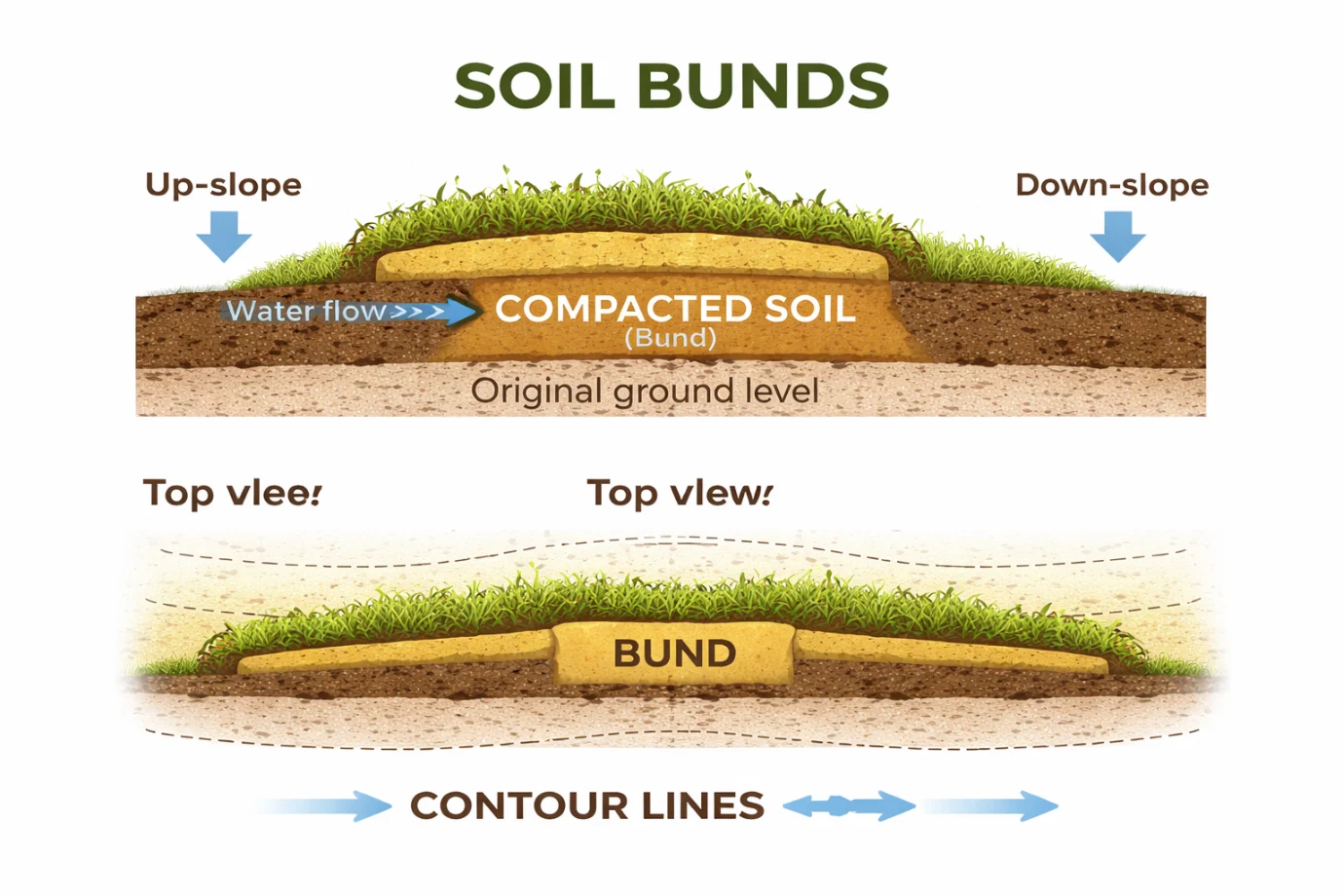
- A bund is a heap of compacted (pressed down firmly) soil
- Bunds are constructed along the contour lines (across the slope)
- They form a ridge or embankment that blocks water flow
How it works:
- Bunds reduce the volume and speed of water flowing down a cultivated field after rainfall
- Water collects behind the bund and has more time to infiltrate into the soil
- This increases soil moisture and benefits crops
- Grasses can be grown on top of the bunds to hold the soil together firmly with their roots
Construction tips:
- Always establish contour lines first before building bunds
- Compact the soil well so the bund doesn't wash away
- Plant grass on the bund to stabilise it
- Maintain bunds regularly by repairing any breaks
Important Note on Contour Farming
Key Points to Remember:
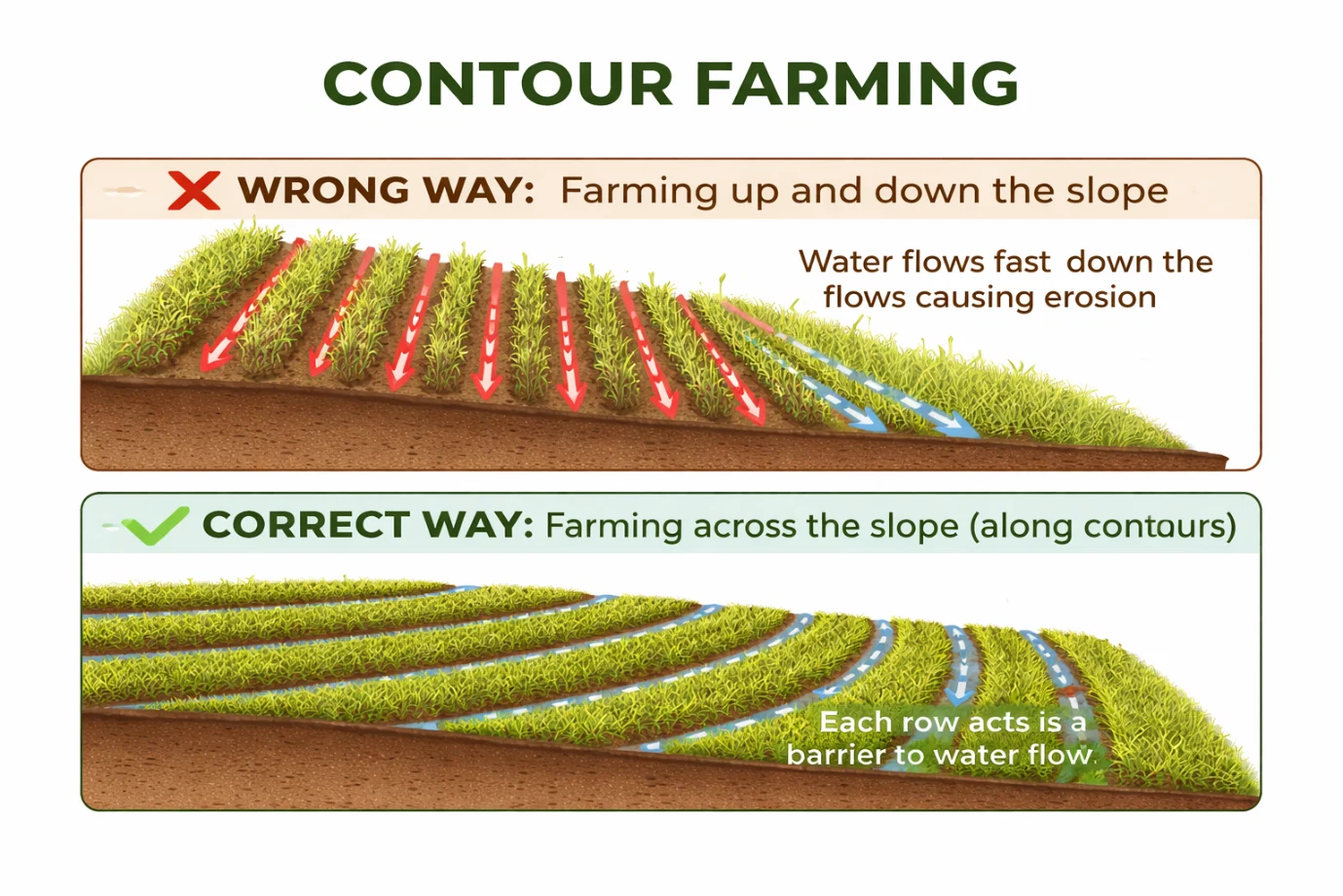
- Most structures constructed to conserve soil are made along the contour line.
- Therefore, it is very important to establish the contour lines first before constructing any soil conservation structures.
- Contour lines are imaginary lines that connect points of equal elevation (height) on a slope. They are established to guide the position of soil conservation measures.
- Contour farming is farming carried out across the slope rather than up and down.
- Therefore, contour lines run across the slope and not up and down.
How to Establish Contour Lines
Materials needed:
- A-Frame or line level
- Measuring tape
- Wooden pegs/stakes
- String
- Marker or chalk
Procedure:
|
Step |
Action |
|---|---|
|
1 |
Start at the top of the slope |
|
2 |
Use an A-frame or line level to find points at the same elevation |
|
3 |
Mark each point with a wooden peg |
|
4 |
Connect the pegs with string to create a visible line |
|
5 |
Repeat at regular intervals down the slope (usually every 10-20 metres depending on steepness) |
|
6 |
These lines become your guide for constructing conservation structures |
Farm Layout and Model Making
 What is a Farm Layout?
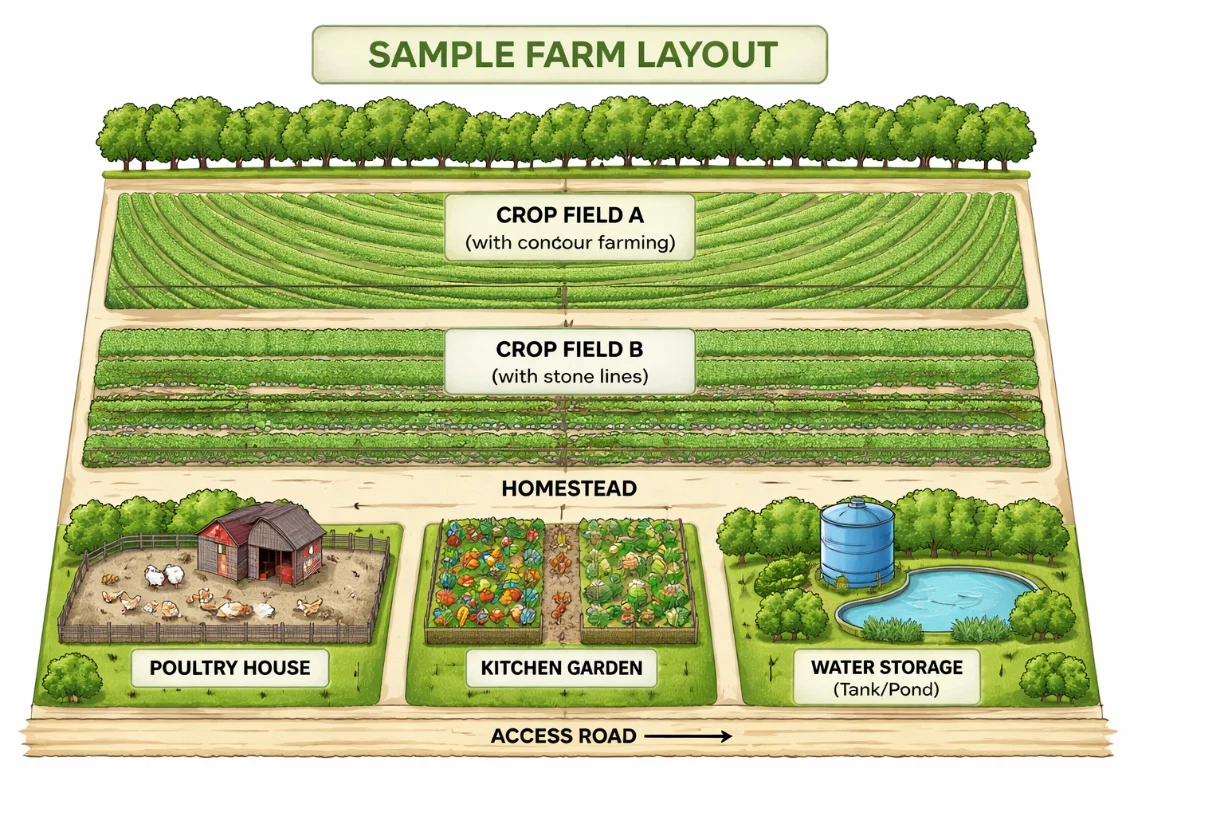
A farm layout is a drawn plan that shows various farm enterprises and where they are placed on the farm. It is a plan of how various farm components (enterprises) are arranged and set up on the farm.
Importance of a Farm Layout:
|
Importance |
Explanation |
|---|---|
|
Maximum land utilization |
Ensures every part of the farm is used effectively |
|
Orderly arrangement |
Farm enterprises are arranged in a logical, convenient way |
|
Efficient workflow |
Reduces time and energy moving between farm areas |
|
Guides planning |
Helps farmer plan future developments |
|
Prevents conflicts |
Ensures incompatible activities are separated |
Materials for Making a Farm Model:
Learners can use locally available materials to create a farm model, including:
|
Material |
Use |
|---|---|
|
Cartons/Cardboard |
Base and structures |
|
Soil |
Ground surface, bunds |
|
Papier-mâché |
Hills, contours, structures |
|
Twigs/Sticks |
Fences, trees |
|
Small stones |
Stone lines, paths |
|
Grass/Leaves |
Vegetation, crops |
|
Clay |
Buildings, water features |
Summary Table: Soil Conservation Methods
|
Method |
Description |
Best Suited For |
Key Benefit |
|---|---|---|---|
|
Strip Cropping |
Alternating strips of cover crops and clean-cultivated crops |
Moderate slopes |
Vegetation strips slow runoff |
|
Grassed Waterways |
Shallow grassed channels for water |
Areas needing safe water drainage |
Safely channels excess water |
|
Stone Lines |
Lines of stones along contours |
Gentle slopes in stony areas |
Increases water infiltration |
|
Trash Lines |
Crop residues piled along contours |
Areas with crop residues |
Low-cost, adds organic matter |
|
Soil Bunds |
Compacted soil ridges along contours |
Various slopes |
Reduces runoff volume |
Key Inquiry Questions
- How can we conserve soil in the environment?
- By using methods such as strip cropping, grassed waterways, stone lines, trash lines, and soil bunds
- By farming along the contour rather than up and down the slope
- By maintaining vegetation cover on the soil
- Why is soil conservation important?
- To maintain soil fertility and productivity
- To ensure food security
- To prevent loss of valuable topsoil
- To protect the environment for future generations