
1. Meaning of Ulum al-Qur'an
Ulum al-Qur'an refers to the branches of knowledge concerned with the revelation, collection, preservation, language, interpretation and characteristics of the Qur'an.
It helps Muslims understand the Qur'an accurately and apply its teachings in everyday life.
2. The miraculous nature of the Qur'an
The miraculous nature of the Qur'an is known as I'jaz al-Qur'an. In Islamic belief, the Qur'an is a divine miracle that human beings cannot reproduce in its entirety.
The Qur'an challenges those who doubt its divine origin to produce a chapter comparable to it (Qur'an 2:23).
Features of the Qur'an regarded as miraculous
a. Linguistic excellence
The Qur'an uses distinctive Arabic expressions, eloquence, imagery, rhythm and rhetorical forms. Muslims regard its language as an extraordinary feature of divine revelation.
b. Preservation
Muslims believe Allah has promised to preserve the Qur'an from corruption, as expressed in Qur'an 15:9. Historically, its preservation has involved memorisation, recitation, written manuscripts and scholarly transmission.
c. Guidance for humanity
The Qur'an provides guidance about worship, morality, justice, family relationships, honesty and responsibility.
d. Consistency of its message
Muslims regard the Qur'an's coherent teachings about the oneness of Allah, accountability and righteous conduct as evidence of its divine origin.
e. Knowledge and reflection
The Qur'an repeatedly encourages human beings to observe nature, reflect on creation and appreciate Allah's power. Muslims understand these passages as signs inviting reflection.
f. Prophecies and historical accounts
The Qur'an contains narratives about previous communities and passages understood within Islamic scholarship as predictions about future events.
3. The language of the Qur'an
blogs.icrc.org
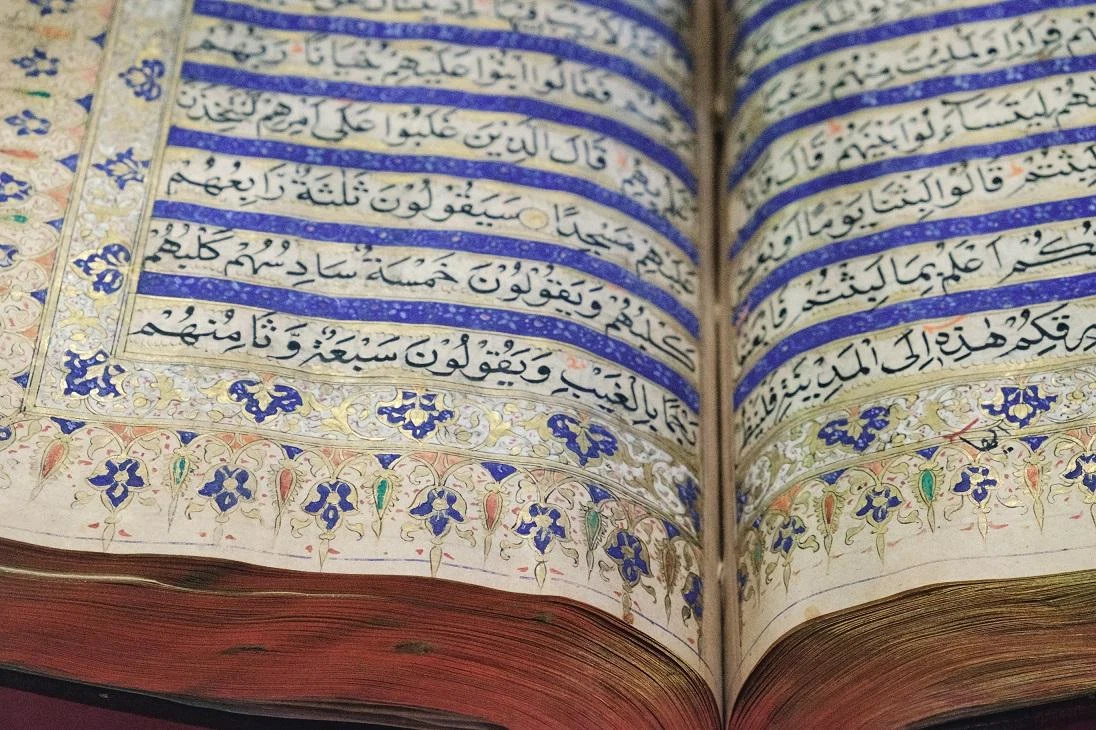
The Qur'an was revealed in Arabic. Its language has distinctive features that influence interpretation and recitation.
|
Feature |
Explanation |
|---|---|
|
Eloquence (Balaghah) |
Effective and meaningful expression |
|
Clarity (Bayan) |
Explanation of religious teachings |
|
Imagery |
Uses comparisons and descriptions to communicate ideas |
|
Repetition |
Emphasises important lessons |
|
Rhythm |
Creates patterns in recitation |
|
Conciseness |
Communicates significant meaning through carefully chosen words |
|
Context |
The circumstances of revelation can help explain meaning |
4. Different styles used in the Qur'an
|
Style |
Description |
Qur'anic example |
|---|---|---|
|
Narrative (Qasas) |
Accounts of prophets and earlier communities |
Story of Prophet Yusuf, Surah 12 |
|
Command |
Instructions about religious and moral duties |
Qur'an 2:43 |
|
Prohibition |
Warnings against forbidden actions |
Qur'an 17:32 |
|
Questioning |
Questions encouraging reflection |
Qur'an 88:17 |
|
Parables (Amthal) |
Comparisons that explain lessons |
Qur'an 14:24–25 |
|
Oaths |
Expressions emphasising important truths |
Qur'an 103:1 |
|
Promise |
Descriptions of rewards for righteousness |
Qur'an 98:7–8 |
|
Warning |
Descriptions of consequences of wrongdoing |
Qur'an 104 |
|
Dialogue |
Conversations illustrating moral or religious ideas |
Qur'an 18:32–44 |
5. Importance of studying Ulum al-Qur'an
- Improves understanding of Islamic teachings.
- Helps distinguish literal and figurative expressions.
- Supports accurate interpretation.
- Strengthens faith (iman).
- Encourages correct recitation and memorisation.
- Helps learners understand the circumstances of revelation.
- Promotes responsible application of Qur'anic teachings.
Activity 1.1
- Define Ulum al-Qur'an.
- Explain four features of the miraculous nature of the Qur'an.
- Identify five literary styles used in the Qur'an.
- Explain why understanding Arabic improves comprehension of the Qur'an.
- State four benefits of studying Ulum al-Qur'an.