
Specific Learning Outcomes
By the end of this sub-strand, the learner should be able to:
- Explain the elements of weather in the atmosphere.
- Describe the effects of weather elements on aircraft in flight.
- Analyse the types of clouds in flight operations.
- Measure elements of weather used in flight operations.
- Appreciate the role of aviation weather in flight operations.
3.1.1 Introduction to Aviation Weather
Weather refers to the condition of the atmosphere at a particular place and time.
Weather conditions change depending on factors such as temperature, atmospheric pressure, humidity, wind, cloud cover and precipitation.
Aviation weather refers to atmospheric conditions and meteorological information relevant to aircraft operations.
The study of aviation weather is known as aviation meteorology.
Aviation meteorology helps pilots, air traffic controllers and other aviation personnel understand weather conditions that may affect flight safety and efficiency.
For example, a pilot preparing to fly from Nairobi to Mombasa needs information about winds, visibility, clouds, storms and other weather conditions along the intended route.
3.1.2 Importance of Studying Aviation Weather
- Flight safety: Helps pilots recognise and avoid hazardous weather.
- Flight planning: Provides information required when selecting routes and flight levels.
- Fuel management: Wind information helps estimate flight duration and fuel requirements.
- Take-off and landing: Wind, visibility and cloud conditions influence airport operations.
- Accident prevention: Weather forecasts help reduce exposure to dangerous conditions.
- Passenger comfort: Avoiding severe turbulence can improve passenger comfort.
- Aircraft performance: Temperature, pressure and wind affect aircraft performance.
- Airport efficiency: Weather information supports decisions about delays, diversions and airport operations.
- Emergency preparedness: Aviation personnel can prepare for adverse weather conditions.
- Environmental efficiency: Appropriate route and altitude selection can reduce unnecessary fuel consumption.
3.1.3 Elements of Weather
The KICD curriculum identifies six main weather elements relevant to flight operations:
- Wind.
- Temperature.
- Atmospheric pressure.
- Humidity.
- Clouds.
- Precipitation.
A. Wind
Wind is the movement of air relative to the Earth's surface.
Wind generally results from differences in atmospheric pressure, with its direction and speed influenced by several factors, including the Earth's rotation and friction.
Characteristics of Wind
Wind is mainly described using:
- Wind direction.
- Wind speed.
- Wind gusts.
Wind direction refers to the direction from which the wind blows.
For example, an easterly wind blows from the east towards the west.
Wind speed refers to the rate at which air moves.
Wind speed in aviation is commonly expressed in knots.
One knot is equal to one nautical mile per hour.
Types of Wind Affecting Aircraft
1. Headwind
A headwind blows against the direction of aircraft travel.
It reduces groundspeed for a given airspeed and generally helps reduce the ground distance required during take-off and landing.
2. Tailwind
A tailwind blows in approximately the same direction as aircraft travel.
It increases groundspeed for a given airspeed and may increase the ground distance needed during take-off and landing.
3. Crosswind
A crosswind blows across the intended direction of aircraft movement.
Crosswinds can make take-off and landing more demanding because the pilot must maintain directional control.
4. Gusts
Gusts are sudden, short-term increases or fluctuations in wind speed.
They may cause abrupt changes in aircraft motion and increase pilot workload.
Effects of Wind on Aircraft
- Changes aircraft groundspeed.
- Influences take-off and landing performance.
- May cause drift away from the intended ground track.
- Can produce turbulence.
- Affects flight duration.
- Influences fuel planning.
- May require changes to runway selection.
- Can make aircraft control more difficult during certain operations.
Measuring Wind
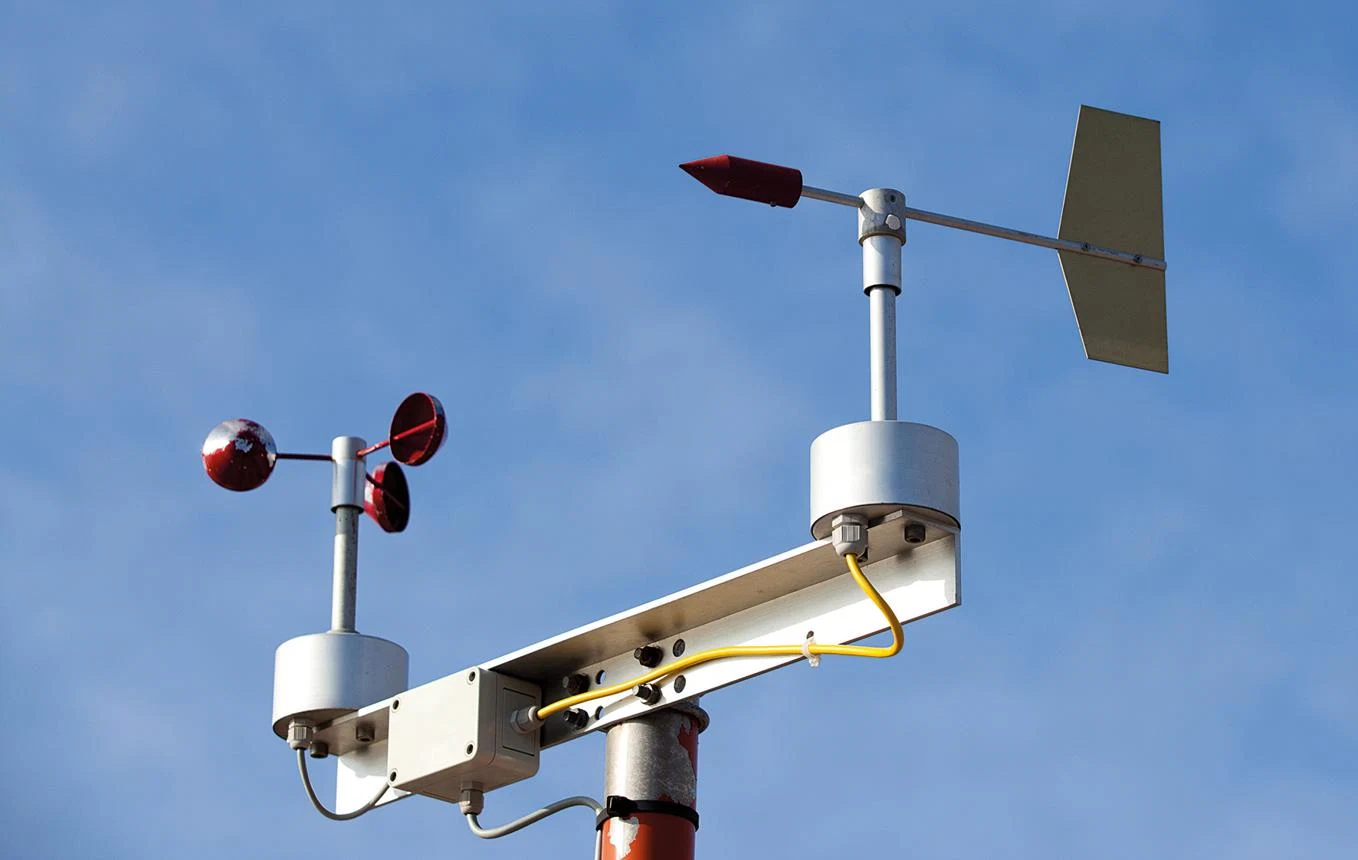
Wind speed is measured using an anemometer.
Wind direction is measured using a wind vane or other appropriate meteorological equipment.
 B. Temperature
Temperature is a measure of how hot or cold a substance or environment is.
Atmospheric temperature describes the thermal condition of the surrounding air.
Temperature is commonly measured in degrees Celsius (°C) or kelvin (K).
Instrument: Thermometer.
Effects of Temperature on Aircraft
1. Air Density
Warm air is generally less dense than cold air at the same pressure.
Reduced air density can decrease aircraft engine and aerodynamic performance.
2. Take-off Performance
High temperatures can increase the distance needed for take-off because lower-density air reduces aerodynamic performance and may reduce engine output.
3. Climb Performance
Aircraft may climb less effectively under hot, high-altitude conditions.
4. Aircraft Icing
At suitable temperatures and moisture conditions, ice may form on aircraft surfaces.
Ice accumulation can interfere with airflow and reduce aircraft performance.
5. Engine Performance
Engine performance can vary depending on air temperature and engine design.
Example from Kenya
Aircraft operating from high-elevation airports such as Wilson Airport may experience reduced performance during hot conditions because air density is relatively low.
C. Atmospheric Pressure
Atmospheric pressure is the force exerted per unit area by the weight of the air above a surface.
Atmospheric pressure generally decreases with increasing altitude.
Instrument: Barometer.
Common Units
- Hectopascals (hPa).
- Millibars (mb).
- Inches of mercury (inHg).
One millibar is numerically equal to one hectopascal.
Standard sea-level atmospheric pressure in the International Standard Atmosphere is approximately 1013.25 hPa.
Effects of Atmospheric Pressure on Aircraft
- Influences atmospheric density.
- Affects aircraft altitude indications.
- Contributes to weather changes.
- Influences aircraft performance.
- Affects the pressure-setting procedures used with altimeters.
Relationship Between Pressure and Altitude
As altitude increases, atmospheric pressure generally decreases.
|
Altitude |
General atmospheric pressure |
|---|---|
|
Sea level |
Highest among these examples |
|
Low altitude |
Relatively high |
|
Medium altitude |
Lower |
|
High altitude |
Much lower |
An aircraft altimeter uses atmospheric pressure to indicate altitude based on its calibration and selected pressure setting.
D. Humidity
Humidity refers to the amount of water vapour present in the air.
Water vapour is water in its gaseous state.
Relative humidity describes the amount of water vapour present compared with the amount needed for saturation at the same temperature, expressed as a percentage.
Instrument: Hygrometer.
Effects of Humidity on Flight Operations
- High humidity can contribute to cloud formation.
- Moist air may form fog when cooled sufficiently.
- Humidity contributes to precipitation processes.
- High humidity can affect air density.
- Moisture may contribute to aircraft icing under suitable conditions.
- Humidity affects visibility through fog and mist formation.
Relationship Between Humidity and Clouds
When moist air cools to its dew point and sufficient condensation nuclei are present, water vapour may condense into tiny droplets.
These droplets can form clouds or fog.
E. Clouds
A cloud is a visible collection of tiny water droplets, ice crystals or both, suspended in the atmosphere.
Clouds form when moist air cools sufficiently for condensation or deposition to occur.
Clouds are important in aviation because they may indicate weather conditions, limit visibility and contain turbulence or icing hazards.
The curriculum specifically identifies cirrus, stratus and cumulus clouds.
1. Cirrus Clouds
 Cirrus clouds are thin, wispy clouds that form at high altitudes.
They are composed mainly of ice crystals.
Characteristics
- Appear thin and feather-like.
- Usually occur at high altitudes.
- Often appear white.
- Generally produce little or no precipitation reaching the ground.
- Can indicate changes in atmospheric conditions.
Importance in Aviation
Cirrus clouds may indicate moisture at high altitude and can sometimes be associated with approaching weather systems.
2. Stratus Clouds
 Stratus clouds are low-level clouds that often form widespread, relatively uniform layers.
Characteristics
- Usually form at low altitudes.
- Often cover large areas of the sky.
- Appear grey or whitish.
- May produce drizzle.
- Can be associated with low cloud ceilings and poor visibility.
Effects on Aviation
Low stratus clouds may interfere with visual flight operations and make approach and landing more demanding.
3. Cumulus Clouds
 Cumulus clouds are clouds with a generally rounded, heaped or cauliflower-like appearance.
They commonly form through convection as warm air rises and cools.
Characteristics
- Have a puffy appearance.
- Often have relatively flat bases.
- Can develop vertically.
- May form during daytime surface heating.
- Small fair-weather cumulus clouds usually indicate relatively limited vertical development.
Effects on Aviation
Growing cumulus clouds can indicate increasing convection and the possibility of turbulence.
Some may develop into towering cumulus or cumulonimbus clouds.
4. Cumulonimbus Clouds — Additional Aviation Application
Cumulonimbus clouds are large, vertically developed storm clouds associated with thunderstorms.
They may produce heavy rain, lightning, hail, severe turbulence and strong wind changes.
Aircraft should avoid hazardous thunderstorms according to appropriate operational guidance.
3.1.4 Comparison of Cloud Types
|
Cloud type |
General appearance |
Common altitude category |
Aviation significance |
|---|---|---|---|
|
Cirrus |
Thin and wispy |
High-level |
May indicate changing weather |
|
Stratus |
Flat or layered |
Low-level |
Can restrict visibility and cloud ceiling |
|
Cumulus |
Puffy or heaped |
Commonly low-based, with varying vertical growth |
May indicate convection and turbulence |
|
Cumulonimbus |
Large vertical storm cloud |
Extends through several altitude levels |
Thunderstorms and potentially severe hazards |
F. Precipitation
Precipitation refers to water in liquid or solid form that falls from clouds and reaches the Earth's surface.
Types of Precipitation
- Rain.
- Drizzle.
- Snow.
- Hail.
- Sleet, where applicable.
Effects of Precipitation on Aircraft
- Heavy rain can reduce visibility.
- Water on runways can affect braking performance.
- Heavy precipitation may be associated with turbulence.
- Freezing precipitation can cause aircraft icing.
- Hail may damage aircraft surfaces.
- Severe precipitation can disrupt airport operations.
Instrument: Rain gauge, for measuring rainfall.
3.1.5 Summary of Weather Elements and Measuring Instruments
|
Weather element |
Instrument |
Measurement |
|---|---|---|
|
Wind speed |
Anemometer |
Knots, metres per second or km/h |
|
Wind direction |
Wind vane |
Compass direction or degrees |
|
Temperature |
Thermometer |
°C or K |
|
Atmospheric pressure |
Barometer |
hPa or mb |
|
Humidity |
Hygrometer |
Percentage relative humidity |
|
Precipitation |
Rain gauge |
Millimetres of rainfall |
|
Cloud cover |
Human observation or suitable observing systems |
Oktas or other reporting conventions |
3.1.6 Effects of Weather on Aircraft Flight
Weather can influence aircraft operations at all stages of a flight.
A. During Take-off
- Strong crosswinds may affect directional control.
- High temperatures may reduce take-off performance.
- Low visibility may restrict operations.
- Heavy rain may affect runway conditions.
B. During Climb
- Turbulence may affect aircraft movement.
- Low-density air may reduce climb performance.
- Cloud and icing conditions may require special precautions.
C. During Cruise
- Winds influence groundspeed and fuel consumption.
- Turbulence may affect comfort and control.
- Thunderstorms may require route changes.
- Icing can affect aircraft performance when conditions are suitable.
D. During Descent and Landing
- Wind direction influences runway selection.
- Crosswinds increase control demands.
- Poor visibility may limit approaches.
- Wet or contaminated runways can increase stopping distances.
3.1.7 Aviation Weather Hazards
A. Turbulence
Turbulence is irregular atmospheric motion that can cause changes in aircraft movement.
Possible Causes
- Atmospheric convection.
- Mountain waves.
- Wind shear.
- Thunderstorms.
- Wake turbulence generated by other aircraft.
Effects
- Aircraft shaking.
- Discomfort or injury to unsecured occupants.
- Increased pilot workload.
- Changes in aircraft altitude or attitude.
B. Fog
Fog is a cloud of tiny water droplets or ice crystals near the Earth's surface that reduces horizontal visibility.
Fog may lead to flight delays, diversions and restrictions on airport operations.
C. Wind Shear
Wind shear is a change in wind speed or direction over a relatively short distance.
Strong wind shear can be particularly dangerous during take-off and landing because it may cause rapid changes in airspeed and flight path.
D. Aircraft Icing
Aircraft icing occurs when ice accumulates on aircraft surfaces or components.
Effects
- Increases weight.
- Can alter the shape of lifting surfaces.
- May reduce lift.
- May increase drag.
- Can interfere with sensors and moving parts.
E. Thunderstorms
Thunderstorms may produce severe turbulence, lightning, heavy precipitation, hail and wind shear.
Thunderstorms are therefore important hazards in aviation weather planning.
3.1.8 Weather Forecasting in Aviation
Weather forecasting is the process of predicting future atmospheric conditions using observations, scientific knowledge and forecasting models.
Aviation weather forecasts help pilots and airport personnel make operational decisions.
Importance of Weather Forecasting
- Assists in selecting appropriate flight routes.
- Helps anticipate hazardous weather.
- Supports take-off and landing decisions.
- Informs fuel planning.
- Supports airport scheduling.
- Helps reduce weather-related disruptions.
- Supports the selection of alternative airports.
- Improves aviation safety.
Aviation Weather Information
METAR is a standard aviation weather report describing observed conditions at an aerodrome.
TAF is a terminal aerodrome forecast that describes expected weather conditions over a specified period.
These reports may contain information on wind, visibility, clouds and significant weather.
3.1.9 Practical Activity: Measuring Weather Elements
Objective: To observe and measure selected weather elements using available instruments.
Materials Required
- Thermometer.
- Simple rain gauge.
- Wind vane.
- Anemometer, where available.
- Hygrometer, where available.
- Recording sheet.
Procedure
- Identify the instruments.
- Explain the use of each instrument.
- Position instruments appropriately.
- Record air temperature.
- Observe wind direction.
- Measure wind speed where equipment is available.
- Record humidity.
- Measure collected rainfall.
- Observe the cloud types.
- Discuss how the observed weather could affect aircraft operations.
Sample Weather Observation Table
|
Weather element |
Observation |
Aviation implication |
|---|---|---|
|
Temperature |
28°C |
May influence aircraft performance |
|
Wind |
Easterly, 12 knots |
Affects runway and flight planning |
|
Pressure |
1012 hPa |
Relevant to altimeter setting |
|
Relative humidity |
70% |
May support cloud or fog formation |
|
Cloud type |
Cumulus |
May indicate convection |
|
Rainfall |
4 mm |
May affect runway surface conditions |
The values above are illustrative classroom examples, not actual weather observations.
Revision Exercise 3.1
- Define aviation weather.
- Explain six reasons for studying aviation meteorology.
- Identify six elements of weather.
- Differentiate between headwind and tailwind.
- Explain five effects of wind on aircraft.
- State four effects of temperature on aircraft performance.
- Explain the relationship between pressure and altitude.
- Define relative humidity.
- Describe how clouds form.
- Explain the characteristics of cirrus clouds.
- Differentiate between stratus and cumulus clouds.
- Identify five types of precipitation.
- Match six weather elements with their measuring instruments.
- Explain the effects of weather during take-off and landing.
- Define turbulence, fog and wind shear.
- Describe three dangers associated with thunderstorms.
- Explain the importance of weather forecasts to pilots.
- Describe a practical activity for measuring rainfall.