
Suggested Number of Lessons: 15
Specific Learning Outcomes
By the end of this sub-strand, the learner should be able to:
- Identify the ICAO phonetics used in aviation communication.
- Interpret standard words and phrases used in aviation communication.
- Describe the transmission techniques used in aviation communication.
- Perform aircraft marshalling signals.
- Appreciate careers related to aviation communication.
3.2.1 Introduction to Aviation Communication
Communication is the process of exchanging information between individuals or groups.
Aviation communication refers to the exchange of information between pilots, air traffic controllers, ground personnel and other aviation professionals to support safe and efficient aircraft operations.
Communication may take place through radio systems, telephones, digital communication equipment, visual signals and written messages.
Effective communication is essential because aviation personnel must coordinate activities accurately, particularly when aircraft are moving.
Importance of Aviation Communication
- Promotes safe aircraft operations.
- Enables pilots to receive instructions.
- Helps coordinate take-off and landing.
- Supports air traffic management.
- Facilitates communication during emergencies.
- Coordinates aircraft ground handling.
- Helps prevent misunderstandings.
- Supports efficient airport operations.
- Assists in the transmission of weather information.
- Promotes teamwork among aviation personnel.
3.2.2 Types of Aviation Communication
A. Air-to-Ground Communication
This is communication between an aircraft and a ground-based station.
For example, a pilot may communicate with an air traffic controller to request permission to taxi.
B. Ground-to-Ground Communication
This is communication between personnel or stations located on the ground.
Examples include communication between airport operations personnel, ground handling teams and maintenance workers.
The Grade 10 curriculum specifically includes standard words and phrases used in ground-to-ground communication.
C. Air-to-Air Communication
Air-to-air communication occurs between aircraft when appropriate.
It may be used for operational coordination on designated communication frequencies or in other authorised situations.
D. Visual Communication
Visual communication involves using signs, lights, hand signals or other visible indications.
An important example is aircraft marshalling.
3.2.3 ICAO Phonetic Alphabet
The International Civil Aviation Organization (ICAO) is a United Nations specialised agency that establishes international standards and recommended practices for civil aviation.
The ICAO spelling alphabet is a system of standard words used to represent letters clearly during radio communication.
It helps reduce confusion when words or letters sound similar.
For example, letters B, D, P and T may be difficult to distinguish over a noisy radio channel.
ICAO Spelling Alphabet
|
Letter |
Code word |
Letter |
Code word |
|---|---|---|---|
|
A |
Alfa |
N |
November |
|
B |
Bravo |
O |
Oscar |
|
C |
Charlie |
P |
Papa |
|
D |
Delta |
Q |
Quebec |
|
E |
Echo |
R |
Romeo |
|
F |
Foxtrot |
S |
Sierra |
|
G |
Golf |
T |
Tango |
|
H |
Hotel |
U |
Uniform |
|
I |
India |
V |
Victor |
|
J |
Juliett |
W |
Whiskey |
|
K |
Kilo |
X |
X-ray |
|
L |
Lima |
Y |
Yankee |
|
M |
Mike |
Z |
Zulu |
Important: The official ICAO spellings include Alfa and Juliett, rather than Alpha and Juliet.
Examples of ICAO Phonetics
Example 1: KQ
K — Kilo
Q — Quebec
Example 2: JKA
J — Juliett
K — Kilo
A — Alfa
Example 3: WILSON
W — Whiskey
I — India
L — Lima
S — Sierra
O — Oscar
N — November
Importance of the ICAO Spelling Alphabet
- Reduces confusion between similar-sounding letters.
- Improves accuracy in radio communication.
- Supports international communication.
- Helps transmit aircraft registration letters.
- Helps communicate call signs.
- Reduces the need to repeat unclear information.
- Supports communication during emergencies.
- Promotes standardisation.
3.2.4 Aviation Numerals
In aviation, numbers may be pronounced differently from ordinary speech to improve clarity.
Standard ICAO Number Pronunciation
|
Number |
Aviation pronunciation |
|---|---|
|
0 |
ZE-RO |
|
1 |
WUN |
|
2 |
TOO |
|
3 |
TREE |
|
4 |
FOW-er |
|
5 |
FIFE |
|
6 |
SIX |
|
7 |
SEV-en |
|
8 |
AIT |
|
9 |
NIN-er |
These pronunciations reduce misunderstandings caused by noise, accents and poor radio reception.
Examples
Number 25: TOO FIFE.
Number 370: TREE SEV-en ZE-RO when transmitted digit by digit.
Number 908: NIN-er ZE-RO AIT.
Some aviation numerical information is spoken according to specific phraseology conventions rather than always digit by digit. Learners should follow the applicable communication procedure.
3.2.5 Time in Aviation Communication
Aviation commonly uses the 24-hour clock to reduce confusion.
Coordinated Universal Time (UTC) is widely used as a common international time reference in aviation.
UTC is sometimes referred to as Zulu time.
Examples of 24-Hour Time
|
12-hour clock |
24-hour clock |
|---|---|
|
6:00 a.m. |
0600 |
|
9:30 a.m. |
0930 |
|
12:00 noon |
1200 |
|
2:15 p.m. |
1415 |
|
6:45 p.m. |
1845 |
|
11:20 p.m. |
2320 |
Kenya uses East Africa Time (EAT), which is UTC+3.
For example, 1200 UTC corresponds to 1500 EAT.
Aviation personnel must confirm which time reference is being used.
3.2.6 Aircraft Call Signs
A call sign is an identification used to distinguish an aircraft, station or operator during radio communication.
It enables communication to be directed to the correct aircraft or station.
Types of Aircraft Call Signs
A. Registration-Based Call Signs
These may use an aircraft registration identifier.
For example, a hypothetical aircraft registration 5Y-ABC can be communicated using ICAO spelling words.
B. Operator-Based Call Signs
Commercial operators may use an approved radiotelephony designator followed by an identification number.
C. Other Approved Call Signs
Some aircraft or operations use special call signs according to applicable rules and authorisation.
Importance of Call Signs
- Identify the intended communication recipient.
- Reduce confusion between aircraft.
- Support air traffic coordination.
- Help ensure that instructions reach the correct aircraft.
- Promote accurate operational records.
3.2.7 Standard Words and Phrases in Aviation Communication
Standard aviation phraseology is a collection of recognised words and expressions used to communicate operational information.
Standard words reduce ambiguity and improve communication efficiency.
Common Standard Words
|
Word or phrase |
Meaning |
|---|---|
|
Roger |
Your last transmission has been received |
|
Wilco |
Your message is understood and will be complied with |
|
Affirm |
Yes |
|
Negative |
No, or permission not granted, depending on context |
|
Stand by |
Wait; I will call you |
|
Say again |
Repeat your transmission or the indicated part |
|
Correction |
An error has been made; the correct information follows |
|
Read back |
Repeat the specified information as received |
|
Unable |
Unable to comply |
|
Break |
Separates parts of a message |
|
Out |
The exchange of transmissions is ended; no response is expected |
|
Over |
My transmission has ended and I expect a response |
Note: In standard aeronautical VHF radiotelephony, the words “over” and “out” are generally not used in routine exchanges.
Examples of Communication
Example 1: Confirming Reception
Ground station: "Maintenance One, confirm you received the instruction."
Maintenance team: "Roger."
Example 2: Requesting Repetition
Ground station: "Ground Vehicle Two, proceed to the assigned location."
Ground vehicle: "Say again."
Example 3: Indicating Inability to Comply
Ground station: "Ground Vehicle Three, proceed to the next checkpoint."
Ground vehicle: "Unable, route obstructed."
These are simplified classroom examples rather than complete operational radio procedures.
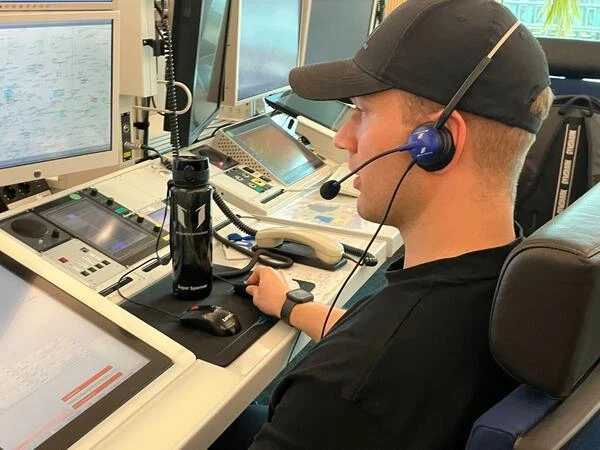
3.2.8 Radio Communication Equipment
Radio communication equipment enables voice information to be transmitted between aviation personnel.
Common equipment includes:
- Handheld radios.
- Aircraft radio transceivers.
- Headsets.
- Microphones.
- Antennas.
- Ground radio stations.
 A. Radio Transceiver
A transceiver is a device capable of both transmitting and receiving radio signals.
B. Microphone
A microphone converts speech into electrical signals for communication.
C. Headset
A headset provides sound output and may include a microphone.
Headsets help users hear communication clearly in noisy working environments.
D. Antenna
An antenna transmits or receives electromagnetic radio waves.
3.2.9 Radio Transmission Techniques
Radio transmission techniques are the methods and practices used to communicate information clearly and accurately through radio equipment.
Principles of Effective Radio Communication
1. Clarity
Speak distinctly so that the message can be understood.
2. Brevity
Use concise messages without unnecessary words.
3. Accuracy
Ensure the information is correct before transmitting.
4. Correct Phraseology
Use appropriate standard aviation words and expressions.
5. Proper Listening
Listen before transmitting to avoid interrupting another radio user.
6. Appropriate Speaking Speed
Speak at a steady pace that allows the listener to understand the message.
7. Correct Identification
Identify the intended receiving station and, where required, the transmitting station.
8. Confirmation
Use appropriate readbacks or acknowledgements for instructions requiring confirmation.
3.2.10 Basic Radio Transmission Procedure
- Confirm the correct radio and assigned frequency.
- Listen to ensure the frequency is available.
- Prepare the message.
- Press and hold the push-to-talk control as required.
- Identify the intended receiving station.
- Identify the transmitting station where required.
- Deliver the message clearly.
- Release the push-to-talk control.
- Listen for the response.
- Read back or acknowledge information as required.
Common Communication Errors
- Speaking too quickly.
- Using incorrect call signs.
- Failing to listen before transmitting.
- Using unclear words.
- Transmitting unnecessary information.
- Failing to confirm important instructions.
- Mispronouncing numbers.
- Speaking with the microphone incorrectly positioned.
3.2.11 Aircraft Marshalling
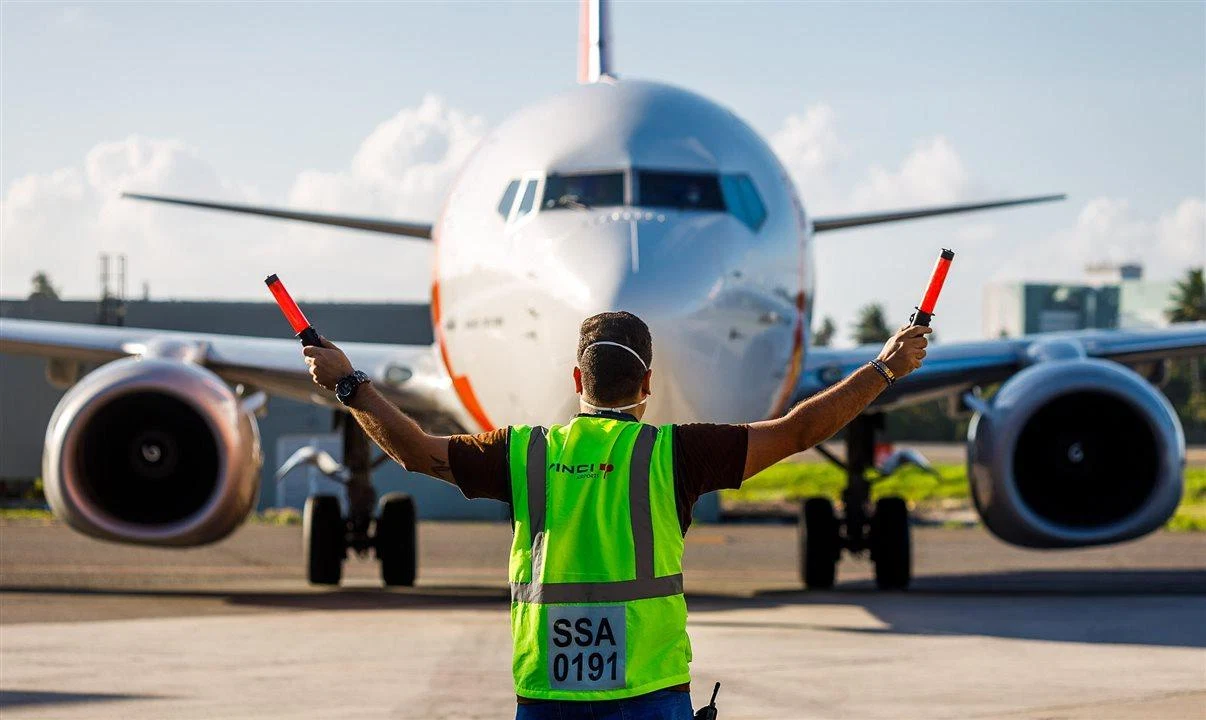
Aircraft marshalling is the process of using standardised visual signals to guide an aircraft during ground movement.
A marshaller is a trained person who communicates with pilots using approved hand, arm or lighted wand signals.
Marshalling may be used when positioning aircraft at parking stands or guiding movement where authorised.
 Importance of Aircraft Marshalling
- Helps guide aircraft into designated parking positions.
- Supports safe aircraft ground movement.
- Reduces the risk of collisions.
- Supports ground handling coordination.
- Helps pilots position aircraft correctly.
- Provides visual communication in appropriate situations.
3.2.12 Common Aircraft Marshalling Signals
Marshalling signals are standardised, and their exact form and meaning must be learned from approved aviation guidance.
A. Proceed Straight Ahead
The marshaller faces the aircraft and gives the approved forward movement signal.
Purpose: Indicates that the aircraft should continue moving forward.
B. Turn Left
The marshaller uses the appropriate arm and wand movements to direct a left turn from the pilot's perspective.
C. Turn Right
The marshaller uses the appropriate arm and wand movements to direct a right turn from the pilot's perspective.
D. Normal Stop
The marshaller raises and crosses the wands above the head using the approved signal.
Purpose: Indicates that the aircraft should stop.
E. Emergency Stop
A more urgent standardised signal is used to indicate that the aircraft must stop immediately.
F. Slow Down
The marshaller gives the approved signal requesting a reduction in taxiing speed.
G. Chocks Inserted or Removed
Standard signals inform the flight crew about the status of aircraft wheel chocks.
Safety: These descriptions are introductory. Actual aircraft marshalling requires authorised training, correct ICAO-standard signals and coordination with the flight crew. Learners should practise only in a safe simulated environment.
3.2.13 Safety Precautions During Aircraft Marshalling
- Wear high-visibility clothing.
- Use suitable marshalling wands.
- Stand at an approved, clearly visible position.
- Maintain visual contact with the flight crew.
- Follow airport operational procedures.
- Keep clear of engines, propellers and other hazards.
- Check that the designated movement area is safe.
- Avoid confusing or unauthorised signals.
- Stop operations when unsafe conditions arise.
- Follow the instructions of authorised aviation personnel.
3.2.14 Careers Related to Aviation Communication
|
Career |
Main responsibility |
|---|---|
|
Air traffic controller |
Coordinates aircraft movements within assigned airspace and aerodrome control areas |
|
Aeronautical radio operator |
Provides authorised aeronautical communication services |
|
Flight operations officer |
Supports aircraft operational planning and coordination |
|
Pilot |
Uses aviation communication during flight operations |
|
Airport operations officer |
Coordinates airport operational activities |
|
Ground handling supervisor |
Coordinates ground handling teams |
|
Aircraft marshaller |
Provides visual guidance to aircraft on the ground |
|
Aviation communication technician |
Maintains relevant communication equipment |
3.2.15 Practical Activity: ICAO Phonetic Alphabet
Objective: To practise accurate pronunciation of the ICAO spelling alphabet.
Materials Required
- ICAO spelling alphabet chart.
- Flashcards.
- Notebook.
- Classroom communication devices, if available.
Procedure
- Study the ICAO spelling alphabet.
- Practise pronouncing each code word.
- Work in pairs.
- One learner spells a word using ICAO phonetics.
- The second learner writes the letters.
- Compare the answer with the original word.
- Exchange roles.
- Discuss any pronunciation difficulties.
Practice Words
|
Word |
ICAO spelling |
|---|---|
|
AIR |
Alfa India Romeo |
|
JET |
Juliett Echo Tango |
|
KENYA |
Kilo Echo November Yankee Alfa |
|
PILOT |
Papa India Lima Oscar Tango |
|
WING |
Whiskey India November Golf |
3.2.16 Practical Activity: Simulated Radio Communication
Objective: To demonstrate basic listening and speaking techniques.
Procedure
- Divide learners into pairs.
- Assign one learner the role of a ground station.
- Assign the other learner the role of a ground vehicle operator.
- Provide a short, predetermined message.
- Practise correct identification.
- Transmit the message clearly.
- Ask the receiver to acknowledge or repeat it.
- Exchange roles.
- Discuss clarity, accuracy and communication errors.
3.2.17 Practical Activity: Simulated Aircraft Marshalling
Objective: To demonstrate introductory aircraft marshalling signals.
Materials
- Approved reference chart.
- Reflective vest.
- Safe training wands.
- Model aircraft.
- Open classroom or school compound.
Procedure
- Study an approved marshalling signal chart.
- Identify signals used for forward movement, turning and stopping.
- Demonstrate the signals under teacher supervision.
- Use a model aircraft to represent ground movement.
- Practise interpreting the signals.
- Discuss the safety precautions.
- Assess learners' accuracy.
Revision Exercise 3.2
- Define aviation communication.
- State eight reasons why communication is important in aviation.
- Differentiate between air-to-ground and ground-to-ground communication.
- Explain the purpose of the ICAO spelling alphabet.
- Write the ICAO phonetic code words for the letters A to Z.
- Spell KENYA using the ICAO alphabet.
- Explain how numerals are pronounced in aviation communication.
- Describe the use of the 24-hour clock.
- Define an aircraft call sign.
- State the meaning of Roger, Wilco, Negative and Say again.
- Identify five items of radio communication equipment.
- Explain eight principles of effective radio communication.
- Describe the basic steps in making a radio transmission.
- Define aircraft marshalling.
- State five reasons why aircraft marshalling is important.
- Identify five common marshalling signals.
- State eight precautions observed during aircraft marshalling.
- Identify six careers related to aviation communication.