
Suggested Number of Lessons: 15
Specific Learning Outcomes
By the end of this sub-strand, the learner should be able to:
- Identify the physical properties of the atmosphere.
- Explain the characteristics of the lower layers of the atmosphere.
- Illustrate the axes of an aircraft in the theory of flight.
- Demonstrate the motion of an aircraft about its axes.
- Evaluate the forces acting on an aircraft in flight.
- Acknowledge the effects of aerodynamic forces on an aircraft in flight.
3.3.1 Introduction to Aerodynamics
Aerodynamics is the branch of science that studies the movement of air and the forces produced when air interacts with objects.
In aviation, aerodynamics explains how air moves around aircraft and how aerodynamic forces affect flight.
The scientific principles of aerodynamics help engineers design aircraft that can generate lift, reduce drag, remain stable and respond to pilot controls.
Importance of Aerodynamics in Aviation
- Explains how aircraft generate lift.
- Helps engineers design efficient wings.
- Supports the design of streamlined aircraft structures.
- Explains aircraft stability and control.
- Helps improve fuel efficiency.
- Supports aircraft performance analysis.
- Helps pilots understand aircraft behaviour.
- Contributes to aviation safety.
3.3.2 The Atmosphere
The atmosphere is the layer of gases surrounding the Earth.
It is held in place mainly by gravity.
The atmosphere provides the air required for conventional aerodynamic flight and supports weather processes.
Composition of the Atmosphere
Dry air near the Earth's surface consists approximately of:
|
Gas |
Percentage by volume |
|---|---|
|
Nitrogen |
78.08% |
|
Oxygen |
20.95% |
|
Argon |
0.93% |
|
Carbon dioxide and other trace gases |
Approximately 0.04% |
Water vapour is also present in variable amounts.
Importance of the Atmosphere to Aviation
- Provides the air needed to generate aerodynamic lift.
- Supplies oxygen for combustion in many aircraft engines.
- Influences aircraft performance through air density.
- Produces wind and weather conditions.
- Affects aircraft speed measurements.
- Influences engine and propulsion performance.
- Provides the medium through which sound travels.
- Affects aircraft operating conditions at different altitudes.
3.3.3 Physical Properties of the Atmosphere
The curriculum identifies four main physical properties:
- Temperature.
- Atmospheric pressure.
- Density.
- Humidity.
A. Temperature
Air temperature influences air density and aircraft performance.
In the lower atmosphere, temperature generally decreases with altitude under standard atmospheric conditions.
In the International Standard Atmosphere, the standard temperature at sea level is 15°C.
B. Atmospheric Pressure
Atmospheric pressure generally decreases as altitude increases.
At standard sea-level conditions, the reference atmospheric pressure is approximately 1013.25 hPa.
Aircraft use pressure information in altitude measurement and flight operations.
C. Air Density
Air density is the mass of air per unit volume.
Where:
- = density.
- = mass.
- = volume.
Air density is commonly expressed in kg/m³.
Under standard sea-level conditions, air density is approximately 1.225 kg/m³.
Factors Affecting Air Density
1. Temperature
At the same pressure, increasing temperature generally reduces air density.
2. Pressure
At the same temperature and humidity, increasing pressure increases air density.
3. Altitude
Air density generally decreases with altitude.
4. Humidity
At the same temperature and pressure, moist air is less dense than dry air because water vapour has a lower molecular mass than the average dry-air constituents.
Importance of Air Density in Flight
- Influences lift generation.
- Affects engine performance.
- Influences propeller performance.
- Affects take-off distance.
- Influences climb performance.
- Affects indicated airspeed relationships.
D. Humidity
Humidity describes water vapour in the atmosphere.
It influences cloud formation, weather conditions and air density.
Humidity is particularly important when considering fog, icing and other weather phenomena.
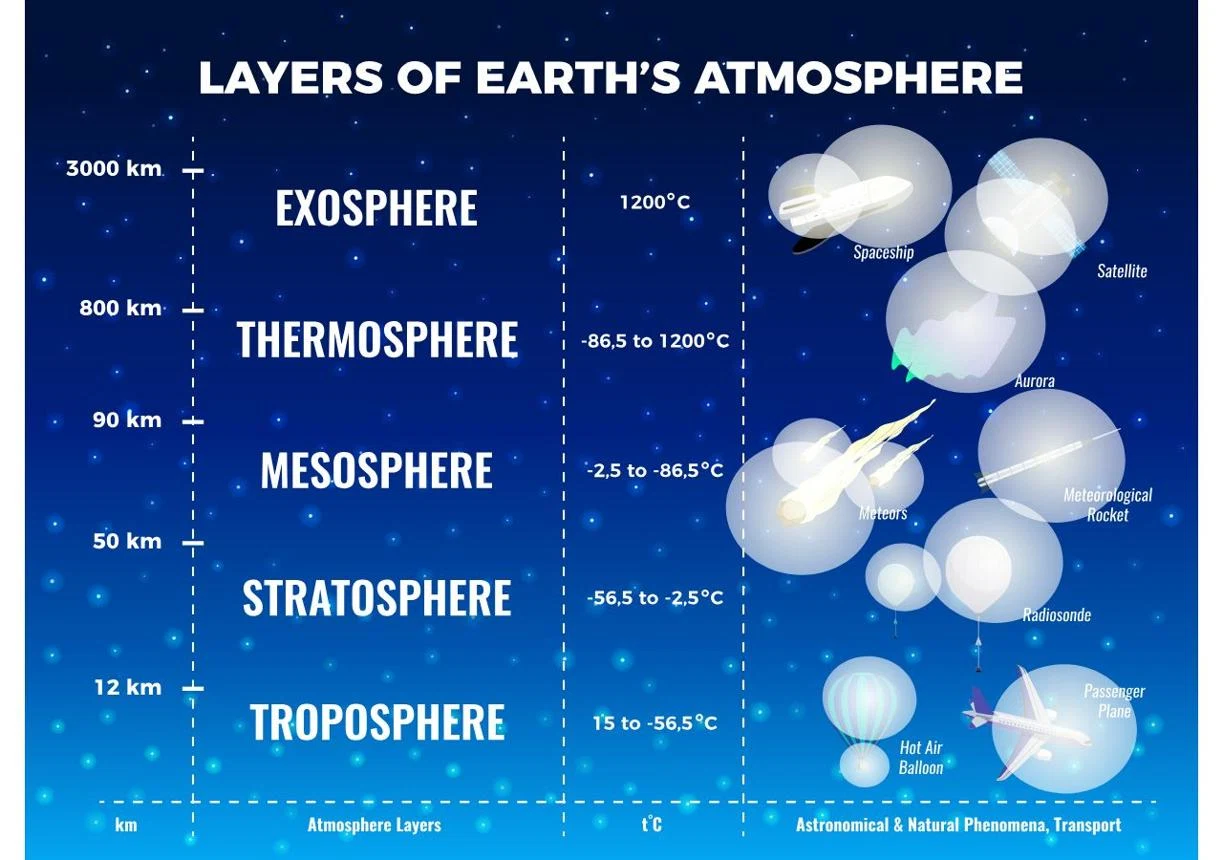
3.3.4 Layers of the Atmosphere
The atmosphere is divided into layers based mainly on changes in temperature with altitude.
The layers include:
- Troposphere.
- Stratosphere.
- Mesosphere.
- Thermosphere.
- Exosphere.
The Grade 10 Aviation Technology curriculum focuses on the two lower layers: the troposphere and stratosphere.
 A. Troposphere
The troposphere is the lowest layer of the Earth's atmosphere.
It extends from the Earth's surface to an altitude that varies by location and season, generally around 8–18 km.
Characteristics of the Troposphere
- It is the lowest atmospheric layer.
- It contains most of the atmosphere's mass.
- It contains most atmospheric water vapour.
- Most familiar weather phenomena occur within it.
- Temperature generally decreases with altitude.
- Clouds and precipitation commonly develop within it.
- It supports many aircraft operations.
Importance of the Troposphere in Aviation
- Most take-offs and landings occur within it.
- It contains clouds and weather systems affecting aircraft.
- Many aircraft operate within this layer.
- Atmospheric density changes influence aircraft performance.
- Turbulence and wind changes may affect flight.
B. Stratosphere
The stratosphere is the atmospheric layer located above the troposphere.
It extends from the tropopause to approximately 50 km altitude.
Characteristics of the Stratosphere
- It lies above the troposphere.
- It contains the ozone layer.
- Temperature generally increases with altitude through much of the layer.
- It contains relatively little water vapour.
- It has fewer ordinary weather disturbances than the troposphere.
- Some high-altitude aircraft operate in its lower portion.
Importance of the Stratosphere in Aviation
- Its lower portion may provide relatively stable flight conditions.
- It is relevant to high-altitude aviation.
- It helps learners understand atmospheric temperature changes.
- It contributes to the study of high-altitude aircraft performance.
Differences Between the Troposphere and Stratosphere
|
Troposphere |
Stratosphere |
|---|---|
|
Lowest atmospheric layer |
Located above the troposphere |
|
Most weather phenomena occur here |
Relatively few ordinary weather disturbances |
|
Temperature generally decreases with altitude |
Temperature generally increases through much of the layer |
|
Contains most atmospheric water vapour |
Contains relatively little water vapour |
|
Many aircraft operate within it |
Some high-altitude aircraft operate in its lower portion |
3.3.5 International Standard Atmosphere (ISA)
The International Standard Atmosphere is a reference atmospheric model used in aviation to compare and calculate aircraft performance under standardised conditions.
It provides reference values for temperature, pressure and density at different altitudes.
Standard Sea-Level Conditions
|
Property |
ISA reference value |
|---|---|
|
Temperature |
15°C |
|
Pressure |
1013.25 hPa |
|
Density |
Approximately 1.225 kg/m³ |
|
Temperature lapse rate in the standard lower troposphere |
6.5°C per km |
Example: Temperature Change with Altitude
Assume a standard temperature of 15°C at sea level.
Calculate the standard temperature at 2,000 metres altitude.
The temperature decreases by 6.5°C per kilometre in the standard lower troposphere.
Therefore, the standard atmospheric temperature at 2,000 metres is 2°C.
Actual temperatures may differ from ISA values.
3.3.6 Aircraft Axes
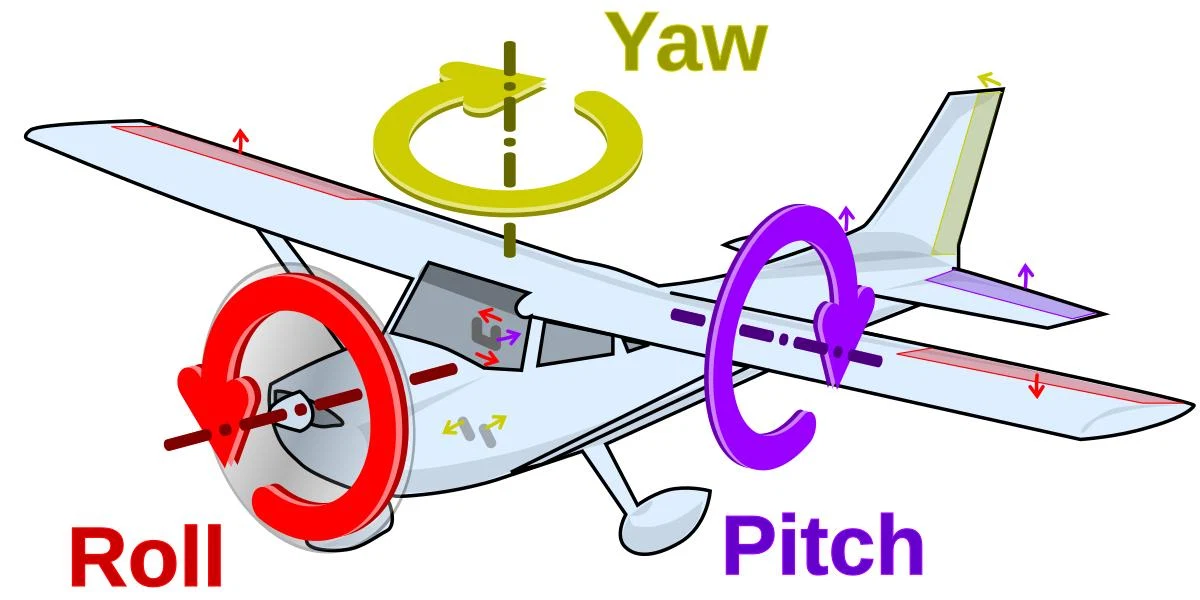
An aircraft can rotate about three imaginary axes passing through a reference point near its centre of gravity.
These axes are:
- Longitudinal axis.
- Lateral axis.
- Vertical axis.
 A. Longitudinal Axis
The longitudinal axis runs from the nose towards the tail.
Rotation about this axis is called roll.
Ailerons are normally the primary roll-control surfaces on conventional fixed-wing aircraft.
B. Lateral Axis
The lateral axis runs from one side of the aircraft towards the other.
Rotation about this axis is called pitch.
Elevators are normally the primary pitch-control surfaces on conventional fixed-wing aircraft.
C. Vertical Axis
The vertical axis runs from the upper part of the aircraft towards its lower part.
Rotation about this axis is called yaw.
The rudder is normally the primary yaw-control surface on conventional fixed-wing aircraft.
Summary of Aircraft Axes
|
Axis |
Direction |
Movement |
Main conventional control surface |
|---|---|---|---|
|
Longitudinal |
Nose to tail |
Roll |
Ailerons |
|
Lateral |
Wing to wing |
Pitch |
Elevator |
|
Vertical |
Top to bottom |
Yaw |
Rudder |
3.3.7 Aircraft Motion About Its Axes
A. Roll Motion
Roll occurs when an aircraft rotates about its longitudinal axis.
The aircraft's wings tilt relative to the horizon.
Roll is important when establishing a bank angle for turning.
B. Pitch Motion
Pitch occurs when an aircraft rotates about its lateral axis.
The aircraft's nose moves upwards or downwards.
Pitch control helps pilots manage aircraft attitude and flight path.
C. Yaw Motion
Yaw occurs when an aircraft rotates about its vertical axis.
The aircraft's nose rotates left or right.
Yaw control helps maintain coordinated flight and directional control.
3.3.8 The Four Forces of Flight
An aircraft in flight experiences four principal forces:
- Lift.
- Weight.
- Thrust.
- Drag.
Simplified illustration of the four forces acting on a powered aircraft in flight.
A. Lift
Lift is the component of aerodynamic force acting perpendicular to the relative airflow.
In ordinary level flight, lift acts approximately upwards.
Lift is generated through the interaction between the aircraft's lifting surfaces and the surrounding air.
Factors Affecting Lift
- Air density.
- Airspeed.
- Wing area.
- Wing shape.
- Angle of attack.
- Configuration of high-lift devices.
A simplified lift equation is:
Where:
- = lift.
- = air density.
- = airspeed relative to the airflow.
- = wing reference area.
- = lift coefficient.
B. Weight
Weight is the force of gravity acting on an aircraft.
Weight acts towards the centre of the Earth.
It depends on the mass of the aircraft and the gravitational field.
Where:
- = weight in newtons.
- = mass in kilograms.
- = gravitational acceleration.
Near the Earth's surface:
Example
An aircraft model has a mass of 5 kg.
Calculate its approximate weight.
C. Thrust
Thrust is the propulsive force that drives an aircraft through the air.
Thrust is commonly generated by propellers, jet engines or other propulsion systems.
Functions of Thrust
- Helps aircraft accelerate.
- Enables powered flight.
- Helps overcome aerodynamic drag.
- Supports take-off and climbing.
- Helps maintain flight speed.
D. Drag
Drag is the component of aerodynamic force that acts parallel and opposite to the aircraft's motion relative to the surrounding air.
Drag resists aircraft movement through the air.
Types of Drag
1. Parasite Drag
Parasite drag is aerodynamic resistance not directly associated with the production of lift.
It includes form drag, skin-friction drag and interference drag.
2. Induced Drag
Induced drag is associated with the generation of lift by a finite wing.
It is influenced by factors such as lift coefficient, wing aspect ratio and efficiency.
Factors Affecting Drag
- Airspeed.
- Air density.
- Aircraft shape.
- Surface roughness.
- Wing configuration.
- Exposed equipment.
- Lift requirements.
3.3.9 Relationship Between the Four Forces
During straight and level flight at constant speed:
- Lift balances weight.
- Thrust balances drag.
These relationships apply to the simplified case of steady, unaccelerated, level flight.
During climbing, descending, accelerating or turning, the force relationships may be different.
3.3.10 Streamlining
Streamlining is the design of an object with a shape that reduces aerodynamic resistance during movement through air.
Aircraft are streamlined to improve aerodynamic efficiency.
Importance of Streamlining
- Reduces unnecessary drag.
- Can reduce fuel consumption.
- Improves aircraft performance.
- Helps achieve efficient cruising speeds.
- Reduces aerodynamic resistance.
- Can improve flight range.
Examples of Streamlined Components
- Aircraft fuselage.
- Engine nacelles.
- Wing profiles.
- Fairings.
- Selected landing gear covers.
3.3.11 The Aerofoil
An aerofoil is a shape designed to produce aerodynamic forces when it interacts with airflow.
Aircraft wings and propeller blades commonly use aerofoil-shaped sections.
Main Parts of an Aerofoil
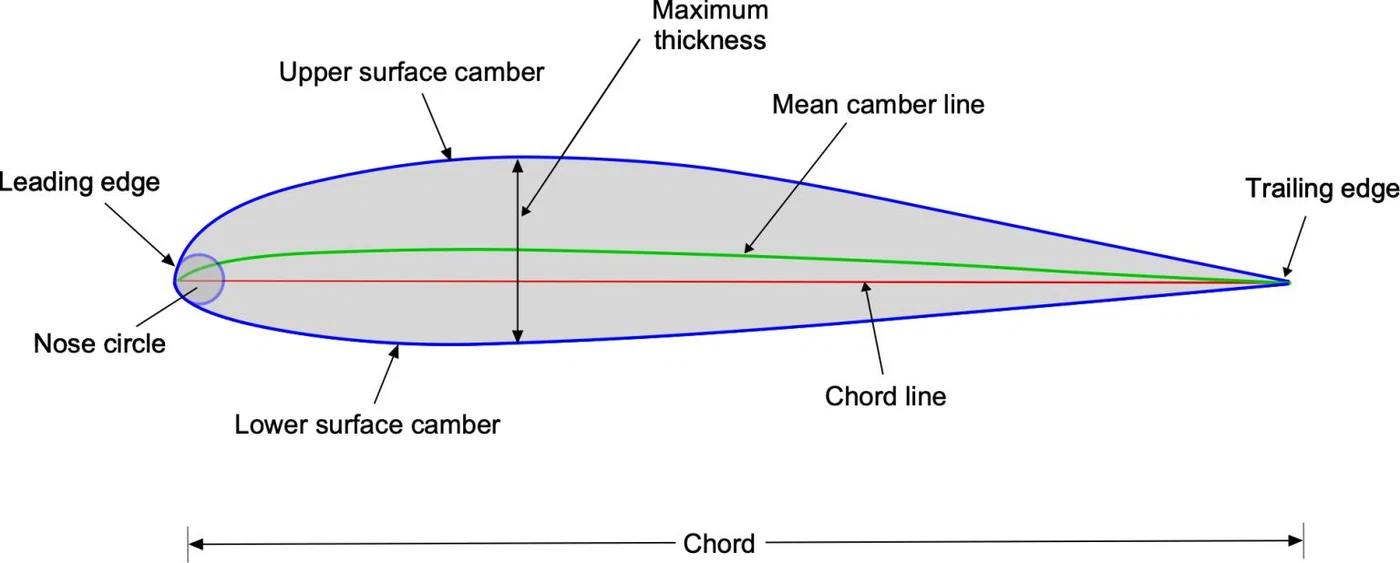 1. Leading Edge
The front edge of an aerofoil that first encounters the airflow.
2. Trailing Edge
The rear edge where the upper and lower surfaces meet.
3. Chord Line
An imaginary straight line joining the leading edge to the trailing edge.
4. Camber
The curvature of the aerofoil relative to its chord line.
5. Upper Surface
The upper boundary of the aerofoil.
6. Lower Surface
The lower boundary of the aerofoil.
Angle of Attack
The angle of attack is the angle between the aerofoil chord line and the relative airflow.
Angle of attack is important because it influences the amount of lift produced.
Increasing angle of attack generally increases lift coefficient up to a certain point.
Beyond the critical angle of attack, airflow separation can cause a substantial reduction in lift.
This condition is known as an aerodynamic stall.
3.3.12 Basic Scientific Principles of Flight
The following scientific principles help explain aerodynamic forces and aircraft movement.
A. Newton's Third Law of Motion
Newton's Third Law states that when one object exerts a force on another, the second exerts an equal and opposite force on the first.
Application in Aviation
A propeller accelerates air backwards, and the corresponding reaction force contributes to forward thrust.
A wing also changes the momentum of airflow, contributing to aerodynamic lift.
B. Bernoulli's Principle
Bernoulli's principle describes a relationship between fluid pressure, speed and elevation under particular flow conditions.
In a simplified steady, incompressible, inviscid flow along a streamline, higher fluid speed can correspond to lower static pressure when elevation is unchanged.
Application to Flight
Pressure differences around an aerofoil contribute to lift.
The complete explanation of lift also involves airflow turning, circulation, momentum change and the aerofoil's angle of attack.
3.3.13 Practical Activity: Demonstrating Newton's Third Law
Objective: To demonstrate action and reaction forces.
Materials
- Balloon.
- Straw.
- String.
- Adhesive tape.
Procedure
- Pass a string through a straw.
- Stretch the string between two secure points.
- Inflate a balloon without tying its opening.
- Attach the balloon to the straw using tape.
- Hold the balloon opening closed.
- Release the opening.
- Observe the balloon's movement.
Observation
The balloon moves in the direction opposite to the escaping air.
Conclusion
The demonstration illustrates Newton's Third Law of Motion.
3.3.14 Practical Activity: Demonstrating the Bernoulli Effect
Objective: To observe the relationship between airflow and pressure in a simple classroom situation.
Materials
- Two lightweight paper strips.
- Suitable air source or controlled blowing.
Procedure
- Hold two paper strips vertically and close together.
- Leave a narrow gap between them.
- Gently blow air through the gap.
- Observe the movement of the strips.
- Discuss the effect of airflow.
Observation
The strips may move towards one another as pressure conditions change.
Conclusion
The demonstration illustrates pressure differences associated with moving air, although the detailed airflow behaviour is more complex than a single simplified principle.
3.3.15 Practical Activity: Demonstrating Aircraft Axes
Objective: To identify aircraft axes and demonstrate pitch, roll and yaw.
Materials
- Model aeroplane.
- Labels.
- Drawing paper.
- Marker pens.
Procedure
- Obtain a model aeroplane.
- Identify the nose, tail and wings.
- Represent the longitudinal axis.
- Represent the lateral axis.
- Represent the vertical axis.
- Rotate the model around the longitudinal axis to demonstrate roll.
- Rotate it around the lateral axis to demonstrate pitch.
- Rotate it around the vertical axis to demonstrate yaw.
- Record the observations.
- Explain the control surfaces associated with each movement.
3.3.16 Practical Activity: Demonstrating Lift and Drag
Objective: To observe how object shape influences movement through air.
Materials
- Paper sheets.
- Cardboard.
- Ruler.
- Lightweight model aeroplane.
- Recording sheet.
Procedure
- Construct two paper gliders with different wing shapes.
- Ensure they have approximately similar mass.
- Release each glider using a consistent method.
- Observe the flight path.
- Measure the distance travelled.
- Repeat several times.
- Record the results.
- Compare the gliders.
- Discuss the possible influence of wing shape, lift, drag and stability.
Conclusion
Differences in shape, mass distribution and launching conditions can affect glider flight performance.
Revision Exercise 3.3
- Define aerodynamics.
- State six benefits of studying aerodynamics.
- Explain the meaning of the atmosphere.
- Identify the main gases present in dry air.
- State four physical properties of the atmosphere.
- Explain the factors influencing air density.
- Differentiate between the troposphere and stratosphere.
- State five characteristics of the troposphere.
- Explain the importance of the stratosphere in aviation.
- Define the International Standard Atmosphere.
- State the standard sea-level temperature and pressure.
- Identify the three axes of an aircraft.
- Differentiate between pitch, roll and yaw.
- Draw a diagram showing the three aircraft axes.
- Identify the four main forces acting on an aircraft.
- Define lift, weight, thrust and drag.
- Explain four factors affecting lift.
- Differentiate between parasite drag and induced drag.
- State six advantages of streamlining.
- Define an aerofoil.
- Draw and label the main parts of an aerofoil.
- Explain the meaning of angle of attack.
- Describe the effect of an aerodynamic stall.
- Explain Newton's Third Law using an aviation example.
- Describe a classroom activity that demonstrates action and reaction forces.
END OF STRAND 3.0: REVISION AND ASSESSMENT
A. Summary of Main Concepts
|
Sub-strand |
Key concepts |
Skills developed |
|---|---|---|
|
3.1 Aviation Weather |
Wind, temperature, pressure, humidity, clouds, precipitation and weather hazards |
Measuring weather elements, observing clouds and interpreting weather effects |
|
3.2 Aviation Communication |
ICAO phonetics, numerals, standard phrases, radio transmission and marshalling |
Pronunciation, communication role-play and simulated marshalling |
|
3.3 Aerodynamics of Flight |
Atmospheric properties, atmospheric layers, aircraft axes and aerodynamic forces |
Identifying axes, demonstrating aircraft motion and conducting basic experiments |
B. End-of-Strand Structured Assessment
Question 1: Aviation Weather
a) Define aviation meteorology.
b) Explain the effects of wind, temperature, pressure and humidity on aircraft operations.
c) Compare cirrus, stratus and cumulus clouds.
d) Describe how four weather elements can be measured.
Question 2: Aviation Communication
a) Explain the importance of ICAO phonetics.
b) Write the ICAO spelling alphabet for the word AVIATION.
c) Explain six standard words used in aviation communication.
d) Describe the importance of aircraft marshalling.
Question 3: Aerodynamics of Flight
a) State four physical properties of the atmosphere.
b) Differentiate between the troposphere and stratosphere.
c) Draw and label the three axes of an aircraft.
d) Explain the four forces acting on an aircraft.
e) Describe the importance of aerodynamic forces during flight.
C. Suggested Competency-Based Assessment Rubric
|
Assessment indicator |
Exceeds expectations |
Meets expectations |
Approaches expectations |
Below expectations |
|---|---|---|---|---|
|
Describing weather effects |
Gives detailed explanations with relevant examples |
Correctly describes the main effects |
Describes some effects |
Needs considerable guidance |
|
Interpreting aviation phrases |
Accurately interprets phrases in varied situations |
Correctly interprets standard phrases |
Interprets some phrases |
Requires assistance |
|
Demonstrating marshalling signals |
Demonstrates approved signals accurately and confidently |
Demonstrates the required signals |
Demonstrates some signals with errors |
Needs guided practice |
|
Explaining aircraft axes |
Accurately relates all axes to aircraft motion |
Correctly identifies axes and movements |
Identifies some axes |
Requires assistance |
|
Explaining aerodynamic forces |
Gives clear explanations and practical applications |
Correctly explains the four forces |
Explains some forces |
Needs considerable assistance |
Key Inquiry Questions
- Why is the study of aviation weather important?
- How does weather affect flight?
- What is the importance of communication in aviation?
- How does aviation communication influence flight operations?
- How does an aircraft fly?
- Why is science important to flight?