
Suggested duration in the detailed curriculum: 18 lessons. The summary gives 22 lessons.
2.2.1 Meaning of Transport in Plants
Transport is the movement of substances from one part of an organism to another.
Plants transport water, mineral ions, sugars and other substances between their roots, stems, leaves and growing regions.
Unlike animals, plants do not possess a heart or blood circulatory system.
Their transport processes depend on vascular tissues, water-potential gradients, pressure differences and other physical and biological mechanisms.
Importance of Transport
- Supplies water to photosynthetic tissues.
- Distributes mineral nutrients.
- Moves manufactured food to growing and storage organs.
- Supports cell turgidity.
- Supplies materials needed for growth.
- Helps distribute certain chemical signals.
2.2.2 External Structures Involved in Transport
A. Roots
Roots anchor plants and absorb water and mineral nutrients.
Adaptations:
- Numerous branches increase the volume of soil explored.
- Root hairs increase absorptive surface area.
- Thin root-hair walls support water movement.
- Transport proteins facilitate uptake of mineral ions.
- Xylem carries water and dissolved minerals towards the shoot.
B. Stems
Stems support leaves, flowers and fruits and contain vascular tissues.
They provide pathways for water, mineral ions and organic substances.
C. Leaves
Leaves are major sites of photosynthesis and transpiration.
Their vascular bundles supply water and minerals and transport photosynthetic products.
2.2.3 Vascular Tissues
Plants contain two major vascular tissues:
- Xylem.
- Phloem.
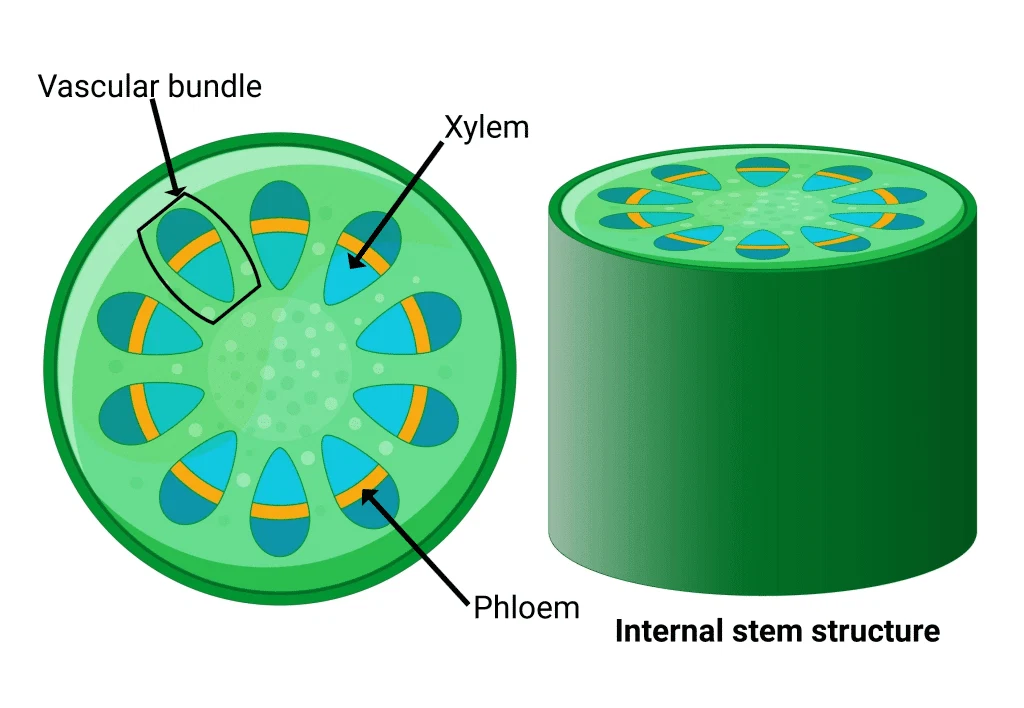
A. Xylem
Xylem transports water and dissolved mineral ions, predominantly from roots towards aerial parts of plants.
It also provides mechanical support.
Components of Xylem
Vessel elements: Cells joined end to end, forming continuous conducting vessels in many flowering plants.
Tracheids: Elongated conducting cells with pits through which water moves.
Xylem fibres: Provide mechanical support.
Xylem parenchyma: Living cells involved in storage and other functions.
Adaptations of Xylem
- Vessel elements are dead at maturity.
- Conducting cells have hollow interiors that reduce resistance to water movement.
- Lignified walls provide strength.
- Pits permit lateral movement of water.
- Vessel elements may form long continuous tubes.
B. Phloem
Phloem transports sugars and other organic substances from sources to sinks.
A source is a region that supplies transportable organic compounds, such as a mature photosynthesising leaf.
A sink is a region that consumes or stores these compounds, such as a growing root, fruit or developing seed.
Components of Phloem
Sieve-tube elements: Living conducting cells that lack a nucleus at maturity.
Companion cells: Metabolically active cells that support sieve-tube elements.
Phloem parenchyma: Involved in storage and lateral transport.
Phloem fibres: Provide mechanical support.
Differences Between Xylem and Phloem
|
Feature |
Xylem |
Phloem |
|---|---|---|
|
Main substances |
Water and mineral ions |
Sugars and other organic solutes |
|
Direction |
Predominantly upward |
Source to sink; can be upward or downward |
|
Conducting cells |
Dead at maturity |
Living at maturity |
|
Wall characteristics |
Often lignified |
Generally not heavily lignified |
|
Energy requirement |
Bulk water movement is largely passive |
Loading and unloading may require metabolic energy |
|
Main role |
Water transport and support |
Distribution of organic nutrients |
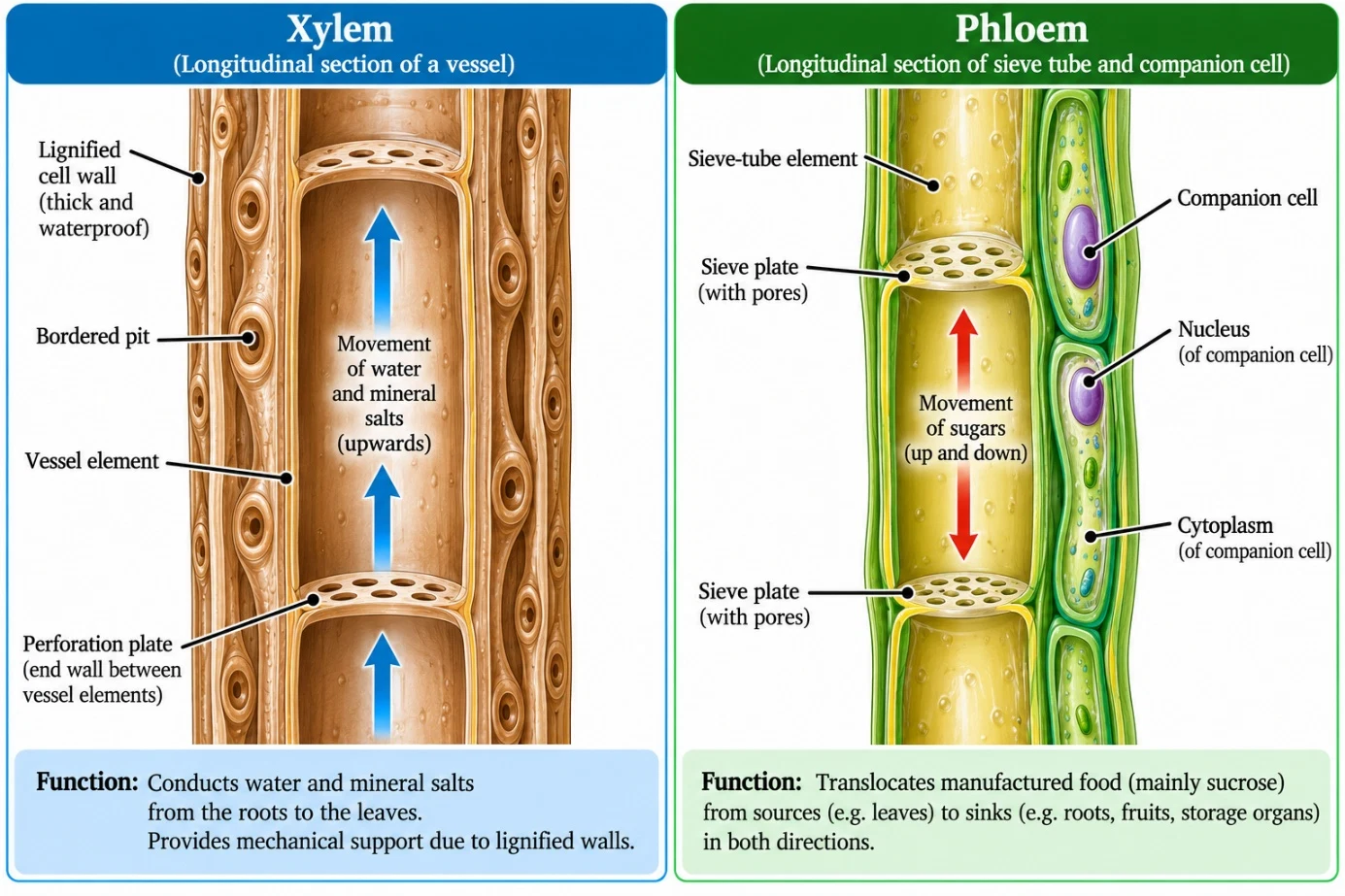
Figure 16: Structural differences between xylem and phloem.
2.2.4 Arrangement of Vascular Tissues in Roots and Stems
The arrangement of xylem and phloem differs between monocotyledonous and dicotyledonous plants.
A. Dicotyledonous Root
A typical young dicot root has centrally located, star-shaped xylem, with phloem positioned between the xylem arms.
B. Monocotyledonous Root
A typical monocot root has xylem and phloem arranged around a central pith.
C. Dicotyledonous Stem
Vascular bundles are commonly arranged in a ring.
The xylem lies towards the inside of each bundle, while the phloem lies towards the outside.
D. Monocotyledonous Stem
Vascular bundles are commonly scattered throughout the ground tissue.
Comparison
|
Feature |
Typical dicot stem |
Typical monocot stem |
|---|---|---|
|
Vascular bundles |
Arranged in a ring |
Scattered |
|
Vascular cambium |
Commonly present |
Usually absent |
|
Secondary thickening |
Common in many species |
Usually limited or absent |
|
Ground tissue |
Cortex and pith often distinguishable |
Often less clearly differentiated |
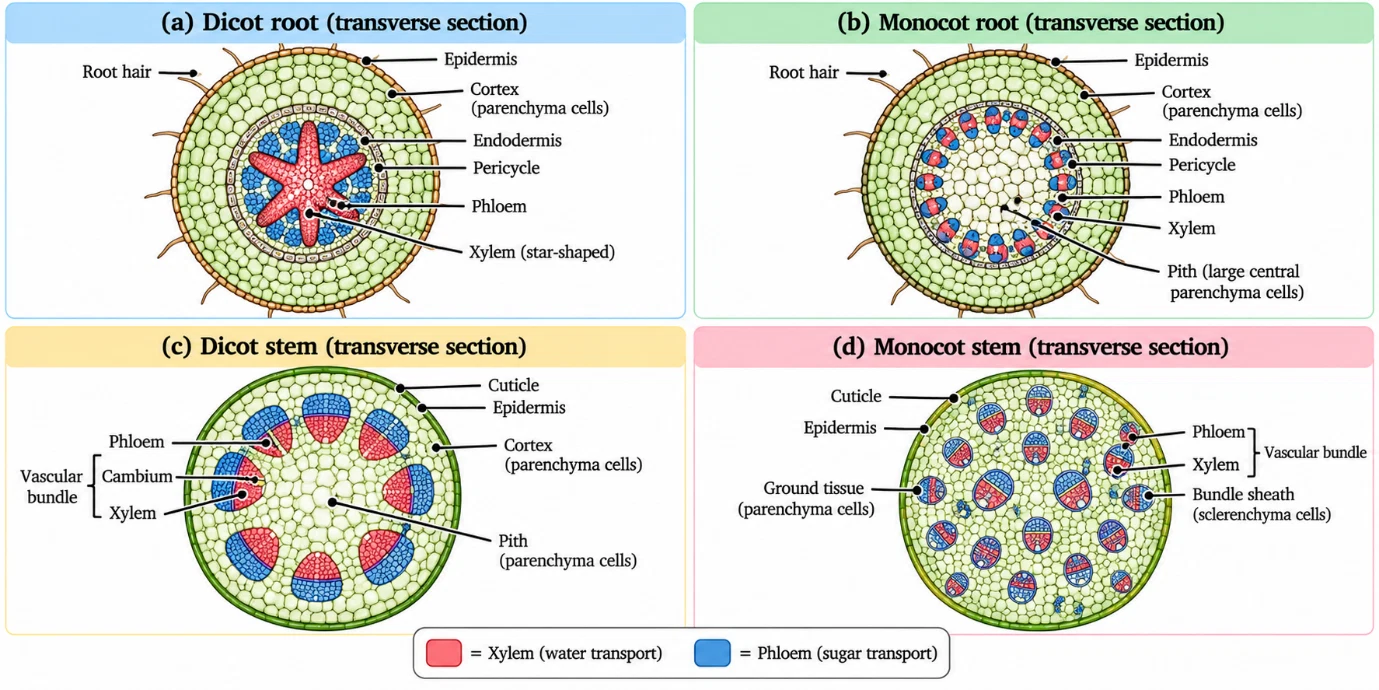
Figure 17: Arrangement of vascular tissues in typical monocot and dicot roots and stems.
2.2.5 Absorption of Water by Roots
Water is mainly absorbed by young root regions, especially through root hairs.
Water enters root hair cells by osmosis.
Osmosis
Osmosis is the net movement of water through a selectively permeable membrane from a region of higher water potential to a region of lower water potential.
Movement of Water Through the Root
Water may travel through root tissues by different pathways.
- Apoplast pathway: Water moves through cell walls and intercellular spaces.
- Symplast pathway: Water moves through cytoplasm connected by plasmodesmata.
- Transmembrane pathway: Water repeatedly crosses cell membranes and cell interiors.
The Casparian strip in the endodermis restricts apoplastic movement, helping regulate entry of substances into the vascular cylinder.
Absorption of Mineral Ions
Mineral ions may enter root cells through passive transport or energy-dependent active transport.
The mechanism depends on the ion, concentration gradients and transport proteins involved.
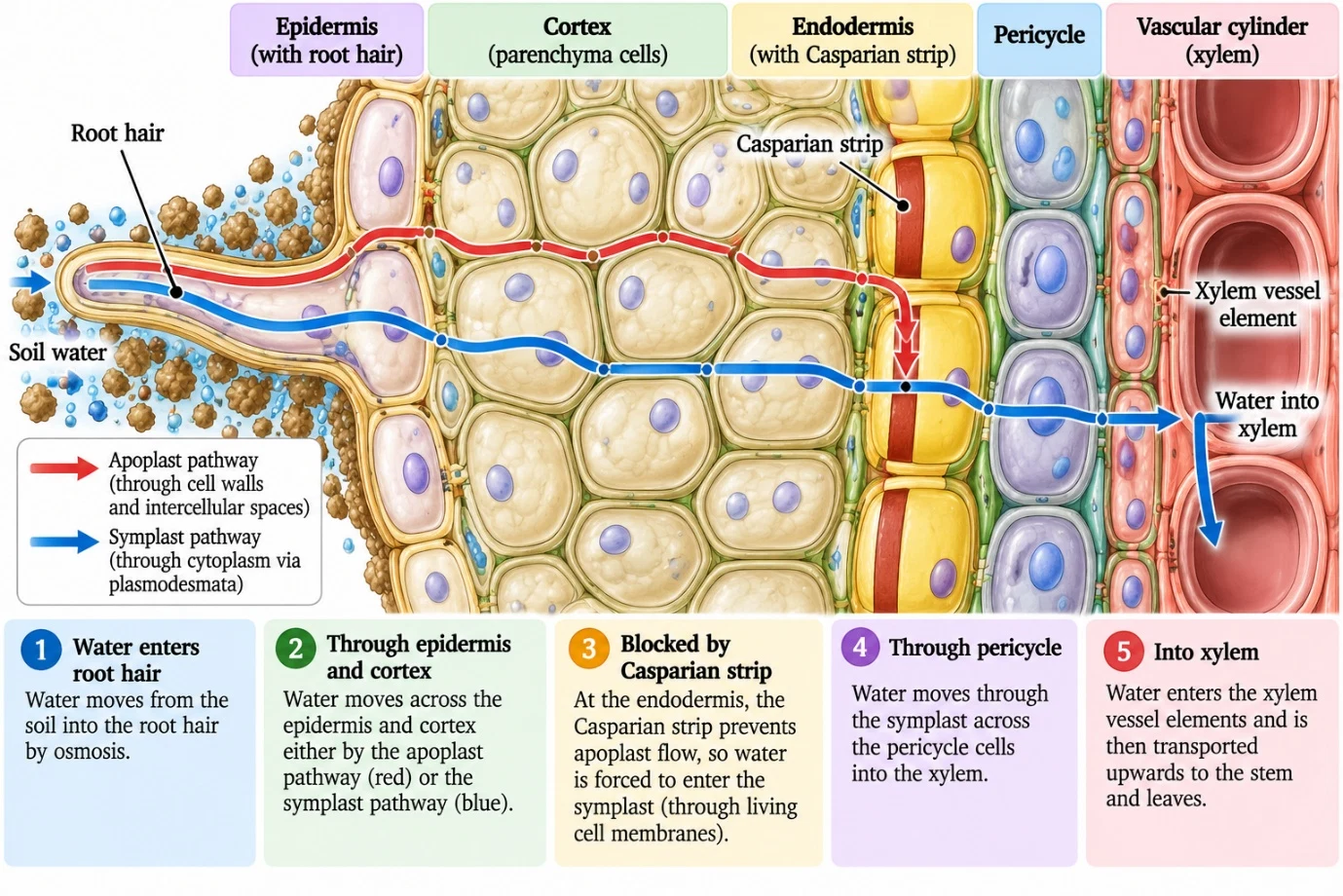
Figure 18: Pathways of water movement from the soil into root xylem.
2.2.6 Ascent of Sap
The ascent of sap is the upward movement of water and dissolved mineral ions through xylem from the roots towards the shoots.
Cohesion–Tension Mechanism
The cohesion–tension mechanism is the principal explanation for water movement through xylem in many vascular plants.
Main Stages
- Water evaporates from moist cell-wall surfaces inside the leaf.
- Water vapour diffuses towards the atmosphere.
- Evaporation lowers water potential in leaf tissues.
- Tension develops in the xylem water column.
- Cohesion between water molecules helps maintain a continuous column.
- The tension pulls water upwards from the roots.
Other Contributing Factors
Adhesion: Attraction between water and xylem walls helps stabilise the water column.
Root pressure: Positive pressure generated in some roots may contribute to water movement under certain conditions, but it is insufficient to explain water transport in tall trees.
Capillarity: Contributes to water movement in narrow spaces but cannot alone explain ascent in tall plants.
2.2.7 Transpiration
Transpiration is the loss of water vapour from aerial parts of plants, mainly through stomata.
Types of Transpiration
- Stomatal transpiration: Water vapour escapes through stomata.
- Cuticular transpiration: Water vapour passes through the cuticle.
- Lenticular transpiration: Water vapour may escape through lenticels in woody stems.
Importance of Transpiration
- Helps maintain the upward movement of water.
- Supports transport of mineral nutrients.
- Contributes to evaporative cooling.
- Influences plant water balance.
Factors Affecting Transpiration
|
Factor |
Typical effect |
|---|---|
|
Increased temperature |
Often increases evaporation and transpiration |
|
Increased wind speed |
Often increases transpiration by removing humid air near leaves |
|
Increased relative humidity |
Usually reduces transpiration |
|
Increased light intensity |
Often increases transpiration by promoting stomatal opening |
|
Low soil-water availability |
Often reduces transpiration through stomatal closure |
|
Larger exposed leaf area |
Can increase total water loss |
|
Thick waxy cuticle |
Reduces cuticular water loss |
These are general trends; actual responses depend on plant species and environmental conditions.
Experiment: Demonstrating Transpiration
Aim: To demonstrate water loss from leaves.
Materials: A healthy potted plant, transparent polythene bag and string.
Procedure:
- Water the plant appropriately.
- Enclose a leafy shoot in a clean, transparent polythene bag.
- Tie the bag loosely around the stem without damaging it.
- Leave the plant in suitable light for a period.
- Observe the inner surface of the bag.
Observation: Water droplets may collect inside the bag.
Explanation: Water vapour released by the leaves condenses on the bag.
Control: A similar empty bag placed nearby helps demonstrate that the droplets are associated with the enclosed shoot.
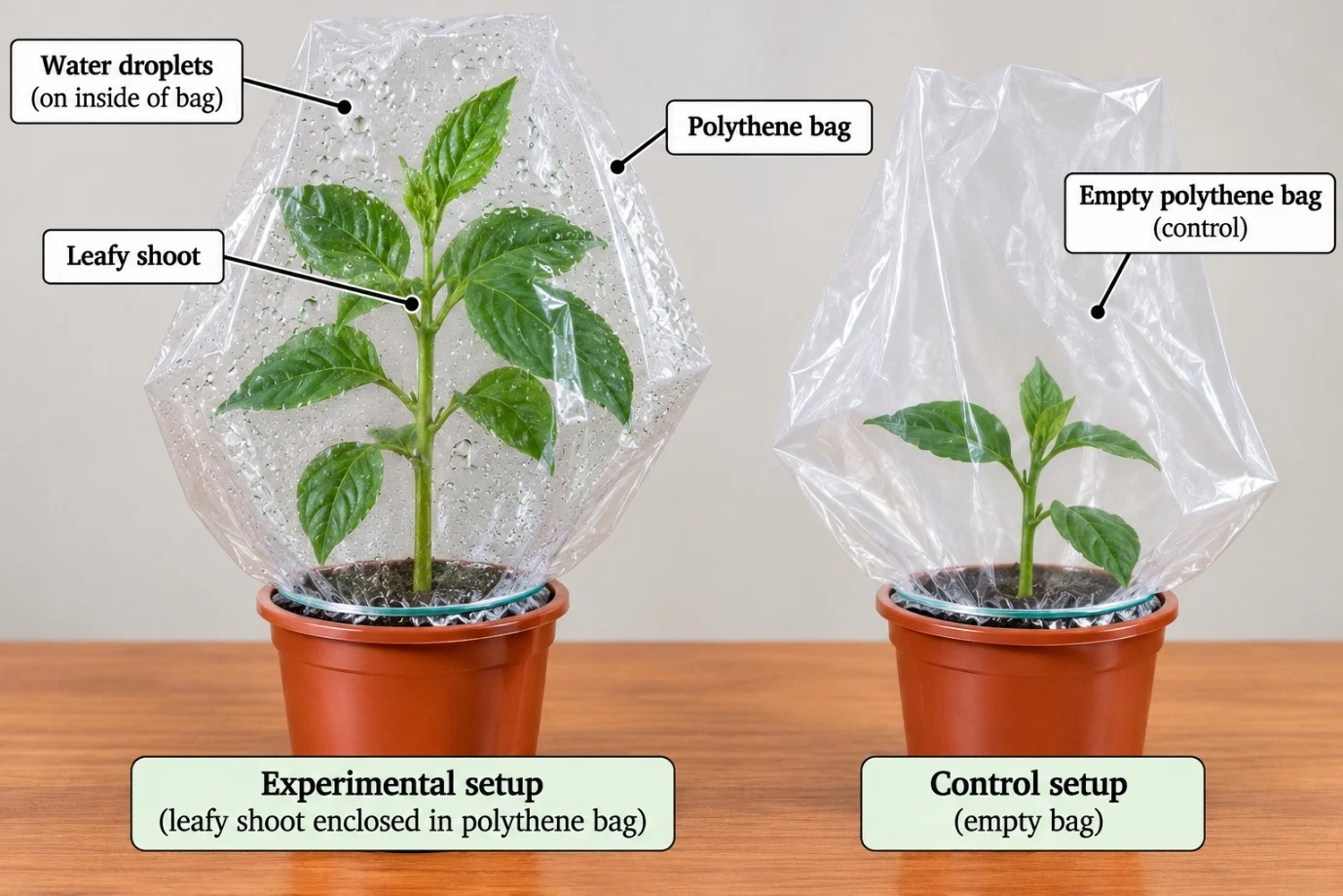
Figure 19: Demonstration of water loss through transpiration.
Measuring Transpiration with a Potometer
A potometer estimates the rate of water uptake by a cut shoot, which may approximate transpiration rate under suitable conditions.
It does not directly measure water vapour lost.
A bubble potometer uses movement of an air bubble along a capillary tube to estimate water uptake.
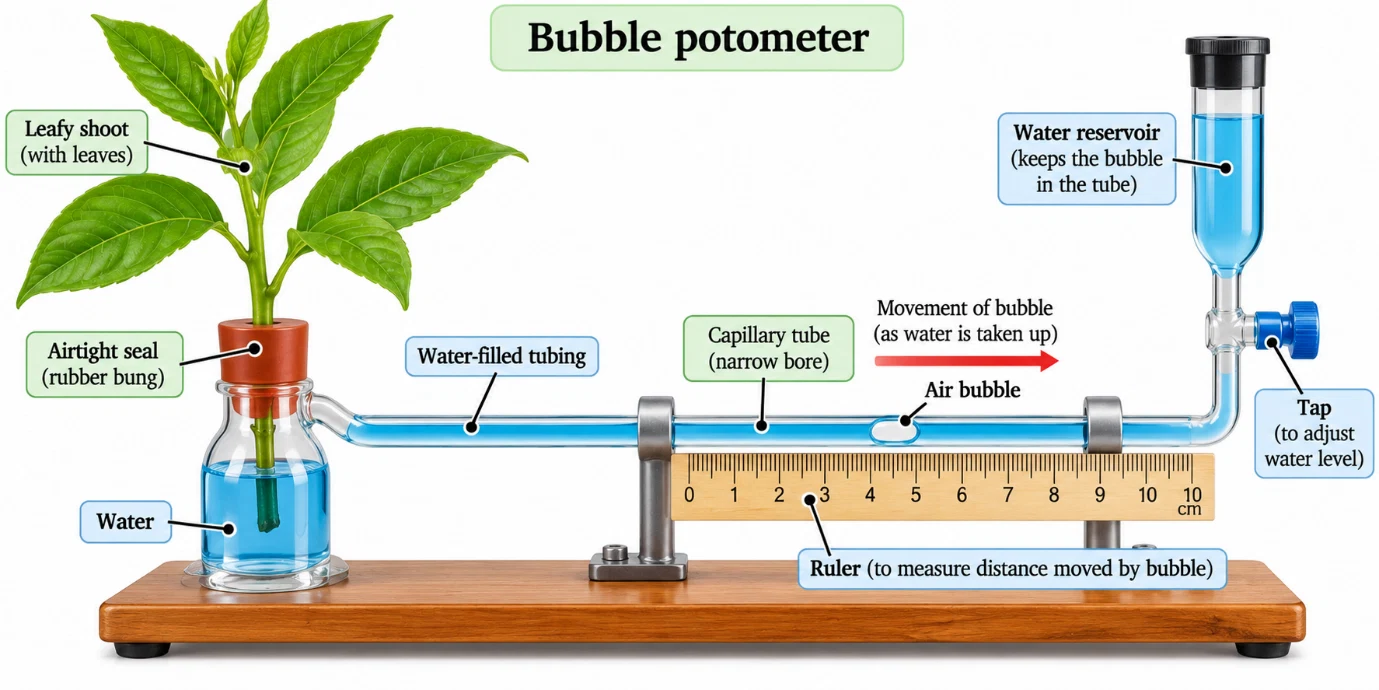
Figure 20: A bubble potometer used to estimate the rate of water uptake.
2.2.8 Translocation of Manufactured Food
Translocation is the transport of organic substances, particularly sucrose, through the phloem from sources to sinks.
Pressure-Flow Hypothesis
The pressure-flow hypothesis explains phloem transport through differences in hydrostatic pressure.
Main Stages
- Sucrose is loaded into phloem at a source.
- Water enters the sieve tubes by osmosis.
- Hydrostatic pressure increases at the source.
- Phloem sap moves towards regions of lower pressure.
- Sucrose is unloaded at the sink.
- Water may move out of the phloem.
Evidence from Bark Ringing
In many woody plants, the phloem is located near the outer part of the stem.
Removing a complete ring of bark containing phloem interrupts downward translocation through that region.
Sugars may accumulate above the ring, leading to swelling.
Environmental precaution: Bark ringing can severely damage or kill a tree. Learners should study teacher-provided photographs, diagrams or suitable demonstrations rather than girdling living trees unnecessarily.
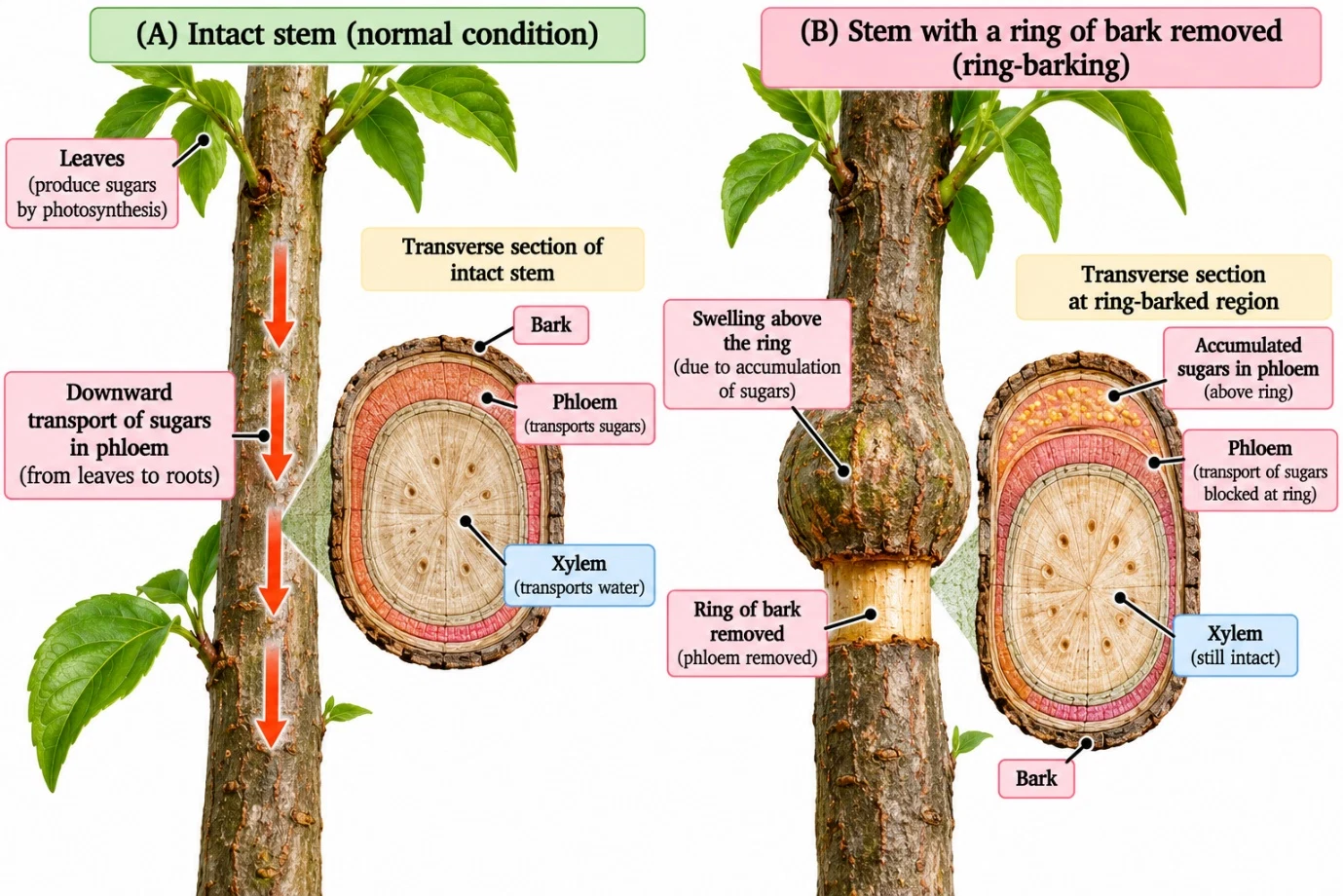
Figure 21: Diagrammatic evidence of phloem translocation from a bark-ringing investigation.
Revision Questions
- Define transport in plants.
- Differentiate between xylem and phloem.
- Describe four adaptations of xylem vessels.
- Explain the arrangement of vascular tissues in a dicot stem.
- Define osmosis.
- Describe the movement of water through a root.
- Explain the cohesion–tension mechanism.
- Define transpiration.
- Describe five factors affecting transpiration.
- Explain the principle of a potometer.
- Define translocation.
- Describe the pressure-flow hypothesis.
- Explain how bark ringing provides evidence for phloem transport.
- State precautions required when carrying out transport experiments.