
Suggested duration: 20 lessons
Specific Learning Outcomes
The learner should be able to examine factors influencing mineral occurrence and exploitation, describe mineral extraction methods, explore limestone mining in Kenya, diamond mining in Botswana and iron ore mining in Australia, analyse environmental effects, apply statistical skills to mineral-production trends in East Africa and recognise the importance of minerals to Kenya's economy.
3.2.1 Meaning of Minerals
A mineral is a naturally occurring inorganic solid with a characteristic chemical composition and an ordered internal structure, subject to some recognised geological exceptions.
Examples include quartz, calcite, gypsum, halite and hematite.
3.2.2 Meaning of Mining
Mining is the extraction of economically valuable minerals or other geological materials from the Earth's crust.
Mining may take place on the surface or underground, depending on the nature and location of the deposit.
3.2.3 Factors Influencing the Occurrence of Minerals
Mineral occurrence depends mainly on geological processes.
These include:
Magmatic processes: Minerals may crystallise from magma or become concentrated during magmatic activity.
Sedimentary processes: Minerals may accumulate through deposition, evaporation or chemical precipitation.
Metamorphic processes: Heat, pressure and fluids may transform existing minerals or contribute to mineral concentration.
Hydrothermal processes: Hot mineral-rich fluids may deposit minerals in cracks and other geological structures.
Weathering and erosion: These processes may concentrate resistant minerals in placer deposits or produce residual mineral deposits.
3.2.4 Factors Influencing Mineral Exploitation
|
Factor |
Influence |
|---|---|
|
Quantity and grade |
Rich, extensive deposits are often more attractive |
|
Accessibility |
Accessible deposits may be cheaper to exploit |
|
Technology |
Determines which deposits can be extracted economically |
|
Capital |
Needed for equipment and infrastructure |
|
Labour |
Skilled and unskilled workers support operations |
|
Transport |
Moves machinery and minerals |
|
Energy |
Powers extraction and processing |
|
Market demand |
Influences commercial viability |
|
Government policy |
Determines licensing and regulatory requirements |
|
Environmental obligations |
Affect operating methods and costs |
|
Security and stability |
Influence investment and continuity |
3.2.5 Methods of Mineral Extraction
A. Open-Cast Mining
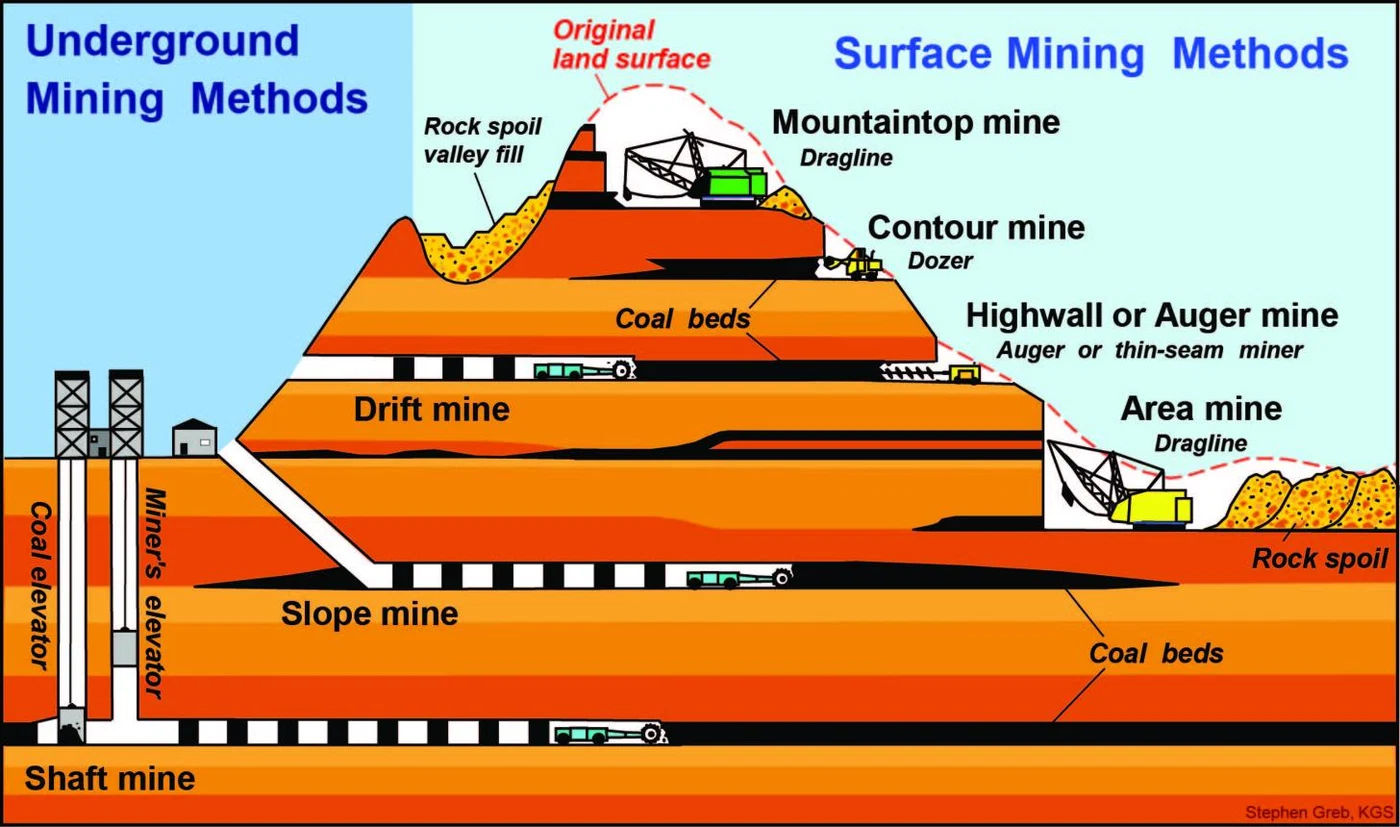
Open-cast mining involves removing surface materials to expose mineral deposits close to the surface.
It is commonly used for some coal, limestone and metal-ore deposits.
B. Underground Mining
Underground mining involves accessing deposits through shafts, tunnels and galleries.
It is suitable for some deep mineral deposits.
C. Quarrying
Quarrying involves extracting stone and other construction materials from surface excavations.
Examples include limestone, granite and building stone.
D. Placer Mining
Placer mining involves recovering valuable minerals from loose sediments, often in riverbeds or alluvial deposits.
E. Solution Mining
Solution mining involves dissolving suitable mineral deposits and recovering the dissolved materials.
3.2.6 Comparison of Mining Methods
|
Method |
Suitable deposits |
Main challenge |
|---|---|---|
|
Open-cast |
Relatively shallow deposits |
Major surface disturbance |
|
Underground |
Deep deposits |
High costs and safety risks |
|
Quarrying |
Stone and construction materials |
Dust, noise and landscape damage |
|
Placer |
Minerals in loose sediments |
Sediment and water disturbance |
|
Solution mining |
Soluble mineral deposits |
Potential groundwater impacts |
Suggested Figure 3.3: Methods of Mineral Extraction
uky.edu
Image type: Three-panel educational illustration. Required labels: Open-Cast Mining, Underground Mining, Quarrying, Mineral Deposit, Overburden, Shaft. Placement: After the comparison table.
3.2.7 Limestone Mining in Kenya
Limestone is a sedimentary rock composed mainly of calcium carbonate.
It is an important raw material in cement manufacturing.
Areas Associated with Limestone Deposits
Limestone and related carbonate deposits occur in parts of Kenya's coastal region and other sedimentary or carbonate-bearing geological areas.
The Athi River area is particularly associated with cement production, although cement factories may obtain raw materials from quarries located elsewhere.
Extraction and Processing
- Geological exploration identifies suitable deposits.
- Overburden is removed where necessary.
- Limestone is extracted through quarrying.
- Large rock pieces are crushed.
- Material is transported for processing.
- Limestone is used in cement production and other industries.
Uses of Limestone
- Cement manufacturing.
- Production of lime.
- Construction materials.
- Soil acidity correction where suitable.
- Industrial chemical processes.
3.2.8 Diamond Mining in Botswana
Botswana is internationally recognised for diamond mining.
Major diamond-producing areas include Orapa and Jwaneng.
Diamond mining in Botswana provides an important case study of mineral exploitation and national economic development.
Characteristics
- Diamonds are extracted from diamond-bearing geological deposits.
- Large-scale mining requires advanced equipment and substantial investment.
- Extracted material undergoes processing to recover diamonds.
- Diamonds are sorted and valued before sale.
Economic Importance
Diamond mining contributes to export earnings, government revenue, employment and infrastructure development.
Challenges
The industry faces exposure to changes in global diamond demand, high operating costs, environmental management requirements and the need for economic diversification.
3.2.9 Iron Ore Mining in Australia
Iron ore is a mineral resource used mainly in iron and steel production.
Australia is a major iron ore producer, with extensive deposits in Western Australia, particularly the Pilbara region.
Mining Process
- Exploration and resource assessment.
- Mine planning.
- Removal of overburden where required.
- Extraction of iron-bearing ore.
- Crushing, screening and processing.
- Transportation, often by rail.
- Export or further industrial use.
Importance
Iron ore mining supports employment, export earnings, infrastructure development and the supply of raw materials to the steel industry.
3.2.10 Comparison of the Three Mining Case Studies
|
Country |
Mineral |
Main extraction approach |
Major economic use |
|---|---|---|---|
|
Kenya |
Limestone |
Quarrying |
Cement and lime production |
|
Botswana |
Diamond |
Open-pit and underground methods, depending on mine |
Gemstone industry and exports |
|
Australia |
Iron ore |
Mainly large-scale surface mining |
Steel production and exports |
3.2.11 Environmental Effects of Mining
Land degradation: Excavations alter landscapes and may leave unstable ground.
Deforestation: Vegetation may be removed during mining development.
Water pollution: Sediments, chemicals and mine drainage can contaminate water.
Air pollution: Dust and emissions may affect air quality.
Noise and vibration: Machinery and blasting may disturb nearby communities.
Loss of biodiversity: Mining may damage habitats.
Waste accumulation: Waste rock and tailings require safe management.
3.2.12 Solutions to Environmental Problems Caused by Mining
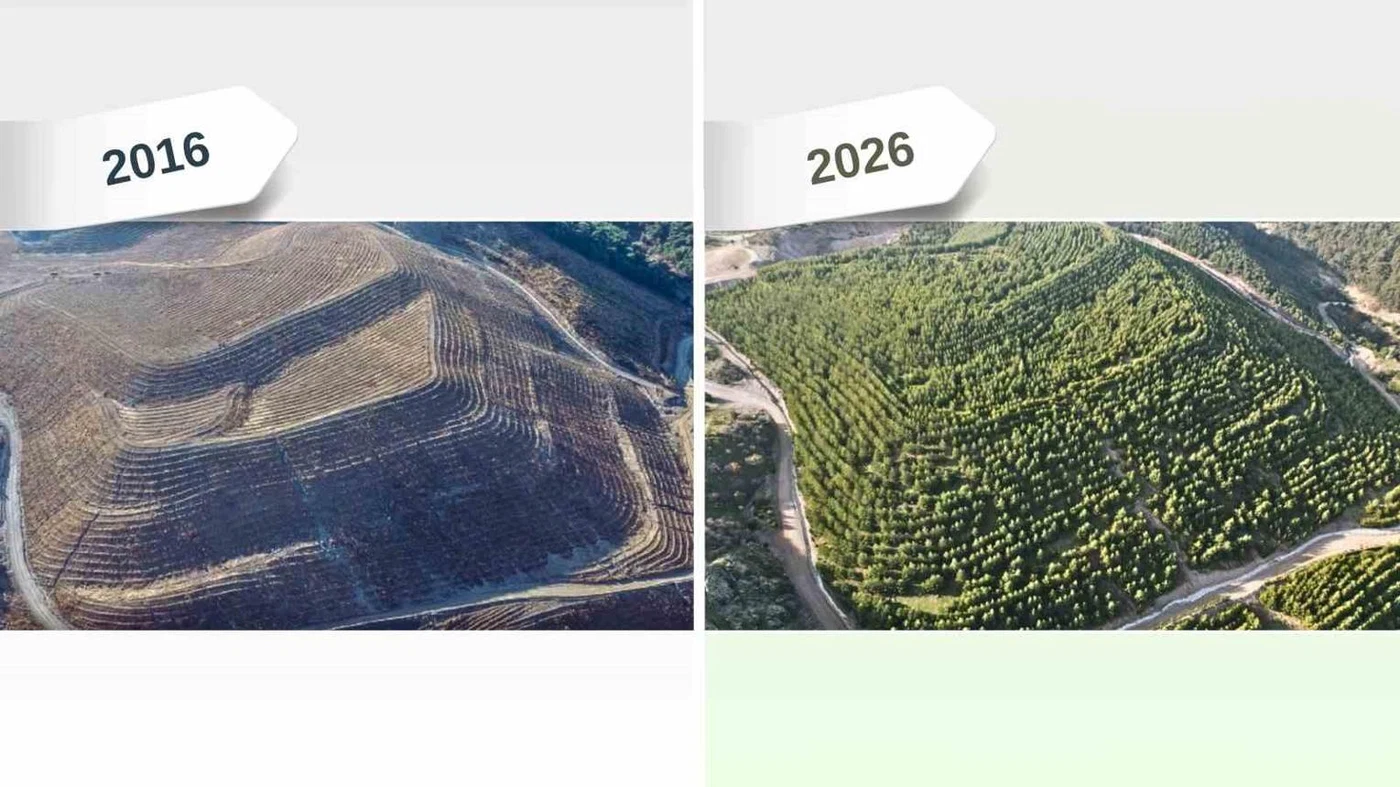
- Rehabilitate exhausted mining sites.
- Replant suitable vegetation.
- Treat contaminated water.
- Control dust emissions.
- Manage mine waste safely.
- Conduct environmental impact assessments.
- Monitor environmental conditions.
- Restore or repurpose excavated land where safe.
- Engage affected communities.
- Enforce environmental and occupational safety requirements.
Suggested Figure 3.4: Mine Rehabilitation
pusuhaber.com.tr
Image type: Two-panel photorealistic illustration. Required labels: Degraded Mining Site, Rehabilitated Mining Site, Re-vegetation, Slope Stabilisation. Placement: After environmental management.
3.2.13 Statistical Analysis of Mineral Production
Statistical information can be used to investigate mineral-production trends in East Africa.
Illustrative dataset only — not actual national production figures
|
Year |
Mineral production (thousand tonnes) |
|---|---|
|
2021 |
120 |
|
2022 |
135 |
|
2023 |
150 |
|
2024 |
140 |
|
2025 |
165 |
Illustrative mineral production trend
Practice data, not official East African production statistics
0 thousand tonnes45 thousand tonnes90 thousand tonnes135 thousand tonnes180 thousand tonnes20212022202320242025
Interpretation: Production generally increased over the five-year period, although it declined between 2023 and 2024.
3.2.14 Significance of Minerals to Kenya's Economy
Minerals support industrial raw-material supply, employment, government revenue, exports, infrastructure development and economic diversification.
However, their contribution depends on responsible extraction, effective governance and appropriate environmental management.
Practical Activity 3.2
Project: Sustainable Mining Awareness Campaign
Prepare an educational poster explaining the effects of mining on the environment and the importance of rehabilitating exhausted mining sites.
Include practical solutions and examples from Kenya.
Revision Questions and Direct Answers
1. Define mining.
The extraction of economically valuable minerals or geological materials from the Earth's crust.
2. Name four methods of mineral extraction.
Open-cast mining, underground mining, quarrying and placer mining.
3. Name the minerals studied in Kenya, Botswana and Australia.
Limestone in Kenya, diamonds in Botswana and iron ore in Australia.
4. State four factors influencing mineral exploitation.
Mineral quantity, technology, capital and market demand.
5. Give four environmental effects of mining.
Land degradation, water pollution, air pollution and habitat destruction.
6. What is mine rehabilitation?
The process of restoring or stabilising land disturbed by mining.