
1. Introduction to leadership
Leadership is the ability to guide, direct and influence people towards achieving a common goal.
A leader is a person who has been given or accepted responsibility for guiding others.
Leadership is important in families, schools, churches, communities and countries.
In the Bible, God chose different people to guide His people.
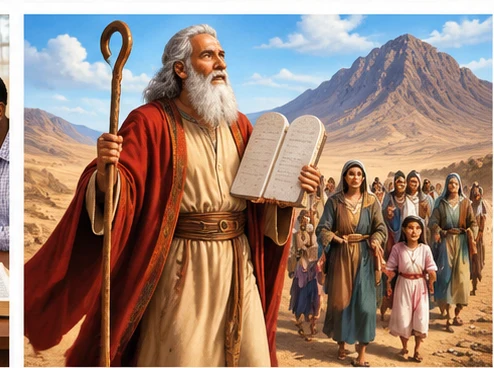
Moses is remembered for leading the Israelites and receiving God's commandments.
One important biblical leader was Moses, whom God chose to lead the Israelites out of slavery in Egypt.
Moses demonstrated important leadership qualities such as courage, obedience, patience, humility and faith in God.
2. Meaning of important terms
Leadership: The ability to guide and influence others towards achieving a common purpose.
Leader: A person entrusted with the responsibility of directing others.
Integrity: The quality of being honest and having strong moral principles.
Courage: The ability to face difficult situations without giving in to fear.
Obedience: Following rightful instructions.
Delegation: Assigning duties and responsibilities to other people.
Exodus: The departure of the Israelites from slavery in Egypt under the leadership of Moses.
Pharaoh: The title used for the rulers of ancient Egypt.
3. Early life of Moses
The birth and early life of Moses are recorded in Exodus 2.
During the time of Moses' birth, the Israelites were living in Egypt.
A new Pharaoh had become concerned about the increasing population of the Israelites.
He feared that they might become powerful and threaten the security of Egypt.
Pharaoh therefore ordered that Hebrew baby boys should be killed.
Moses was born during this difficult period.
His parents were Amram and Jochebed, from the tribe of Levi.
They hid him for three months to protect him from Pharaoh's order.
When they could no longer hide him, his mother placed him in a basket made of papyrus and coated it with tar and pitch.
She placed the basket among the reeds along the River Nile.
Moses' sister watched from a distance to see what would happen.
Pharaoh's daughter went to the river and discovered the baby.
She felt sorry for him and decided to adopt him.
Moses' sister approached her and offered to find a Hebrew woman to nurse the baby.
She brought Moses' mother, who was allowed to take care of him during his early childhood.
Later, Moses was taken to Pharaoh's daughter and raised as her son.
He was given the name Moses because he had been drawn out of the water.
4. How God prepared Moses for leadership
God prepared Moses for leadership through different experiences.
A. Moses was raised in Pharaoh's palace
Moses grew up in the Egyptian royal household.
This exposed him to leadership, administration and the activities of government.
He acquired knowledge and experience that would later help him lead the Israelites.
B. Moses learned about his Hebrew identity
Although Moses was raised in Pharaoh's palace, he knew that he belonged to the Hebrew people.
This helped him identify with the suffering of the Israelites.
C. Moses demonstrated concern for the oppressed
One day, Moses saw an Egyptian beating a Hebrew man.
He became angry and killed the Egyptian.
When Pharaoh learned about the incident, Moses feared for his life and fled from Egypt.
This experience exposed him to the suffering of his people.
D. Moses settled in Midian
Moses travelled to Midian, where he met the daughters of a priest called Reuel or Jethro.
He helped them when other shepherds were mistreating them at a well.
Moses was later welcomed into the family and married Zipporah.
He worked as a shepherd.
E. Moses gained experience as a shepherd
While in Midian, Moses looked after the flocks of his father-in-law.
This helped him develop patience, responsibility and care.
These qualities were important for leading a large group of people.
F. Moses encountered God at the burning bush
One day, Moses was tending the flock near Mount Horeb.
He saw a bush that was burning but was not being consumed by the fire.
God called him from the bush and instructed him to remove his sandals because the place was holy.
God revealed that He had seen the suffering of the Israelites in Egypt and had heard their cries.
God then chose Moses to lead them out of slavery.
G. God assured Moses of His presence
Moses was afraid and felt unqualified for the task.
God assured him that He would be with him.
God also revealed His name and gave him instructions about returning to Egypt.
H. God provided Aaron as a helper
Moses was concerned that he was not a good speaker.
God appointed his brother Aaron to assist him in communicating with Pharaoh and the Israelites.
This showed Moses that leaders can work with other people to accomplish their responsibilities.
5. The calling of Moses
The calling of Moses is recorded in Exodus 3 and 4.
God called Moses while he was tending sheep in Midian.
He instructed him to return to Egypt and lead the Israelites out of slavery.
Moses initially raised several concerns.
A. Moses questioned his ability
He wondered why God had chosen him for such a difficult task.
God assured him of His presence.
B. Moses asked about God's name
God revealed Himself as "I AM WHO I AM."
This demonstrated God's eternal existence and authority.
C. Moses feared that the Israelites would not believe him
God gave him signs to demonstrate that he had been sent by Him.
D. Moses was concerned about his speaking ability
God appointed Aaron to assist him.
Eventually, Moses accepted the responsibility and returned to Egypt.
6. Roles played by Moses during the Exodus
The Exodus was the departure of the Israelites from slavery in Egypt.
Moses played several important roles during this period.
A. Delivering God's message to Pharaoh
Moses and Aaron went to Pharaoh and demanded that he release the Israelites.
They communicated God's command that His people should be allowed to leave Egypt.
B. Performing signs and wonders
Moses performed signs through God's power to demonstrate that God had sent him.
These signs included the transformation of his staff into a snake.
C. Announcing God's judgement on Egypt
Moses communicated God's warnings to Pharaoh.
These warnings were followed by the ten plagues.
The plagues demonstrated God's power over Egypt.
D. Leading the Israelites out of Egypt
After the final plague, Pharaoh allowed the Israelites to leave.
Moses guided the Israelites as they departed from Egypt.
E. Leading the Israelites across the Red Sea
When Pharaoh changed his mind and pursued the Israelites, they found themselves trapped near the sea.
God instructed Moses to stretch out his hand over the sea.
The waters separated, allowing the Israelites to cross on dry ground.
The pursuing Egyptian army was later overwhelmed by the returning waters.
F. Leading the Israelites through the wilderness
Moses guided the Israelites during their journey towards the Promised Land.
He helped them deal with challenges such as hunger, thirst and uncertainty.
G. Seeking water for the Israelites
At different stages of the journey, the Israelites complained about the lack of water.
Moses cried to God for help.
God provided instructions through which the people obtained water.
H. Receiving God's laws
Moses went up Mount Sinai, where he received God's commandments and instructions for the Israelites.
These laws guided the people's religious and social lives.
I. Teaching the Israelites
Moses instructed the Israelites about God's laws and their responsibilities.
He helped them understand how to live as God's chosen people.
J. Interceding for the Israelites
When the Israelites sinned, Moses prayed to God on their behalf.
He appealed for God's mercy and forgiveness.
K. Appointing other leaders
Moses received advice from his father-in-law, Jethro, about sharing leadership responsibilities.
He appointed capable men to help judge and manage the people's affairs.
L. Preparing the Israelites for the Promised Land
Moses continued guiding the Israelites and reminding them of God's promises.
He encouraged them to obey God and remain faithful.
7. Challenges faced by Moses as a leader
Moses faced several challenges during his leadership.
A. Opposition from Pharaoh
Pharaoh refused to release the Israelites.
He repeatedly resisted God's instructions.
B. Complaints from the Israelites
The Israelites frequently complained about food, water and difficulties in the wilderness.
C. Lack of confidence
Moses initially doubted his ability to perform the task given to him.
D. Difficult living conditions
The wilderness journey exposed the Israelites to hunger, thirst and other challenges.
E. Rebellion
Some Israelites disobeyed God and challenged Moses' leadership.
F. Heavy leadership responsibilities
Moses had to guide a large population and address their disputes and concerns.
G. Lack of cooperation
Some people were unwilling to follow instructions and caused difficulties during the journey.
8. Leadership qualities demonstrated by Moses
Moses displayed several qualities that modern leaders can learn from.
A. Courage
Moses faced Pharaoh despite the danger involved.
He continued communicating God's message even when Pharaoh opposed him.
B. Faith in God
Moses trusted God to guide and strengthen him.
C. Obedience
He followed God's instructions and accepted the responsibility of leading the Israelites.
D. Humility
Moses recognised that he needed God's assistance.
He did not consider himself greater than others.
E. Patience
He continued guiding the Israelites despite their repeated complaints.
F. Perseverance
Moses continued with his mission despite difficulties and opposition.
G. Compassion
He cared about the suffering of the Israelites and prayed for them when they sinned.
H. Responsibility
He accepted the task of leading God's people and worked to fulfil it.
I. Wisdom
Moses used guidance and advice to improve the management of the Israelites.
J. Faithfulness
He remained committed to the responsibility God had given him.
K. Good communication
Moses communicated God's instructions and guided the people.
L. Ability to delegate
He appointed other capable people to help manage the Israelites' affairs.
9. Lessons learners can acquire from Moses
- Trust God when facing difficulties.
- Accept responsibilities willingly.
- Be courageous when defending what is right.
- Listen to advice from others.
- Show concern for people experiencing suffering.
- Be patient when dealing with difficult situations.
- Remain faithful to assigned duties.
- Avoid discrimination and unfair treatment.
- Be humble when exercising authority.
- Work with others to achieve common goals.
- Avoid giving up when challenges arise.
- Use leadership positions to serve others.
10. Applying Moses' leadership qualities in daily life
Learners can apply the qualities demonstrated by Moses in different settings.
At school:
- Class leaders should be honest.
- Learners should obey rightful instructions.
- Student leaders should treat classmates fairly.
- Leaders should listen to other learners.
- Learners should accept responsibilities.
At home:
- Children should assist with household duties.
- Family members should respect one another.
- Older children should guide younger siblings positively.
- Family members should resolve disagreements peacefully.
At church:
- Church leaders should serve with humility.
- Members should cooperate during church activities.
- Young people should participate in community service.
In the community:
- People should elect leaders of integrity.
- Leaders should protect public resources.
- Community members should cooperate in development activities.
- Leaders should be accountable for their decisions.
11. Choosing leaders of integrity
Integrity is the quality of being honest and having strong moral principles.
People should choose leaders who demonstrate good character and responsible behaviour.
Qualities to consider when choosing leaders
- Honesty.
- Accountability.
- Fairness.
- Transparency.
- Respect for others.
- Responsibility.
- Wisdom.
- Courage.
- Commitment to serving others.
- Respect for the law.
Importance of choosing leaders of integrity
- Promotes good governance.
- Reduces corruption.
- Encourages national unity.
- Promotes fairness.
- Protects public resources.
- Encourages development.
- Builds public trust.
- Promotes peaceful coexistence.
12. Practical activities
Activity 1: Bible reading
Read Exodus 2:11–13, Exodus 3:1–12 and Exodus 6:12.
Identify ways God prepared Moses for leadership.
Activity 2: Studying Moses' roles
Read Exodus 14:13–16, Exodus 15:22–25 and Exodus 18:17–24.
Identify the roles Moses played during the Exodus.
Activity 3: Leadership journal
Write a journal explaining how you can demonstrate Moses' leadership qualities at school, church and home.
Activity 4: Leadership debate
Debate the statement: "Leaders of integrity promote stable governments."
13. Summary
Moses was chosen by God to lead the Israelites out of slavery in Egypt.
God prepared him through his upbringing in Pharaoh's palace, experiences in Midian and encounter with the burning bush.
Moses played important roles during the Exodus, including confronting Pharaoh, leading the Israelites across the Red Sea and teaching them God's laws.
He demonstrated courage, faith, humility, patience, responsibility and perseverance.
Modern leaders and learners can apply these qualities in their daily lives.
14. Revision questions and answers
Q1. Who were the parents of Moses?
Amram and Jochebed.
Q2. Why did Moses' mother hide him after his birth?
She wanted to protect him from Pharaoh's order to kill Hebrew baby boys.
Q3. How did Moses escape death as a baby?
His mother placed him in a basket among the reeds along the River Nile, where Pharaoh's daughter discovered him.
Q4. How did Moses demonstrate concern for the Israelites while in Egypt?
He intervened when he saw an Egyptian beating a Hebrew man.
Q5. Where did Moses escape after leaving Egypt?
He escaped to Midian.
Q6. How did God call Moses to lead the Israelites?
God called him through the burning bush while he was tending sheep near Mount Horeb.
Q7. Why did Moses feel unsuitable for leadership?
He doubted his ability to speak effectively and feared that he could not accomplish the task.
Q8. Who assisted Moses in communicating with Pharaoh?
His brother Aaron.
Q9. State five roles played by Moses during the Exodus.
- Confronting Pharaoh.
- Leading the Israelites out of Egypt.
- Leading them across the Red Sea.
- Guiding them through the wilderness.
- Teaching them God's laws.
Q10. State five leadership qualities demonstrated by Moses.
Courage, faith, humility, patience and responsibility.
Q11. Explain the importance of delegation in leadership.
Delegation helps leaders share responsibilities and manage duties more effectively.
Q12. Give five qualities of leaders of integrity.
Honesty, accountability, fairness, transparency and responsibility.