
1. Introduction to worship
Worship is the act of showing love, honour, respect and devotion to God.
Christians worship God because He is their Creator and provider.
Worship helps believers develop their relationship with God and strengthen their faith.
Christians worship God in different ways, including prayer, singing, praise, thanksgiving, fasting and reading the Bible.
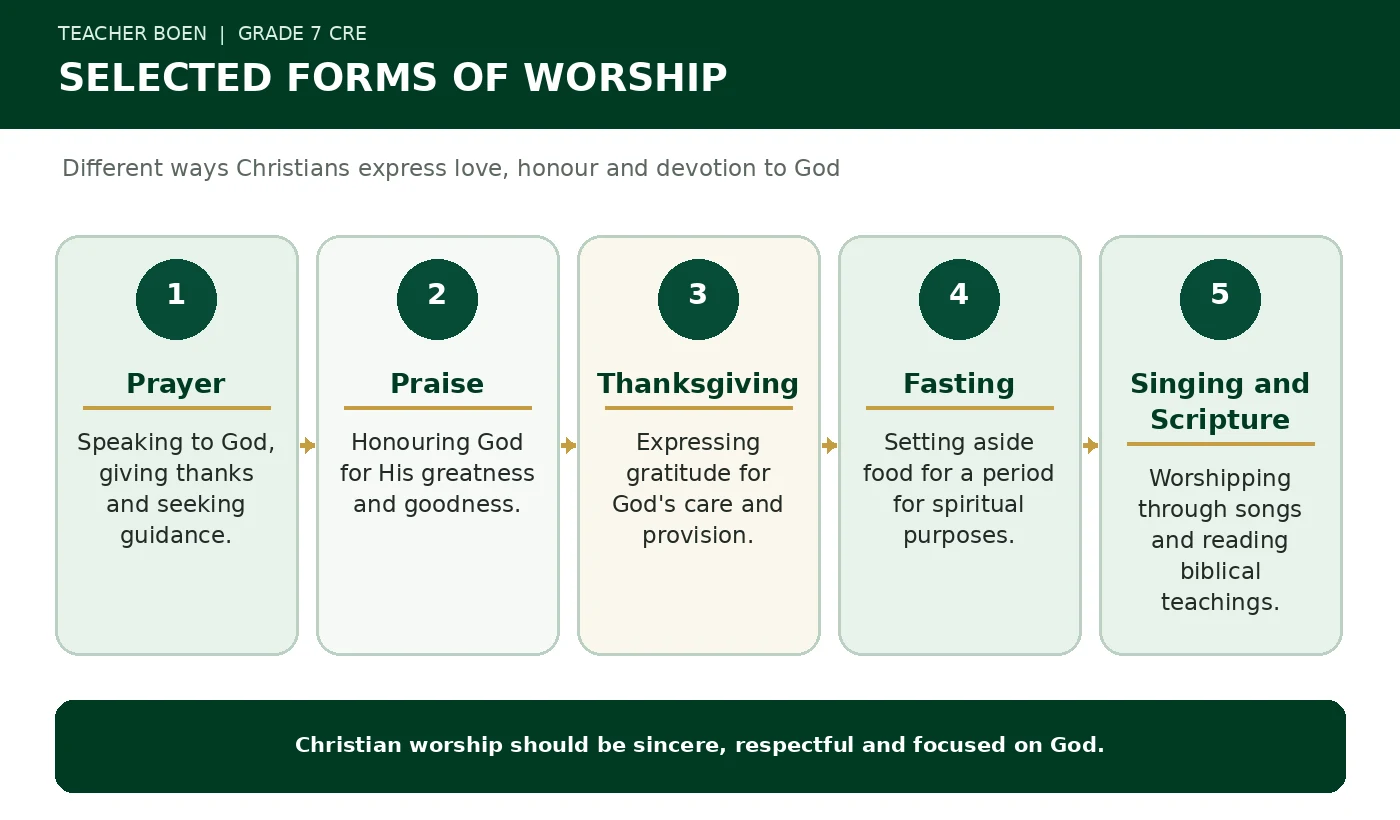
Selected ways Christians express worship and devotion to God.
Worship can take place at home, in church, at school or in other suitable places.
2. Meaning of important terms
Worship: Showing love, honour and devotion to God.
Praise: Expressing admiration and honour towards God because of who He is and what He does.
Thanksgiving: Expressing gratitude to God for His blessings and goodness.
Prayer: Communicating with God through speaking, listening and reflection.
Fasting: Voluntarily abstaining from food for a spiritual purpose, usually accompanied by prayer.
Adoration: Showing deep love, respect and honour towards God.
Supplication: Making humble requests to God.
Intercession: Praying to God on behalf of other people.
3. Forms of worship practised by Christians
Christians worship God through different activities.
A. Prayer
Prayer is communication between human beings and God.
Through prayer, Christians express their needs, confess sins, give thanks and seek God's guidance.
Prayer may be offered individually or in groups.
Examples include:
- Morning prayers.
- Evening prayers.
- Family prayers.
- Prayers before meals.
- Church prayers.
- Prayers for the sick.
B. Praise
Praise involves expressing admiration and honour towards God.
Christians praise God because of His goodness, power, love and faithfulness.
Praise can be expressed through:
- Singing.
- Dancing.
- Clapping.
- Playing musical instruments.
- Reciting Psalms.
- Speaking words of praise.
C. Thanksgiving
Thanksgiving means expressing gratitude to God for His blessings.
Christians thank God for:
- The gift of life.
- Good health.
- Food and shelter.
- Protection.
- Education.
- Family and friends.
- Answered prayers.
- Success and achievements.
D. Fasting
Fasting involves voluntarily abstaining from food for a spiritual purpose.
Christians may fast when seeking God's guidance, praying for others or strengthening their spiritual lives.
Fasting is usually accompanied by prayer and reflection.
E. Singing hymns and spiritual songs
Christians use songs to express faith, praise and thanksgiving.
Songs can also teach biblical lessons and encourage believers.
F. Reading the Bible
Reading Scripture helps Christians understand God's Word.
It is an important part of personal and group worship.
G. Giving
Christians give offerings and other contributions to support church activities and assist people in need.
Giving is an expression of gratitude and generosity.
H. Fellowship
Fellowship involves believers meeting and sharing their faith.
It promotes unity, encouragement and spiritual growth.
4. Biblical teachings on praise and thanksgiving
The Bible encourages Christians to praise God and give thanks in all circumstances.
The curriculum identifies several passages that explain these forms of worship.
A. Exodus 15:20–21
This passage describes Miriam, the sister of Moses and Aaron, leading the women in singing and dancing after the Israelites crossed the Red Sea.
She praised God for delivering His people from the Egyptians.
Lessons:
- Christians should praise God for His protection.
- Singing is an important form of worship.
- People should appreciate God's deliverance.
- Worship can be expressed through music and dancing.
- Christians should encourage others to praise God.
B. Psalm 30:11–12
David praises God for changing his sorrow into joy.
He expresses his intention to praise God and give thanks.
Lessons:
- God deserves praise during difficult and happy times.
- Christians should remain grateful.
- God can provide comfort during suffering.
- Thanksgiving should be part of daily Christian living.
C. Psalm 96:1–2
This passage encourages people to sing a new song to the Lord.
It teaches believers to praise God and proclaim His salvation daily.
Lessons:
- Christians should praise God regularly.
- Worship should come from sincere hearts.
- People should share God's goodness with others.
- Singing is a way of expressing faith.
D. Psalm 150:1–5
This Psalm encourages people to praise God using different musical instruments.
It mentions instruments such as trumpets, harps, lyres, tambourines, strings and cymbals.
Lessons:
- Music is an important part of Christian worship.
- People can use different talents to praise God.
- Christians should participate actively in worship.
- All creation should recognise God's greatness.
E. Ephesians 5:19
Paul encourages Christians to speak to one another using Psalms, hymns and spiritual songs.
He also teaches believers to sing and make music to the Lord from their hearts.
Lessons:
- Christians should encourage one another through songs.
- Worship should be sincere.
- Spiritual songs help believers grow in faith.
- Singing promotes unity among Christians.
5. Difference between praise and thanksgiving
|
Praise |
Thanksgiving |
|---|---|
|
Expresses admiration and honour towards God. |
Expresses gratitude for God's blessings. |
|
Focuses on God's character and greatness. |
Focuses on what God has done. |
|
Includes singing about God's power and holiness. |
Includes thanking God for life, protection and provision. |
|
Can be expressed through songs, dancing and spoken words. |
Can be expressed through prayers, songs and personal testimonies. |
6. Importance of praise and thanksgiving
- They help Christians appreciate God's goodness.
- They strengthen faith.
- They encourage spiritual growth.
- They promote unity among believers.
- They help people remain hopeful.
- They remind Christians of God's faithfulness.
- They encourage positive attitudes.
- They help believers develop gratitude.
- They create opportunities for fellowship.
- They encourage people to recognise God's blessings.
7. Prayer as a form of worship
Prayer is an important way through which Christians communicate with God.
It helps believers express their thoughts, feelings and needs.
Christians pray for different reasons.
A. To praise God
They praise God for His greatness, power and goodness.
B. To give thanks
They thank God for life, protection, family and other blessings.
C. To confess sins
They ask God for forgiveness when they have done wrong.
D. To request guidance
They ask God to help them make wise decisions.
E. To seek protection
They pray for safety and protection during difficult situations.
F. To intercede for others
They pray for family members, friends, leaders and people experiencing difficulties.
G. To seek spiritual strength
They pray for strength to resist temptation and live according to Christian teachings.
8. The Lord's Prayer
The Lord's Prayer is recorded in Matthew 6:9–13.
Jesus taught His disciples how to pray.
The prayer provides a model that Christians can follow when communicating with God.
Its main parts include:
A. Addressing God
"Our Father in heaven..."
This reminds Christians that God is their heavenly Father.
B. Praising God's name
"Hallowed be thy name."
This expresses honour and respect for God.
C. Seeking God's will
"Thy kingdom come, thy will be done..."
Christians should desire that God's will is fulfilled.
D. Requesting daily provision
"Give us this day our daily bread."
This teaches dependence on God for daily needs.
E. Seeking forgiveness
"Forgive us our debts, as we forgive our debtors."
Christians should seek forgiveness and also forgive others.
F. Seeking protection from temptation
"Lead us not into temptation, but deliver us from evil."
This reminds believers to seek God's help in avoiding wrongdoing.
9. Importance of prayer in Christian life
- It strengthens the relationship between God and believers.
- It provides an opportunity to seek forgiveness.
- It encourages faith and trust in God.
- It provides comfort during difficult situations.
- It helps Christians seek guidance.
- It encourages thanksgiving.
- It promotes unity when believers pray together.
- It helps Christians develop self-discipline.
- It encourages compassion through intercessory prayers.
- It provides spiritual encouragement.
10. Fasting as a form of worship
Fasting is the voluntary abstaining from food for a spiritual purpose.
Christians may combine fasting with prayer, Bible reading and personal reflection.
Fasting should not be used to show off or attract attention.
It should be undertaken responsibly, with appropriate parental and religious guidance for young learners. Prolonged fasting or fasting that could harm health should not be attempted by children.
11. Biblical teachings on fasting
A. Luke 4:1–2
This passage describes Jesus being led by the Holy Spirit into the wilderness, where He fasted for forty days.
Lessons:
- Fasting can be connected with spiritual preparation.
- Christians should seek God's guidance.
- Believers should develop self-discipline.
- People should depend on God during difficult situations.
B. Acts 13:1–3
The early Church leaders in Antioch were worshipping and fasting when the Holy Spirit instructed them to set apart Barnabas and Saul for a special mission.
They prayed, fasted and laid their hands on them before sending them away.
Lessons:
- Fasting can accompany prayer.
- Christians can seek God's guidance together.
- Church leaders should depend on God.
- Worship can prepare believers for service.
- Christians should support one another in ministry.
C. Matthew 6:16
Jesus taught His followers not to fast in order to attract attention.
He discouraged people from displaying sadness simply to make others notice their fasting.
Lessons:
- Fasting should be sincere.
- Christians should avoid pride.
- Worship should not be done to impress people.
- People should focus on their relationship with God.
D. 1 Thessalonians 5:16–18
Paul encourages Christians to rejoice always, pray continually and give thanks in all circumstances.
Lessons:
- Prayer should be part of daily life.
- Christians should maintain a thankful attitude.
- Believers should remain hopeful.
- Prayer should not be limited to church services.
12. Importance of fasting
- It helps Christians concentrate on spiritual matters.
- It provides time for prayer and reflection.
- It encourages self-discipline.
- It can accompany prayer when seeking God's guidance.
- It strengthens commitment to worship.
- It encourages believers to examine their behaviour.
- It promotes unity when done collectively and responsibly.
13. Proper conduct during fasting
According to the teaching in Matthew 6:16:
- Fasting should be sincere.
- People should avoid showing off.
- It should not be used to attract praise.
- Christians should maintain humility.
- It should be accompanied by prayer and reflection.
- It should be guided by responsible religious teaching.
- Young learners should never put their health at risk.
14. Ways learners can participate in worship
At home:
- Praying with family members.
- Reading the Bible.
- Singing Christian songs.
- Giving thanks before meals.
- Participating in family devotion.
At school:
- Participating in school prayers.
- Singing hymns.
- Reading Bible passages.
- Taking part in Christian fellowship.
- Respecting different forms of worship.
At church:
- Participating in praise and worship.
- Listening to sermons.
- Reading Scripture.
- Giving offerings.
- Joining fellowship activities.
- Participating in appropriate prayer sessions.
15. Practical activities
Activity 1: Bible study
Read Exodus 15:20–21, Psalm 30:11–12 and Psalm 150:1–5.
Identify the teachings about praise and thanksgiving.
Activity 2: Composing a song
Compose a Christian song based on Psalm 150:1–5.
Activity 3: Prayer reflection
Write a journal explaining the importance of prayer in your life.
Activity 4: Worship report
Participate in worship at home, church or school and write a report about the activities observed.
16. Summary
Worship is an expression of love, honour and devotion to God.
Christians worship through prayer, praise, thanksgiving, fasting, singing, Bible reading and fellowship.
The Bible encourages believers to praise God and remain thankful.
Prayer helps Christians communicate with God, while fasting provides an opportunity for spiritual reflection.
Learners should participate responsibly in worship at home, school and church.
17. Revision questions and answers
Q1. What is worship?
Worship is showing love, honour and devotion to God.
Q2. Differentiate between praise and thanksgiving.
Praise expresses admiration towards God, while thanksgiving expresses gratitude for His blessings.
Q3. Name five forms of Christian worship.
Prayer, praise, thanksgiving, fasting and singing hymns.
Q4. State four lessons from Exodus 15:20–21.
God deserves praise, worship can involve singing, Christians should appreciate God's protection and believers should encourage others to worship.
Q5. What is prayer?
Prayer is communication between human beings and God.
Q6. State five parts of the Lord's Prayer.
Addressing God, praising His name, seeking His will, requesting daily provision and seeking forgiveness.
Q7. What is fasting?
Fasting is voluntarily abstaining from food for a spiritual purpose.
Q8. State four lessons from Matthew 6:16.
Fasting should be sincere, Christians should avoid pride, worship should not be done to impress others and believers should maintain humility.
Q9. Give four reasons why prayer is important.
It strengthens faith, provides comfort, encourages forgiveness and helps believers seek guidance.
Q10. Why should Christians give thanks to God?
They should give thanks because God provides life, protection, guidance and other blessings.