
1. Introduction
The church plays an important role in the development of society.
Apart from teaching people about God, churches participate in activities that improve people's social and economic lives.
Two important areas where churches contribute are education and health.
Churches establish schools, colleges, hospitals, health centres and other institutions that serve communities.
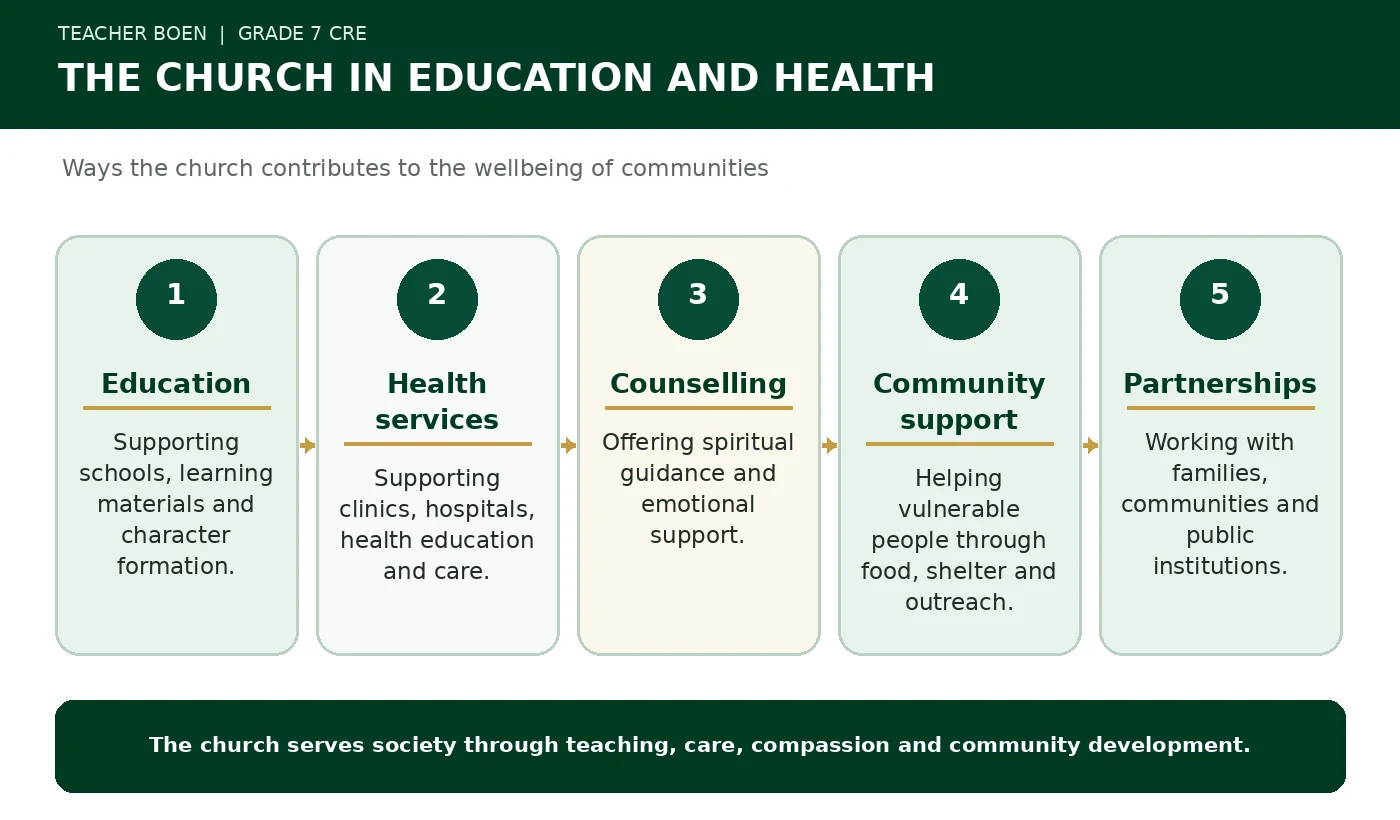
Examples of the church's contribution to education, health and community wellbeing.
They also provide guidance, counselling and support to people experiencing difficulties.
In Kenya, Christian organisations have contributed to the development of education and healthcare services.
2. Meaning of important terms
Church: A community of Christians who come together to worship God and practise their faith.
Mission work: Activities carried out by Christians to spread the Gospel and serve communities.
Education: The process of acquiring knowledge, skills, values and attitudes.
Healthcare: Services aimed at preventing diseases, maintaining health and treating illnesses.
Dispensary: A healthcare facility that provides basic medical services and treatment.
Hospital: A healthcare institution that provides medical care to patients.
Missionary: A person sent to spread religious teachings and serve people in a particular community.
Community development: Activities aimed at improving the living conditions of people in a community.
3. Role of the church in education
The church contributes to education through several activities.
A. Establishing schools
Churches establish primary schools, junior schools, secondary schools and other learning institutions.
These schools provide educational opportunities to children and young people.
B. Establishing colleges and universities
Some churches establish institutions of higher learning.
These institutions train teachers, nurses, religious leaders and other professionals.
C. Promoting literacy
Churches encourage reading and writing through formal education and community literacy programmes.
They may also support adult education.
D. Providing scholarships and bursaries
Churches assist learners from disadvantaged families by providing financial support.
This helps children remain in school.
E. Promoting moral education
Churches teach values such as honesty, respect, responsibility, kindness and discipline.
These values contribute to responsible behaviour among learners.
F. Training teachers
Church institutions may establish teacher training programmes or support the professional development of educators.
G. Supporting needy learners
Churches may provide:
- School uniforms.
- Books and stationery.
- Meals.
- School fees assistance.
- Learning materials.
H. Promoting special needs education
Churches may support learners with disabilities by establishing suitable learning programmes and providing resources.
I. Supporting technical and vocational education
Some church organisations establish vocational training centres.
These centres provide skills in areas such as:
- Carpentry.
- Tailoring.
- Agriculture.
- Hospitality.
- Computer studies.
- Mechanical work.
J. Providing guidance and counselling
Church leaders and trained counsellors may assist learners experiencing personal, family or educational challenges.
K. Promoting peace and unity in schools
Christian teachings encourage respect, cooperation, forgiveness and peaceful relationships.
These values help create positive learning environments.
L. Supporting educational research and resources
Church institutions may contribute to research, libraries, publications and the development of learning materials.
4. Role of the church in health
Churches also contribute to healthcare services in Kenya.
Their contributions include the following.
A. Establishing hospitals
Some churches establish hospitals that provide medical services to communities.
These institutions treat different illnesses and injuries.
B. Establishing dispensaries and health centres
Churches may establish smaller facilities that provide basic healthcare services.
They help people access treatment within their communities.
C. Providing maternal healthcare
Church health facilities may offer services such as:
- Antenatal care.
- Skilled delivery services.
- Postnatal care.
- Family health education.
D. Providing child healthcare
Churches may support immunisation programmes, nutrition education and treatment of childhood illnesses.
E. Promoting disease prevention
Churches organise health education programmes to teach people how to prevent diseases.
Topics may include hygiene, sanitation, nutrition and disease prevention.
F. Supporting people living with HIV
Church organisations may provide counselling, education and other forms of support to people living with HIV.
They can also help reduce discrimination and stigma.
G. Providing medical outreach services
Churches may organise medical camps in areas where people have limited access to healthcare.
These camps can provide screening, health education and basic treatment.
H. Supporting people with disabilities
Churches may provide rehabilitation support and assistance to people with physical or other disabilities.
I. Providing counselling services
Church leaders and trained professionals may support individuals and families facing emotional, social and psychological difficulties.
J. Promoting nutrition
Churches educate communities on balanced diets, proper feeding practices and the importance of good nutrition.
K. Supporting vulnerable groups
Churches may assist:
- Orphans.
- Elderly people.
- People living with disabilities.
- Poor households.
- People affected by disasters.
- People experiencing illness.
L. Providing spiritual support
Churches visit patients, pray with them and provide encouragement during sickness.
5. Examples of church contributions in the Kenyan community
Churches contribute to education and healthcare through:
- Establishment of church-sponsored schools.
- Establishment of hospitals and health centres.
- Community health education.
- Support for vulnerable learners.
- Provision of bursaries.
- Training of teachers and healthcare workers.
- Organising medical outreach programmes.
- Supporting rehabilitation programmes.
- Offering counselling services.
- Participating in community development.
6. Importance of the church's contribution to education
- It increases access to education.
- It promotes literacy.
- It supports learners from disadvantaged backgrounds.
- It encourages moral development.
- It creates employment opportunities.
- It develops professional skills.
- It promotes discipline.
- It supports national development.
- It provides opportunities for lifelong learning.
- It encourages peaceful coexistence.
7. Importance of the church's contribution to health
- It increases access to medical services.
- It supports disease prevention.
- It promotes proper nutrition.
- It provides maternal and child healthcare.
- It supports vulnerable people.
- It promotes health education.
- It provides counselling services.
- It creates employment opportunities.
- It supports rehabilitation.
- It improves community wellbeing.
8. Barriers to effective church mission work in Kenya today
Despite its contributions, the church faces several challenges when providing education, health and other community services.
A. Inadequate financial resources
Establishing and maintaining schools and hospitals requires substantial funding.
Some churches lack sufficient resources to support their programmes.
B. Poverty
Many communities cannot afford school fees, medicines and other services.
This makes it difficult for church institutions to sustain their activities.
C. Shortage of qualified personnel
Some church institutions experience shortages of trained teachers, doctors, nurses and other professionals.
D. Poor infrastructure
Some communities lack adequate roads, electricity, water and communication facilities.
This makes it difficult to provide services.
E. Cultural barriers
Certain cultural beliefs and practices may prevent people from accepting some educational and healthcare interventions.
F. Denominational differences
Disagreements between religious groups may affect cooperation and joint mission activities.
G. Insecurity
Violence, conflict and insecurity can prevent churches from operating effectively in some areas.
H. Competition for limited resources
Different institutions may compete for the same financial, human and material resources.
I. Resistance to change
Some people may be unwilling to adopt new educational practices or healthcare recommendations.
J. Poor management
Weak leadership, inadequate planning and poor accountability can affect the performance of church institutions.
K. Geographical challenges
Remote areas may be difficult to reach because of distance and poor transport networks.
L. Changing social needs
Communities face new challenges that require specialised skills, technology and additional resources.
9. Solutions to barriers hindering effective church mission work
A. Mobilising financial resources
Churches should encourage fundraising, donations and partnerships to support their programmes.
B. Training personnel
Churches should invest in training teachers, healthcare workers and other professionals.
C. Working with government
Churches should cooperate with government institutions to improve education and healthcare services.
D. Partnering with other organisations
Partnerships with NGOs, development agencies and community organisations can increase available resources.
E. Promoting accountability
Church institutions should maintain transparent financial and administrative systems.
F. Improving infrastructure
Churches should invest in suitable buildings, equipment, water supply and transport facilities.
G. Community involvement
Churches should involve community members when planning and implementing programmes.
H. Promoting tolerance
Religious groups should respect one another and cooperate where possible.
I. Using technology
Technology can support education, healthcare communication and administration.
J. Strengthening leadership
Churches should promote responsible leadership, good planning and proper management.
K. Expanding outreach programmes
Churches should organise outreach activities to reach people in remote and disadvantaged areas.
10. Ways learners can appreciate the church's contribution
- Respecting church institutions.
- Participating in community service.
- Supporting needy learners.
- Promoting hygiene and sanitation.
- Respecting healthcare workers and teachers.
- Participating in environmental clean-ups.
- Helping vulnerable members of society.
- Appreciating the importance of education.
- Promoting peace and unity.
- Participating in appropriate church activities.
11. Practical activities
Activity 1: Community research
Identify a school or healthcare facility established by a church in your community.
Describe the services it provides.
Activity 2: Map activity
Use a county map or digital map to identify church-established healthcare facilities in Kenya.
Activity 3: Interview
Interview a church leader or healthcare worker about the contribution of the church to education and health.
Activity 4: Group discussion
Discuss barriers affecting church mission work and suggest appropriate solutions.
12. Summary
The church contributes to education and health through schools, colleges, hospitals, dispensaries, scholarships, counselling and community programmes.
These activities improve access to education, healthcare and social support.
However, churches face challenges such as inadequate funding, shortage of qualified personnel, poor infrastructure and cultural barriers.
Partnerships, training, accountability and community participation can help overcome these challenges.
13. Revision questions and answers
Q1. State five ways the church contributes to education.
- Establishing schools.
- Providing scholarships.
- Training teachers.
- Promoting literacy.
- Supporting needy learners.
Q2. Identify five ways the church contributes to healthcare.
- Establishing hospitals.
- Establishing dispensaries.
- Providing health education.
- Organising medical camps.
- Offering counselling services.
Q3. Explain the importance of church-sponsored schools.
They increase access to education, promote moral development and provide learning opportunities.
Q4. State five barriers to effective church mission work.
Inadequate funding, poverty, shortage of qualified personnel, poor infrastructure and insecurity.
Q5. Give five solutions to barriers facing church mission work.
Fundraising, training personnel, partnerships, accountability and community involvement.
Q6. How does the church support vulnerable people?
It provides food, shelter, education assistance, healthcare and counselling.
Q7. Why should churches cooperate with government institutions?
Cooperation helps mobilise resources and improve the delivery of education and healthcare services.
Q8. State four ways learners can appreciate the church's contribution.
Participating in community service, respecting institutions, helping needy people and promoting hygiene.