
Introduction
A class reader is a book selected for learners to read and study as part of their English learning programme.
Before reading a book, it is important to examine its cover, title, blurb and other features.
Previewing a book helps learners develop expectations about its contents and understand its author and setting.
A. Meaning of previewing a book
Previewing is the process of examining a book before reading it in detail.
It helps readers obtain an idea of what the book contains.
B. Parts of a book used during previewing
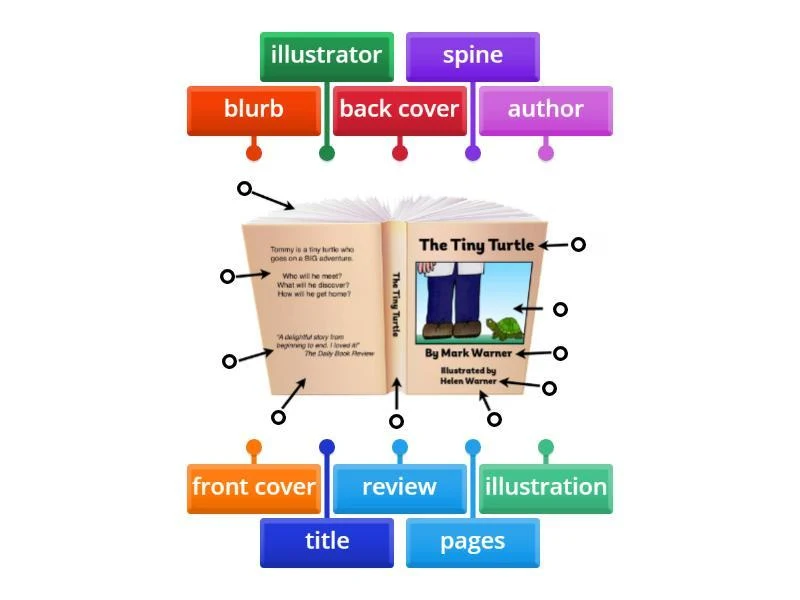
A diagram showing the parts of a book that learners can examine when previewing reading material.
1. Front cover
The front cover is the outer front part of a book.
It may contain:
- Title.
- Author's name.
- Publisher's name.
- Illustration or photograph.
2. Back cover
The back cover is the outer rear part of a book.
It may contain:
- A short description.
- Author information.
- Reviews.
- Publisher details.
- ISBN.
3. Title
The title is the name given to a book.
It provides clues about the subject or content.
4. Blurb
A blurb is a short description of a book, usually printed on the back cover.
It gives readers an idea of what the book is about without revealing everything.
5. Author
The author is the person who writes the book.
6. Publisher
The publisher is the organisation responsible for producing and distributing the book.
7. Illustrations
Illustrations are pictures or drawings used to support the information or story.
C. Meaning of the setting
The setting is the time and place in which a story takes place.
It helps readers understand the circumstances surrounding the events.
D. Types of setting
1. Physical setting
This refers to the place where the story occurs.
Examples:
- A village.
- A town.
- A school.
- A forest.
- A hospital.
- A city.
2. Time setting
This refers to when the events occur.
Examples:
- Morning.
- Night.
- During a historical period.
- During a particular year.
- During a holiday.
E. How to identify the setting
Readers can identify the setting by examining:
- Words describing the location.
- Names of places.
- References to time.
- Weather conditions.
- Descriptions of buildings.
- Cultural activities.
- Historical references.
- Pictures and illustrations.
F. The author's background
Learning about an author can help readers understand the book.
Information about an author may include:
- Full name.
- Educational background.
- Nationality.
- Occupation.
- Other books written.
- Awards and achievements.
G. Graphic organisers for studying a class reader
A graphic organiser is a visual tool used to arrange information.
Examples include:
1. Mind map
A mind map places the main subject at the centre and connects it to related ideas.
2. Tree map
A tree map arranges information into categories and subcategories.
3. K-W-W-L chart
This chart helps learners organise what they know and what they learn.
|
K – What I Know |
W – What I Want to Know |
W – Where I Learned It |
L – What I Learned |
|---|---|---|---|
|
The title of the book |
Who wrote it? |
Book cover |
Author's name |
|
The main setting |
When does it happen? |
Story text |
Time setting |
|
The main topic |
What happens? |
Blurb and chapters |
Main events |
H. Why we should not judge a book by its cover
- The cover may not reveal the entire story.
- Interesting information may be found inside the book.
- A simple cover may contain a very informative story.
- Illustrations may not fully represent the content.
- The value of a book depends on its contents, not merely its appearance.
Activities
- Select a class reader.
- Examine its front and back covers.
- Read the blurb.
- Identify the title, author and publisher.
- Research information about the author.
- Identify the setting in terms of time and place.
- Prepare a mind map or tree map.
- Complete a K-W-W-L chart.
- Present findings to classmates.
Summary
Previewing a class reader involves examining its cover, title, blurb, author and illustrations. Learners should also identify the setting in terms of time and place before reading the book in detail.