
Introduction
Pronunciation refers to the way words and sounds are produced when speaking. Correct pronunciation enables people to communicate clearly and helps listeners understand the intended meaning of spoken words.
In English, words are made up of different sounds. These include consonant sounds and vowel sounds. Some words also have stressed syllables that influence their pronunciation and meaning.
In this sub-strand, learners practise:
- Consonant sounds /t/, /d/, /l/ and /r/.
- Vowel sounds /ʊ/ and /uː/.
- Word stress.
- Pronunciation of words according to their stressed syllables.
A. Consonant sounds
A consonant sound is produced when air flowing from the lungs is obstructed or restricted by parts of the speech organs, such as the tongue, teeth and lips.
The four consonant sounds covered in this sub-strand are:
|
Sound |
Example words |
Description |
|---|---|---|
|
/t/ |
Toll, table, time |
Produced by briefly blocking airflow with the tongue against the area behind the upper teeth and releasing it. |
|
/d/ |
Doll, dog, day |
Produced in a similar position to /t/, but with vibration of the vocal cords. |
|
/l/ |
Liver, love, light |
Produced by placing the tongue against the area behind the upper teeth while air flows around its sides. |
|
/r/ |
River, rain, road |
Produced by shaping the tongue to allow air to pass without completely blocking it. |
Understanding the difference between /t/ and /d/
These sounds are produced using similar positions of the tongue, but they differ in voicing.
- /t/ is a voiceless sound.
- /d/ is a voiced sound.
Examples:
- Tie and die.
- Ten and den.
- Town and down.
Activity 1: Pronunciation practice
Read the following words aloud:
- /t/: table, tall, tea, train, tree.
- /d/: dance, door, drum, doll, day.
- /l/: lion, leaf, lamp, land, light.
- /r/: road, river, rain, ring, right.
Work in pairs. One learner pronounces a word while the other listens and identifies the sound.
B. Vowel sounds
A vowel sound is produced when air flows through the mouth without significant obstruction.
The two vowel sounds covered in this sub-strand are /ʊ/ and /uː/.
1. The short vowel sound /ʊ/
This is a short vowel sound. It is heard in words such as:
- Pull
- Bull
- Full
- Book
- Foot
- Good
2. The long vowel sound /uː/
This is a longer vowel sound. It is heard in words such as:
- Pool
- Boot
- Food
- School
- Moon
- Blue
Differences between /ʊ/ and /uː/
|
/ʊ/ |
/uː/ |
|---|---|
|
Short vowel sound |
Long vowel sound |
|
Pull |
Pool |
|
Full |
Fool |
|
Foot |
Food |
|
Look |
Luke |
|
Could |
Cooled (different consonant context) |
The length of the vowel sound can change the meaning of a word.
Pronunciation illustration
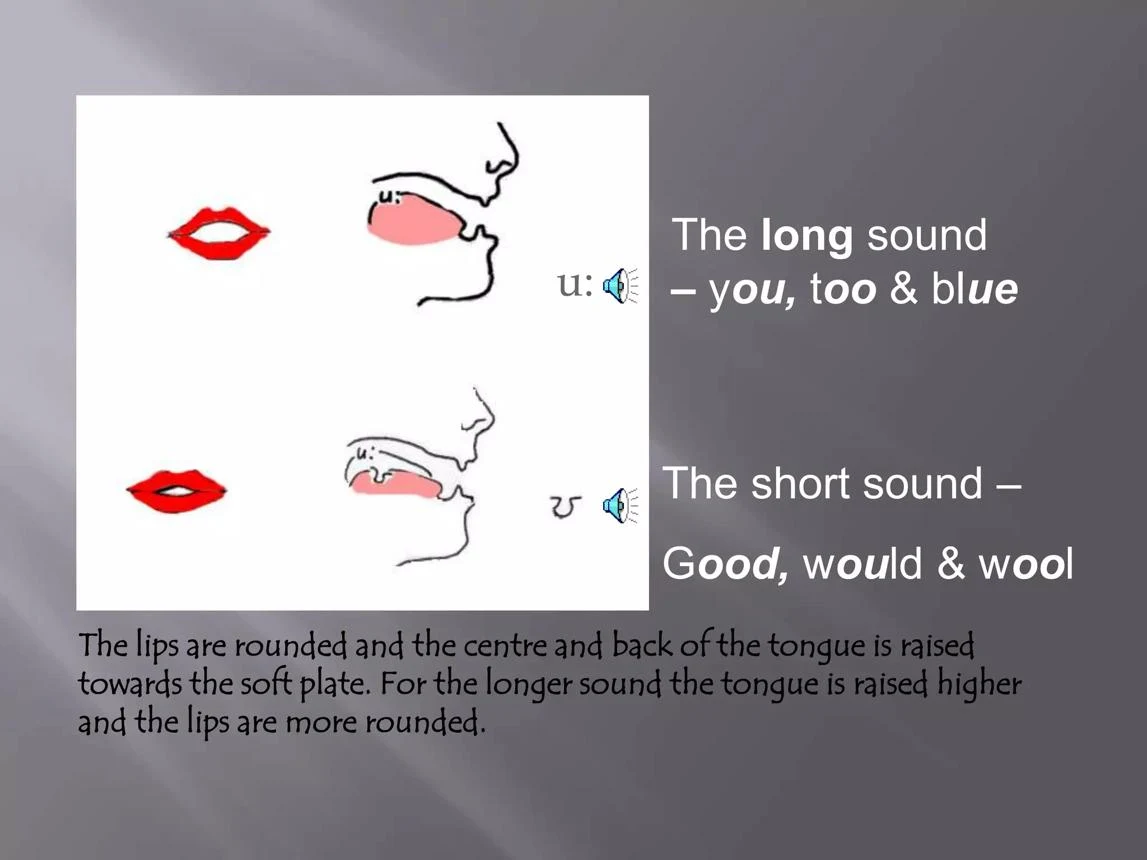
The speech-organ illustration supports the pronunciation of the short vowel sound /ʊ/.
/ʊ/
Short vowel sound
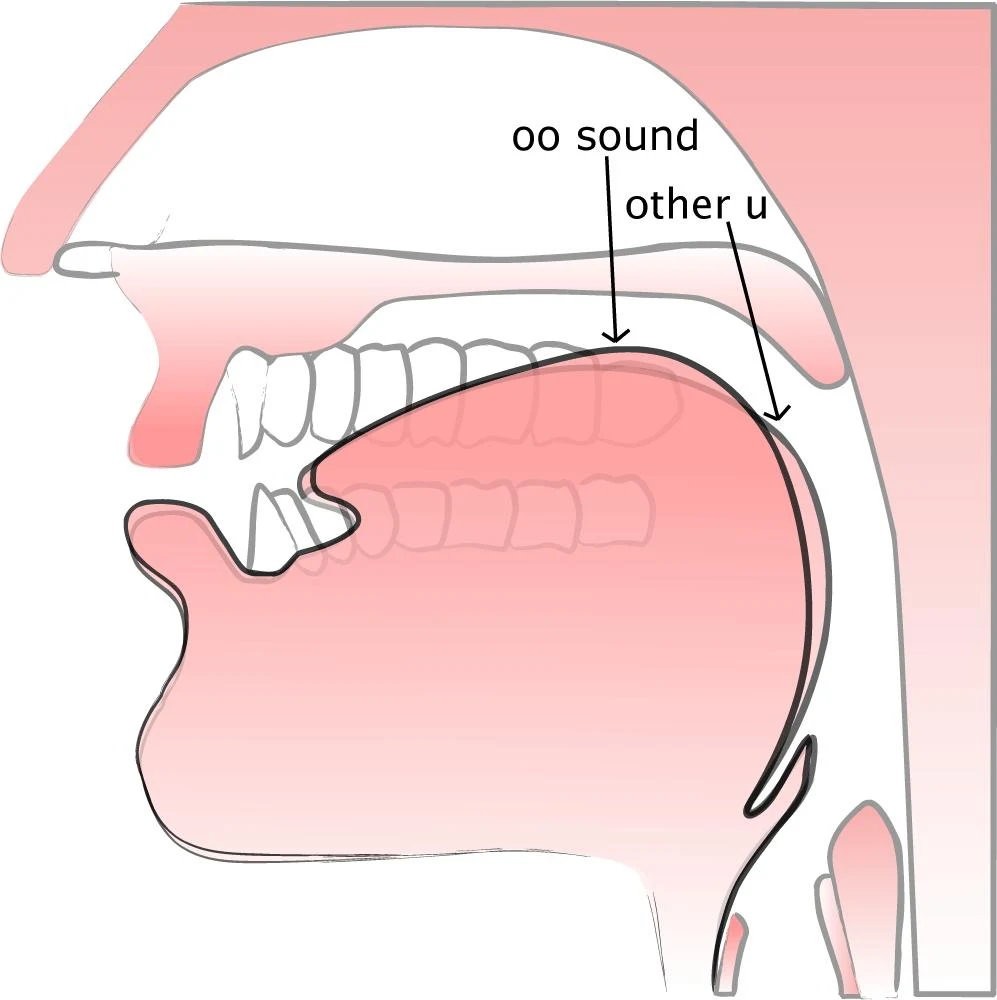
The speech-organ illustration supports the pronunciation of the long vowel sound /uː/.
/uː/
Long vowel sound
Activity 2: Word classification
Classify the following words according to their vowel sounds:
Pull, pool, foot, food, full, fool, book, boot, good, school.
C. Word stress
Word stress refers to the emphasis placed on a particular syllable when pronouncing a word.
A syllable is a unit of pronunciation containing a vowel sound, with or without surrounding consonant sounds.
For example:
- TA-ble
- DOC-tor
- BEAU-ti-ful
- EDU-CA-tion
The stressed syllable is pronounced with greater prominence.
Types of word stress
- First-syllable stress: The first syllable receives emphasis.
- Second-syllable stress: The second syllable receives emphasis.
- Third-syllable stress: The third syllable receives emphasis.
Examples:
|
Word |
Stressed syllable |
|---|---|
|
TAble |
First |
|
DOCtor |
First |
|
beGIN |
Second |
|
aBOUT |
Second |
|
eduCAtion |
Third |
D. Word stress and meaning
In English, changing the stressed syllable can change the meaning or grammatical function of a word.
Examples:
|
Noun |
Verb |
|---|---|
|
REcord |
reCORD |
|
PREsent |
preSENT |
|
OBject |
obJECT |
|
CONduct |
conDUCT |
- REcord: A written or stored account of information.
- reCORD: To store information using a recording device.
- PREsent: A gift.
- preSENT: To give or show something.
E. Importance of correct pronunciation
Correct pronunciation is important because it:
- Makes communication clear.
- Prevents misunderstanding.
- Helps listeners distinguish between similar words.
- Improves confidence when speaking.
- Makes oral presentations more effective.
- Improves reading aloud.
- Supports effective participation in discussions.
F. How to improve pronunciation
- Listen to recordings of correctly pronounced English words.
- Watch educational videos demonstrating English pronunciation.
- Practise difficult sounds repeatedly.
- Read poems and tongue twisters aloud.
- Work with a partner to identify pronunciation errors.
- Use dictionaries that provide phonetic transcriptions.
- Record your speech and listen to identify areas that need improvement.
Summary
Pronunciation involves the correct production of speech sounds. Learners should distinguish the consonant sounds /t/, /d/, /l/, /r/ and vowel sounds /ʊ/, /uː/. Word stress is also important because it can change the meaning or grammatical function of words.