
Introduction
A class reader is a book selected for learners to read and study as part of their English language learning.
Intensive reading involves reading a text carefully to understand its details, characters, events, vocabulary and messages.
In this sub-strand, learners concentrate on understanding the sequence of events in sections of their class reader.
A. Meaning of sequence of events
Sequence of events refers to the order in which incidents or activities happen in a story.
Events must be arranged in the correct order to make the story understandable.
Example
Consider a story about a learner who becomes a school prefect.
- A learner is selected to become a prefect.
- The learner receives responsibilities.
- The learner faces challenges while performing duties.
- The learner seeks advice from the teacher.
- The learner successfully manages the responsibilities.
These events follow a logical sequence.
B. Stages of a story
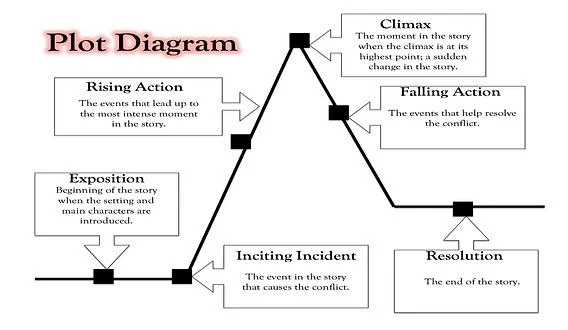
A plot diagram shows how a narrative develops through its main stages.
1. Introduction (Exposition)
This is the beginning of the story. It introduces the characters, setting and background information.
2. Rising action
These are events that develop the story and introduce problems or challenges.
3. Climax
The climax is the most exciting or important point of a story. It is often where the main conflict reaches its highest point.
4. Falling action
These are events that follow the climax and lead towards the resolution.
5. Resolution
The resolution is the conclusion of the story, where the main problem is resolved or brought to an end.
C. Identifying the sequence of events
Readers can identify the sequence of events by:
- Identifying what happens at the beginning.
- Identifying the actions of the main characters.
- Looking for events that introduce problems.
- Identifying the climax.
- Identifying how the problem is addressed.
- Establishing how the story ends.
D. Sequence words
Certain words help show the order of events.
|
Sequence word |
Meaning or use |
|---|---|
|
First |
Introduces the first event. |
|
Initially |
Shows what happened at the beginning. |
|
Next |
Introduces the following event. |
|
Then |
Shows what happened afterwards. |
|
Afterwards |
Introduces a later event. |
|
Meanwhile |
Shows events happening during the same period. |
|
Finally |
Introduces the last event. |
E. Preparing a sequence chart
A sequence chart is a diagram used to arrange events in the order in which they occur.
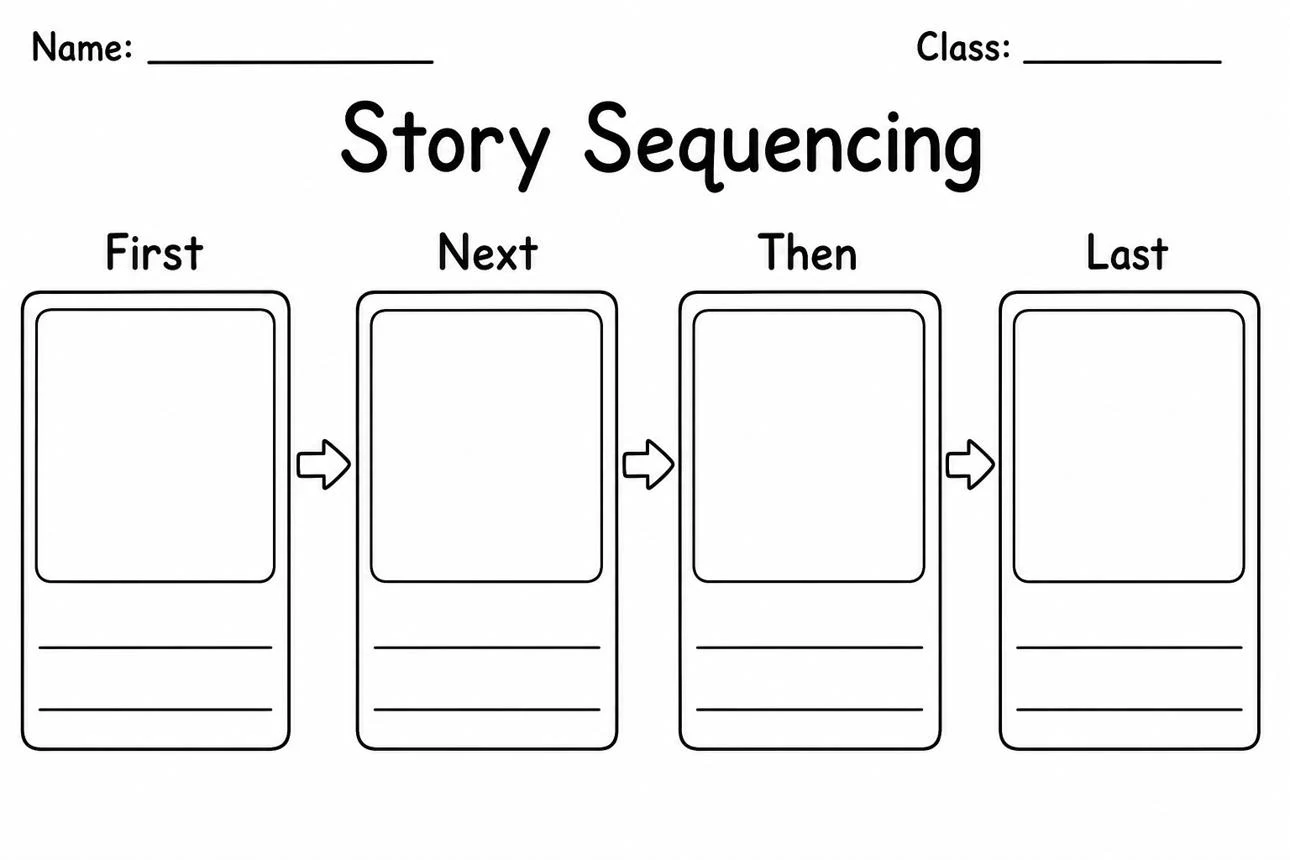
A story-sequencing chart helps arrange events in the order in which they happen.
Example:
|
Stage |
Event |
|---|---|
|
Beginning |
The main character arrives in a new school. |
|
Next |
The character meets new classmates. |
|
Middle |
The character experiences difficulties. |
|
Climax |
A major disagreement occurs. |
|
Ending |
The disagreement is resolved. |
F. Making short notes on events
Short notes are brief statements that capture important information from a text.
When making notes:
- Read the section carefully.
- Identify the major events.
- Remove unnecessary details.
- Use short and clear phrases.
- Arrange the events in the correct order.
- Review the notes to ensure accuracy.
G. How characters influence the flow of a story
Characters influence events through their decisions, actions and relationships.
For example:
- A brave character may help solve a community problem.
- A dishonest character may create conflict.
- A wise character may guide others.
- A selfish character may cause disagreements.
H. Relating events to real life
Readers should connect the events in a class reader to their own experiences.
For example, a story about helping a neighbour may remind learners of the importance of kindness and community service.
I. Solving problems presented in a class reader
When a story presents a problem, readers should consider:
- The cause of the problem.
- The people affected.
- The actions taken by the characters.
- Whether the solutions were effective.
- Other possible solutions.
Activities
- Read a selected section of the class reader.
- Identify the main events.
- Arrange the events in chronological order.
- Prepare a sequence chart.
- Make short notes.
- Dramatise a section of the story.
- Discuss the possible solutions to problems presented.
Summary
Intensive reading helps learners understand the details of a literary text. Understanding the sequence of events helps readers follow the development of a story, identify its climax and appreciate its message.