
Learning Outcomes
By the end of this sub-strand, the learner should be able to:
- a) Explain the factors considered when locating a production unit
- b) Analyse the factors determining the size of a production unit
- c) Locate a production unit in a suitable area
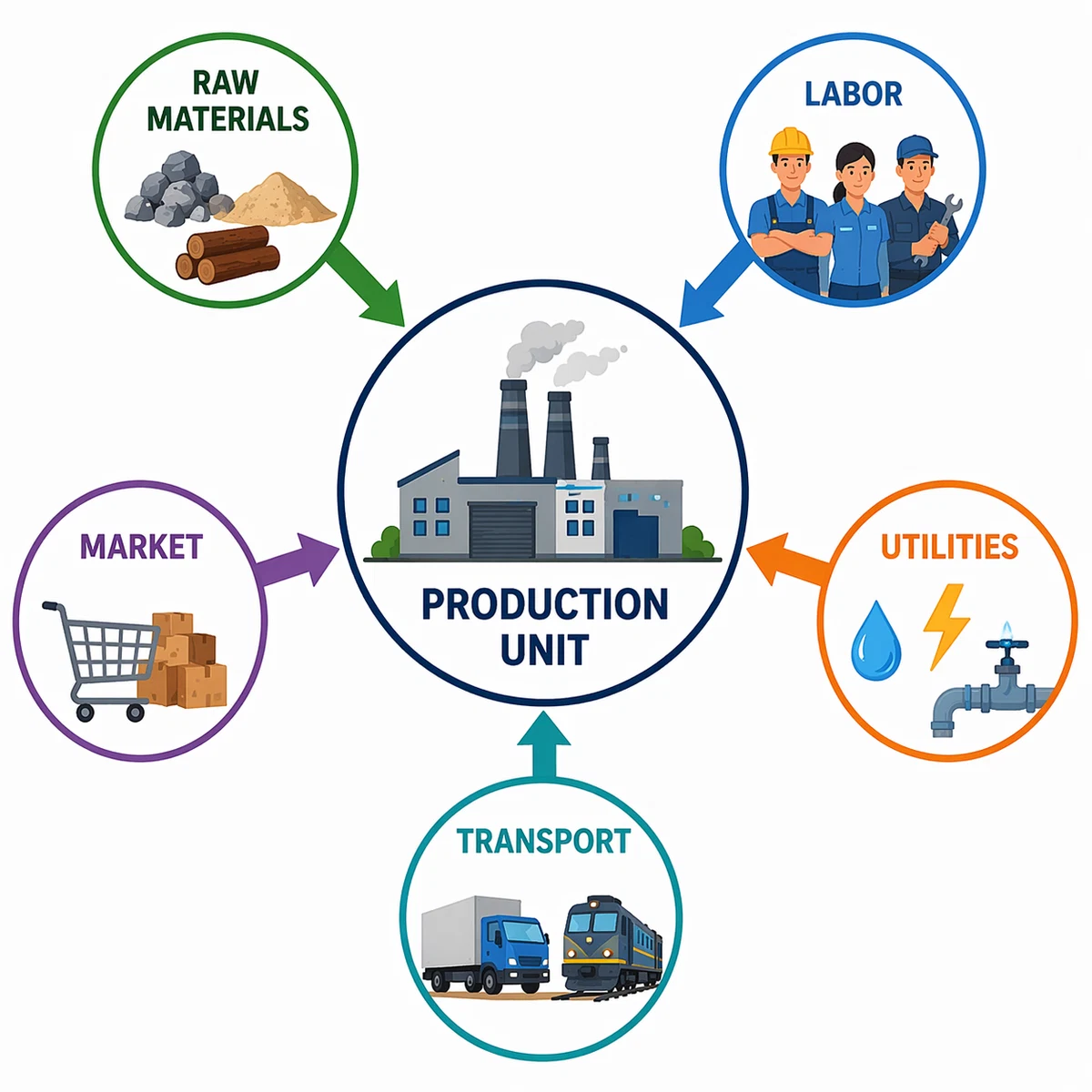
a) Explain the Factors Considered When Locating a Production Unit
A production unit is a business enterprise that uses economic resources (land, labor, capital) to produce goods or services for sale with the aim of making a profit. Examples include a posho mill, salon, barber shop, welding workshop, cybercafé, or bakery.
Choosing the right location is critical to the success of a production unit.
|
Factor |
Explanation |
Example |
|---|---|---|
|
Access to Raw Materials |
The business should be near the source of materials it needs to operate, especially if materials are bulky or perishable. |
A posho mill is best located near where maize is grown. A fruit processing plant near orchards. |
|
Availability of Labor |
The area should have a sufficient pool of workers with the required skills (skilled, semi-skilled, or unskilled). |
A cybercafé needs staff with computer skills. A welding shop needs trained welders. |
|
Proximity to Market |
The business should be close to its customers to reduce transportation costs for finished goods and make it convenient for customers to visit. |
A salon or barber shop is located in a populated area or shopping center. |
|
Availability of Utilities |
Reliable supply of electricity and water is essential for most businesses. |
A posho mill needs electricity; a salon needs water. |
|
Transport and Infrastructure |
Good roads and transport networks are needed to bring in materials and distribute products. |
A production unit might locate along a major highway for easy access. |
|
Government Policies and Incentives |
The government may offer tax breaks, subsidized land, or infrastructure development to encourage businesses in certain areas (e.g., Export Processing Zones). |
Locating in a Special Economic Zone (SEZ) can reduce operating costs. |
|
Security |
The area should be safe for employees, customers, and property. High crime rates increase insurance costs and risk of theft. |
Businesses prefer areas with police patrols or private security. |
|
Availability of Supporting Services |
Access to banking, insurance, repair services, and warehousing is beneficial. |
A business may want to be near a bank for deposits and loans. |
|
Social Amenities |
Employees need access to housing, schools, healthcare, and recreation. This affects ability to attract and retain workers. |
A large factory may locate near a town with good amenities. |
|
Cost of Land/Rent |
The cost of acquiring or renting premises must be affordable and fit within the business budget. |
Small businesses may start in lower-rent areas. |
b) Analyse the Factors Determining the Size of a Production Unit
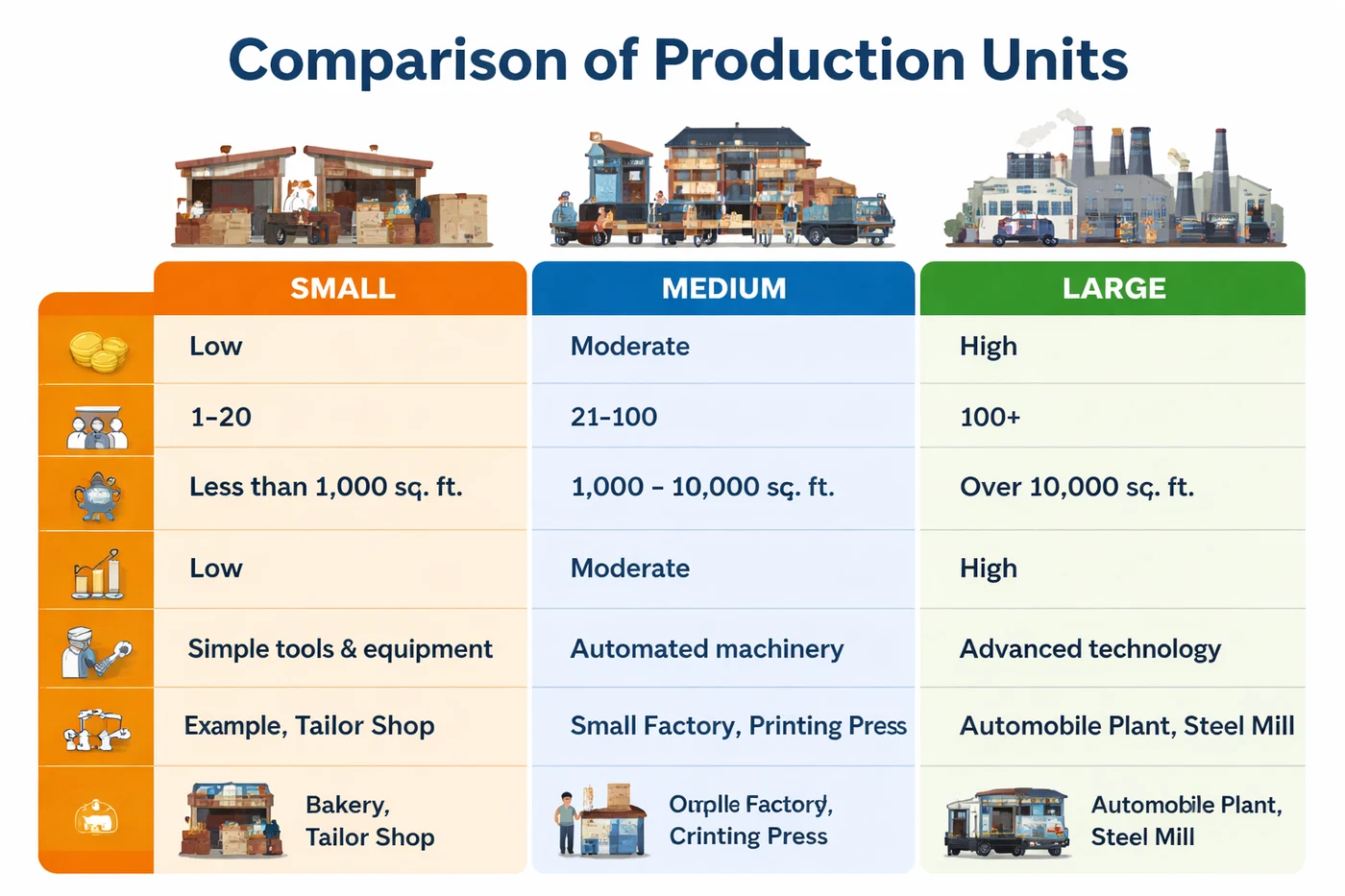
The size of a production unit is not just about physical dimensions; it refers to the scale of its operations.
|
Factor |
How It Determines Size |
|---|---|
|
Volume of Output |
The quantity of goods or services produced over a given period. A large unit produces high volumes; a small unit produces low volumes. |
|
Number of Workers |
The number of employees. Large units employ many people; small units may be operated by the owner alone or with a few helpers. |
|
Capital Invested |
The amount of money put into the business for equipment, buildings, and working capital. Large units require significant capital investment. |
|
Methods of Production |
Highly mechanized, capital-intensive methods (using many machines) are characteristic of large-scale production. Labor-intensive methods (relying on human effort) are typical of small-scale production. |
|
Size of Market Controlled |
The share of the total market that the business serves. A large unit may supply a national or international market; a small unit serves a local neighborhood. |
|
Volume of Sales |
The total revenue generated. Large units have high sales figures; small units have modest sales. |
|
Floor Area Covered |
The physical space occupied by the business premises. Large factories cover extensive areas; small shops occupy limited space. |
Categories of Production Units by Size:
|
Size Category |
Characteristics |
Examples |
|---|---|---|
|
Micro/Small Enterprise |
Few employees (often owner-operated), low capital, serves local market, labor-intensive. |
Neighborhood salon, small posho mill, individual tailor, barber shop, small kiosk. |
|
Medium Enterprise |
More employees, some mechanization, serves regional market, moderate capital. |
Mid-sized bakery, furniture workshop, cybercafé with multiple computers, printing shop. |
|
Large Enterprise |
Many employees, highly mechanized, serves national/international market, high capital investment. |
Large manufacturing plants, big construction companies, national retail chains. |
c) Locate a Production Unit in a Suitable Area
Applying the factors to a real-world scenario helps in making informed decisions.
Case Study 1: Locating a Posho Mill
|
Factor |
Consideration for Posho Mill |
Suitable Location |
|---|---|---|
|
Raw Materials |
Needs steady supply of maize. |
Near a farming area or grain market. |
|
Labor |
Requires semi-skilled operator. |
Where labor is available. |
|
Market |
Serves local households. |
In or near a residential area/village center. |
|
Utilities |
Requires electricity (3-phase power for large mills). |
Where electricity is available. |
|
Transport |
Farmers need to bring maize; customers need to carry flour. |
Near a road accessible by vehicles and foot traffic. |
|
Competition |
Check for existing posho mills. |
Area with sufficient population but not oversaturated with mills. |
Recommended Location: A small trading center in a maize-growing region, on a main road with electricity connection.
Case Study 2: Locating a Salon
|
Factor |
Consideration for Salon |
Suitable Location |
|---|---|---|
|
Market |
Needs a steady flow of customers, mostly from nearby. |
Busy shopping center, near a market, or in a densely populated estate. |
|
Labor |
Requires skilled hairdressers. |
Area with available trained personnel or where owner provides services. |
|
Utilities |
Needs reliable water and electricity. |
Location with consistent utility supply. |
|
Security |
Needs to be safe for customers and for storing equipment overnight. |
Well-lit area with other businesses, possibly with security guard services. |
|
Competition |
Other salons in the area. |
A location with good demand but manageable competition; may differentiate by offering unique services. |
|
Rent |
Affordability. |
A smaller space in a good location may be better than a large space in a poor location. |
Recommended Location: A busy shopping plaza near a residential estate, with good security and reliable utilities.
Practical Activity: Surveying a Local Production Unit
- Select a production unit in your locality (e.g., a welding shop, cybercafé, grocery store).
- Interview the owner or observe the following:
- Why did they choose this specific location?
- How many employees work there?
- What is the approximate size of the premises?
- Where do their customers come from?
- Where do they get their raw materials or supplies?
- Present your findings to the class.