
Meaning of oral expression
Oral expression refers to communicating feelings, opinions, experiences and information clearly through spoken language.
It includes describing people or places, giving opinions, explaining daily activities, making requests and presenting information.
1. Describing oneself and others
Useful vocabulary for describing people:
|
French |
English |
|---|---|
|
Grand / Grande |
Tall |
|
Petit / Petite |
Short / Small |
|
Jeune |
Young |
|
Gentil / Gentille |
Kind |
|
Intelligent / Intelligente |
Intelligent |
|
Travailleur / Travailleuse |
Hardworking |
|
Timide |
Shy |
|
Sportif / Sportive |
Sporty |
|
Heureux / Heureuse |
Happy |
|
Sérieux / Sérieuse |
Serious |
Example
Mon amie s'appelle Fatima. Elle a quatorze ans. Elle est grande, gentille et intelligente. Elle aime lire et jouer au volley-ball. Elle habite près de notre école.
My friend's name is Fatima. She is fourteen years old. She is tall, kind and intelligent. She likes reading and playing volleyball. She lives near our school.
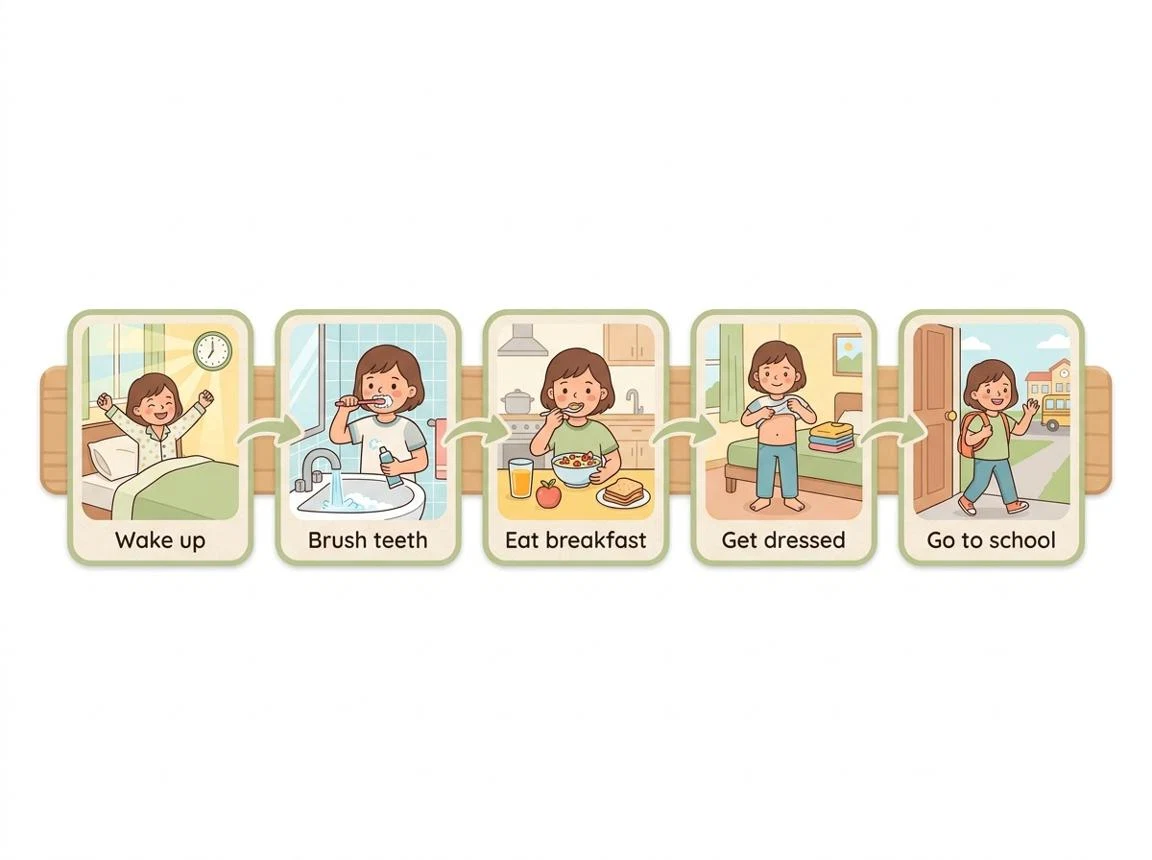
2. Talking about daily routines (La routine quotidienne)
ezducate.ai
French reflexive verbs are commonly used to describe daily activities.
|
French expression |
English |
|---|---|
|
Je me réveille à six heures. |
I wake up at six. |
|
Je me lève. |
I get up. |
|
Je me lave. |
I wash myself. |
|
Je me brosse les dents. |
I brush my teeth. |
|
Je prends mon petit-déjeuner. |
I have breakfast. |
|
Je vais à l'école. |
I go to school. |
|
Je fais mes devoirs. |
I do my homework. |
|
Je me couche à neuf heures. |
I go to bed at nine. |
3. Giving opinions and preferences
To express an opinion:
- Je pense que… — I think that…
- À mon avis… — In my opinion…
- Je crois que… — I believe that…
- Je préfère… — I prefer…
- J'aime… — I like…
- Je n'aime pas… — I do not like…
- J'adore… — I love…
- Je déteste… — I hate…
Examples
J'aime le français parce que c'est intéressant.
I like French because it is interesting.
Je préfère le football au basket-ball.
I prefer football to basketball.
À mon avis, la lecture est importante.
In my opinion, reading is important.
4. Speaking clearly and confidently
Effective oral presentations require preparation and practice.
Learners should speak at an appropriate speed, pronounce words clearly, organise ideas, use familiar vocabulary, maintain suitable eye contact and avoid unnecessary repetition.
5. Basic French pronunciation
Some sounds in French differ from English.
|
French feature |
Explanation and example |
|---|---|
|
é |
A closed vowel, as in été. |
|
è / ê |
A more open vowel, as in père and fête. |
|
ou |
Sounds like the vowel in English food, as in vous. |
|
u |
A rounded front vowel, as in tu; unlike English oo. |
|
ch |
Usually sounds like sh, as in chat. |
|
gn |
Sounds approximately like ny, as in montagne. |
|
Nasal vowels |
Occur in words such as bon, pain and sans. |
A final consonant is often silent in French, but not always. For example, the final s is silent in vous, while the final c is pronounced in avec.
Activity 1.3: Oral presentation
Prepare a one-minute presentation entitled Ma vie scolaire (My school life).
Your presentation should cover your name, school, favourite subjects, best friend, activities and reasons you enjoy learning French.
Model introduction
Bonjour à tous. Je m'appelle Brian. Je suis élève en neuvième année. J'étudie dans une école au Kenya. Ma matière préférée est le français parce que j'aime apprendre de nouvelles langues…