
1. Meaning of a cube
The cube of a number is obtained by multiplying that number by itself three times.
Examples
A negative number cubed gives a negative answer because it is multiplied an odd number of times.
2. Cubes of common numbers
|
Number |
Cube |
|---|---|
|
1 |
1 |
|
2 |
8 |
|
3 |
27 |
|
4 |
64 |
|
5 |
125 |
|
6 |
216 |
|
7 |
343 |
|
8 |
512 |
|
9 |
729 |
|
10 |
1,000 |
|
11 |
1,331 |
|
12 |
1,728 |
3. Meaning of a cube root
The cube root of a number is a number that, when multiplied by itself three times, gives the original number.
Examples
4. Finding cube roots using prime factorisation
Worked example: Find
Express 1728 as a product of prime factors:
Group the factors in threes:
Therefore:
Worked example 2: Find
5. Finding cubes and cube roots using tables
Traditional mathematical tables can be used to find cubes and cube roots.
For cubes: Locate the given number and read the corresponding cube, applying the table's instructions for decimal positions.
For cube roots: Locate the given number in the cube table, then read the number whose cube matches it.
For example, since:
then:
For numbers not appearing exactly in a table, interpolation or other methods may be needed, depending on the table.
6. Using a calculator
To calculate a cube, enter the number and use the function, or multiply the number by itself three times.
To calculate a cube root, use the function where available, or raise a positive number to the power .
Example
7. Real-life application: Volume of a cube
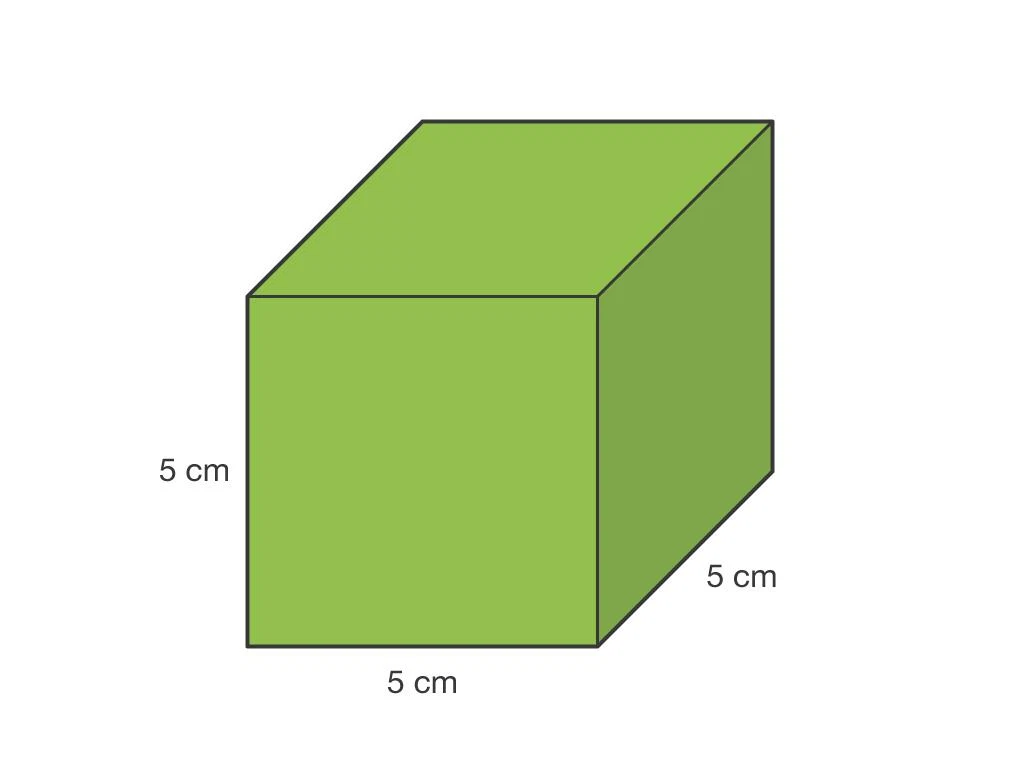
The volume of a cube is:
Where is the length of one edge.
A cubic water tank has an internal side length of 3 m.
If the volume of a cube is 64 cm³, its side length is:
Exercise 1.2
- Find .
- Find .
- Calculate .
- Find using factorisation.
- A cube has a volume of 1,000 cm³. Find its side length.