
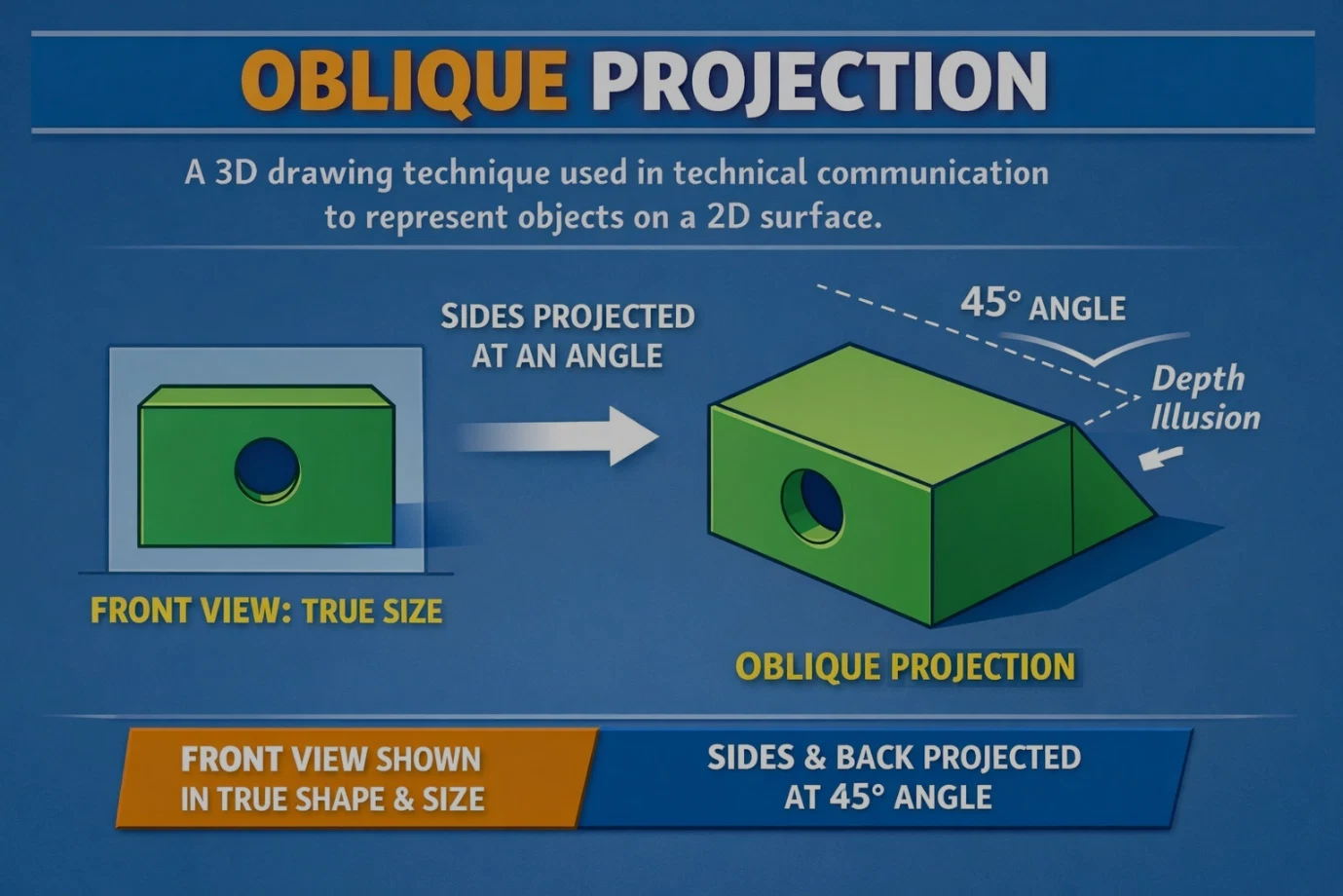
Definition Oblique projection is a 3D drawing technique used in technical communication to represent objects on a flat (2D) surface. It shows the front view in true shape/size and projects the sides/back at an angle (usually 45°) to give the illusion of depth/3D.
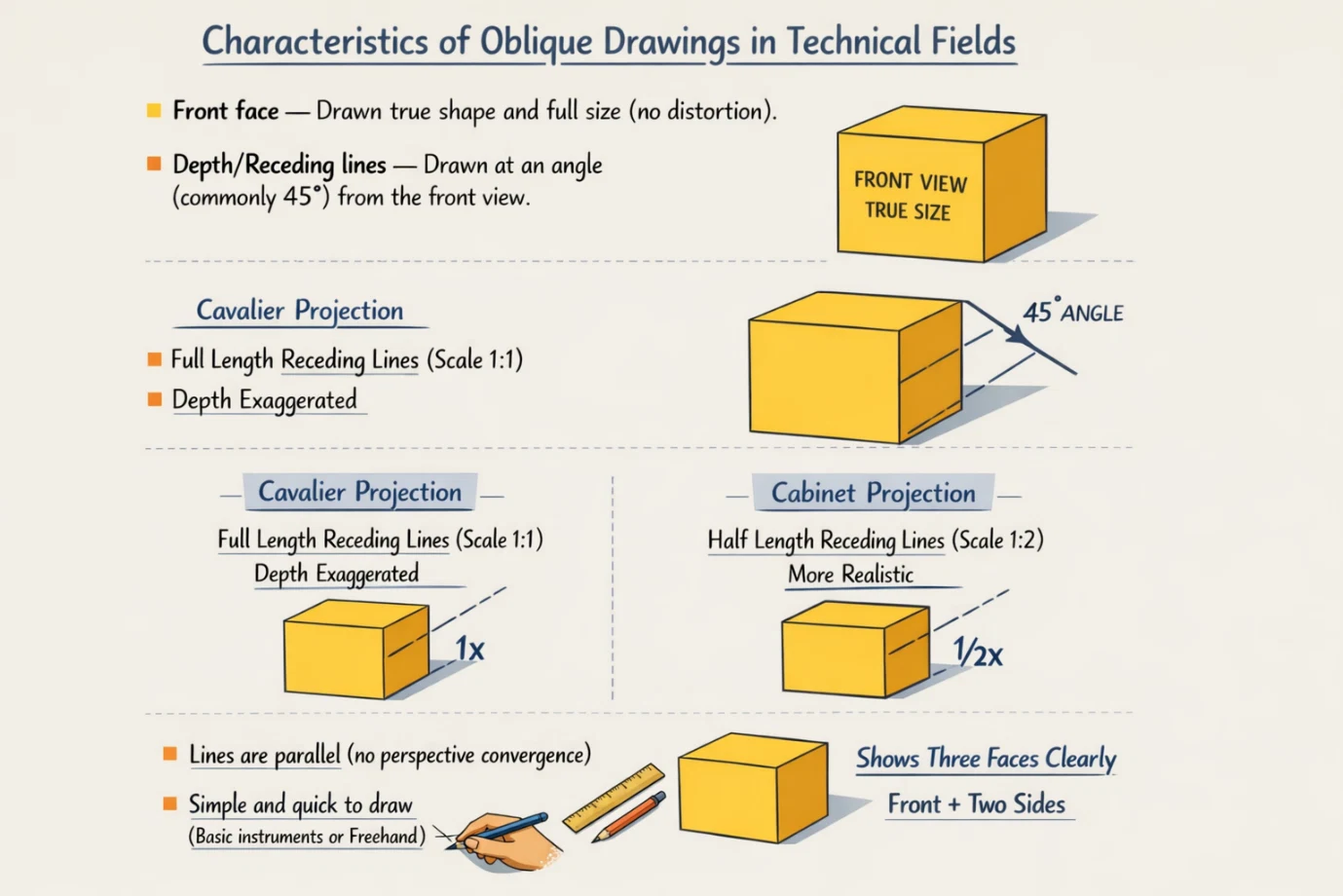
Characteristics of Oblique Drawings in Technical Fields
- Front face — Drawn true shape and full size (no distortion).
- Depth/Receding lines — Drawn at an angle (commonly 45°) from the front view.
- Two main types:
- Cavalier projection — Receding lines drawn full length (scale 1:1) → depth looks exaggerated.
- Cabinet projection — Receding lines drawn half length (scale 1:2) → looks more realistic/natural.
- Lines are parallel (no perspective convergence).
- Simple and quick to draw (uses basic instruments or freehand).
- Shows three faces of an object clearly (front + two sides).
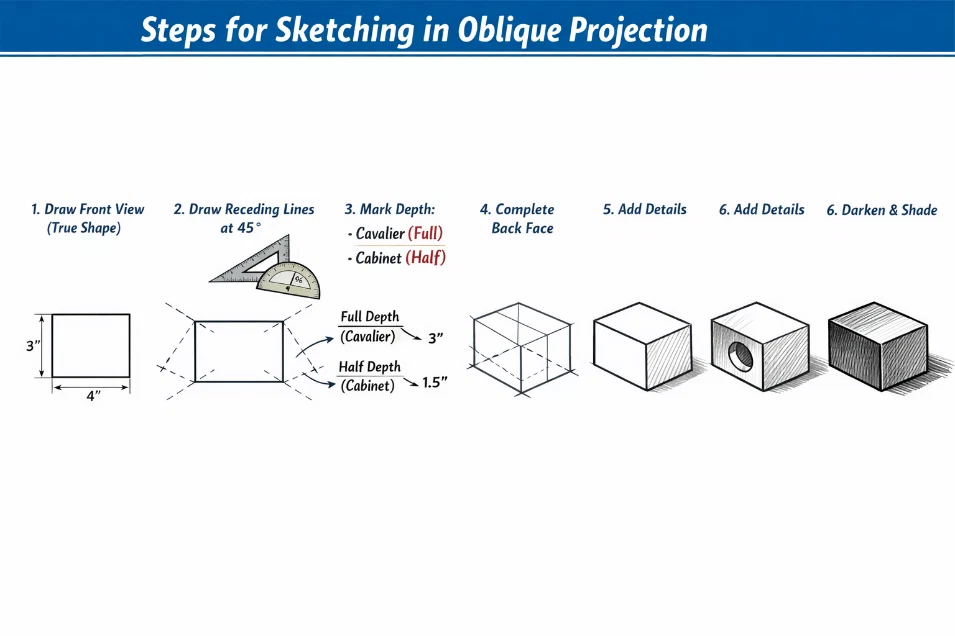
Steps for Sketching/Drawing in Oblique Projection
- Draw the front view true shape/size (use actual measurements).
- From each corner of the front view, draw receding lines at 45° angle (use set square or protractor).
- Measure and mark depth along receding lines:
- Full length for cavalier.
- Half length for cabinet.
- Complete the back face by connecting the ends of receding lines (parallel to front).
- Add details (curves, circles become ellipses on receding faces).
- Darken outlines and add shading/hatching if needed.
Drawing Shaped Blocks in Oblique Projection
- Shaped blocks = Objects with curves, holes, steps, or irregular shapes (e.g., L-block, stepped block, block with cylinder).
- Use geometrical set (pencils, set square, compass, ruler).
- For curves/circles on receding faces: Draw as ellipses (use compass or freehand approximation).
- Practice: Draw given 2D views → convert to oblique (cavalier then cabinet).
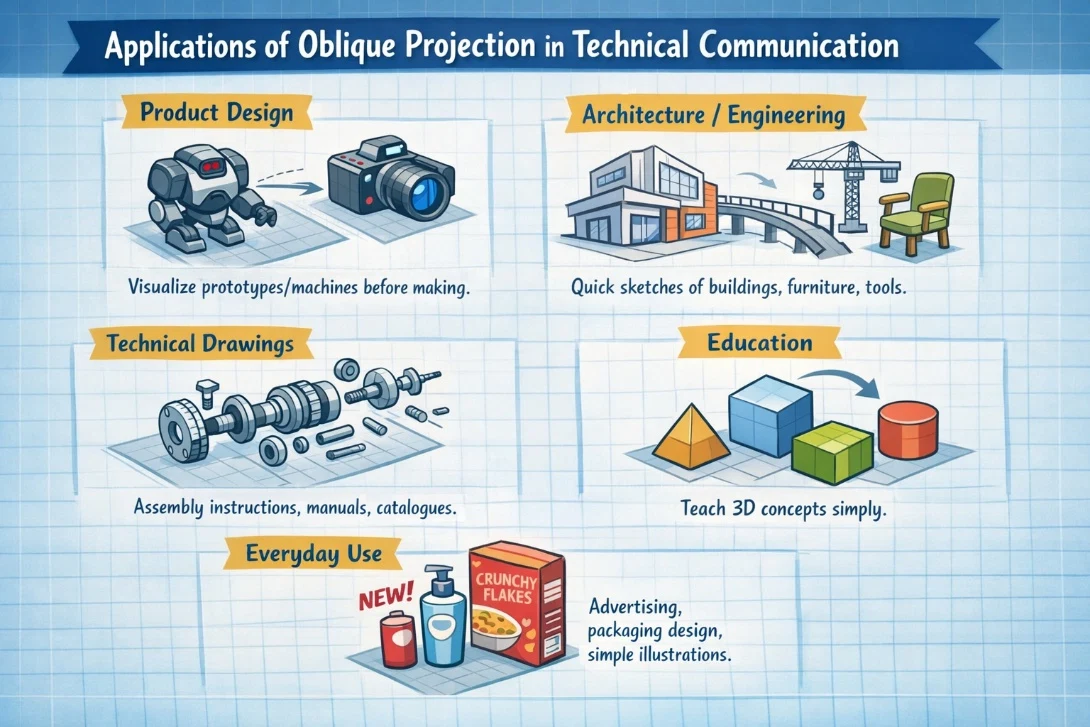
Applications of Oblique Projection in Technical Communication
- Product design → Visualize prototypes/machines before making.
- Architecture/engineering → Quick sketches of buildings, furniture, tools.
- Technical drawings → Assembly instructions, manuals, catalogues.
- Education → Teach 3D concepts simply.
- Everyday use → Advertising, packaging design, simple illustrations.
Importance of Oblique Projection
- Easy/fast for beginners (no complex perspective rules).
- Clearly shows details of front + depth.
- Useful in technical fields for quick communication of ideas.
- Develops spatial visualisation, precision, and creativity.