
Definition Holding tools are devices used to grip, secure, or support workpieces firmly during cutting, shaping, drilling, filing, or other operations. They prevent movement of the material, ensure accuracy, and improve safety.
Holding Tools Used in Day-to-Day Life Common holding tools (focus on those in Grade 9 syllabus):
|
Tool |
Description / Parts |
Main Uses / Tasks Performed |
Typical Materials Held |
|---|---|---|---|
|
Bench Vice |
Fixed to workbench; has two jaws (fixed + movable), handle, base. |
Holding wood/metal for sawing, filing, drilling. |
Wood planks, metal bars, small assemblies. |
|
Hand Vice |
Small portable vice with two jaws and handle. |
Holding small items for filing, drilling, shaping. |
Small metal pieces, wires, jewellery items. |
|
G-Clamp / C-Clamp |
C-shaped frame with screw thread to tighten jaws. |
Clamping workpieces to bench or together temporarily. |
Wood boards, metal sheets during gluing/welding. |
|
Sash Cramp |
Long bar with movable head and fixed foot; screw tightens. |
Holding long pieces or frames during gluing. |
Door frames, table tops, long timber. |
|
Toolmaker’s Vice |
Precision vice with smooth jaws (often on milling/drilling machines). |
Holding delicate/precise work. |
Small metal parts, engineering components. |
|
Pliers (various) |
Long-nose, combination, flat-nose, round-nose, side-cutting. |
Gripping, bending, twisting, cutting small wires/objects. |
Wires, nails, small components. |
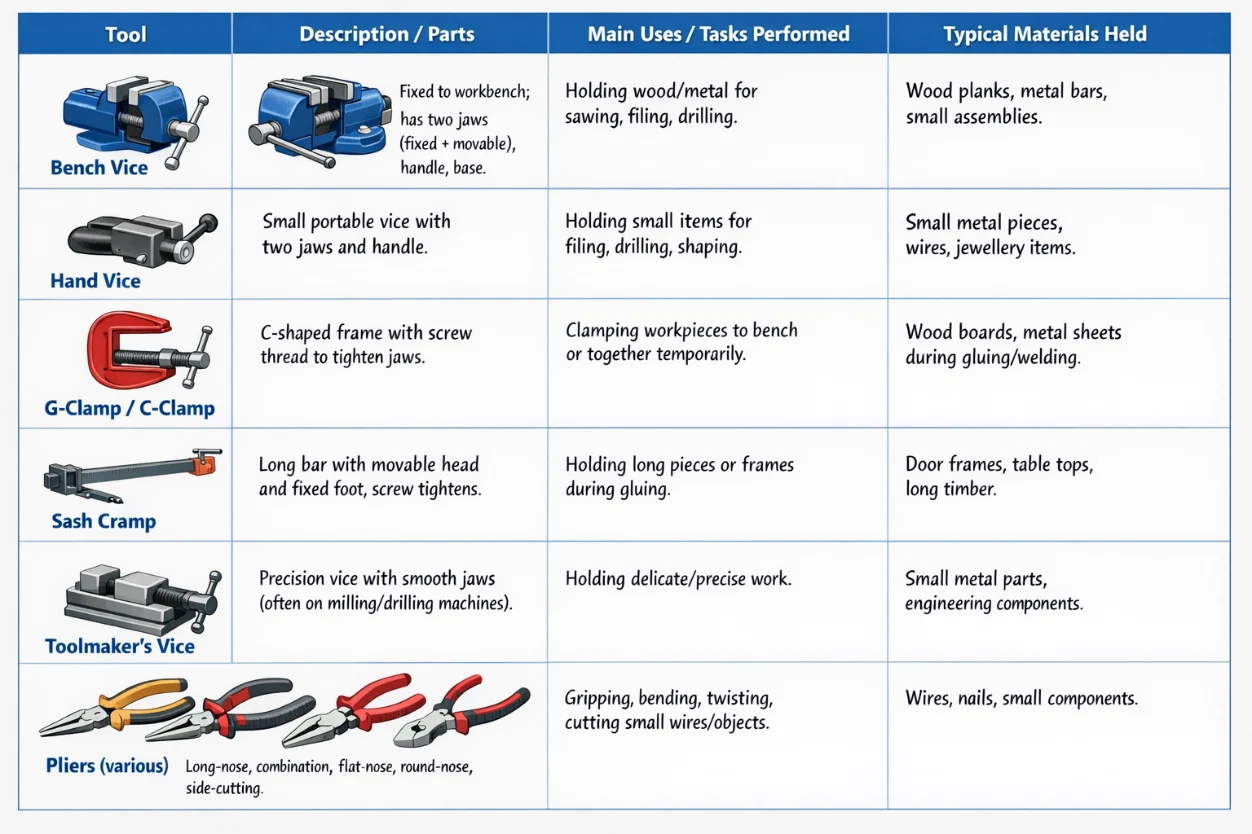
Selecting Holding Tools for Performing Given Tasks
- Match tool size/capacity to workpiece size (e.g., large bench vice for big timber).
- Choose jaw type: smooth jaws for delicate/finished surfaces, serrated for rough grip.
- Consider task: permanent hold (vice) vs temporary (clamp).
- Ensure tool is in good condition (no cracks, jaws align properly).
- Select based on material: soft jaws/padding for polished wood/metal to avoid marks.
Uses of Holding Tools
- Secure workpiece to prevent slipping → accurate cuts/shapes.
- Free both hands for tool operation (saw, chisel, file).
- Improve safety (reduce risk of injury from moving workpiece).
- Support gluing/joining (clamps hold pieces until adhesive sets).
- Allow precise work on small or awkward shapes.
Caring for Holding Tools Used in Day-to-Day Life
- Clean after use (remove dust, grease, metal shavings).
- Oil moving parts (screw threads, handles) to prevent rust/sticking.
- Store in dry place, hanging or on racks (avoid floor contact).
- Check jaws/threads regularly; repair/replace if worn.
- Do not overload or misuse (e.g., no hammering on vice).
- Protect jaws with soft material when holding finished surfaces.
Importance of Holding Tools in Day-to-Day Life
- Ensures accuracy and quality in production (carpentry, metalwork).
- Increases safety (prevents slips, flying pieces).
- Saves time and reduces effort.
- Extends tool/workpiece life (proper grip avoids damage).
- Supports trades/jobs (carpenters, mechanics, artisans).