
Definition
Financial services are activities and institutions that help individuals and businesses manage money, save, borrow, invest, make payments, and reduce financial risks.
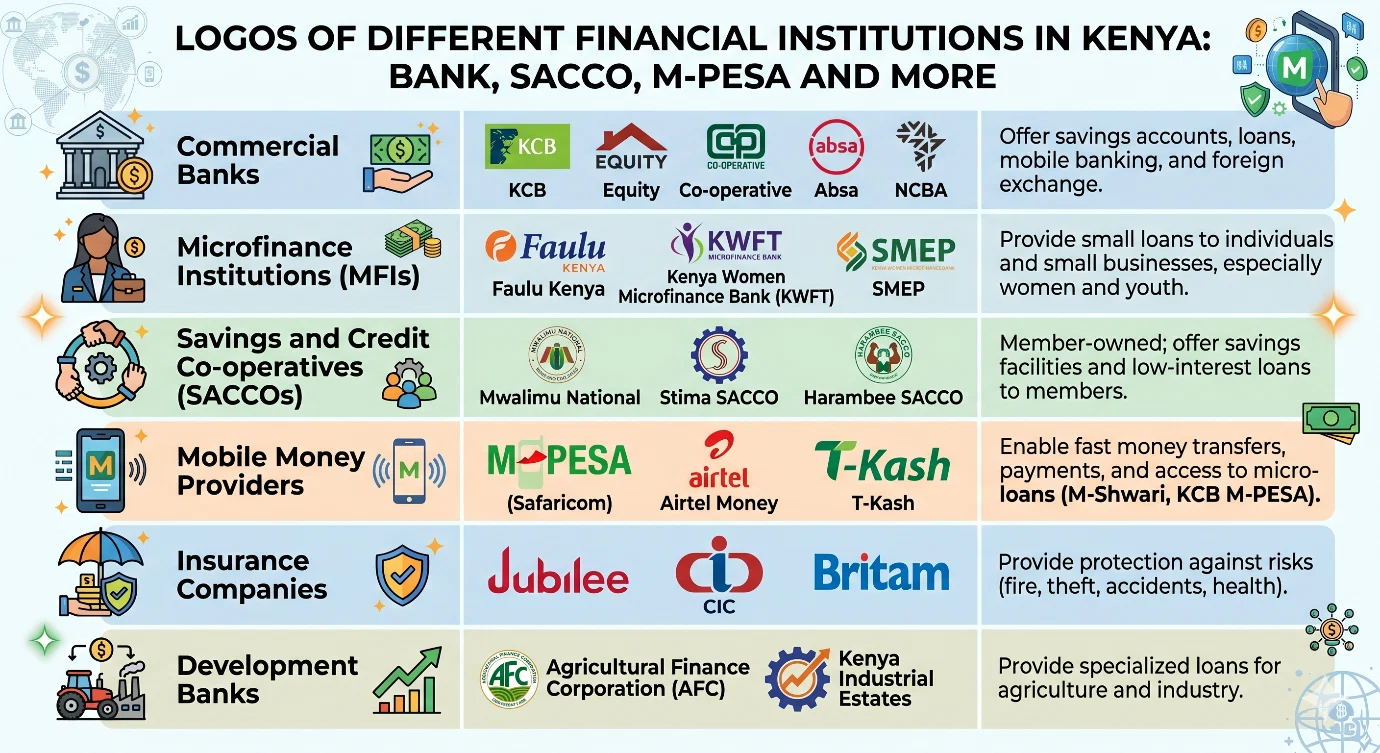
Financial Institutions Available in Kenya
|
Type |
Examples |
Description |
|---|---|---|
|
Commercial Banks |
KCB, Equity, Co-operative, Absa, NCBA |
Offer savings accounts, loans, mobile banking, and foreign exchange. |
|
Microfinance Institutions (MFIs) |
Faulu Kenya, Kenya Women Microfinance Bank (KWFT), SMEP |
Provide small loans to individuals and small businesses, especially women and youth. |
|
Savings and Credit Co-operatives (SACCOs) |
Mwalimu National, Stima SACCO, Harambee SACCO |
Member-owned; offer savings facilities and low-interest loans to members. |
|
Mobile Money Providers |
M-PESA (Safaricom), Airtel Money, T-Kash |
Enable fast money transfers, payments, and access to micro-loans (M-Shwari, KCB M-PESA). |
|
Insurance Companies |
Jubilee, CIC, Britam |
Provide protection against risks (fire, theft, accidents, health). |
|
Development Banks |
Agricultural Finance Corporation (AFC), Kenya Industrial Estates |
Provide specialized loans for agriculture and industry. |
Classification of Financial Institutions
- Banking Financial Institutions: Mainly accept deposits and provide loans (e.g., Commercial Banks, regulated by Central Bank of Kenya).
- Non-Banking Financial Institutions: Provide specific financial services but do not take demand deposits (e.g., SACCOs, Insurance Companies, MFIs).
Services Offered
- Savings & Deposits: Safe keeping of money (Savings accounts, Fixed deposits).
- Loans & Credit: Providing capital to start or expand a business (Business loans, Asset finance).
- Payments & Transfers: Mobile money, bank transfers (RTGS, EFT), cheques.
- Insurance: Protecting businesses from unforeseen risks (Fire, Theft, Business Interruption).
- Investment: Money market funds, treasury bills, shares.
- Financial Advice: Budgeting and business planning support.
Utilising Financial Services for Entrepreneurial Development
- Access to Capital: Use loans from banks or SACCOs to buy tools/materials or expand operations.
- Daily Transactions: Use mobile money (M-PESA) for supplier payments and customer collections.
- Risk Management: Use insurance to protect business assets from fire/theft.
- Financial Tracking: Use bank statements to monitor cash flow and plan budgets.