
1. Meaning of community service learning
Community Service Learning (CSL) is a learning approach through which learners identify real community needs, undertake activities that respond to those needs and reflect on what they have learned.
CSL combines classroom learning with responsible community participation.
2. Importance of community service learning
- Encourages active citizenship.
- Develops teamwork.
- Promotes empathy.
- Builds problem-solving skills.
- Encourages responsibility.
- Strengthens relationships between schools and communities.
- Helps learners apply classroom knowledge.
3. Stages of a community service learning project
1
Identify the problem
Observe and investigate an actual community need
2
Design a solution
Compare possible responses and choose a suitable one
3
Plan the project
Set objectives, tasks, materials, budget and timetable
4
Implement the plan
Carry out agreed activities safely
5
Monitor and evaluate
Check results against the objectives
6
Write the report
Record activities, achievements, challenges and lessons
4. Identifying community problems
Learners may identify problems through observation, interviews, community meetings, simple surveys and discussions with teachers or local leaders.
Examples include poor waste disposal, soil erosion, littering, limited tree cover, neglected public spaces and inadequate awareness about water conservation.
5. Example project: Improving school waste management
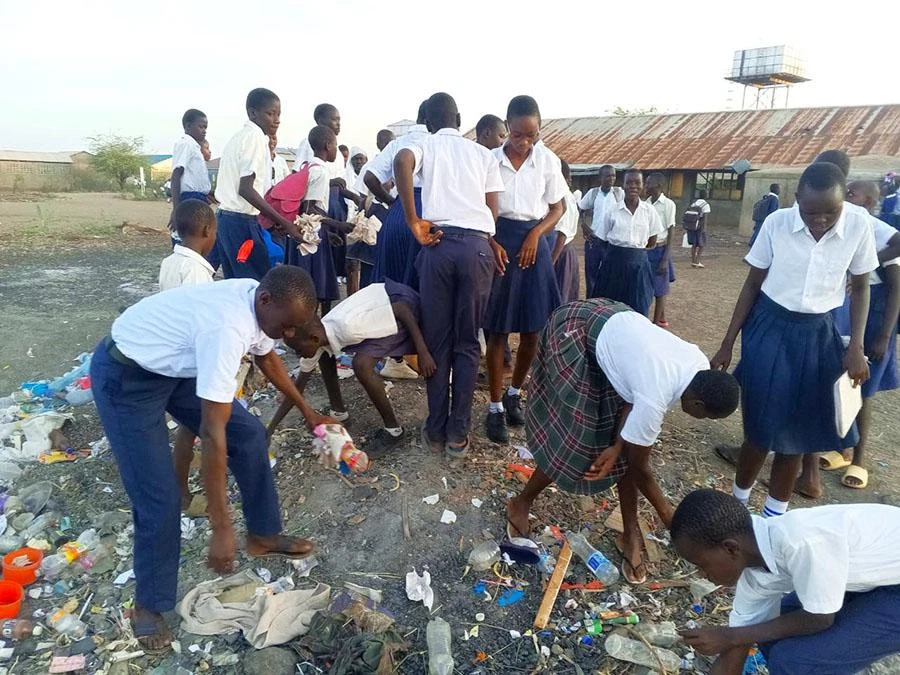
educationaboveall.org
Problem: Littering around the school compound.
Proposed solution: Organise a supervised clean-up and establish labelled waste collection points.
Project objectives
- Identify common types of litter.
- Remove safely collectable litter from selected areas.
- Install or label waste containers where approved.
- Educate learners about responsible waste disposal.
- Evaluate whether littering decreases.
6. Sample project work plan
|
Activity |
Responsible persons |
Resources |
Expected result |
|---|---|---|---|
|
Survey littered areas |
Learner group |
Notebook, checklist |
Problem locations identified |
|
Seek permission |
Group leader and teacher |
Project proposal |
Activity approved |
|
Organise materials |
Logistics group |
Gloves, bags, bins |
Materials available |
|
Conduct clean-up |
Supervised learners |
Protective supplies |
Area cleaned |
|
Awareness campaign |
Communication group |
Posters |
Learners informed |
|
Evaluate results |
Project team |
Checklist, photographs |
Changes documented |
7. Sample project budget
|
Item |
Quantity |
Illustrative cost (KSh) |
|---|---|---|
|
Reusable protective gloves |
10 pairs |
1,000 |
|
Waste collection bags |
10 |
500 |
|
Poster materials |
1 set |
400 |
|
Labels |
1 set |
200 |
|
Total |
2,100 |
These are example planning figures, not verified local prices.
8. Structure of a community service learning report
A project report should include:
- Project title.
- Background and problem statement.
- Objectives.
- Location and participants.
- Materials and resources.
- Activities undertaken.
- Results and evidence.
- Challenges experienced.
- Solutions used.
- Lessons learned.
- Recommendations.
- Conclusion.
9. Importance of teamwork
Teamwork promotes sharing of responsibilities, efficient use of resources, cooperation, creativity and mutual accountability.
Safety: Projects should be approved and supervised. Learners should not handle sharps, medical waste, hazardous chemicals or dangerous locations.
Activity 2.1: Identify one problem in your school or community and prepare a one-page project proposal, including objectives, resources, roles and a simple work plan.