CBC Main Exam Preparation Strategies: From Confusion to Competency – The Ultimate Blueprint for KPSEA, KJSEA & Senior School

CBC Main Exam Preparation Strategies: From Confusion to Competency – The Ultimate Blueprint for KPSEA, KJSEA & Senior School
CBC main exam preparation strategies must shift radically from the old culture of cramming. Imagine two learners waiting for their final assessment results. One spent months swallowing a textbook whole, ready to regurgitate facts. The other built a solar oven from scrap metal for a community project, argued a case before a mock “parliament” in English, and kept a journal of every mistake they ever made in Mathematics. Under Kenya’s Competency-Based Curriculum (CBC), only one of these learners is truly prepared—and it is not the walking encyclopedia. The big national moments, like the KPSEA at Grade 6, the KJSEA at Grade 9, or the forthcoming Senior School gateways, are not about what you can remember on a single morning. They are a celebration of what you can do with what you know.
This guide is your map to that celebration. We will decode the hidden architecture of CBC exams, rewire your study brain for competency, and turn the “boring” parts—like portfolios and community service—into your secret weapons.
1. Know Your Battleground: It’s a Duet, Not a Solo
The old system was a single high-stakes choir performance; you either hit the high note on exam day or you crashed. CBC is a duet between two partners that sing all year long.
- School-Based Assessments (SBA): The Daily Rehearsal
Think of these as your artistic portfolio. Every project, science experiment improvised from makaa, persuasive letter, and group debate counts. In many proposals, these classroom performances contribute up to 20% of your final score. They are not “busy work”; they are the evidence of your skill in action. If you treat the SBA as a dress rehearsal, the main exam loses its terror because you have already proven you can dance. - National Summative Exams: The Live Performance
At the end of Grades 6, 9, and 12, the Kenya National Examinations Council (KNEC) invites you to the main stage. This is where you perform under the lights. However, the rubric is not looking for perfect script-memorization. It is looking for creativity, problem-solving, and communication within that pressure moment. The KPSEA and KJSEA are designed to assess whether you can apply your knowledge to an unfamiliar problem, not recite a definition.
The Creative Shift: Stop asking, “Will this be on the exam?” and start asking, “What can I build, solve, or express with this?”
2. Core CBC Main Exam Preparation Strategies: The Competency Gym
Your brain is not a storage hard drive; it’s a Swiss Army knife. All effective CBC main exam preparation strategies begin by opening the tools, not just cataloguing the box.
Focus on Competencies, Not Cramming
CBC tests seven core competencies, including critical thinking, imagination, and self-efficacy. To train these, turn your revision into a simulation. For instance, don’t just read the Kiswahili comprehension passage—rewrite its ending to show you understand the characters’ motivations. In Mathematics, stop at the answer and build a physical model of the problem using kadogo clay or string. When you explain your reasoning to a younger sibling, you are practising communication and collaboration simultaneously.
Your Digital Training Partners
You don’t have to wander alone. Use tools that understand the CBC rhythm:
- Past Papers as a Flight Simulator: Platforms like EasyElimu offer a treasure trove of KPSEA and KJSEA-style tasks. Don’t just “do” the paper. Set a timer, sit in a quiet space as if in the exam hall, then review the marking scheme to understand why an answer was “Exceeding Expectations” rather than just “Meeting” them.
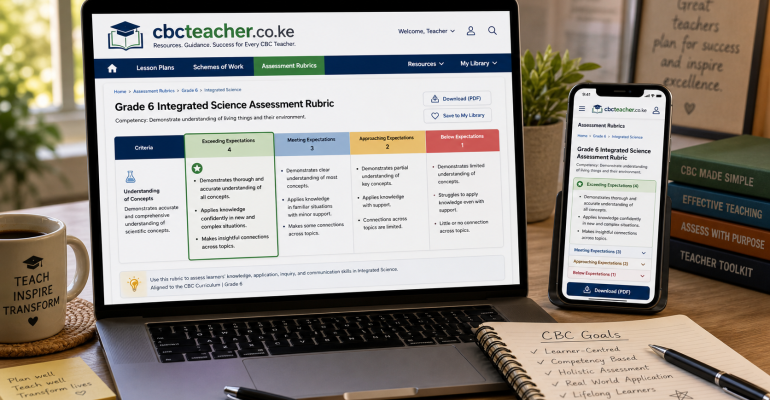
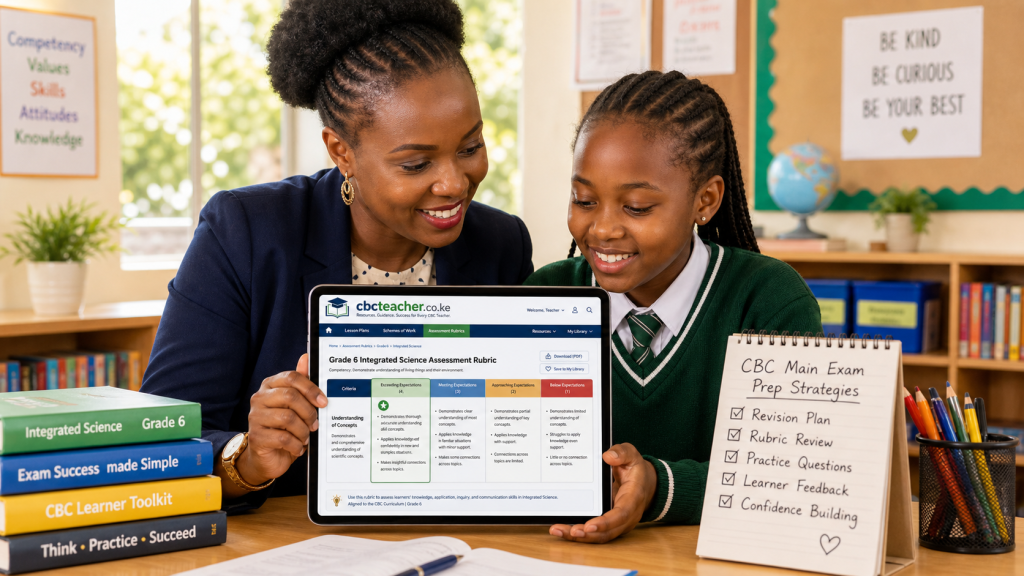
- The Teacher’s Vault – cbcteacher.co.ke: While learners sharpen their skills, parents and teachers need an arsenal of quality-assured materials. cbcteacher.co.ke is the dedicated online staffroom for CBC educators, packed with professional lesson plans, strand-specific assessment rubrics, and ready-to-use schemes of work. For a parent, it’s a window into exactly what “Meeting Expectations” looks like across each subject. For a teacher, it’s the ultimate time-saver that ensures every classroom activity is aligned with KICD designs. When you understand the teacher’s roadmap, you can walk it like a star performer.
- Revision Apps as a Personal Coach: Apps like Enovate CBC Exam go beyond static questions. They track your progress across strands and sub-strands, helping you see with brutal clarity that you’re a superhero in Measurements but a sidekick in Geometry. Grade-specific kits let you attack your weak spots daily, turning your phone into a gym for the mind.
The KICD Seal of Authenticity
The market is flooded with materials from the 8-4-4 era painted in new colours. Be ruthless: only use revision textbooks and kits stamped with the Kenya Institute of Curriculum Development (KICD) approval. If a book asks for a single correct answer to “What is a community?”, leave it. A real CBC question would describe a village with a flooded river and ask you to design a low-cost bridge, write a persuasive speech to the county government, and calculate the materials needed. This is exactly what the best CBC main exam preparation strategies reinforce daily.
3. Subject Superpowers and Pathway Clues
Look at your subjects not as isolated subjects but as a set of tools in your utility belt.
The Compulsory Core: Your Origin Story
Mastery in English, Mathematics, Kiswahili (or Kenyan Sign Language), and Community Service Learning (CSL) is non-negotiable. But mastery here means fluency, not just literacy. In CSL, you are not memorizing the definition of a “problem”; you are identifying a real one in your neighbourhood—perhaps plastic waste clogging a drain—and documenting how you mobilized others to clean and recycle it. That act of documentation is what the exam rubric will see.
Pathway Orientation: The Compass in Grade 9
For Grade 9 learners, the KJSEA is a fork in the road leading to Senior School pathways: Arts and Sports Science, Social Sciences, or STEM. Your performance sends a signal.
- If you find yourself not just calculating averages in Mathematics but using them to predict the trajectory of a football in a Creative Arts and Sports project, the Arts pathway is calling.
- If you dissect an Integrated Science experiment on plant growth and immediately wonder how to improve food security in arid areas, you are reading your compass toward STEM.
- Approach these subjects like an explorer. The exam will ask you to connect dots: “Using your knowledge of Integrated Science and Mathematics, design a sustainable irrigation calendar.” The connections are the mark of a future pathway specialist.
4. The Unseen Syllabus: A Practical Checklist for the Whole Family
Half of the CBC assessment happens before you sit down in the exam hall. Here is your creative, tactical checklist that forms part of your long-term CBC main exam preparation strategies.
1. The Portfolio as a Treasure Chest
Your school-based projects—drawings, written reflections, corrected math drafts—are not just papers; they are gold. Keep them immaculately, arranged by subject and strand, in a dedicated folder. When a KNEC assessor (or your teacher) opens it, they should see a story of growth, not a pile of loose leaves. A portfolio that shows a first failed attempt at an irrigation model, a reflection on why it failed, and a beautiful final version is the very definition of “Exceeding Expectations.”
2. Community Service Learning: The Real-World Lab
Stop treating CSL as a Wednesday afternoon chore. This is where you show that you can transfer classroom ethics into life. If you build a “talking wall” at a local dispensary to teach hygiene in English and Kiswahili, you have just integrated language, art, and citizenship. The exam reflection might ask, “What unintended challenge did you face, and how did your group adapt?” You can only answer that if you actually did the work, not if you just read about it.
3. Rubric Review: Steal the Director’s Notes
The greatest creative secret in CBC is that teachers hold the script to success: the assessment rubric. Ask for it before every major task. It will have explicit descriptions of what “Beginning,” “Approaching,” “Meeting,” and “Exceeding” expectations look like. For a story-writing exercise, “Meeting” might be a correct plot with good grammar; “Exceeding” might be a plot with an unexpected twist, vivid sensory details, and dialogue that reveals character. You cannot stumble into “Exceeding”—you design your project to match that rubric’s image of brilliance. This is strategic artistry. (And if your own teacher hasn’t shared one, platforms like cbcteacher.co.ke offer sample rubrics directly aligned to KNEC’s expectations, so you never work blind.)
The Final Creative Act
Preparing for your CBC main exam using these CBC main exam preparation strategies is really the act of becoming a problem-solver who can stand in front of any mystery—a scientific one, a social one, a linguistic one—and say, “I can figure this out.” When you walk into the KPSEA or KJSEA room, do not see a trap; see an empty stage, an open canvas, or a community waiting for your solution. You’ve been rehearsing all year. Now, perform.
The pen is no longer red; it’s your brush. Paint your future.