
Introduction
Salts are important chemical substances used in homes, agriculture, medicine, manufacturing and laboratories.
Common table salt is sodium chloride, but many other compounds are also classified as salts. These include copper(II) sulfate, calcium carbonate, sodium nitrate and ammonium sulfate.
Salts differ in their solubility, colour, crystal structure, behaviour in air and chemical properties.
Understanding these properties helps learners classify salts, select suitable preparation methods and explain their uses.
Specific Learning Outcomes
By the end of this sub-strand, learners should be able to classify salts according to their properties, prepare selected salts using appropriate laboratory methods, describe their behaviour in air, explain their applications and appreciate the importance of responsible chemical use.
Key Inquiry Questions
- How do salts behave when exposed to air?
- How can salts be prepared in the laboratory?
2.2.1 Meaning of a Salt
A salt is an ionic compound that can be considered to result from replacement of one or more ionisable hydrogen ions of an acid by metal ions, ammonium ions or other suitable cations.
For example, sodium chloride may be formed by neutralising hydrochloric acid with sodium hydroxide.
HCl+NaOH → NaCl+H₂O
The salt produced is sodium chloride.
Common Salts and Their Uses
|
Salt |
Formula |
Common application |
|---|---|---|
|
Sodium chloride |
NaCl |
Food seasoning and chemical manufacture |
|
Calcium carbonate |
CaCO₃ |
Cement and building materials |
|
Copper(II) sulfate |
CuSO₄ |
Laboratory and selected industrial uses |
|
Ammonium sulfate |
(NH₄)₂SO₄ |
Fertiliser |
|
Sodium carbonate |
Na₂CO₃ |
Glass and detergent manufacture |
|
Potassium nitrate |
KNO₃ |
Selected fertiliser applications |
|
Magnesium sulfate |
MgSO₄ |
Agriculture and chemical applications |
The applications of salts depend on their purity, composition and intended use.
2.2.2 Classification of Salts
Salts may be classified as normal, acidic, basic or double salts.
Normal Salts
A normal salt is formed when all replaceable acidic hydrogen ions have been replaced by suitable cations.
Examples:
Acid Salts
An acid salt results from partial replacement of the ionisable hydrogen ions of a polyprotic acid.
It retains at least one potentially ionisable hydrogen.
Examples:
An acid salt is not necessarily acidic when dissolved in water. Sodium hydrogen carbonate, for example, forms a mildly alkaline aqueous solution.
Basic Salts
Basic salts contain hydroxide or oxide components together with other anions, arising under suitable conditions of partial neutralisation or related reactions.
An example is basic copper(II) carbonate:
Basic salts should not be confused with all salts that form alkaline solutions.
Double Salts
A double salt contains two or more simple salts crystallised together in a definite composition and generally dissociates into its constituent ions in aqueous solution.
An example is potassium aluminium sulfate dodecahydrate, commonly called potash alum:
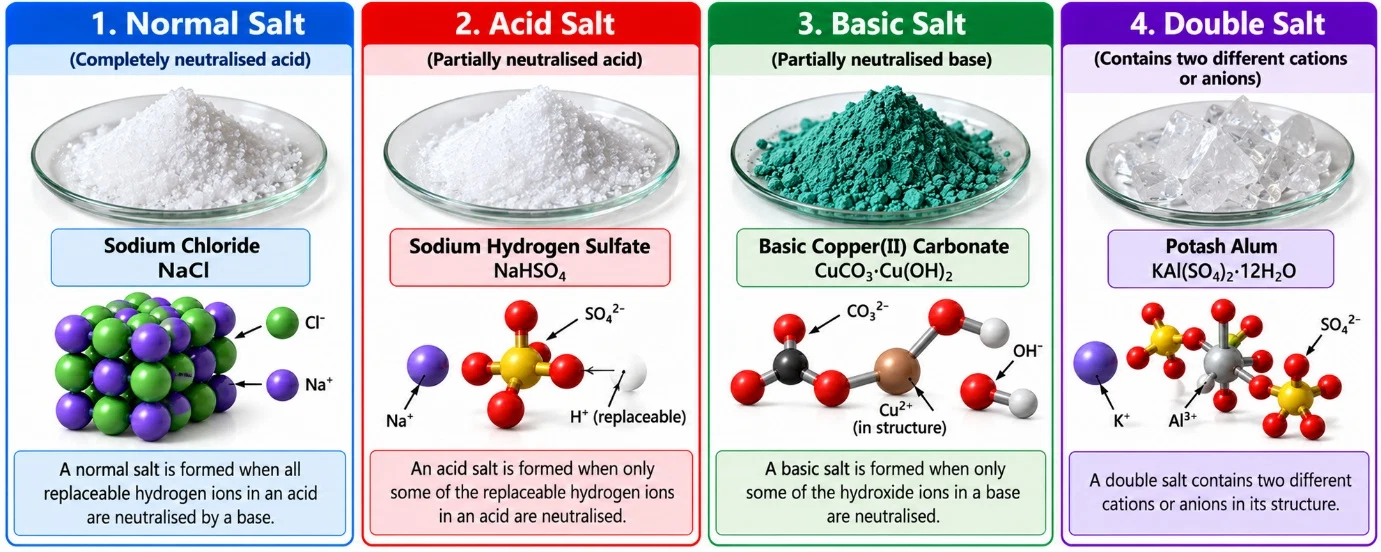
Figure 2.7: Types of Salts
2.2.3 Classification According to Solubility
Salts may also be classified according to their solubility in water.
A soluble salt dissolves to an appreciable extent under specified conditions.
An insoluble salt has very low solubility in water.
Solubility depends on temperature and the chemical nature of the salt.
General Solubility Rules
|
Salt category |
General rule |
Important exceptions or qualifications |
|---|---|---|
|
Sodium, potassium and ammonium salts |
Usually soluble |
Particular compounds may show unusual behaviour |
|
Nitrates |
Soluble |
No common introductory exceptions |
|
Chlorides |
Most soluble |
Silver chloride and lead(II) chloride have low solubility |
|
Sulfates |
Many soluble |
Barium sulfate and lead(II) sulfate have very low solubility |
|
Carbonates |
Most insoluble |
Sodium, potassium and ammonium carbonates are generally soluble |
|
Hydroxides |
Many insoluble |
Sodium and potassium hydroxides are soluble; calcium hydroxide is sparingly soluble |
Solubility rules are useful for predicting precipitation reactions.
2.2.4 Experimental Investigation of Solubility
Solubility can be investigated by adding small amounts of selected salts to water and observing whether they dissolve.
However, absence of visible solid does not by itself provide a quantitative solubility value, and some substances dissolve slowly.
Practical Activity 2.4: Classification of Salts by Solubility
Aim: To classify selected salts as soluble or relatively insoluble.
Materials: Teacher-approved small samples, distilled water, test tubes, spatulas and suitable protective equipment.
Suggested samples: Sodium chloride, potassium nitrate, calcium carbonate and other approved materials.
Procedure:
- Label the test tubes.
- Add a small measured quantity of water to each.
- Introduce a controlled sample of the selected salt.
- Stir gently using an appropriate method.
- Observe whether visible solid remains.
- Record findings.
- Compare observations with approved solubility data.
- Dispose of materials appropriately.
Example Recording Table
|
Salt |
Formula |
Expected behaviour in water |
|---|---|---|
|
Sodium chloride |
NaCl |
Soluble |
|
Potassium nitrate |
KNO₃ |
Soluble |
|
Calcium carbonate |
CaCO₃ |
Low solubility |
|
Copper(II) sulfate |
CuSO₄ |
Soluble |
|
Barium sulfate |
BaSO₄ |
Very low solubility |
Barium compounds should not be handled by learners unless an appropriate risk assessment and safe alternative arrangements are provided.
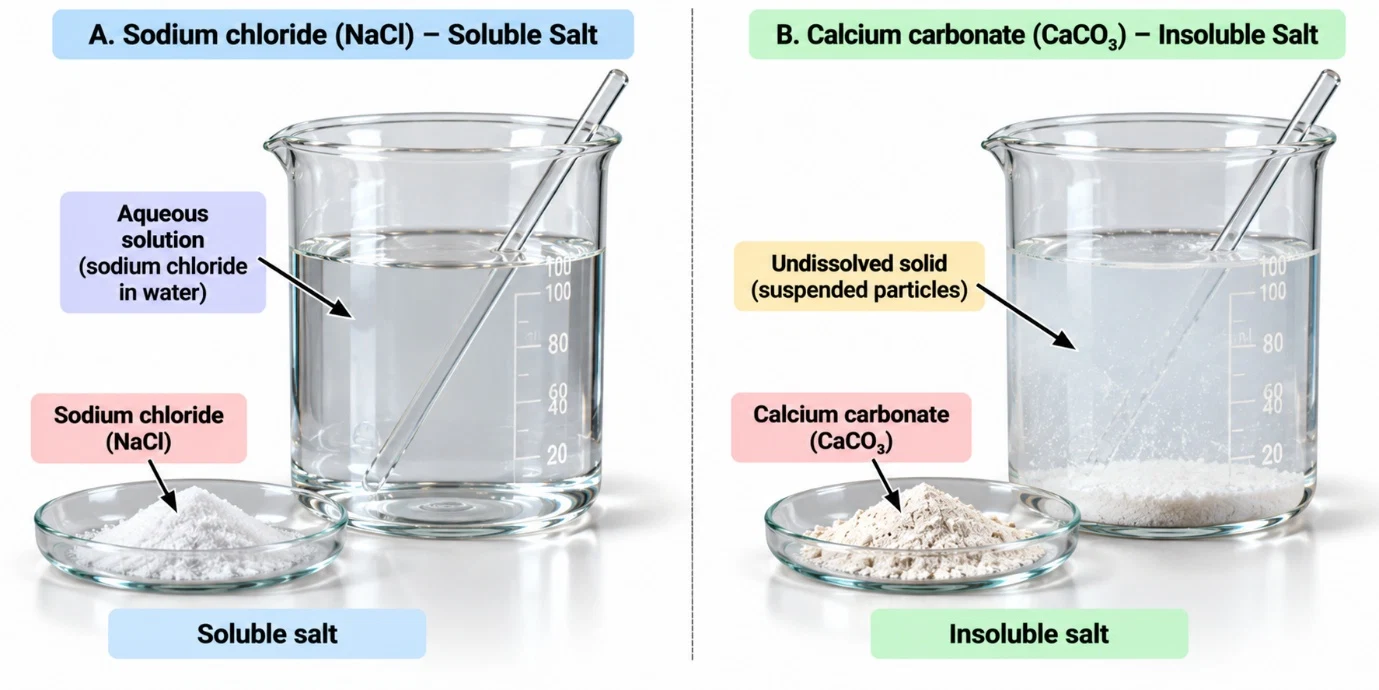
Figure 2.8: Soluble and Insoluble Salts
2.2.5 Methods of Preparing Salts
The method selected depends on the chemical properties and solubility of the desired salt.
The curriculum includes:
- Direct synthesis.
- Reaction of acids with metals.
- Reaction of acids with bases.
- Reaction of acids with carbonates.
- Reaction of acids with hydrogen carbonates.
- Precipitation reactions.
2.2.6 Preparation by Direct Synthesis
Direct synthesis involves combining appropriate elements to form a compound.
Example: Formation of Magnesium Chloride
Mg+Cl₂ → MgCl₂
Magnesium combines with chlorine to form magnesium chloride.
Example: Formation of Iron(II) Sulfide
Fe+S → FeS
Iron and sulfur react under suitable conditions to produce iron(II) sulfide.
Safety: Reactions involving chlorine gas or heated reactive mixtures require suitable facilities and competent supervision. Classroom teaching can use approved demonstrations or simulations.
2.2.7 Preparation by Reaction of Acids with Metals
Suitable metals can react with dilute acids to form salts and hydrogen gas.
General Equation
Metal+Acid → Salt+Hydrogen
Example: Zinc Sulfate
Zn+H₂SO₄ → ZnSO₄+H₂
Laboratory Principle
For a suitable soluble salt, an approved small-scale preparation may involve allowing an appropriate metal to react with a dilute acid, removing excess unreacted metal, and recovering salt through evaporation or crystallisation.
Hydrogen generation requires appropriate precautions, including the absence of ignition sources.
2.2.8 Preparation by Acid–Base Reaction
A soluble salt can be prepared by neutralisation.
General Equation
Acid+Base → Salt+Water
Example: Sodium Chloride
HCl+NaOH → NaCl+H₂O
Where both reactants are soluble, titration or a controlled neutralisation procedure may be used to determine suitable reacting quantities.
Example: Copper(II) Sulfate
CuO+H₂SO₄ → CuSO₄+H₂O
Copper(II) oxide is insoluble in water and can be used under suitable conditions to react with dilute sulfuric(VI) acid.
After removal of excess solid, the resulting solution may be crystallised.
2.2.9 Preparation Using Acids and Carbonates
Carbonates react with appropriate acids to produce salts, water and carbon dioxide.
Example: Copper(II) Carbonate and Sulfuric(VI) Acid
CuCO₃+H₂SO₄ → CuSO₄+CO₂+H₂O
A soluble copper(II) sulfate solution may be obtained, followed by crystallisation under suitable laboratory conditions.
Example: Calcium Carbonate and Hydrochloric Acid
CaCO₃+2HCl → CaCl₂+CO₂+H₂O
2.2.10 Preparation Using Hydrogen Carbonates
Hydrogen carbonates react with acids to form salts, water and carbon dioxide.
Example
NaHCO₃+HCl → NaCl+H₂O+CO₂
This reaction demonstrates the production of carbon dioxide from a hydrogen carbonate.
2.2.11 Preparation by Precipitation
Precipitation is the formation of a relatively insoluble solid when suitable aqueous solutions are mixed.
The solid formed is called a precipitate.
Precipitation reactions are commonly used to prepare insoluble salts.
Example: Silver Chloride
AgNO₃(aq)+NaCl(aq) → AgCl(s)+NaNO₃(aq)
A white precipitate of silver chloride forms.
Net Ionic Equation
Ag⁺(aq)+Cl⁻(aq) → AgCl(s)
The spectator ions are sodium and nitrate ions.
Example: Barium Sulfate
BaCl₂(aq)+Na₂SO₄(aq) → BaSO₄(s)+2NaCl(aq)
Net ionic equation:
Ba²⁺(aq)+SO₄²⁻(aq) → BaSO₄(s)
Safety: Soluble barium salts and silver nitrate present significant hazards. These examples should be taught through appropriately controlled teacher demonstrations or approved alternatives.
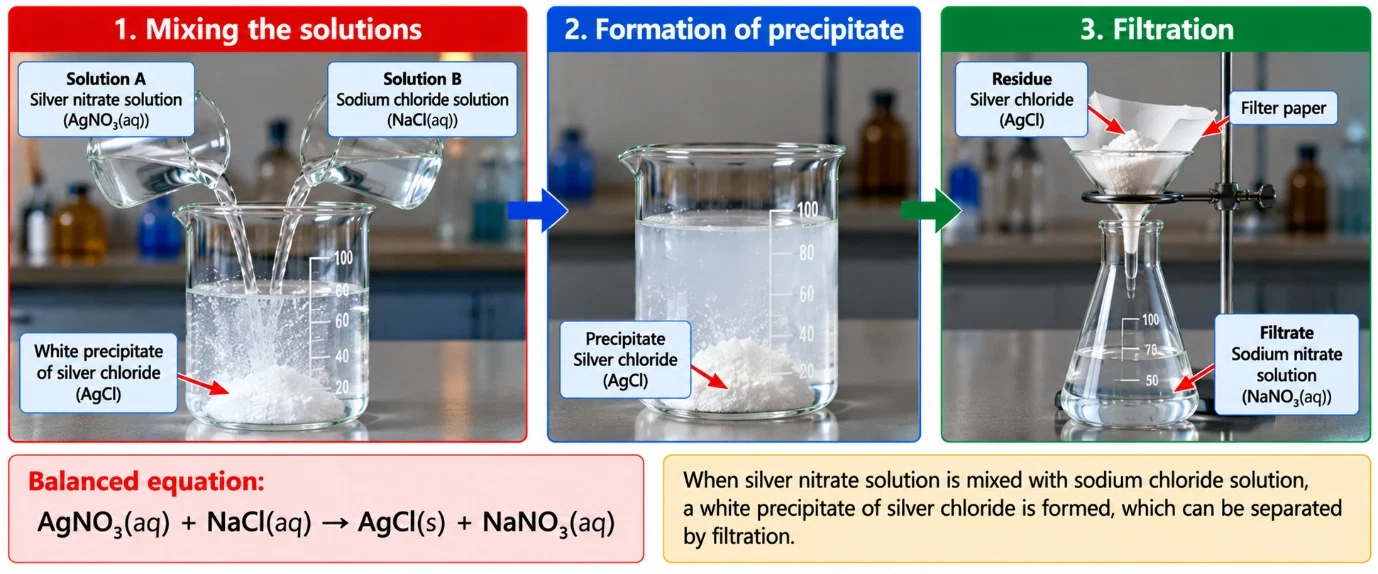
Figure 2.9: Formation of a Precipitate
2.2.12 Writing Ionic Equations for Precipitation Reactions
An ionic equation represents the ions directly involved in the chemical change.
Steps
- Write the balanced full chemical equation.
- Identify soluble strong electrolytes.
- Write them as their constituent ions.
- Remove spectator ions appearing unchanged on both sides.
- Check that atoms and total charges balance.
Worked Example 2.3
Consider:
AgNO₃+NaCl → AgCl+NaNO₃
Full ionic equation:
Ag⁺+NO₃⁻+Na⁺+Cl⁻ → AgCl(s)+Na⁺+NO₃⁻
Remove sodium and nitrate spectator ions:
Ag⁺+Cl⁻ → AgCl(s)
Worked Example 2.4
Reaction between calcium chloride and sodium carbonate:
CaCl₂+Na₂CO₃ → CaCO₃+2NaCl
Net ionic equation:
Ca²⁺+CO₃²⁻ → CaCO₃(s)
2.2.13 Crystallisation
Crystallisation is a process through which a crystalline solid separates from a solution.
It is useful for obtaining crystals of soluble salts.
General Principles
A suitable salt solution may be concentrated by controlled evaporation and then allowed to cool so crystals form.
The crystals can be separated from the remaining solution and dried using an appropriate method.
Important Terms
Saturated solution: A solution containing the maximum dissolved solute possible under specified conditions in equilibrium with undissolved solute.
Mother liquor: The solution remaining after crystals have separated.
Crystal: A solid with an ordered internal structure.
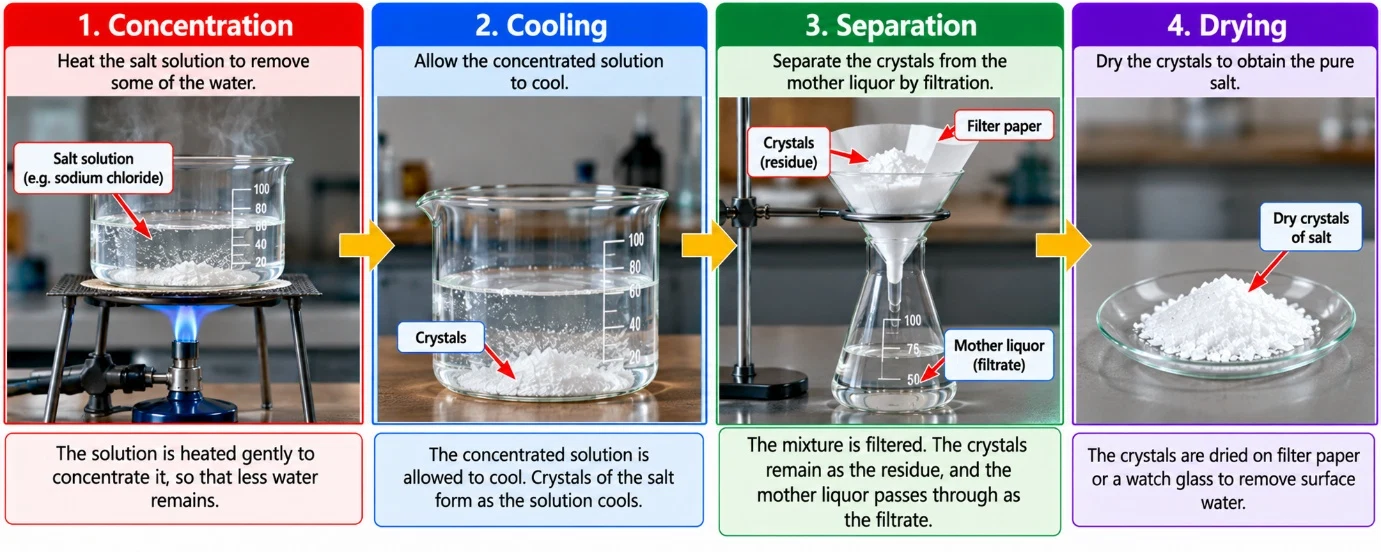
Figure 2.10: Crystallisation of a Soluble Salt
2.2.14 Filtration
Filtration separates an insoluble solid from a liquid using a suitable porous medium.
The solid retained is the residue.
The liquid passing through is the filtrate.
Filtration is especially useful during preparation of insoluble salts or removal of excess insoluble reactants.
2.2.15 Evaporation
Evaporation involves the conversion of a liquid into vapour from its surface.
In salt preparation, controlled evaporation may remove some solvent and increase solute concentration.
Complete evaporation is not always suitable because some salts decompose, lose water of crystallisation or form less desirable products under excessive heating.
2.2.16 Water of Crystallisation
Some crystalline salts incorporate water molecules within their crystal structures.
This water is called water of crystallisation.
Example: Hydrated Copper(II) Sulfate
The formula indicates five water molecules per formula unit of copper(II) sulfate in the crystal.
Hydrated copper(II) sulfate is typically blue.
Anhydrous copper(II) sulfate is white or very pale grey.
Under appropriate controlled conditions, heating hydrated copper(II) sulfate removes water of crystallisation.
CuSO₄ · 5H₂O → CuSO₄+5H₂O
Aspect Ratio: 16:9.
Placement: After Section 2.2.16.
2.2.17 Behaviour of Salts When Exposed to Air
Some salts undergo visible physical changes when left exposed to the atmosphere.
The curriculum specifically identifies hygroscopic, deliquescent and efflorescent behaviour.
Hygroscopic Salts
A hygroscopic substance absorbs moisture from the surrounding air.
A hygroscopic salt may become damp but does not necessarily dissolve in the absorbed water.
Deliquescent Salts
A deliquescent substance absorbs enough moisture from the atmosphere to dissolve and form a solution under suitable humidity conditions.
An example is calcium chloride.
Efflorescent Salts
An efflorescent salt loses some or all of its water of crystallisation on exposure to air under suitable conditions.
An example is hydrated sodium carbonate:
It may lose water of crystallisation and develop a powdery surface.
Comparison
|
Property |
Hygroscopic |
Deliquescent |
Efflorescent |
|---|---|---|---|
|
Main behaviour |
Absorbs moisture |
Absorbs moisture until it can form a solution |
Loses water of crystallisation |
|
Typical observation |
Becomes damp |
May become wet and dissolve |
May develop a powdery appearance |
|
Example |
Selected anhydrous salts |
Calcium chloride |
Hydrated sodium carbonate |
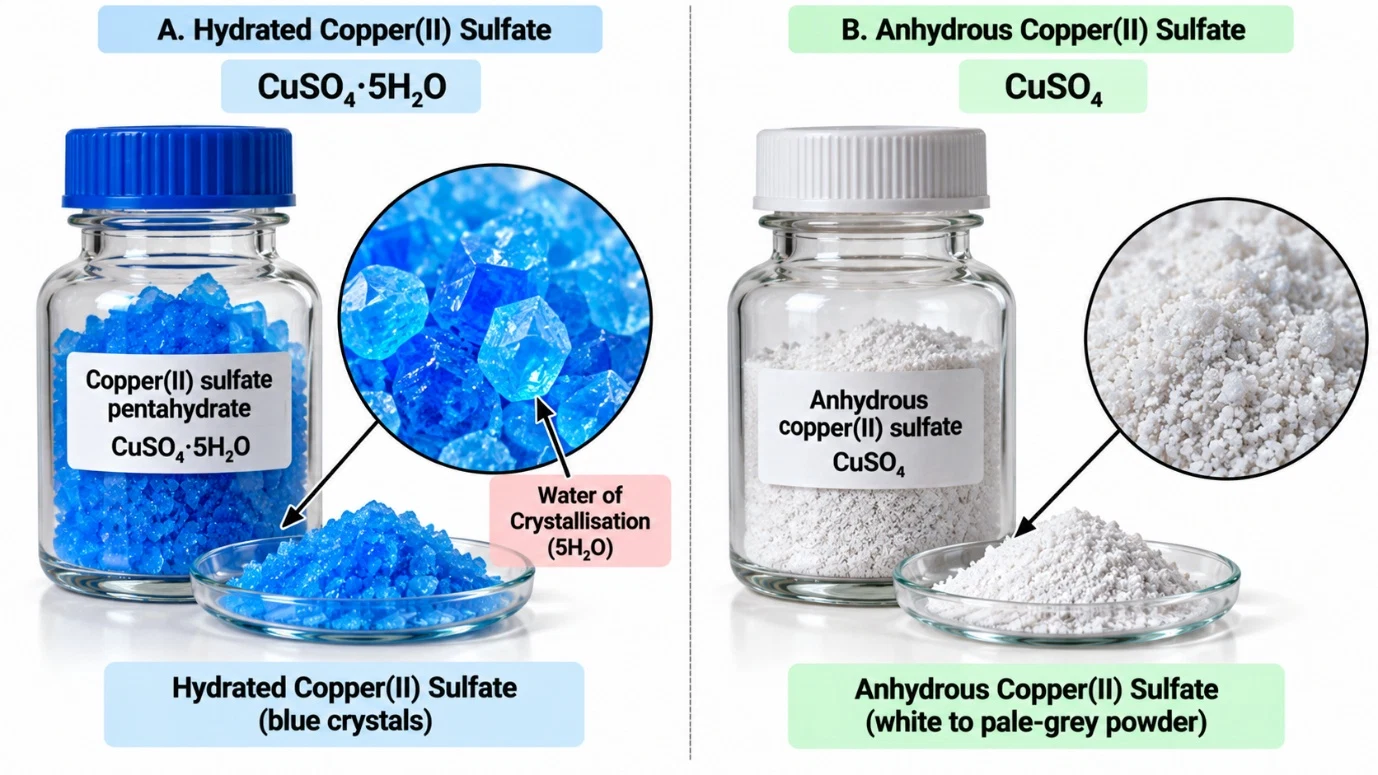
Figure 2.12: Hygroscopic, Deliquescent and Efflorescent Behaviour
2.2.18 Importance of Understanding Salt Behaviour
Salt behaviour influences:
- Packaging requirements.
- Storage conditions.
- Shelf life.
- Product quality.
- Laboratory accuracy.
- Industrial processing.
- Handling and transportation.
For example, moisture-sensitive materials are often stored in properly sealed containers.
2.2.19 Uses of Salts in Agriculture
Salts are important components of many fertilisers.
Examples include ammonium sulfate, potassium nitrate and certain phosphate fertilisers.
They supply nutrients necessary for plant growth when used appropriately.
Nitrogen
Nitrogen supports the synthesis of proteins and other important plant compounds.
Phosphorus
Phosphorus contributes to plant energy-transfer systems and growth processes.
Potassium
Potassium supports enzyme activity, water regulation and other plant functions.
Correct fertiliser application should be based on crop requirements and suitable soil information.
2.2.20 Environmental Effects of Excessive Fertiliser Use
Improper or excessive use of inorganic fertilisers can create environmental problems.
Water Pollution
Nutrient runoff and leaching can introduce nitrogen and phosphorus compounds into water bodies.
Eutrophication
Eutrophication is nutrient enrichment of water that can stimulate excessive plant or algal growth.
General Sequence
- Excess nutrients enter a water body.
- Algae or aquatic plants grow excessively.
- Some of the accumulated organic matter dies.
- Decomposition consumes dissolved oxygen.
- Oxygen depletion may harm aquatic organisms.
The precise process depends on water conditions and the organisms involved.
Soil Effects
Poor fertiliser management may contribute to undesirable changes in soil chemistry.
Air Pollution
Certain nitrogen-related agricultural processes can contribute to emissions such as ammonia or nitrous oxide.
Aspect Ratio: 16:9.
Placement: After Section 2.2.20.
2.2.21 Measures for Sustainable Fertiliser Use
Appropriate practices include:
- Soil testing.
- Applying fertilisers according to crop requirements.
- Avoiding unnecessary excessive application.
- Observing suitable application timing.
- Protecting watercourses with appropriate buffer arrangements.
- Maintaining soil cover to reduce erosion.
- Using good drainage and runoff management.
- Following relevant agricultural and environmental guidance.
2.2.22 Uses of Salts in the Food Industry
Some salts are used in seasoning, preservation, processing and formulation.
Examples include sodium chloride and certain approved food additives.
The suitability of any salt for food use depends on its composition, purity and applicable food safety requirements.
Laboratory-grade salts must not be assumed suitable for consumption.
2.2.23 Uses of Salts in Medicine
Selected salts are used in approved medicinal formulations.
Examples include compounds used in oral rehydration formulations and other medical products.
Medicinal applications require appropriate purity, dosage and professional guidance.
2.2.24 Uses of Salts in the Glass Industry
Sodium carbonate is an important raw material in conventional soda-lime glass manufacture.
It helps reduce the temperature required for melting the glass-forming mixture.
Other materials, including silica and calcium-containing components, are also used.
2.2.25 Uses of Salts in Paper and Paint Industries
Selected inorganic salts serve as fillers, additives, pigments or processing agents.
Their functions depend on the manufacturing process and the material involved.
For example, calcium carbonate is used as a filler or coating component in some paper and paint formulations.
2.2.26 Uses of Salts in Laundry
Sodium carbonate may be used as a water-softening or cleaning aid in suitable detergent formulations.
The action and suitability of salts depend on the product and conditions of use.
2.2.27 General Safety Precautions When Handling Salts
- Read chemical labels.
- Follow teacher instructions.
- Use appropriate protective equipment.
- Avoid inhaling dust.
- Never taste laboratory salts.
- Avoid unnecessary skin contact.
- Keep samples in suitable labelled containers.
- Do not return unused chemicals to stock bottles.
- Prevent mixing of incompatible materials.
- Follow approved waste-disposal procedures.
Practical Activity 2.5: Investigating Salt Behaviour in Air
Aim: To compare the behaviour of teacher-approved hygroscopic, deliquescent and efflorescent samples.
Use sealed reference demonstrations, images or controlled samples selected through a laboratory risk assessment.
Observation Table
|
Sample |
Initial condition |
Observation |
Classification |
|---|---|---|---|
|
A |
Dry material |
Becomes damp |
Hygroscopic behaviour |
|
B |
Solid sample |
Forms a liquid mixture |
Deliquescent behaviour |
|
C |
Hydrated crystals |
Develops a powdery surface |
Efflorescent behaviour |
The observations are illustrative. Actual results depend on the material, atmospheric humidity, temperature and duration.
Practical Activity 2.6: Preparing and Recording Salt Samples
Aim: To understand how soluble and insoluble salts may be obtained using appropriate methods.
Learners should use teacher-selected safe materials, approved microscale activities and supervised demonstrations.
Record the reactants, reaction type, observations, product, relevant balanced chemical equation and method of separation.
Practical Activity 2.7: Investigating the Uses of Salts
Aim: To identify salts used in common products.
Procedure:
- Collect approved product labels or reference photographs.
- Identify named chemical compounds.
- Write their chemical formulae.
- Classify their uses.
- Discuss possible safety and environmental considerations.
- Present the findings.
Example Recording Table
|
Product category |
Example salt |
Formula |
Application |
|---|---|---|---|
|
Food |
Sodium chloride |
NaCl |
Seasoning |
|
Agriculture |
Ammonium sulfate |
(NH₄)₂SO₄ |
Fertiliser |
|
Glass manufacture |
Sodium carbonate |
Na₂CO₃ |
Industrial raw material |
|
Building materials |
Calcium carbonate |
CaCO₃ |
Cement-related manufacture |
Summary of Sub-strand 2.2
Salts are important ionic substances with a wide range of properties and applications.
They may be classified as normal, acidic, basic or double salts.
Solubility rules help predict whether salts dissolve in water or form precipitates.
Salts may be prepared by direct synthesis, acid–metal reactions, neutralisation, acid–carbonate reactions and precipitation.
Crystallisation is used to obtain crystals from suitable solutions.
Some salts absorb atmospheric moisture, dissolve after absorbing sufficient water or lose water of crystallisation.
Salts are widely used in agriculture, food processing, medicine and industry, but inappropriate use can harm the environment.
Revision Questions
- Define a salt.
- Distinguish between normal and acid salts.
- Give two examples of basic salts.
- Explain the meaning of a double salt.
- Identify four generally soluble salt categories.
- State three general solubility rules.
- Describe four methods of preparing salts.
- Write a balanced equation for the formation of magnesium chloride by direct synthesis.
- Write a balanced equation for zinc reacting with dilute sulfuric(VI) acid.
- Explain the reaction of copper(II) oxide with sulfuric(VI) acid.
- Define precipitation.
- Write the net ionic equation for silver chloride precipitation.
- Explain the meaning of spectator ions.
- Describe crystallisation.
- Differentiate between residue and filtrate.
- Define water of crystallisation.
- Explain the differences between hygroscopic, deliquescent and efflorescent substances.
- Identify four applications of salts in everyday life.
- Explain eutrophication.
- State five measures for reducing the environmental effects of excessive fertiliser use.
Selected Revision Answers
Question 8
Mg+Cl₂ → MgCl₂
Question 9
Zn+H₂SO₄ → ZnSO₄+H₂
Question 10
CuO+H₂SO₄ → CuSO₄+H₂O
Question 12
Ag⁺+Cl⁻ → AgCl(s)
END-OF-STRAND 2 ASSESSMENT
Section A: Knowledge and Understanding
- Define acids, bases and salts.
- Distinguish between strong and weak acids.
- Explain the function of an acid–base indicator.
- Describe three reactions of acids.
- Explain amphoteric behaviour.
- Classify salts as normal, acidic, basic or double.
- Describe precipitation.
- Explain hygroscopic, deliquescent and efflorescent behaviour.
- Discuss four industrial applications of salts.
- Explain how excessive fertiliser use can affect aquatic environments.
Section B: Chemical Equations
Balance or complete the following equations:
1. Magnesium and hydrochloric acid
Mg+2HCl → MgCl₂+H₂
2. Calcium carbonate and hydrochloric acid
CaCO₃+2HCl → CaCl₂+CO₂+H₂O
3. Sodium hydroxide and sulfuric(VI) acid
2NaOH+H₂SO₄ → Na₂SO₄+2H₂O
4. Zinc oxide and hydrochloric acid
ZnO+2HCl → ZnCl₂+H₂O
5. Sodium carbonate and calcium chloride
Na₂CO₃+CaCl₂ → CaCO₃(s)+2NaCl
Section C: Competency-Based Assessment
Project: Investigating Household Chemical Products
Prepare a report examining selected safe household chemical products.
The report should include:
- Names of products investigated.
- Relevant chemical compounds shown on labels.
- Classification where supported by the available information.
- Main uses.
- Safety precautions.
- Environmental considerations.
- Suggestions for responsible storage and disposal.
- A conclusion.
Expected Product: A written investigation report, correctly labelled tables and an oral presentation.