
1. Introduction to human sexuality
Human sexuality is an important part of human development and relationships.
It involves the physical, emotional, social and moral aspects of human life associated with being human and relating to others.
Christian Religious Education teaches that human sexuality should be guided by respect, responsibility, self-control and love.
Young people experience physical, emotional and social changes as they grow.
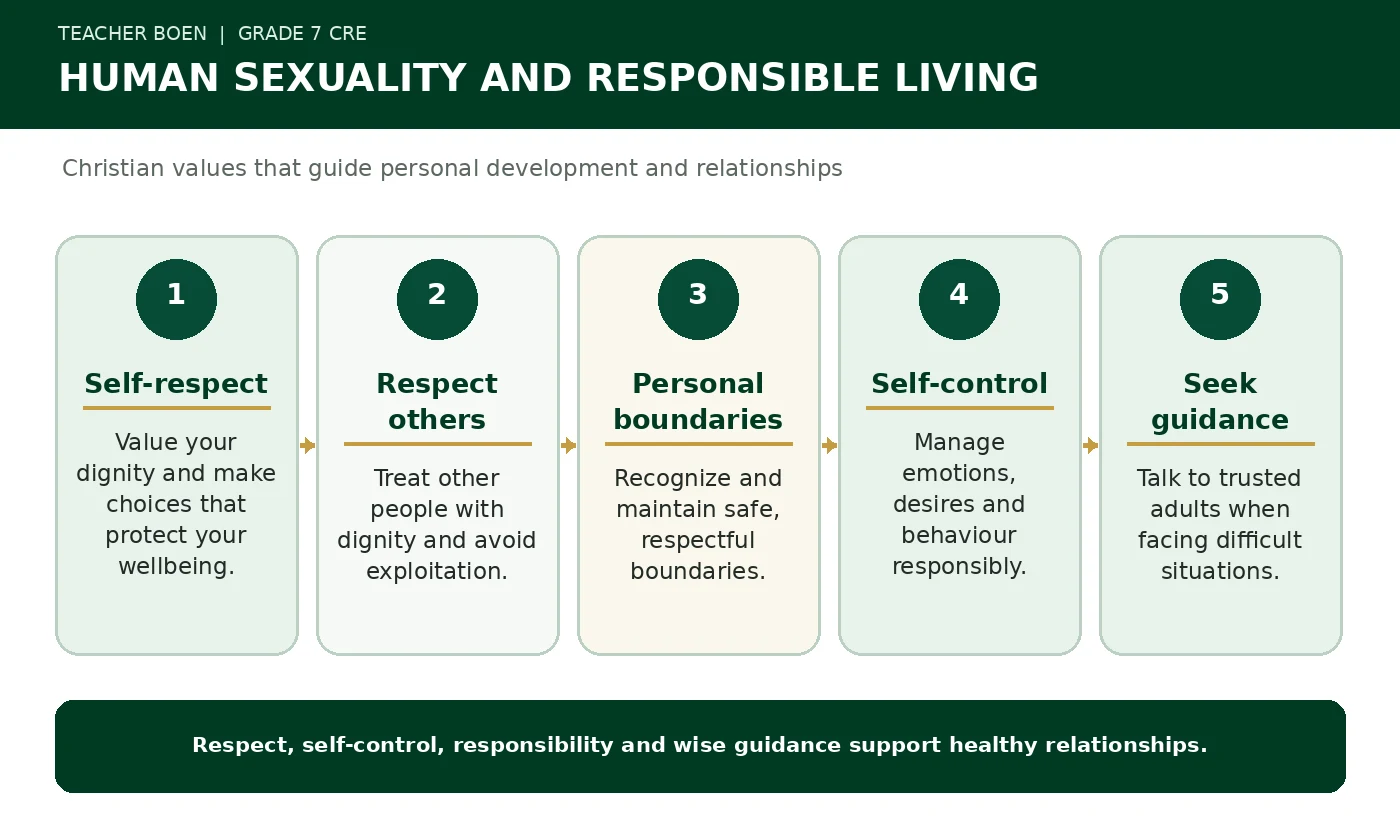
Christian values that encourage respect, self-control and responsible relationships.
They therefore need proper guidance to make responsible decisions and develop healthy relationships.
The Bible encourages Christians to maintain sexual purity and respect their bodies.
2. Meaning of important terms
Human sexuality: The physical, emotional, social and moral aspects of human life relating to sexuality and relationships.
Sexual purity: Living according to moral and religious principles concerning sexual behaviour.
Chastity: Abstaining from sexual activity outside marriage according to Christian teaching.
Healthy relationship: A relationship based on respect, honesty, trust, care and responsible behaviour.
Unhealthy relationship: A relationship involving harmful behaviour such as manipulation, disrespect, coercion or exploitation.
Peer pressure: Influence from friends or people of the same age group to behave in a particular way.
Self-control: The ability to manage one's feelings, desires and behaviour.
Consent: A freely given agreement to something. It must not be obtained through force, threats, pressure or manipulation.
Temptation: An experience or situation that encourages someone to do something considered wrong.
3. Understanding human sexuality
Human sexuality involves different aspects of human development.
A. Physical aspect
This relates to the human body and the physical changes experienced during growth.
During adolescence, young people experience changes associated with puberty.
These changes are a normal part of human development.
B. Emotional aspect
Human sexuality also involves feelings and emotions.
Young people may experience:
- Attraction towards others.
- Changes in emotions.
- A desire for friendship and companionship.
- Increased interest in relationships.
- A need for acceptance and belonging.
Learners should understand their feelings and respond responsibly.
C. Social aspect
This concerns how people relate to one another.
It involves:
- Respecting other people.
- Developing healthy friendships.
- Communicating appropriately.
- Respecting personal boundaries.
- Avoiding discrimination and exploitation.
D. Moral and spiritual aspect
Christian teachings guide believers on how to behave responsibly.
They encourage:
- Chastity.
- Self-control.
- Respect.
- Faithfulness.
- Honesty.
- Responsibility.
4. Importance of understanding human sexuality
- It helps young people understand their development.
- It encourages responsible decision-making.
- It promotes respect for other people.
- It helps learners develop healthy relationships.
- It encourages personal responsibility.
- It helps young people recognise harmful situations.
- It promotes sexual purity according to Christian teachings.
- It helps learners resist negative peer pressure.
- It encourages respect for human dignity.
- It prepares young people to make responsible choices in adulthood.
5. Healthy relationships
A healthy relationship is one in which people treat one another with respect, honesty, kindness and responsibility.
Healthy relationships can exist among family members, friends, classmates and other people.
Characteristics of healthy relationships
A. Mutual respect
People appreciate one another and respect personal differences.
B. Honesty
People communicate truthfully and avoid deception.
C. Trust
Individuals can depend on one another and keep reasonable commitments.
D. Good communication
People express their thoughts and feelings respectfully.
E. Support
Individuals encourage one another during difficult situations.
F. Responsibility
People accept responsibility for their actions.
G. Healthy boundaries
Individuals respect personal space, privacy and decisions.
H. Kindness
People treat one another with care and consideration.
I. Freedom from coercion
No one is forced, threatened or manipulated into doing something against their wishes.
J. Forgiveness
People learn to resolve disagreements peacefully and accept genuine apologies.
6. Unhealthy relationships
An unhealthy relationship is one that causes harm, fear, disrespect or emotional distress.
It may involve manipulation, dishonesty, intimidation or exploitation.
Characteristics of unhealthy relationships
- Constant insults and humiliation.
- Threats and intimidation.
- Physical or emotional abuse.
- Excessive control over another person.
- Dishonesty and manipulation.
- Disrespect for personal boundaries.
- Pressure to engage in inappropriate activities.
- Isolation from family and friends.
- Bullying and discrimination.
- Lack of trust and respect.
7. Differences between healthy and unhealthy relationships
|
Healthy relationship |
Unhealthy relationship |
|---|---|
|
Based on mutual respect. |
Characterised by disrespect. |
|
Encourages honesty. |
Involves dishonesty and deception. |
|
Promotes trust. |
Involves suspicion and manipulation. |
|
Respects personal boundaries. |
Disregards personal boundaries. |
|
Encourages positive behaviour. |
Encourages harmful behaviour. |
|
Supports personal development. |
May interfere with personal development. |
|
Resolves disagreements peacefully. |
Uses threats, insults or violence. |
|
Allows responsible independence. |
Involves excessive control. |
8. Circumstances that can lead to unhealthy relationships
Young people may experience situations that expose them to harmful relationships.
A. Negative peer pressure
Friends may encourage young people to engage in irresponsible activities.
B. Lack of parental guidance
Limited communication and guidance at home may leave young people without appropriate support.
C. Low self-esteem
Some individuals may accept harmful treatment because they feel they are not worthy of respect.
D. Desire for acceptance
Young people may engage in inappropriate behaviour to gain approval from friends or partners.
E. Exposure to inappropriate media
Some media content may encourage disrespectful or irresponsible relationships.
F. Substance abuse
Alcohol and other substances can impair judgement and increase vulnerability to exploitation.
G. Manipulation
Some people use gifts, money, promises or threats to control others.
H. Lack of knowledge
Limited understanding of healthy relationships and personal boundaries can make young people vulnerable.
I. Social pressure
Some young people may feel pressured to engage in activities simply because others are doing them.
J. Exploitation by older people
Some adults or older individuals may misuse their power or influence to take advantage of young people.
9. Circumstances that may lead to sexual temptation
- Spending time in unsafe environments.
- Negative peer influence.
- Exposure to inappropriate online content.
- Lack of personal boundaries.
- Pressure from romantic partners.
- Substance use.
- Unsupervised situations involving coercive or inappropriate behaviour.
- Desire for acceptance.
- Manipulation through gifts or money.
- Lack of guidance and support.
10. Consequences of engaging in sex before marriage
According to Christian teachings, sexual relations should be reserved for marriage.
The Bible encourages young people to practise chastity and self-control.
Engaging in sexual activity before marriage may have several consequences.
A. Unplanned pregnancy
Sexual activity can result in pregnancy, which may create significant responsibilities for young people.
B. Sexually transmitted infections
Unprotected sexual activity can expose individuals to infections such as HIV and other sexually transmitted infections.
C. Disruption of education
Early parenthood and other related responsibilities may interfere with school attendance and educational progress.
D. Emotional distress
Some young people may experience anxiety, fear, regret or emotional difficulties.
E. Financial difficulties
Pregnancy and other consequences may create financial responsibilities that young people are not prepared to manage.
F. Family conflicts
Some situations may cause disagreements between young people and their parents or guardians.
G. Relationship difficulties
Irresponsible sexual behaviour may lead to mistrust, conflict and strained relationships.
H. Social challenges
Young people may experience stigma, discrimination or social pressure.
I. Spiritual challenges
Some Christians may experience conflict between their behaviour and their religious beliefs.
J. Loss of personal opportunities
Early responsibilities may make it difficult for young people to pursue their educational and personal goals.
Important: Anyone who experiences sexual coercion, abuse or exploitation deserves protection and support. Such experiences are not the victim's fault. A trusted parent, guardian, teacher or qualified professional should be informed.
11. Biblical teachings on human sexuality
The curriculum identifies several important Bible passages.
A. 1 Corinthians 6:9 and 18
Paul warns Christians against immoral behaviour and encourages them to avoid sexual immorality.
Lessons:
- Christians should respect their bodies.
- Young people should practise self-control.
- Believers should avoid sexual immorality.
- Christians should live responsibly.
- People should honour God through their behaviour.
B. Philippians 4:8–9
Paul encourages believers to think about things that are true, honourable, just, pure, lovely and worthy of praise.
Lessons:
- Young people should develop positive thoughts.
- Christians should avoid harmful influences.
- People should focus on good behaviour.
- Learners should practise what they have been taught.
C. Galatians 5:23
This passage identifies self-control as one of the fruits of the Holy Spirit.
Lessons:
- Christians should control their behaviour.
- Self-discipline helps people resist temptation.
- Believers should depend on God's guidance.
- Young people should make responsible decisions.
D. 1 Thessalonians 4:3
Paul teaches that it is God's will for believers to live holy lives and avoid sexual immorality.
Lessons:
- Christians should value sexual purity.
- Young people should avoid irresponsible sexual behaviour.
- Believers should respect their bodies.
- People should make decisions that honour God.
12. Values needed to avoid irresponsible sexual behaviour
A. Chastity
Chastity involves maintaining sexual purity according to Christian teachings.
B. Self-control
It helps young people manage their feelings and avoid harmful decisions.
C. Respect
Young people should respect their bodies and the dignity of others.
D. Responsibility
People should accept responsibility for their actions.
E. Honesty
Honesty promotes trust and healthy communication.
F. Patience
Patience helps young people avoid making decisions under pressure.
G. Faithfulness
Faithfulness encourages commitment to moral and religious principles.
H. Humility
Humility helps people accept guidance and correction.
I. Love
Genuine love involves care, respect and concern for another person's wellbeing.
J. Courage
Courage enables young people to reject inappropriate pressure.
13. Life skills needed to maintain healthy relationships
Life skills are abilities that help people deal effectively with everyday challenges.
Important life skills include:
A. Decision-making
The ability to evaluate different choices and select responsible actions.
B. Assertiveness
The ability to express one's views and refuse inappropriate requests respectfully.
C. Effective communication
The ability to express thoughts and feelings clearly.
D. Critical thinking
The ability to examine information and make informed decisions.
E. Problem-solving
The ability to identify problems and find appropriate solutions.
F. Self-awareness
Understanding one's strengths, weaknesses, emotions and personal values.
G. Refusal skills
The ability to say no when pressured to engage in harmful activities.
H. Seeking help
The ability to approach trusted people when facing difficult situations.
14. Ways of avoiding sexual temptation
- Choose friends who encourage responsible behaviour.
- Avoid unsafe and inappropriate environments.
- Set clear personal boundaries.
- Avoid inappropriate online content.
- Participate in positive school and church activities.
- Practise self-control.
- Seek guidance from responsible adults.
- Avoid situations involving coercion or manipulation.
- Read the Bible and pray regularly.
- Focus on education and personal development.
- Learn to refuse inappropriate requests.
- Report abuse or exploitation to trusted adults.
15. Practical activities
Activity 1: Bible study
Read 1 Corinthians 6:9 and 18, Philippians 4:8–9 and 1 Thessalonians 4:3.
Identify the lessons about sexual purity.
Activity 2: Role-play
Demonstrate how a learner can respond to negative peer pressure.
Activity 3: Personal reflection
Write a journal explaining the values and life skills needed to maintain healthy relationships.
Activity 4: Group discussion
Discuss how young people can avoid situations that may expose them to unhealthy relationships.
16. Summary
Human sexuality involves physical, emotional, social and moral aspects of human life.
Christian teachings encourage young people to respect their bodies, practise self-control and develop healthy relationships.
Healthy relationships are based on honesty, respect, trust and responsibility.
Young people should avoid unhealthy relationships, resist negative peer pressure and seek guidance when facing difficult situations.
17. Revision questions and answers
Q1. What is human sexuality?
It involves the physical, emotional, social and moral aspects of human life relating to sexuality and relationships.
Q2. State five characteristics of healthy relationships.
Respect, honesty, trust, good communication and responsibility.
Q3. Identify five characteristics of unhealthy relationships.
Manipulation, threats, dishonesty, disrespect and exploitation.
Q4. State five circumstances that may lead to unhealthy relationships.
Peer pressure, low self-esteem, lack of guidance, manipulation and exposure to inappropriate media.
Q5. Give five consequences of engaging in sex before marriage.
Unplanned pregnancy, sexually transmitted infections, emotional distress, financial difficulties and disruption of education.
Q6. State five values needed to avoid irresponsible sexual behaviour.
Chastity, self-control, respect, responsibility and honesty.
Q7. What is assertiveness?
It is the ability to express one's views and refuse inappropriate requests respectfully.
Q8. What does Galatians 5:23 teach?
It identifies self-control as one of the fruits of the Holy Spirit.
Q9. State four ways young people can avoid sexual temptation.
Choosing responsible friends, setting boundaries, avoiding unsafe situations and seeking guidance.
Q10. Why is it important to develop healthy relationships?
Healthy relationships promote respect, trust, emotional wellbeing and responsible behaviour.