
1. Introduction to the Descant Recorder
A descant recorder is a small wind musical instrument that produces sound when a player blows air through its mouthpiece.
It belongs to the woodwind family of musical instruments.
The recorder is commonly used in schools to introduce learners to basic music performance and reading musical notation.
It produces different musical pitches depending on the holes covered by the fingers.
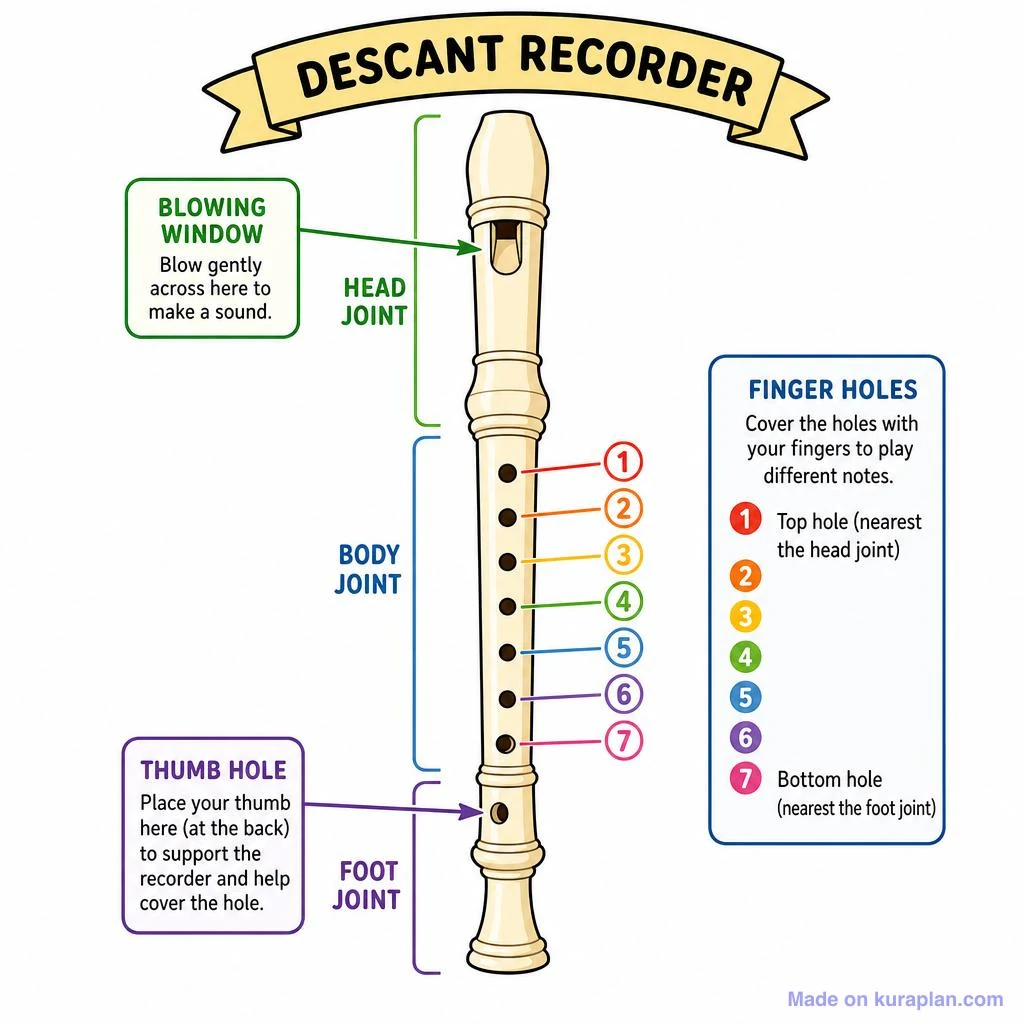
The descant recorder has finger holes and sections that support sound production.
2. Parts of a Descant Recorder
A descant recorder has three main sections.
A. Head joint
This is the upper section of the recorder. It contains the mouthpiece through which the player blows air.
B. Body joint
This is the middle section of the recorder. It contains most of the finger holes used to produce different pitches.
C. Foot joint
This is the lower section of the recorder. It contains additional holes that help produce different notes.
3. How the Descant Recorder Produces Sound
The recorder produces sound through the vibration of air inside the instrument.
The player blows gently through the mouthpiece.
The fingers cover or uncover different holes to produce different pitches.
Steps in playing the recorder
- Hold the recorder correctly using both hands.
- Place the mouthpiece gently between the lips.
- Cover the appropriate holes using the fingertips.
- Blow gently and steadily.
- Change the finger positions to produce different notes.
- Maintain proper posture while playing.
4. Care and Maintenance of a Descant Recorder
A recorder should be handled carefully to maintain its quality and ensure good sound production.
Ways of caring for a recorder
- Clean it after playing.
- Avoid sharing the mouthpiece without proper hygiene measures.
- Store it in a suitable protective case.
- Avoid exposing it to excessive heat.
- Do not drop or throw the instrument.
- Assemble and dismantle it carefully where necessary.
- Keep it away from dust and dirt.
5. Understanding Musical Staff Notation
Staff notation is a system of writing music using symbols placed on five horizontal lines and four spaces.
It enables musicians to read and perform musical compositions.
The treble staff is used when reading the simple melodies covered in this sub-strand.
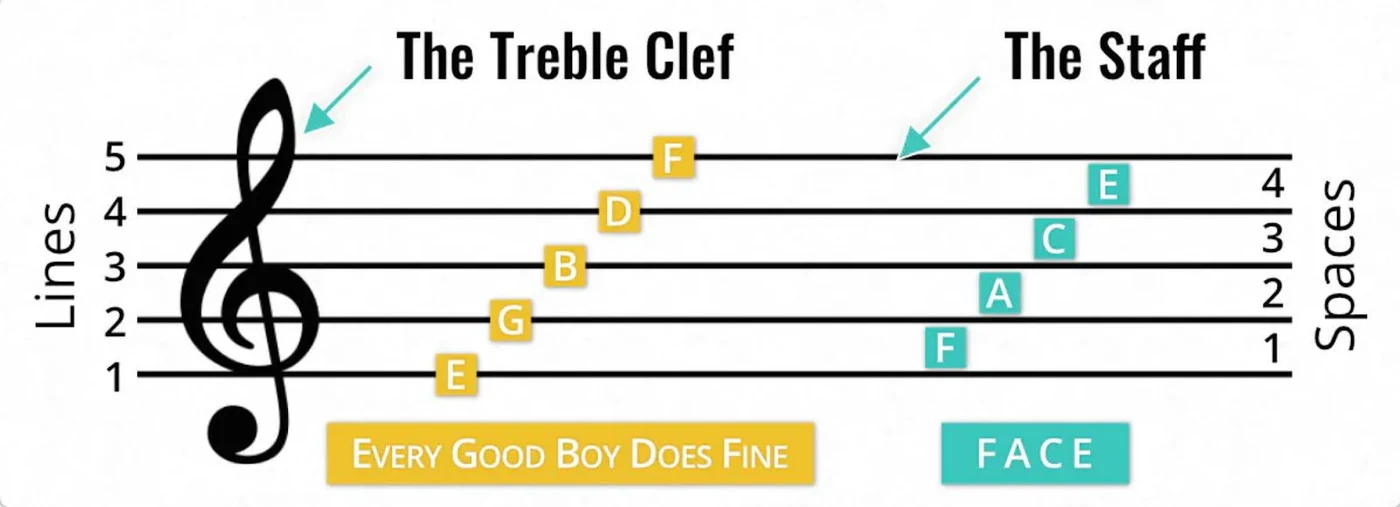
The treble clef identifies the staff used for reading many recorder melodies.
The five lines from bottom to top are:
- E
- G
- B
- D
- F
The four spaces from bottom to top are:
- F
- A
- C
- E
6. Factors to Consider When Interpreting Melodies on Staff Notation
When reading a melody written on a musical staff, learners should consider the following:
A. Key Signature
A key signature is a group of sharps or flats placed at the beginning of a musical staff after the clef.
It indicates which notes are to be raised or lowered throughout a musical composition.
For example, C major has no sharps or flats in its key signature.
B. Time Signature
A time signature indicates how beats are organized in each musical bar.
For example, 2/4 time indicates two crotchet beats in each bar.
C. Note Values
Note values show the duration of musical sounds.
The main note values include:
|
Note |
Duration |
|---|---|
|
Semibreve |
4 beats |
|
Minim |
2 beats |
|
Crotchet |
1 beat |
|
Pair of quavers |
1 beat |
Learners should identify the note values before playing a melody.
7. Performance Directions
Performance directions are instructions that guide musicians on how to perform a musical composition.
The curriculum emphasizes two main performance directions:
- Dynamics.
- Tempo.
A. Dynamics
Dynamics refer to the loudness or softness of music.
They help performers control the volume of their music.
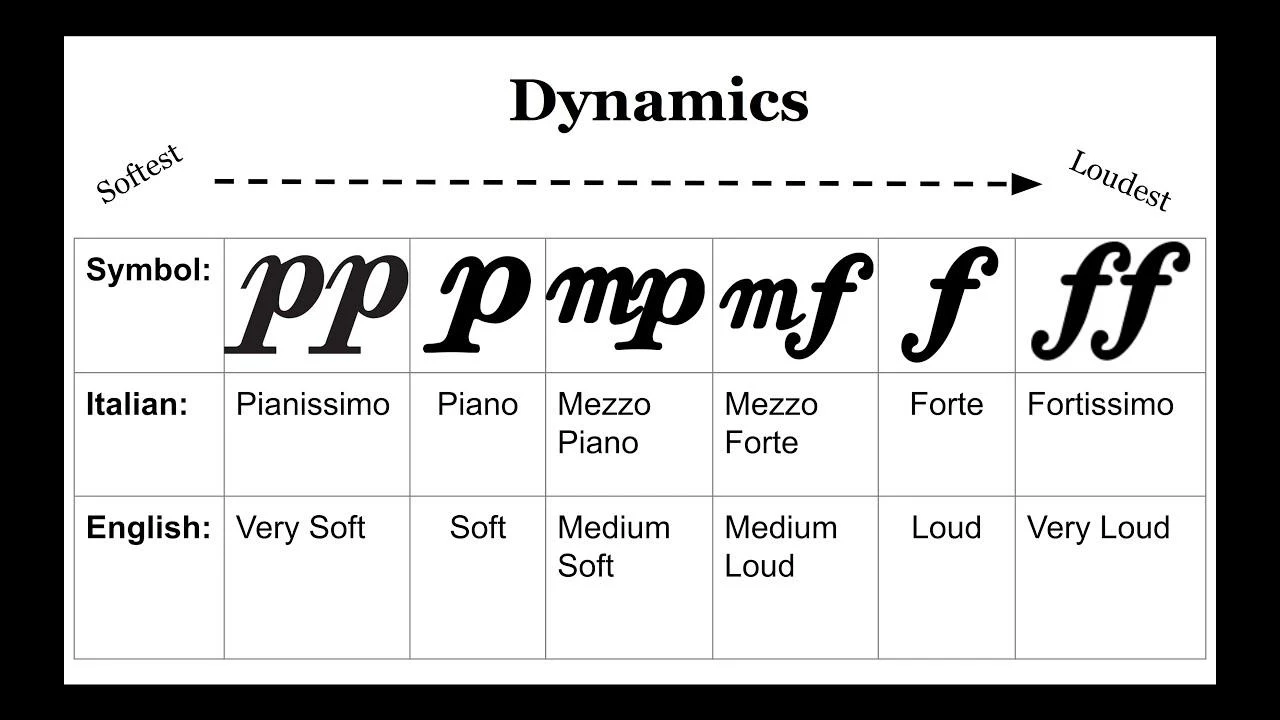
Dynamic markings indicate how loudly or softly a piece should be played.
Two basic dynamics are:
Loud
This means performing music using a strong or powerful sound.
Soft
This means performing music using a gentle or quiet sound.
Other common dynamic markings include:
|
Symbol |
Meaning |
|---|---|
|
p |
Piano: Soft |
|
f |
Forte: Loud |
|
pp |
Pianissimo: Very soft |
|
ff |
Fortissimo: Very loud |
B. Tempo
Tempo refers to the speed at which a musical composition is performed.
It determines how fast or slowly a piece of music should be played.
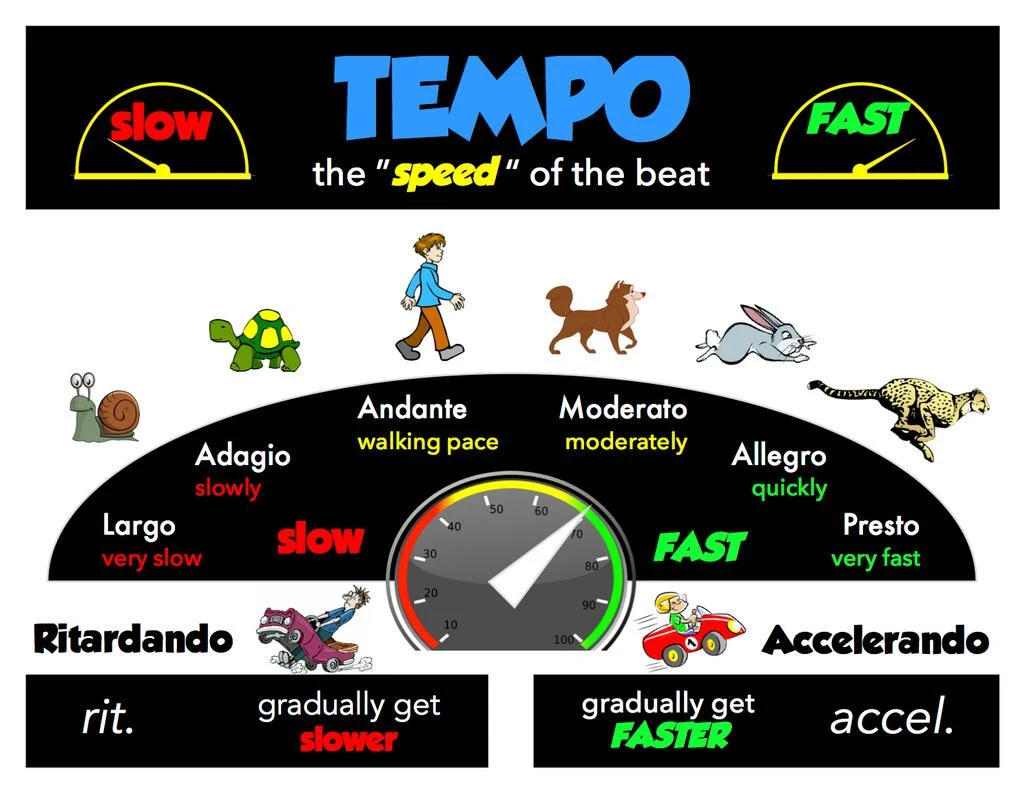
Tempo markings show whether music should be performed slowly or quickly.
The two basic tempo directions emphasized in this sub-strand are:
Fast tempo
Music is performed at a quick speed.
Slow tempo
Music is performed at a relaxed speed.
Other common tempo terms include:
- Adagio: Slowly.
- Andante: At a walking pace.
- Moderato: At a moderate speed.
- Allegro: Fast and lively.
8. Sight Reading on the Descant Recorder
Sight reading is the ability to read and perform a piece of music from written notation without having to memorize it beforehand.
It helps musicians interpret musical compositions accurately.
Steps in sight reading
- Observe the treble clef.
- Identify the key signature.
- Identify the time signature.
- Read the notes on the staff.
- Identify the note values and rests.
- Observe the performance directions.
- Practise the melody slowly.
- Play the complete melody while maintaining the correct rhythm.
9. Playing a Piece in C Major
C major is a musical key based on the C major scale.
The scale contains the following notes:
C - D - E - F - G - A - B - C.
The corresponding solfa names are:
Do - Re - Mi - Fa - So - La - Ti - Do.
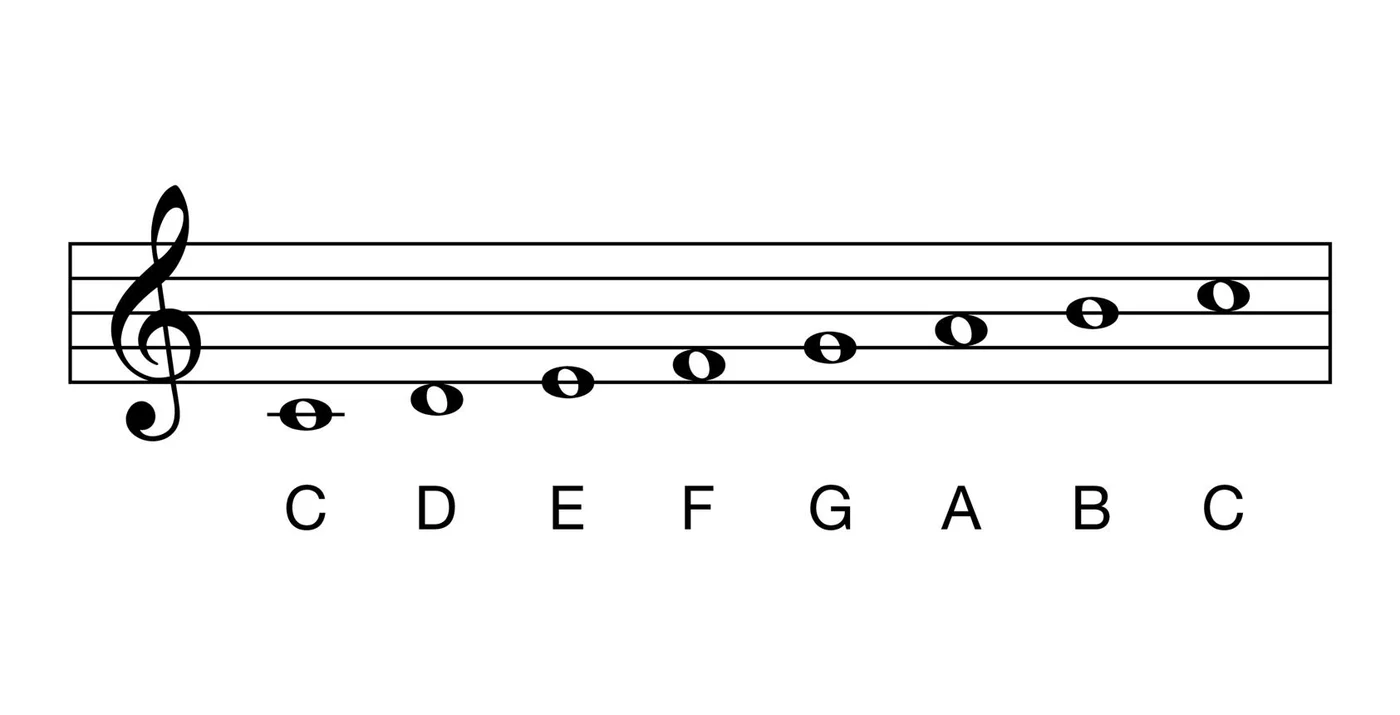
The C major scale can be practised through written notes and keyboard positions.
The curriculum requires learners to perform a simple solo piece in C major and 2/4 time using a descant recorder.
Procedure
- Identify the notes in the melody.
- Identify the key and time signatures.
- Observe the note values.
- Identify the loud and soft sections.
- Identify the fast and slow sections.
- Practise the melody using the correct fingering.
- Play the melody while maintaining a steady rhythm.
- Perform the complete piece.
10. Importance of Learning to Play the Descant Recorder
- Develops musical skills.
- Improves concentration.
- Develops coordination between fingers and breathing.
- Improves the ability to read musical notation.
- Promotes creativity.
- Builds confidence during performances.
- Encourages appreciation of music.
- Develops discipline and patience.
Summary
- A descant recorder is a wind musical instrument.
- It produces sound through vibrating air.
- It has three main sections: head joint, body joint and foot joint.
- Staff notation helps musicians read written music.
- Key signatures and time signatures guide musical interpretation.
- Dynamics indicate loudness and softness.
- Tempo indicates the speed of music.
- Learners should be able to sight-read and perform simple melodies in C major.
Revision Questions
- Define a descant recorder.
- Identify the three main parts of a descant recorder.
- Explain how a recorder produces sound.
- State five ways of caring for a recorder.
- What is staff notation?
- Explain the meaning of a key signature.
- What is a time signature?
- Differentiate between dynamics and tempo.
- Explain the meaning of piano and forte.
- Describe the steps involved in sight reading a melody.
- Write the notes of the C major scale.
- State five benefits of learning to play the descant recorder.