
Introduction
A narrative composition is a piece of writing that tells a story about real or imaginary events.
Narratives may describe personal experiences, historical events, adventures or fictional situations.
In this sub-strand, learners develop the ability to write well-organised narrative compositions of approximately 200–240 words.
A. Features of a good narrative composition
1. A clear and narrow focus
A narrative should concentrate on a specific subject or event.
Example:
- The Day I Met a National Hero.
- An Unexpected Visit.
- The Hero Who Saved Our Village.
2. A strong introduction
The introduction should attract the reader's attention and introduce the main situation.
3. Character descriptions
Characters should be described clearly to help readers understand their appearance, behaviour and personalities.
4. Dialogue
Dialogue refers to the words spoken by characters in a story.
Example:
"Why are you helping us?" asked the young boy.
"I believe everyone deserves a chance," replied the old man.
5. Setting description
The setting describes where and when the story happens.
6. Interesting details
These include descriptions, actions and incidents that make the story engaging.
7. Logical sequence
Events should follow an understandable order.
8. Purposeful and precise word choice
Writers should select words that communicate their ideas accurately.
9. Varied sentence structures
A good narrative combines different sentence structures to make writing interesting.
10. A strong conclusion
The conclusion brings the story to a suitable end and may communicate a lesson.
B. Structure of a narrative composition
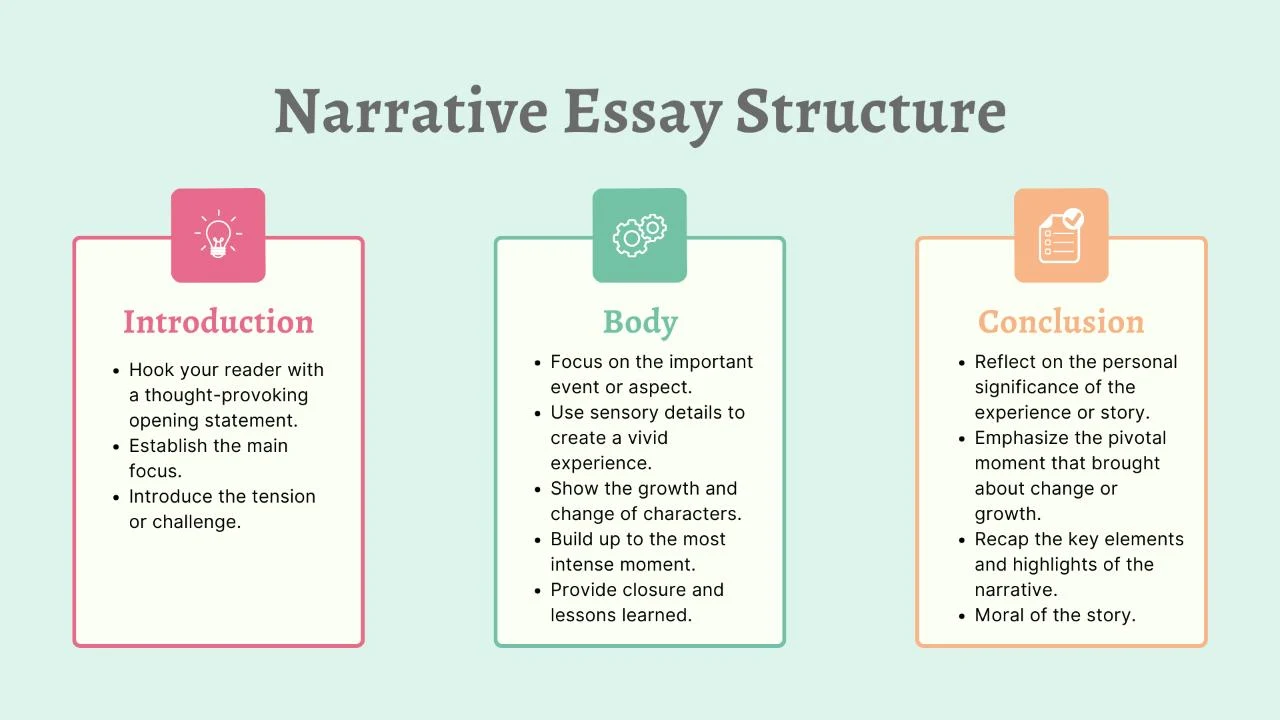
A narrative composition is organised into an introduction, body and conclusion.
|
Section |
Explanation |
|---|---|
|
Introduction |
Introduces the characters, setting and main situation. |
|
Body |
Explains the events, challenges and climax. |
|
Conclusion |
Explains how the events end and may communicate a lesson. |
C. Steps in writing a narrative
Step 1: Understanding the topic
Read the topic carefully and identify what the composition requires.
Step 2: Brainstorming
Think about possible characters, settings and events.
Step 3: Planning
Arrange the events in a logical sequence.
Step 4: Drafting
Write the first version of the composition.
Step 5: Editing and revising
Correct grammar, spelling, punctuation and sentence structure. Improve sections that are unclear.
Step 6: Publishing
Prepare the final copy for presentation or sharing.
D. Sample narrative composition
THE DAY I MET A NATIONAL HERO
I will never forget the day our school invited a retired freedom fighter to speak to learners. I had always heard stories about people who sacrificed their lives for Kenya, but I had never met one personally.
The visitor arrived at exactly ten o'clock. He was an elderly man with a calm voice and a welcoming smile. Our head teacher introduced him, and we welcomed him with applause.
During his speech, he explained how Kenyans struggled for independence. He described the difficulties people experienced and the sacrifices made by those who wanted freedom. I listened carefully as he encouraged us to love our country and respect one another.
After the presentation, our teacher invited learners to ask questions. I stood up and asked him why he had risked his life for other people. He smiled and explained that freedom was worth fighting for because every Kenyan deserved dignity and justice.
Before leaving, he encouraged us to work hard and become responsible citizens. I realised that being a hero does not always mean performing extraordinary actions. It can also mean serving others with honesty and courage.
That day taught me that patriotism, sacrifice and responsibility are important qualities. I promised myself that I would contribute positively to my country.
Model composition: approximately 215 words.
E. Importance of narrative writing
- Develops creativity.
- Improves vocabulary.
- Strengthens grammar and sentence construction.
- Develops imagination.
- Helps communicate experiences.
- Encourages critical thinking.
- Promotes moral learning.
Summary
A good narrative has a clear focus, interesting characters, an identifiable setting, a logical sequence of events and a strong conclusion. Learners should practise planning, drafting, editing and publishing compositions of 200–240 words.