
2.2.1 Introduction to Acids and Bases
Acids and bases are two important groups of chemical substances found in our homes, industries, laboratories and natural environment.
They have different properties and can be identified using special substances called indicators.
Examples of acids include:
- Lemon juice.
- Vinegar.
- Orange juice.
- Citric acid.
- Hydrochloric acid.
Examples of bases include:
- Soap solutions.
- Baking soda solutions.
- Washing soda solutions.
- Sodium hydroxide.
- Magnesium hydroxide.
Acids and bases are useful in everyday life, including food preparation, cleaning, medicine production and manufacturing.
2.2.2 Meaning of Acids
An acid is a substance that produces hydrogen ions (H⁺) when dissolved in water.
Acids have characteristic properties that distinguish them from bases.
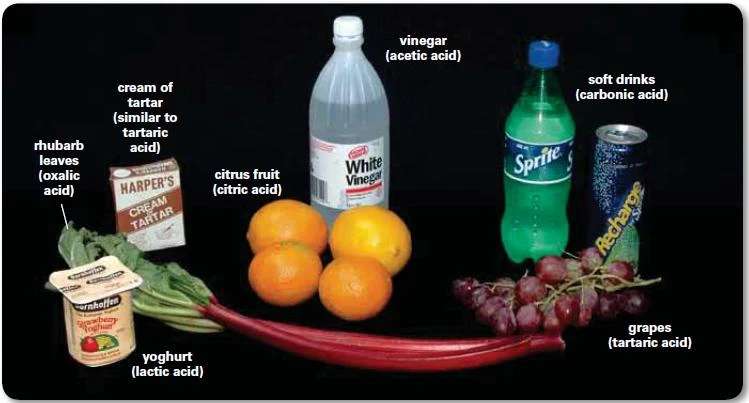
Examples of acids
|
Acid |
Where it is found or used |
|---|---|
|
Citric acid |
Citrus fruits such as lemons and oranges |
|
Acetic acid |
Vinegar |
|
Hydrochloric acid |
Stomach digestive juice |
|
Sulphuric acid |
Lead-acid batteries |
|
Carbonic acid |
Carbonated drinks |
2.2.3 Physical Properties of Acids
Acids have several characteristic properties.
1. Sour Taste
Many naturally occurring acids have a sour taste.
Examples include:
- Lemon juice.
- Orange juice.
- Vinegar.
However, learners should never taste laboratory chemicals to identify them because some acids are poisonous or corrosive.
2. Effect on Blue Litmus Paper
Acids turn blue litmus paper red.
This is one of the main laboratory tests used to identify an acidic substance.
3. pH Value
Acids have a pH value below 7.
The pH scale helps determine whether a substance is acidic, neutral or basic.
4. Solubility
Many common acids dissolve in water to form acidic solutions.
5. Corrosive Nature
Some acids can damage skin, eyes and other materials, especially when concentrated.
Therefore, they must be handled carefully.
2.2.4 Meaning of Bases
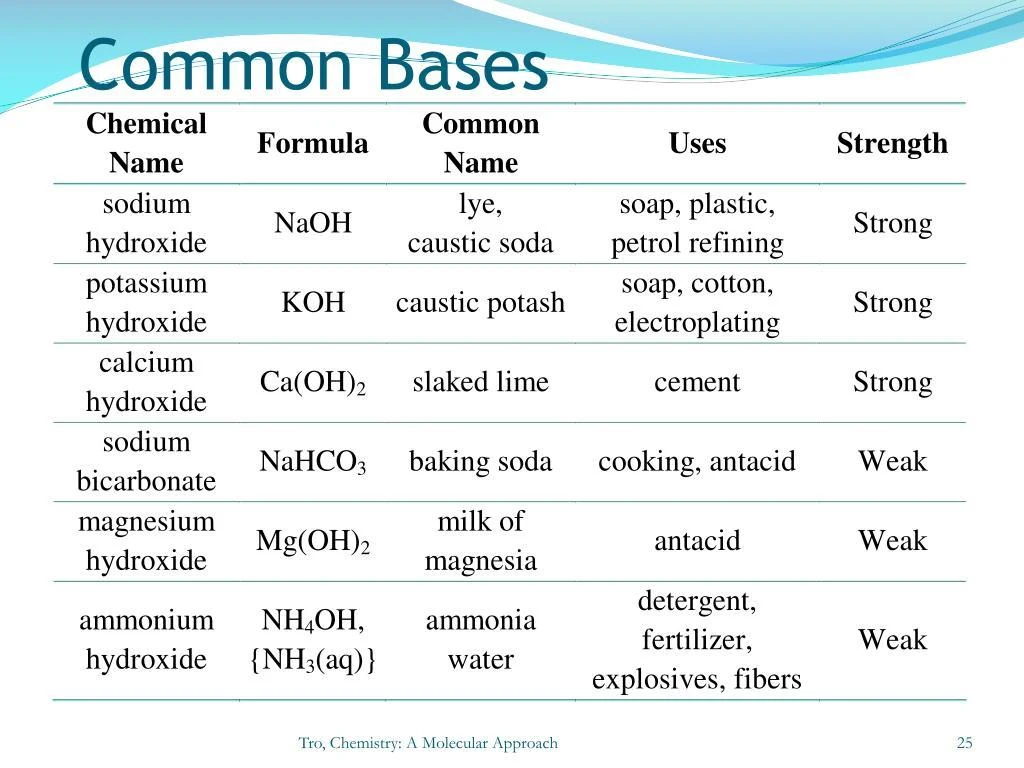
A base is a substance that neutralises an acid. Many bases produce hydroxide ions (OH⁻) when dissolved in water.
A base that dissolves in water is called an alkali.
Examples of bases include:
- Sodium hydroxide.
- Calcium hydroxide.
- Magnesium hydroxide.
- Sodium bicarbonate.
- Some soap solutions.
2.2.5 Physical Properties of Bases
1. Bitter Taste
Many bases have a bitter taste.
However, learners should never taste laboratory bases because some are poisonous or corrosive.
2. Slippery or Soapy Feel
Many alkaline solutions feel slippery or soapy.
Learners should not touch laboratory chemicals to test this property.
3. Effect on Red Litmus Paper
Bases turn red litmus paper blue.
4. pH Value
Bases have a pH value above 7.
5. Solubility
Some bases dissolve in water to form alkaline solutions, while others are poorly soluble.
6. Corrosive Nature
Strong bases can damage the skin and eyes.
They should be handled with appropriate protective equipment.
2.2.6 Differences Between Acids and Bases
|
Acids |
Bases |
|---|---|
|
Have a pH below 7 |
Have a pH above 7 |
|
Turn blue litmus red |
Turn red litmus blue |
|
Many naturally occurring acids taste sour |
Many bases taste bitter |
|
Some are corrosive |
Some are corrosive |
|
Examples include vinegar and lemon juice |
Examples include sodium hydroxide and baking soda solutions |
2.2.7 The pH Scale
The pH scale is a numerical scale used to show how acidic or basic a substance is.
It generally ranges from 0 to 14.
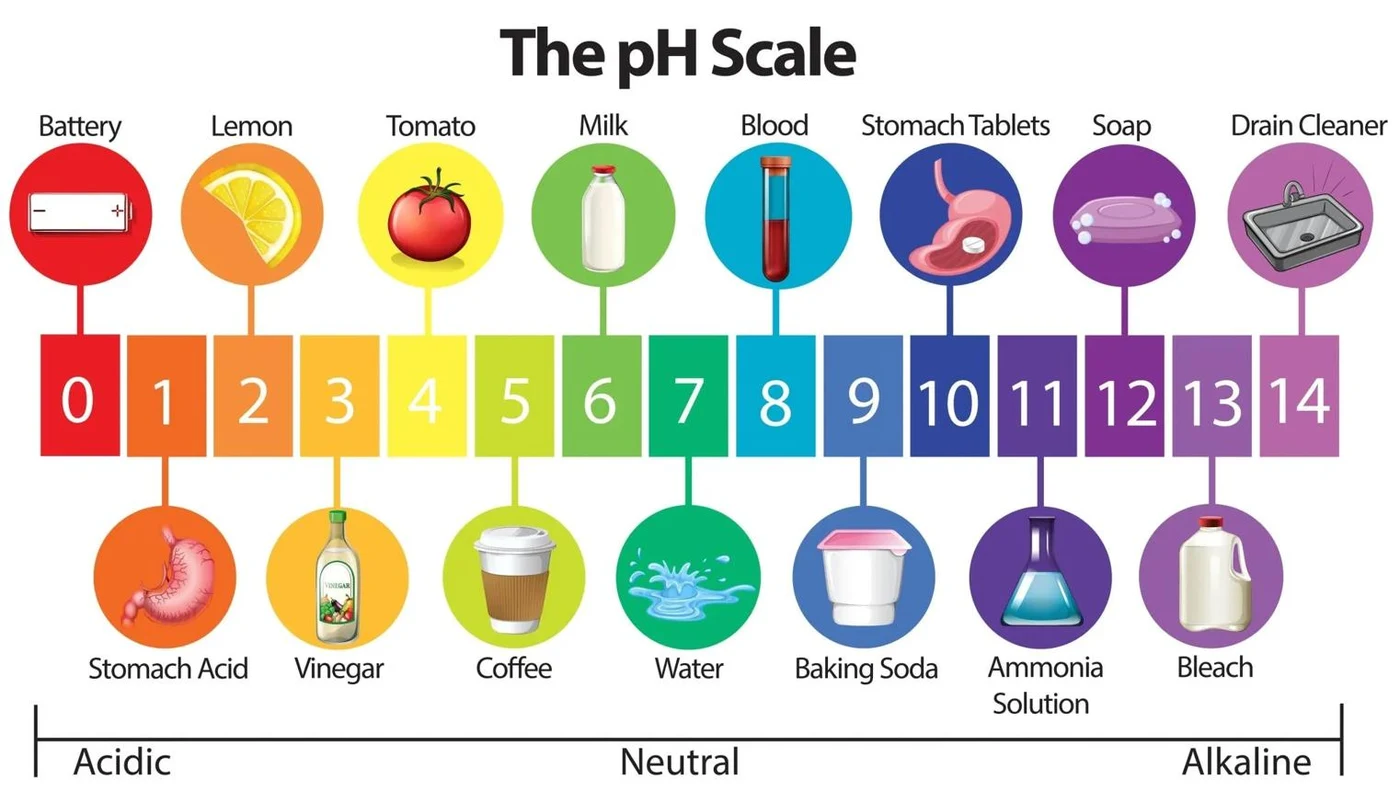
The pH scale can be divided into three main categories.
A. Acidic Substances
- Have a pH below 7.
- The lower the pH, the more acidic the solution generally is.
- Examples include lemon juice and vinegar.
B. Neutral Substances
- Have a pH of 7.
- They are neither acidic nor basic.
- Pure water is a common example under standard conditions.
C. Basic or Alkaline Substances
- Have a pH above 7.
- The higher the pH, the more alkaline the solution generally is.
- Examples include soap solutions and sodium hydroxide solutions.
2.2.8 Meaning of Indicators
An indicator is a substance that changes colour depending on whether a solution is acidic, neutral or basic.
Indicators are used to identify acids and bases.
Examples of indicators include:
- Litmus paper.
- Universal indicator.
- Red cabbage extract.
- Hibiscus extract.
- Turmeric extract.
2.2.9 Litmus Paper
Litmus paper is a special paper treated with a dye obtained from lichens.
It is commonly used to identify acids and bases.
There are two main types:
- Red litmus paper.
- Blue litmus paper.
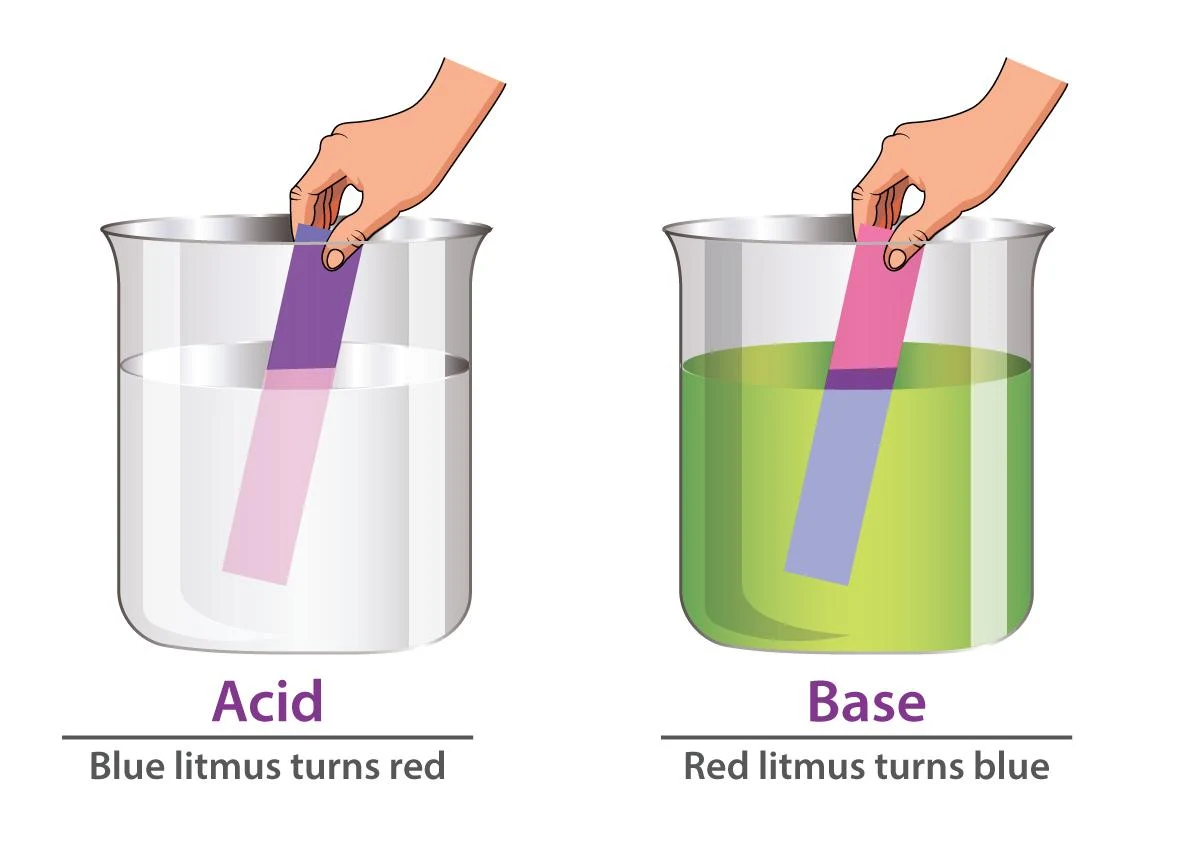
How litmus paper identifies acids
When blue litmus paper is placed in an acidic solution, it changes from blue to red.
How litmus paper identifies bases
When red litmus paper is placed in a basic solution, it changes from red to blue.
Results of Litmus Paper Tests
|
Substance tested |
Blue litmus paper |
Red litmus paper |
|---|---|---|
|
Acid |
Turns red |
Remains red |
|
Base |
Remains blue |
Turns blue |
|
Neutral substance |
Remains blue |
Remains red |
Example
If a learner places blue litmus paper into vinegar and observes that it turns red, the learner can conclude that vinegar is acidic.
If red litmus paper is placed into a soap solution and turns blue, the learner can conclude that the soap solution is basic.
2.2.10 Preparation of Acid-Base Indicators from Plant Extracts
Some plants contain natural pigments that change colour when placed in acidic or basic solutions.
These pigments can be extracted and used to prepare natural indicators.
Examples include:
- Red cabbage.
- Hibiscus flowers.
- Turmeric.
- Red onion skins.
- Some coloured flower petals.
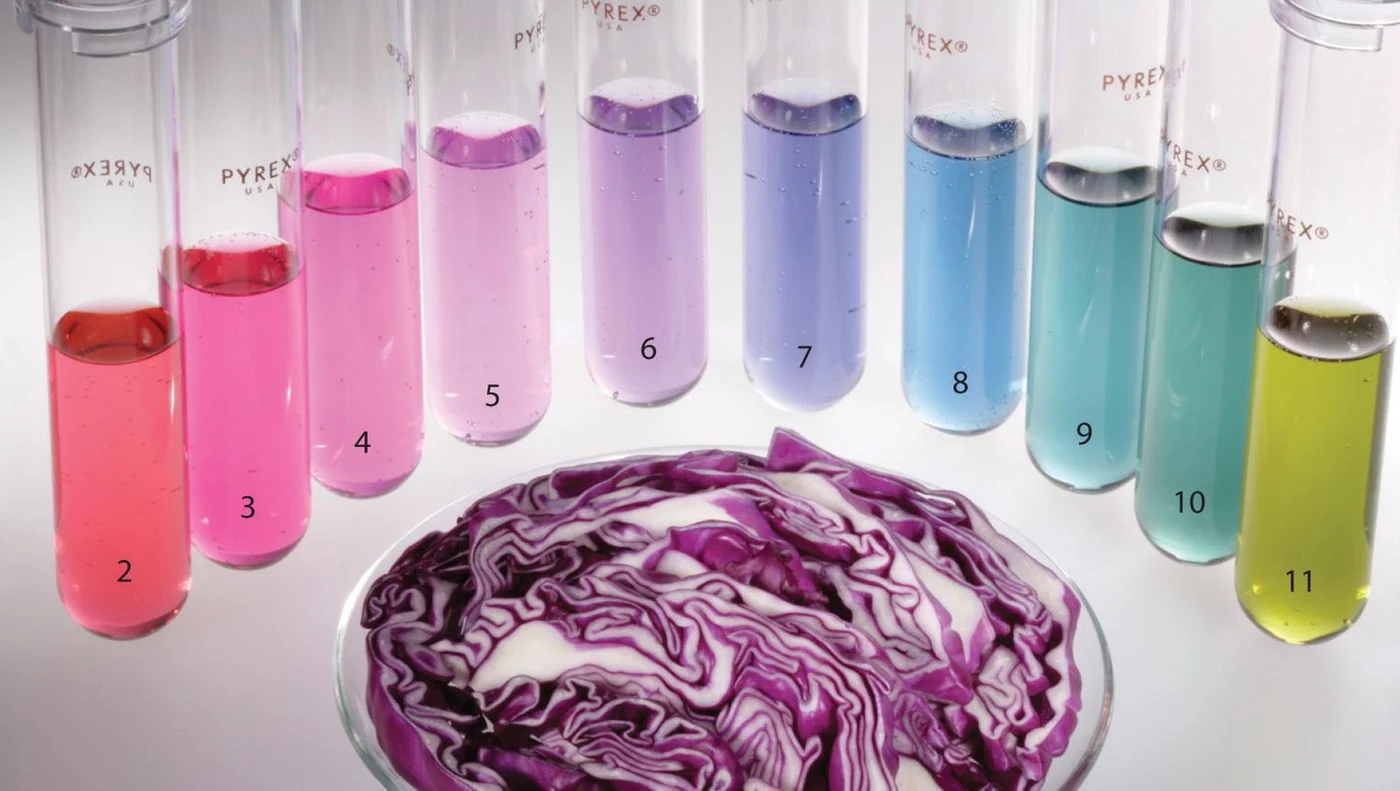
A. Red Cabbage Indicator
Red cabbage contains natural pigments called anthocyanins.
These pigments change colour depending on the acidity or alkalinity of a solution.
Materials required
- Red cabbage leaves.
- Clean water.
- A container.
- A mortar and pestle or a suitable crushing tool.
- A filter or clean cloth.
- A clean collecting container.
Preparation procedure
- Collect fresh red cabbage leaves.
- Wash the leaves thoroughly.
- Cut them into small pieces.
- Crush the leaves using a mortar and pestle.
- Add a small amount of warm water.
- Stir the mixture to release the coloured pigment.
- Filter the mixture using a clean cloth or filter paper.
- Collect the coloured liquid in a clean container.
The collected liquid can be used as a natural acid-base indicator.
Expected colour changes
|
Solution |
Approximate colour of red cabbage indicator |
|---|---|
|
Acidic |
Red or pink |
|
Neutral |
Purple |
|
Basic |
Blue, green or yellow-green |
The exact colour depends on the strength of the solution and the concentration of the indicator.
B. Hibiscus Indicator
Hibiscus flowers contain natural coloured pigments that can be used to prepare an acid-base indicator.
Materials required
- Fresh hibiscus flowers.
- Warm water.
- A container.
- A filter.
- A collecting bottle.
Preparation procedure
- Collect fresh hibiscus flowers.
- Remove unwanted materials.
- Wash the petals.
- Crush the petals in a container.
- Add warm water.
- Stir to release the coloured substances.
- Filter the mixture.
- Collect the coloured liquid.
The liquid obtained can be used to test acidic and basic substances.
Expected observations
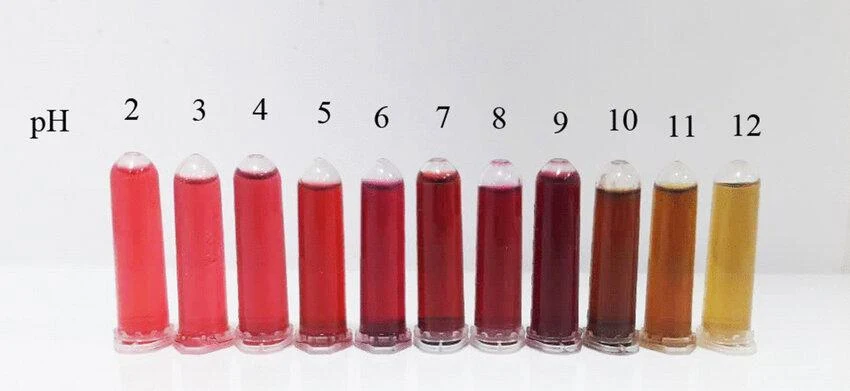
- Acidic solutions generally produce a red or pink colour.
- Basic solutions may produce greenish or darker colour changes.
- Neutral solutions generally show less dramatic changes.
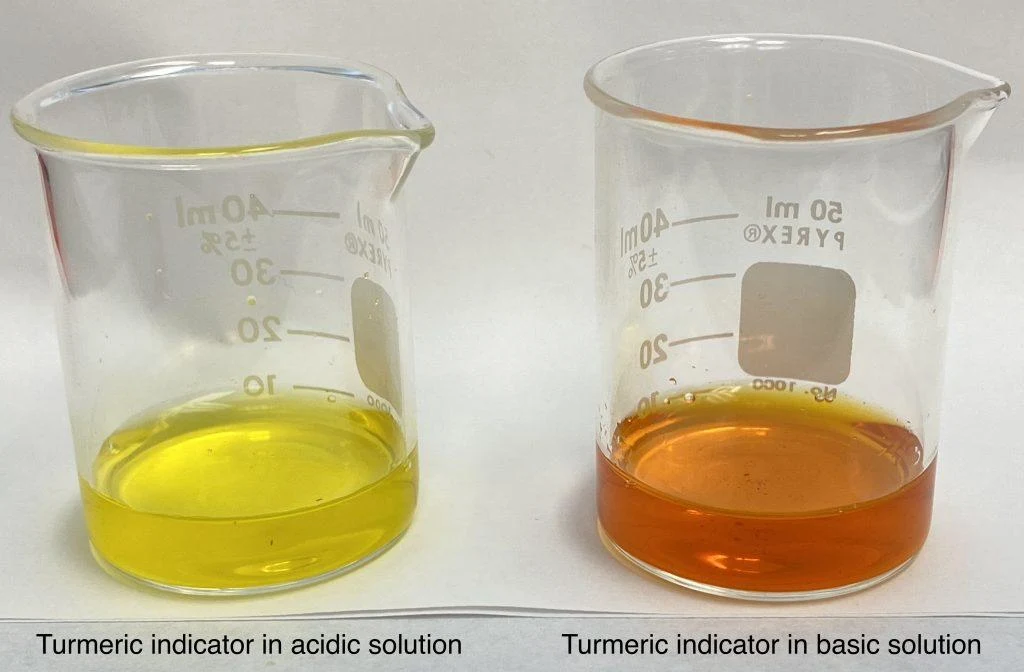
C. Turmeric Indicator
Turmeric is a yellow natural substance obtained from the turmeric plant.
It contains a pigment called curcumin, which changes colour in alkaline conditions.
Materials required
- Turmeric powder.
- Clean water or suitable solvent.
- A container.
- Filter paper or clean cloth.
Preparation procedure
- Place turmeric powder in a container.
- Add a suitable amount of water.
- Stir thoroughly.
- Allow the mixture to settle.
- Filter the liquid if necessary.
- Collect the prepared indicator.
Expected observations
|
Substance |
Colour observation |
|---|---|
|
Acidic solution |
Remains yellow |
|
Neutral solution |
Remains yellow |
|
Basic solution |
Changes to reddish-brown |
2.2.11 Comparing Different Natural Indicators
|
Indicator |
Acidic solution |
Neutral solution |
Basic solution |
|---|---|---|---|
|
Red cabbage |
Red/pink |
Purple |
Blue/green |
|
Hibiscus |
Red/pink |
Usually retains its original shade |
Greenish or darker shade |
|
Turmeric |
Yellow |
Yellow |
Reddish-brown |
Importance of natural indicators
- They provide an alternative to manufactured indicators.
- They help learners understand acid-base reactions.
- They encourage the use of locally available materials.
- They make practical science activities interesting.
- They promote creativity and scientific investigation.
2.2.12 Classification of Commonly Used Substances as Acids and Bases
Different household substances can be classified as acidic, basic or neutral using indicators.
The following are common examples.
|
Substance |
Classification |
|---|---|
|
Lemon juice |
Acidic |
|
Vinegar |
Acidic |
|
Orange juice |
Acidic |
|
Tamarind juice |
Acidic |
|
Baking soda solution |
Basic |
|
Soap solution |
Basic |
|
Washing soda solution |
Basic |
|
Sodium hydroxide solution |
Basic |
|
Pure water |
Neutral |
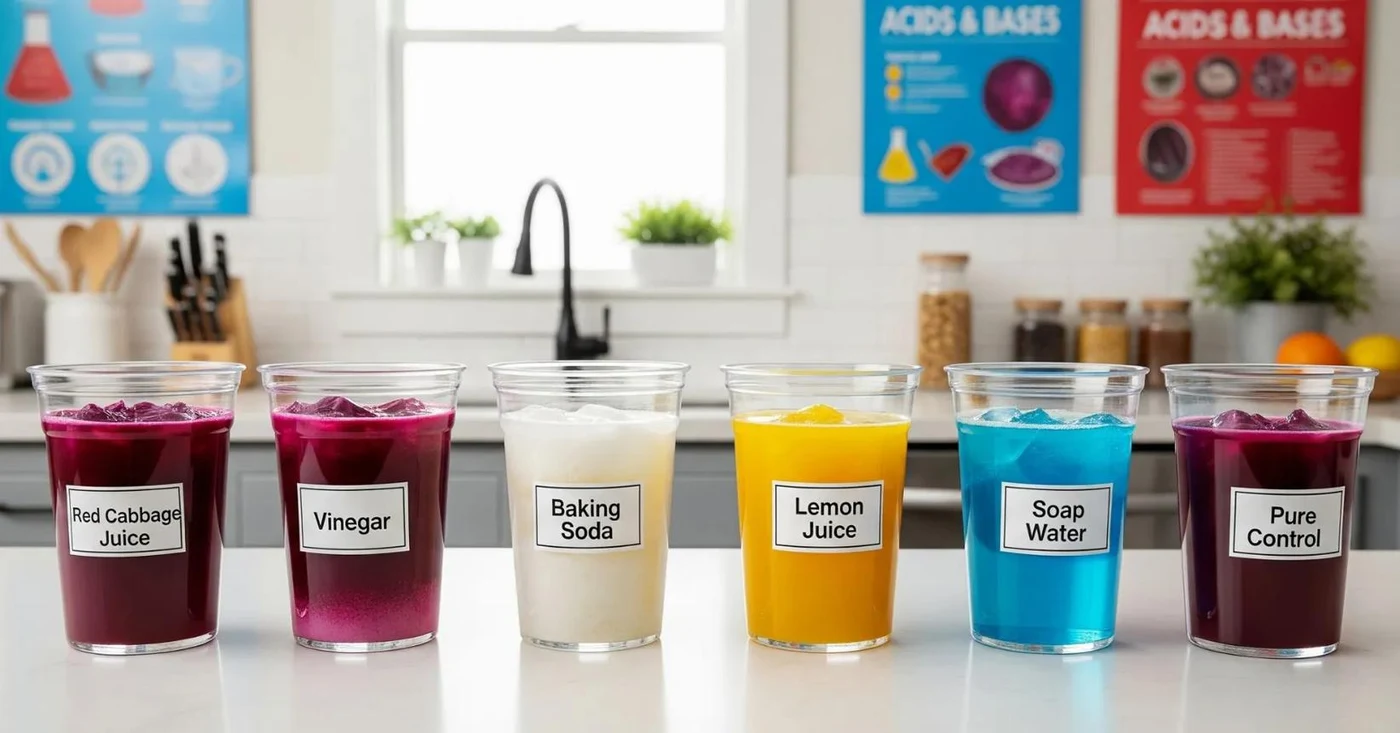
2.2.13 Practical Activity: Testing Household Substances
Aim: To classify common household substances as acidic, basic or neutral using an indicator.
Materials required
- Blue litmus paper.
- Red litmus paper.
- Lemon juice.
- Vinegar.
- Soap solution.
- Baking soda solution.
- Pure water.
- Droppers.
- Small containers.
Procedure
- Label the containers according to the substances being tested.
- Pour a small amount of each substance into its container.
- Dip a clean piece of blue litmus paper into each sample.
- Record the colour change.
- Repeat using red litmus paper.
- Compare the observations.
- Classify each substance as acidic, basic or neutral.
Expected results
|
Substance |
Blue litmus |
Red litmus |
Classification |
|---|---|---|---|
|
Lemon juice |
Turns red |
Remains red |
Acidic |
|
Vinegar |
Turns red |
Remains red |
Acidic |
|
Soap solution |
Remains blue |
Turns blue |
Basic |
|
Baking soda solution |
Remains blue |
Turns blue |
Basic |
|
Pure water |
Remains blue |
Remains red |
Neutral |
Conclusion
Litmus paper can be used to distinguish acidic, basic and neutral substances through their colour changes.
Safety precautions
- Do not taste any of the substances.
- Avoid direct contact with unknown chemicals.
- Use clean droppers for different samples.
- Wash hands after the activity.
- Carry out the experiment under the teacher's supervision.
2.2.14 Uses of Acids in Real Life
Acids have many important applications in homes, agriculture, medicine and industries.
1. Food Preparation
Some acids are used in food preparation.
Examples:
- Citric acid gives citrus fruits their sour taste.
- Acetic acid is found in vinegar.
- Citric acid is used in some food products.
2. Digestion
Hydrochloric acid is found in the stomach.
It helps create suitable conditions for digestion and assists in killing some harmful microorganisms.
3. Battery Manufacture
Sulphuric acid is used as an electrolyte in certain lead-acid batteries.
4. Fertiliser Manufacture
Some acids are used in the manufacture of fertilisers that supply nutrients to plants.
5. Industrial Cleaning
Some acids are used in industrial processes to remove unwanted deposits and rust from metal surfaces under controlled conditions.
6. Manufacture of Chemicals
Acids are used in manufacturing different chemical products.
2.2.15 Uses of Bases in Real Life
Bases are also important in everyday life.
1. Manufacture of Soap
Some bases, such as sodium hydroxide, are used in soap manufacture.
2. Cleaning
Alkaline substances are found in some cleaning products and detergents.
3. Medicine
Some bases are used in antacids to help neutralise excess stomach acid.
Example: Magnesium hydroxide.
4. Agriculture
Calcium hydroxide is sometimes used to reduce excessive acidity in agricultural soils.
5. Food Preparation
Sodium bicarbonate, commonly known as baking soda, is used in baking.
6. Industrial Manufacturing
Bases are used in the manufacture of paper, detergents and other industrial products.
2.2.16 Uses of Indicators in Real Life
Indicators are useful because they help identify whether substances are acidic or basic.
Applications include:
- Testing household substances.
- Testing soil acidity in agriculture.
- Testing water in laboratories.
- Monitoring chemical processes.
- Teaching and learning chemistry.
- Checking acidity and alkalinity in different industrial processes.
2.2.17 Safety Measures When Handling Acids and Bases
Some acids and bases can be dangerous, especially when concentrated.
Learners should observe the following precautions:
- Never taste acids or bases.
- Avoid touching unknown chemicals.
- Wear protective gloves when required.
- Wear safety goggles when handling substances that may splash.
- Follow the teacher's instructions.
- Use small quantities during experiments.
- Wash affected skin immediately with plenty of running water.
- Report chemical spills and accidents.
- Do not mix cleaning products or laboratory chemicals without proper instructions.
- Store chemicals in properly labelled containers.
- Dispose of chemical waste according to laboratory instructions.
- Wash hands after experiments.
2.2.18 Summary of Acids, Bases and Indicators
|
Concept |
Key information |
|---|---|
|
Acid |
A substance that produces hydrogen ions in water |
|
Base |
A substance that neutralises an acid |
|
Alkali |
A base that dissolves in water |
|
Indicator |
A substance that changes colour depending on acidity or alkalinity |
|
Blue litmus |
Turns red in acids |
|
Red litmus |
Turns blue in bases |
|
Acidic solution |
Has a pH below 7 |
|
Neutral solution |
Has a pH of 7 |
|
Basic solution |
Has a pH above 7 |
|
Natural indicator |
An indicator obtained from plant materials |
Curriculum alignment: KICD Grade 7 Integrated Science, Strand 2.0, sub-strand 2.2.
BATCH 1: GENERAL REVISION AND KEY LEARNING POINTS
A. Important Definitions to Remember
|
Term |
Definition |
|---|---|
|
Integrated Science |
Study of different scientific fields together |
|
Laboratory |
A place where scientific investigations are carried out |
|
Laboratory hazard |
Anything that can cause harm or injury |
|
Observation |
Collecting information using senses or instruments |
|
Measurement |
Determining the quantity of something |
|
Classification |
Grouping materials according to similarities |
|
Prediction |
Stating what is likely to happen |
|
Conclusion |
A statement based on investigation findings |
|
SI units |
Internationally accepted units of measurement |
|
Mixture |
Physical combination of two or more substances |
|
Homogeneous mixture |
A mixture with uniform composition |
|
Heterogeneous mixture |
A mixture with non-uniform composition |
|
Solute |
Substance that dissolves |
|
Solvent |
Substance that dissolves another substance |
|
Solution |
A homogeneous mixture of a solute and solvent |
|
Evaporation |
Change of liquid into vapour |
|
Crystallisation |
Formation of crystals from a solution |
|
Sublimation |
Direct change of a solid into gas |
|
Chromatography |
Separation of substances based on their movement through a medium |
|
Acid |
Substance that produces hydrogen ions in water |
|
Base |
Substance that neutralises an acid |
|
Indicator |
Substance used to identify acidity or alkalinity |
B. Important Formulae
|
Quantity |
Formula |
SI unit |
|---|---|---|
|
Area |
Length × Width |
m² |
|
Volume |
Length × Width × Height |
m³ |
|
Speed |
Distance ÷ Time |
m/s |
|
Density |
Mass ÷ Volume |
kg/m³ |
C. Important Scientific Facts
- Blue litmus turns red in an acidic solution.
- Red litmus turns blue in a basic solution.
- A neutral substance has a pH of 7.
- Acids have a pH below 7.
- Bases have a pH above 7.
- Salt dissolved in water forms a homogeneous mixture.
- Air is a homogeneous mixture of gases.
- Brass is an alloy made mainly of copper and zinc.
- A light microscope is used to magnify small objects.
- A Bunsen burner is used for heating substances.
- Mass is measured in kilograms.
- Weight is measured in newtons.
- Speed is measured in metres per second.
- Density is measured in kilograms per cubic metre.
- Chromatography can separate different colours in ink.
D. Quick Revision Questions and Answers
1. What are the four main components of Integrated Science discussed in these notes?
Biology, Chemistry, Physics, and Environmental and Earth Science.
2. What is the main purpose of laboratory safety?
To prevent accidents, injuries and damage.
3. Which hazard symbol represents a poisonous substance?
The skull and crossbones.
4. Which instrument measures mass?
A balance.
5. Which instrument measures temperature?
A thermometer.
6. What is the function of an objective lens in a microscope?
It magnifies the specimen being observed.
7. What is the SI unit of length?
Metre (m).
8. What is the SI unit of electric current?
Ampere (A).
9. What is a homogeneous mixture?
A mixture with uniform composition throughout.
10. What is the solute in salt water?
Salt.
11. Which method is used to obtain salt from seawater?
Evaporation.
12. Which method is used to separate different colours in ink?
Chromatography.
13. What is the difference between simple and fractional distillation?
Simple distillation is commonly used to recover a liquid from a solution, while fractional distillation separates miscible liquids with different but relatively close boiling points.
14. Which litmus paper is used to identify an acid?
Blue litmus paper.
15. What colour does red litmus paper turn in a basic solution?
Blue.
16. Name two natural indicators.
Red cabbage extract and hibiscus extract.
17. What is the pH of a neutral solution?
7.
18. Give two examples of acids found in everyday life.
Vinegar and lemon juice.
19. Give two examples of bases.
Sodium hydroxide and magnesium hydroxide.
20. Why are indicators important?
They help identify whether a substance is acidic, basic or neutral
batch 2
Worked for 49s
GRADE 7 INTEGRATED SCIENCE
LEARNER'S NOTES – BATCH 2
CBC / CBE
Grade 7
Batch 2 of 2
Curriculum reference: Kenya Institute of Curriculum Development (KICD), Grade 7 Integrated Science Curriculum Design, July 2024.
Content covered in Batch 2
|
Strand |
Sub-strand |
|---|---|
|
3.0 Living Things and Their Environment |
3.1 Human Reproductive System |
|
3.2 Human Excretory System | |
|
4.0 Force and Energy |
4.1 Electrical Energy |
|
4.2 Magnetism |
These notes cover definitions, parts and functions of body systems, scientific explanations, practical activities, diagrams, examples, safety measures and applications of science in everyday life.