
1. Meaning of an atom
An atom is the smallest particle of a chemical element that retains the chemical identity of that element.
Everything around us, including air, water, rocks, plants and human bodies, is made of atoms.
Examples of elements include hydrogen, oxygen, carbon, iron, copper and aluminium.
2. Structure of an atom
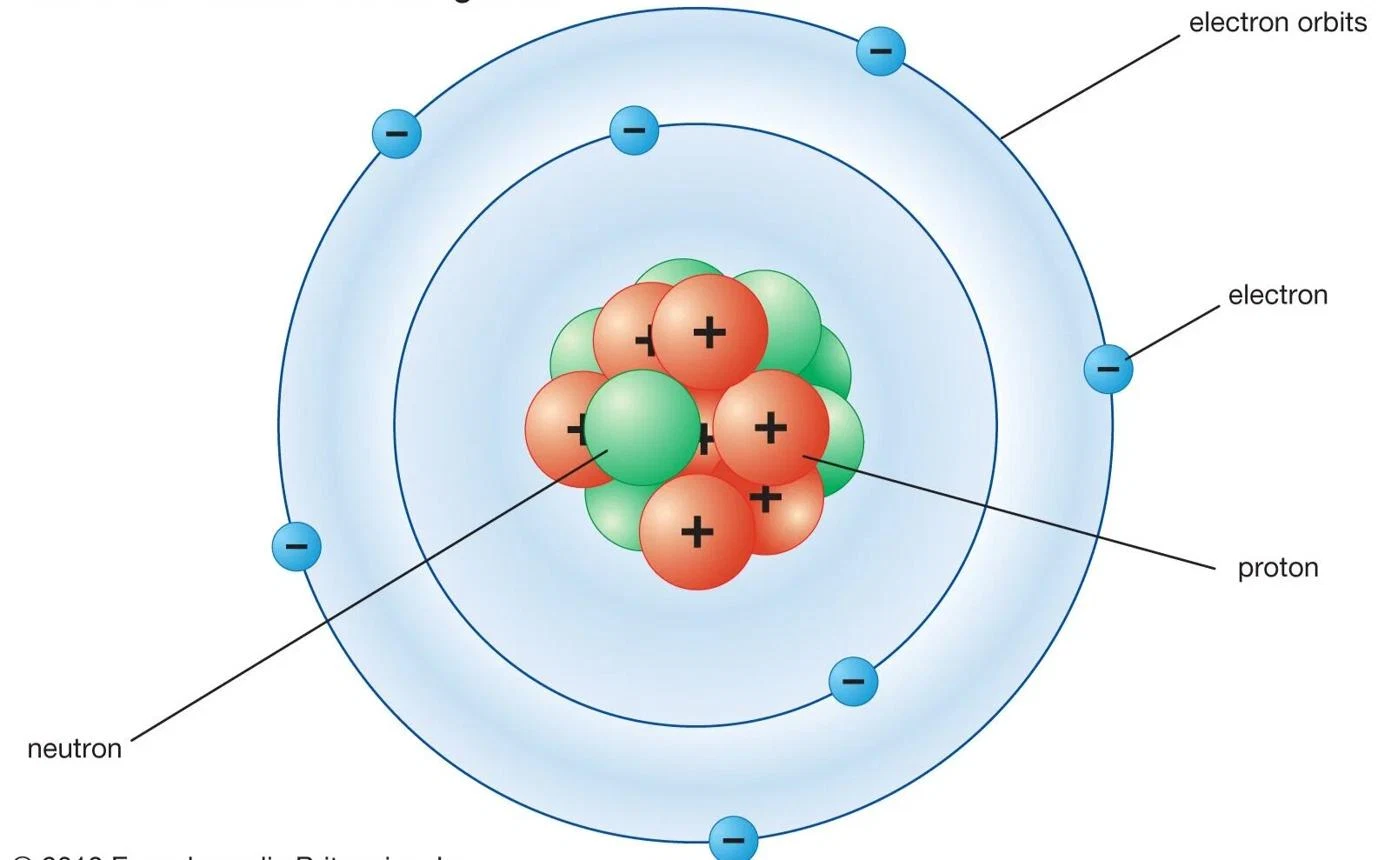
An atom consists of two main regions:
- The nucleus: The small, dense central region containing protons and neutrons.
- The electron region: The space around the nucleus occupied by electrons. At this level, electrons are represented using shells or energy levels.
The three main subatomic particles are:
|
Particle |
Symbol |
Charge |
Relative mass |
Location |
|---|---|---|---|---|
|
Proton |
p⁺ |
+1 |
1 |
Nucleus |
|
Neutron |
n⁰ |
0 |
1 |
Nucleus |
|
Electron |
e⁻ |
−1 |
About 1/1836 |
Region around nucleus |
Important facts
- Protons have positive charges.
- Electrons have negative charges.
- Neutrons have no electrical charge.
- A neutral atom has equal numbers of protons and electrons.
- Almost all the mass of an atom is concentrated in its nucleus.
The shell model is useful for school-level diagrams, although electrons do not actually move along fixed circular paths.

Khan Academy
+1
3. Atomic number and mass number
Atomic number (Z) is the number of protons in the nucleus.
In a neutral atom:
Mass number (A) is the total number of protons and neutrons in the nucleus.
Where:
- = mass number
- = number of protons
- = number of neutrons
To determine the number of neutrons:
Worked example 1: Sodium
A sodium atom has atomic number 11 and mass number 23.
Number of protons = 11
Number of electrons = 11, because the atom is neutral.
Number of neutrons:
Therefore, sodium has 11 protons, 12 neutrons and 11 electrons.
Worked example 2: Oxygen
An oxygen-16 atom has atomic number 8 and mass number 16.
Protons = 8
Electrons = 8
Neutrons = 16 − 8 = 8
4. Atomic notation
An element may be represented as:
Where is the chemical symbol, is the mass number and is the atomic number.
For example:
This indicates sodium with 11 protons and a mass number of 23.
5. Electron arrangement in atoms
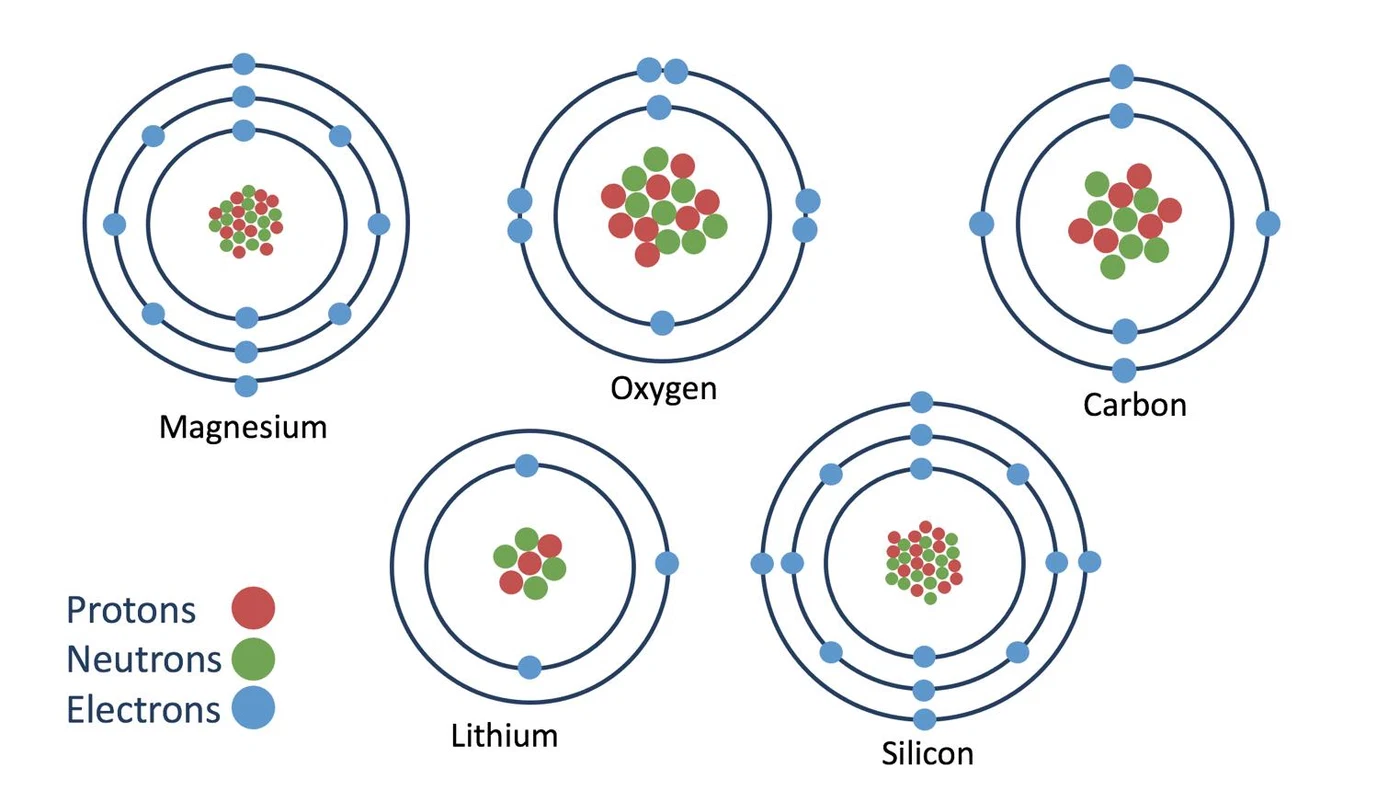
Electrons are arranged in energy levels called electron shells.
For the first 20 elements, the introductory shell model uses:
- First shell (K): up to 2 electrons.
- Second shell (L): up to 8 electrons.
- Third shell (M): up to 8 electrons for these introductory arrangements.
- Fourth shell (N): begins filling for potassium and calcium.
nuclearenergyfutures.org
|
Element |
Atomic number |
Electron arrangement |
|---|---|---|
|
Hydrogen |
1 |
1 |
|
Helium |
2 |
2 |
|
Lithium |
3 |
2,1 |
|
Carbon |
6 |
2,4 |
|
Nitrogen |
7 |
2,5 |
|
Oxygen |
8 |
2,6 |
|
Neon |
10 |
2,8 |
|
Sodium |
11 |
2,8,1 |
|
Magnesium |
12 |
2,8,2 |
|
Aluminium |
13 |
2,8,3 |
|
Chlorine |
17 |
2,8,7 |
|
Argon |
18 |
2,8,8 |
|
Potassium |
19 |
2,8,8,1 |
|
Calcium |
20 |
2,8,8,2 |
6. Drawing electron arrangements using dots or crosses
A dot (•) or cross (×) represents one electron.
For sodium, which has 11 electrons:
- Draw the nucleus.
- Draw three shells around it.
- Place 2 electrons in the first shell.
- Place 8 electrons in the second shell.
- Place 1 electron in the third shell.
The arrangement is 2,8,1.
Interactive electron arrangement
Select an element to see the number and distribution of its electrons in a simplified shell diagram.
H
C
O
Na
Mg
Cl
11
Protons
12
Neutrons
11
Electrons
Illustrative shell model showing selected common isotopes, not to scale.
7. Classification of elements into metals and non-metals
Elements can be grouped according to their physical and chemical properties.
Metals are elements that generally conduct heat and electricity well, have a metallic appearance and can be shaped.
Examples: iron, copper, zinc, aluminium, gold and sodium.
Non-metals are elements that generally conduct heat and electricity poorly and have different physical characteristics from metals.
Examples: oxygen, carbon, sulphur, nitrogen, chlorine and phosphorus.

Metals

Non-metals
|
Property |
Metals |
Non-metals |
|---|---|---|
|
Appearance |
Usually shiny when polished |
Often dull |
|
Heat conduction |
Usually good |
Usually poor |
|
Electrical conduction |
Usually good |
Usually poor |
|
Malleability |
Usually malleable |
Solid non-metals usually brittle |
|
Ductility |
Usually ductile |
Usually not ductile |
|
State at room temperature |
Mostly solid |
Solid, liquid or gas |
|
Sound when struck |
Often sonorous |
Generally not sonorous |
Exceptions: Mercury is a liquid metal at room temperature. Graphite, a form of carbon, conducts electricity.
Activity 1.1
- Draw and label an atom showing a nucleus, protons, neutrons and electrons.
- Calculate the neutrons in chlorine-35, given an atomic number of 17.
- Draw the electron arrangement of magnesium.
- State four differences between metals and non-metals.
- Explain why an atom is electrically neutral.