
1. Meaning of mass
Mass is a measure of the quantity of matter in an object and its resistance to acceleration.
The SI unit of mass is the kilogram (kg).
2. Units of mass
|
Unit |
Equivalent |
|---|---|
|
1 tonne |
1,000 kg |
|
1 kg |
1,000 g |
|
1 g |
1,000 mg |
Example
Convert 2.75 kg into grams.
3. Meaning of weight
Weight is the gravitational force acting on an object.
Where:
- = weight in newtons (N).
- = mass in kilograms (kg).
- = gravitational field strength in N/kg.
Near Earth's surface, . Some school problems use 10 N/kg for simpler calculations.
4. Difference between mass and weight
|
Mass |
Weight |
|---|---|
|
Amount of matter/inertial property |
Force due to gravity |
|
Measured in kilograms |
Measured in newtons |
|
Does not depend on local gravity |
Depends on local gravitational field strength |
|
Measured using a balance |
Can be measured using a calibrated force meter |
5. Calculating weight
A learner has mass 50 kg. Find their approximate weight on Earth.
6. Meaning of density
Density is mass per unit volume of a substance.
Where:
- = density.
- = mass.
- = volume.
Common units are kg/m³ and g/cm³.
7. Calculating density
Example
A metal block has mass 540 g and volume 200 cm³.
8. Finding mass using density
If oil has density , find the mass of 500 cm³.
9. Measuring the volume of irregular objects
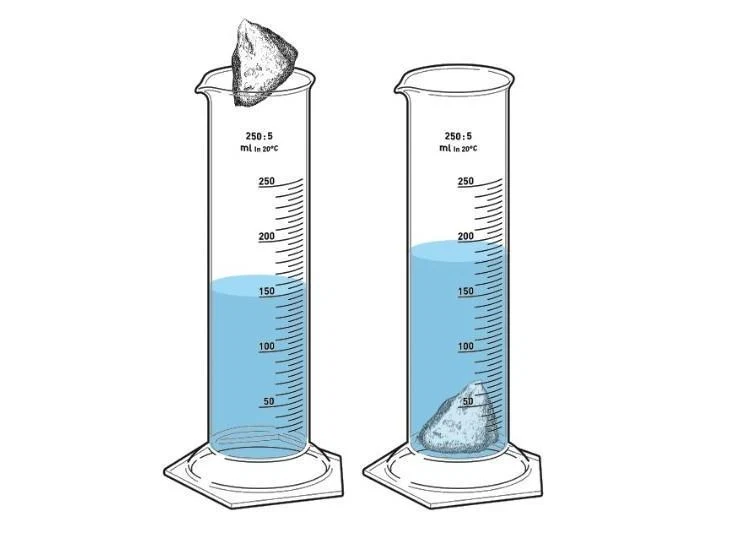
An irregular object can be measured using water displacement, provided it does not dissolve or absorb significant water.
brainly.in
Procedure
- Pour water into a measuring cylinder.
- Record the initial reading, .
- Carefully immerse the object.
- Record the final reading, .
- Calculate:
If the water rises from 50 mL to 75 mL:
10. Applications of density
Density helps explain floating and sinking, the selection of construction materials, liquid layering and the operation of some measuring instruments.
Exercise 3.3
- Convert 4.5 kg into grams.
- Calculate the weight of an object with mass 8 kg using .
- Find the density of a substance with mass 750 g and volume 250 cm³.
- A liquid has density 1.2 g/cm³ and volume 400 cm³. Find its mass.
- Explain why some objects float on water while others sink.