
1. Meaning of speed
Speed is the distance travelled per unit time.
From this formula:
2. Units of speed
Common units include metres per second (m/s) and kilometres per hour (km/h).
To convert:
Example
Convert 72 km/h to m/s.
Convert 15 m/s to km/h.
3. Calculating speed
A bus travels 180 km in 3 hours.
4. Average speed
Average speed is calculated using total distance divided by total time.
Example
A vehicle travels 120 km in 2 hours and another 180 km in 3 hours.
Total distance:
Total time:
Average speed:
Do not simply average two speeds unless the circumstances justify that method.
5. Velocity
Velocity is the rate of change of displacement. Unlike speed, velocity has both magnitude and direction.
For motion in a straight line:
Example
A learner walks 100 m east in 20 seconds.
6. Acceleration
Acceleration is the rate of change of velocity.
Where:
- = initial velocity.
- = final velocity.
- = time taken.
Example
A vehicle increases its velocity from 10 m/s to 30 m/s in 5 seconds.
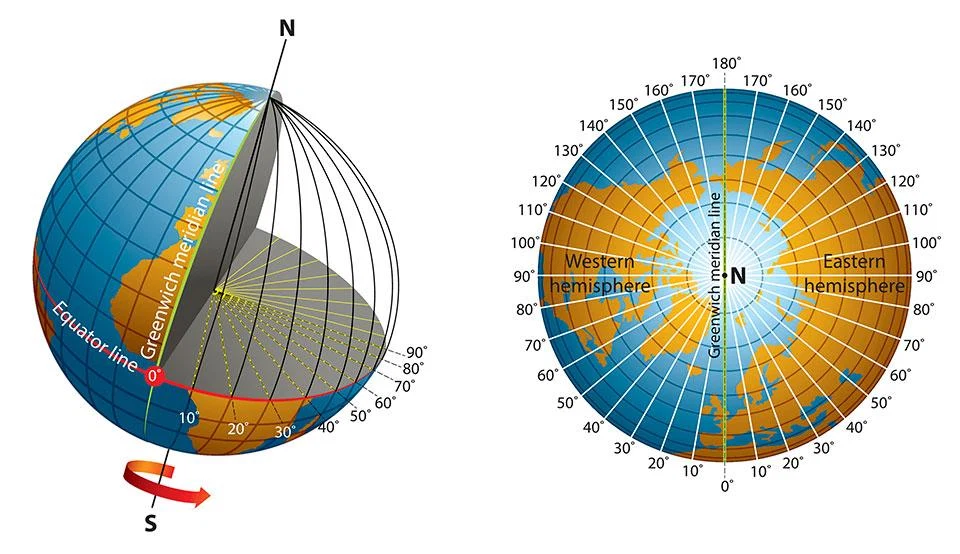
7. Longitudes and time
Longitude is the angular distance east or west of the Prime Meridian, which is taken as 0° longitude.
oceanservice.noaa.gov
Earth rotates approximately 360° in 24 hours.
Therefore:
Since one hour has 60 minutes:
Thus:
This relationship is used for idealised local solar time. Official clock time follows time zones and may not match local solar time.
8. Rules for longitude and time
- Places farther east have later local solar time.
- Places farther west have earlier local solar time.
- Add the time difference when moving east.
- Subtract the time difference when moving west.
9. Worked example
Town A is at longitude 30°E and Town B is at longitude 45°E.
Find the local solar time at B when it is 10:00 a.m. at A.
Longitude difference:
Time difference:
B is east of A.
Exercise 3.4
- Convert 90 km/h to m/s.
- A cyclist travels 45 km in 3 hours. Find the average speed.
- A car accelerates from 5 m/s to 25 m/s in 4 seconds. Calculate acceleration.
- Find the longitude difference between 20°E and 50°E.
- Find the ideal local solar time at 60°E when it is noon at 30°E.