Definition Wood is a natural, renewable, organic material obtained from the trunks, branches, and roots of trees. It consists mainly of cellulose fibres bound by lignin, providing strength, flexibility, and durability. Wood is a key material for production due to its availability, workability, strength-to-weight ratio, and aesthetic appeal.
Classification of Wood
According to Physical Characteristics
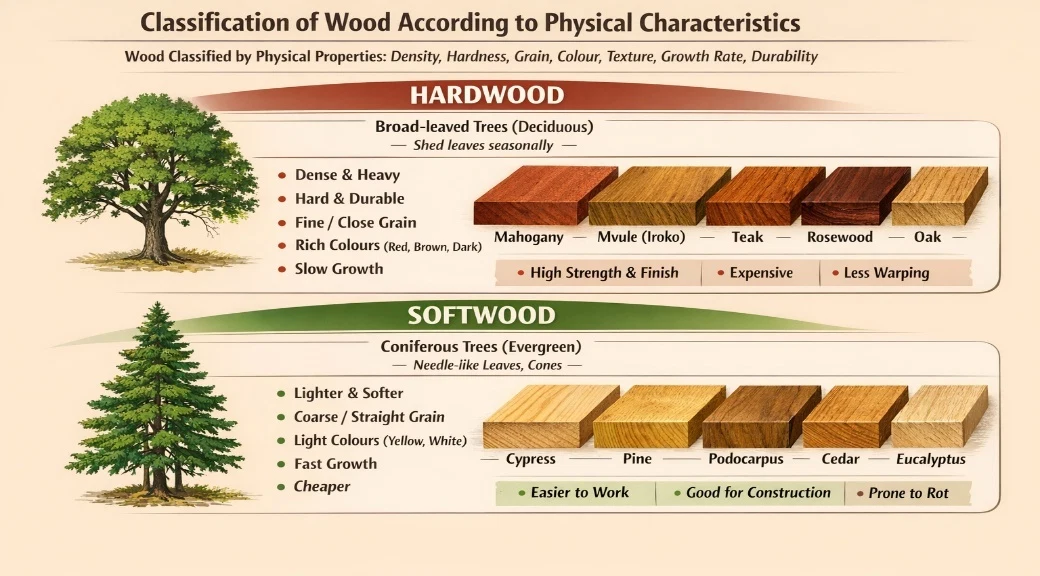
Wood is classified into two main groups based on physical properties (density, hardness, grain pattern, colour, texture, growth rate, durability):
|
Type |
Source (Tree Type) |
Physical Characteristics |
Common Kenyan Examples |
Typical Properties & Behaviour |
|---|---|---|---|---|
|
Hardwood |
Broad-leaved trees (deciduous – shed leaves seasonally) |
Dense, heavy, hard, strong, durable, fine/close grain, rich colours (red, brown, dark), slow growth, more resistant to decay/insects |
Mahogany, Mvule (Iroko), Teak, Camphor, Rosewood, Oak |
High strength, good finish, expensive, less warping |
|
Softwood |
Coniferous trees (evergreen – needle-like leaves, cones) |
Lighter, less dense, softer, easier to work/cut, coarse/straight grain, light colours (yellow, white, pale), fast growth, cheaper |
Cypress, Pine, Podocarpus (Muthi/Mukinduri), Cedar, Eucalyptus |
Easier machining, good for construction, prone to rot if untreated |
Key Differences Between Hardwood and Softwood
- Hardwood — Harder, denser, more durable, better aesthetic finish, slower-growing (expensive).
- Softwood — Softer, lighter, faster-growing (cheaper), easier to cut/shape but less resistant to wear/decay.
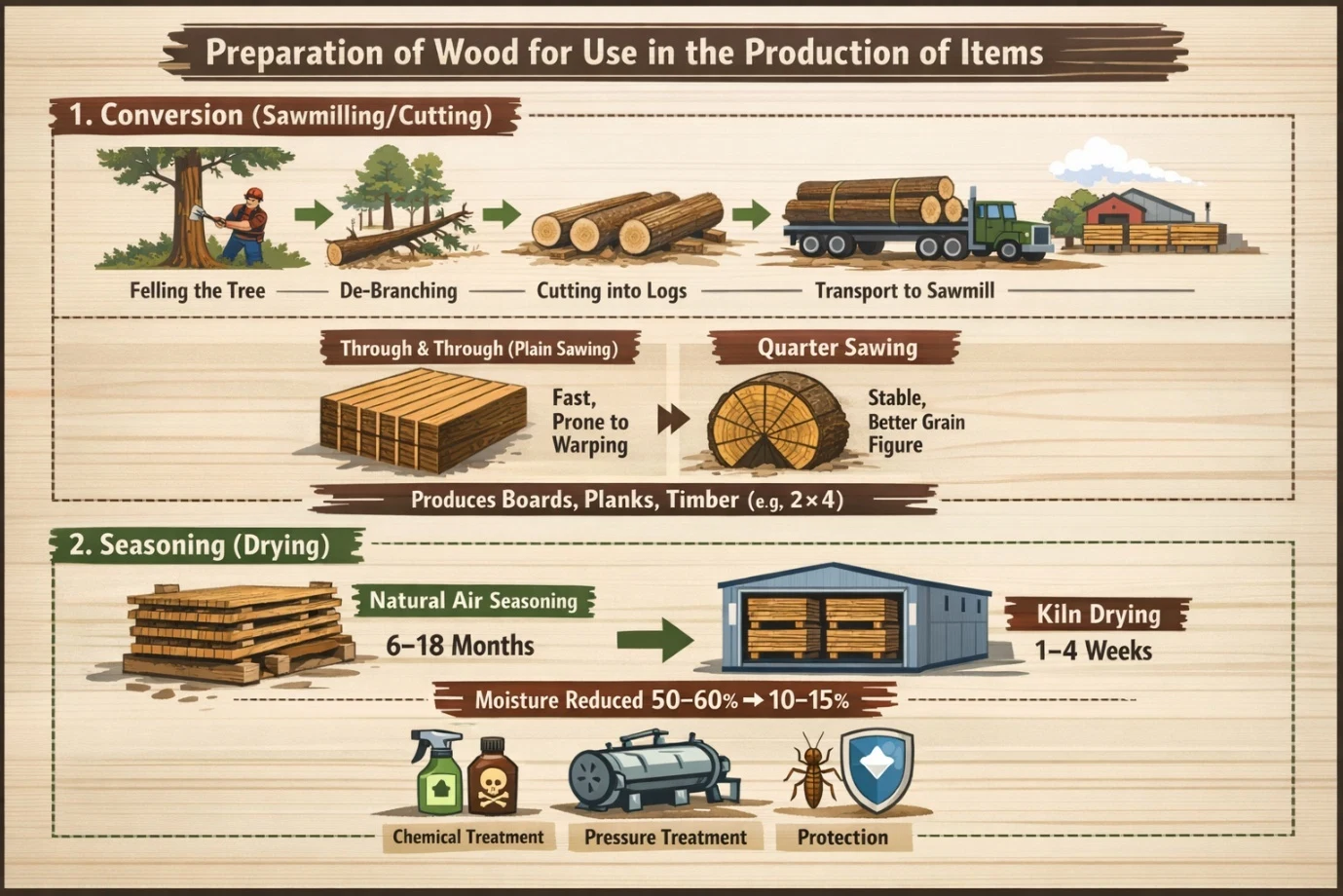
Preparation of Wood for Use in the Production of Items Preparation makes raw wood suitable for use (reduces moisture, improves stability, prevents defects). Two main processes:
- Conversion (Sawmilling/Cutting)
- Felling the tree → De-branching → Cutting into logs → Transport to sawmill.
- Sawing methods:
- Through-and-through/plain sawing (parallel cuts – fast, but prone to warping).
- Quarter sawing (radial cuts – more stable, better grain figure).
- Produces boards, planks, timber of standard sizes (e.g., 2×4 inches).
- Seasoning (Drying)
- Reduces moisture content from 50–60% (green wood) to 10–15% (usable). Prevents shrinking, warping, cracking, rotting, insect attack.
- Natural/Air seasoning: Stack timber outdoors with spacers for airflow (6–18 months, weather-dependent).
- Artificial/Kiln seasoning: Use heated chambers/kilns (controlled temperature/humidity, 1–4 weeks, faster/uniform).
- Additional treatments: Chemical preservatives (e.g., against termites), pressure treatment.
Types of Wood and Their Uses in Day-to-Day Community Life
- Hardwood — High-quality furniture (tables, chairs, cabinets), doors/windows, flooring, carvings (Kamba/Maasai art), tool handles (hammers, axes).
- Softwood — Construction (roof trusses, framing, scaffolding), packing crates/pallets, interior finishing (skirting, panelling), paper/pulp, fencing poles, simple furniture.
- General uses — Fuel (firewood/charcoal), crafts, building shelters, farm tools.
Importance of Wood in Day-to-Day Life
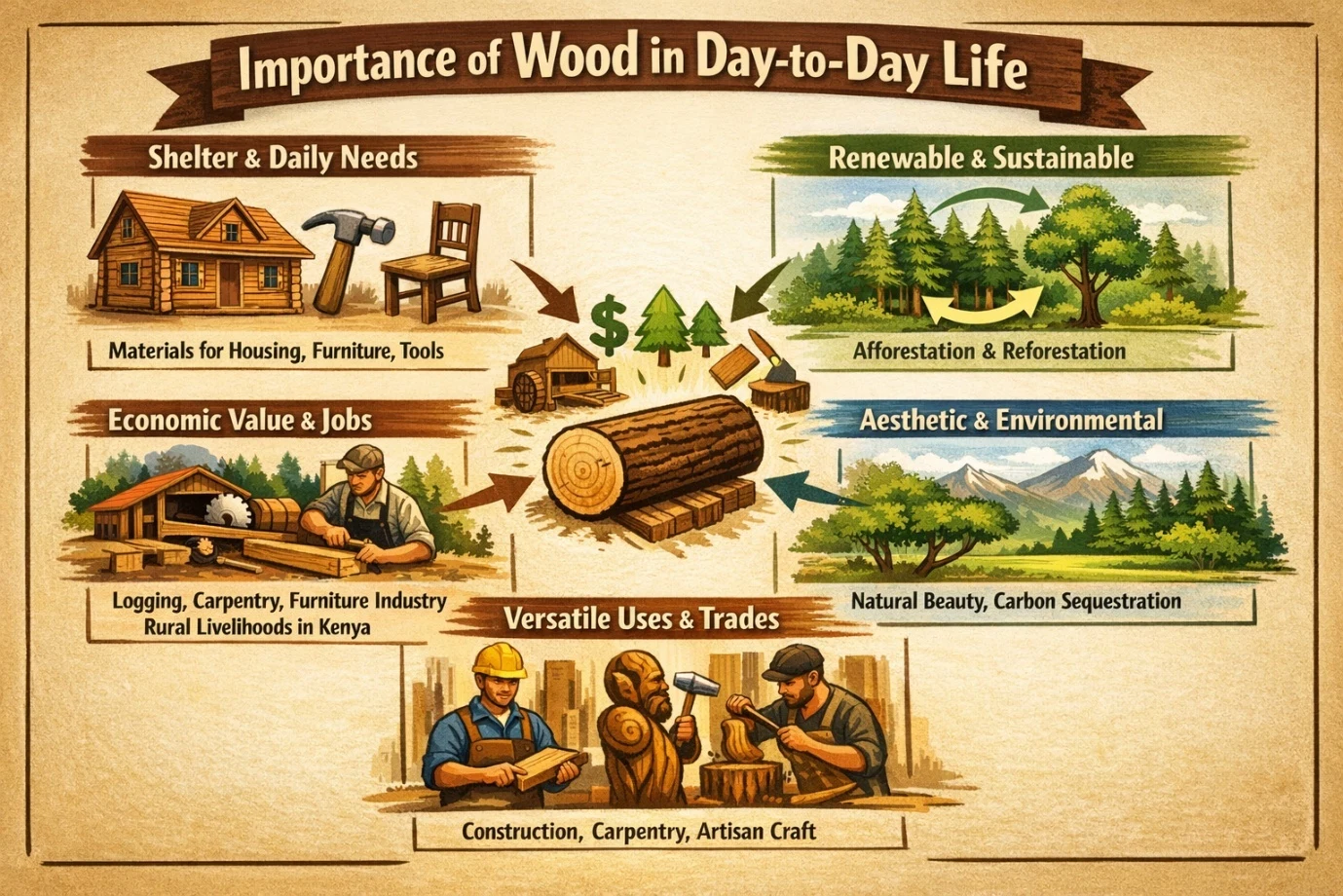
- Provides essential materials for housing, furniture, tools → supports shelter and daily needs.
- Renewable/sustainable if managed (afforestation, reforestation).
- Economic value → jobs in logging, sawmilling, carpentry, furniture industry (rural livelihoods in Kenya).
- Aesthetic/environmental benefits → natural beauty, carbon sequestration.
- Versatile for trades (construction, carpentry, art) and small-scale production.