Definitions
- Self-Exploration: The process of discovering your own interests, strengths, weaknesses, values, talents, and abilities.
- Talent: A natural gift or ability (e.g., singing, drawing).
- Ability: A skill developed through practice and learning.
- Career Development: The process of learning and planning for a job or career path.
Why Self-Exploration is Necessary
- Helps you understand your strengths and interests.
- Guides you to choose a career that matches your talents → leads to job satisfaction and success.
- Prevents choosing wrong careers due to peer/family pressure.
- Builds self-confidence and prepares you for Senior School pathway selection.
Ways of Nurturing Talents and Abilities
- Practice Regularly: Dedicate time daily/weekly to improve.
- Join Clubs/Societies: Engage in Drama, Music, Science Club, Sports teams.
- Seek Mentorship: Talk to teachers, parents, or professionals for advice.
- Attend Workshops/Training: Participate in talent shows, bootcamps, or coaching.
- Set Goals: Use SMART goals (Specific, Measurable, Achievable, Relevant, Time-bound).
- Use Available Resources: School labs, internet tutorials, library books.
Career Pathways in Senior School (CBC)
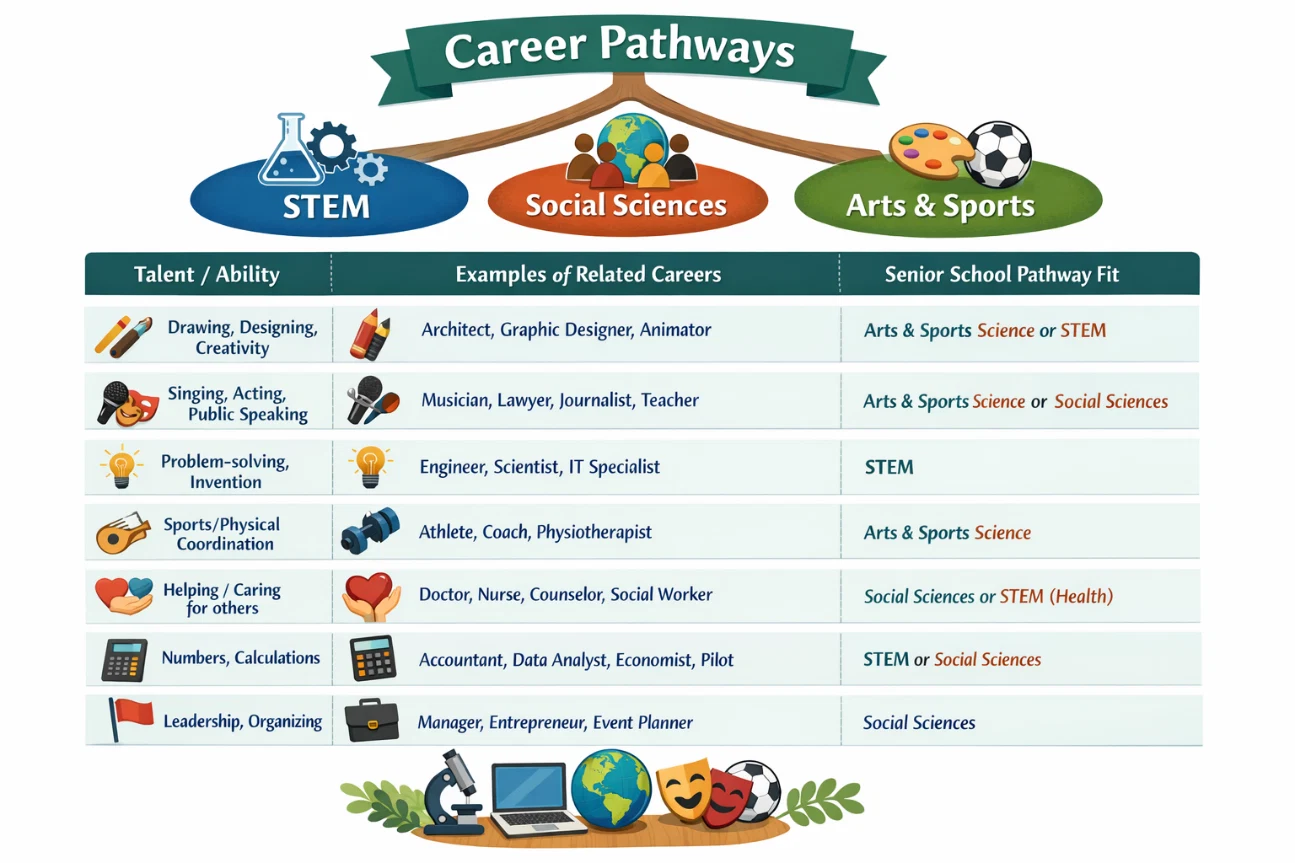
- Arts and Sports Science: For creative, performing, athletic, and design talents.
- Social Sciences: For communication, leadership, and helping others.
- STEM (Science, Technology, Engineering, Mathematics): For problem-solving, invention, numbers, and technical skills.
Relating Talents and Abilities to Career Pathways
|
Talent / Ability |
Examples of Related Careers |
Senior School Pathway Fit |
|---|---|---|
|
Drawing, Designing, Creativity |
Architect, Graphic Designer, Animator |
Arts & Sports Science or STEM |
|
Singing, Acting, Public Speaking |
Musician, Lawyer, Journalist, Teacher |
Arts & Sports Science or Social Sciences |
|
Problem-solving, Invention |
Engineer, Scientist, IT Specialist |
STEM |
|
Sports/Physical Coordination |
Athlete, Coach, Physiotherapist |
Arts & Sports Science |
|
Helping/Caring for others |
Doctor, Nurse, Counselor, Social Worker |
Social Sciences or STEM (Health) |
|
Numbers, Calculations |
Accountant, Data Analyst, Economist, Pilot |
STEM or Social Sciences |
|
Leadership, Organizing |
Manager, Entrepreneur, Event Planner |
Social Sciences |
Ethical and Unethical Practices
Ethical Practices (Positive Use):
- Using talents to help the community.
- Being honest about your skills (no false claims).
- Respecting copyright (no copying others' work).
- Working hard and crediting mentors.
Unethical Practices (Negative Use):
- Cheating/Plagiarism (copying work as your own).
- Using talents to harm others (cyberbullying, hacking).
- Using performance-enhancing drugs in sports.
- Forging certificates to qualify for opportunities.