
AGRICULTURE AND NUTRITION – GRADE 8

About This Course
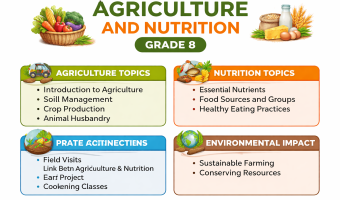
Agriculture and Nutrition is an integrated learning area for Junior School that anchors on the United Nations Sustainable Development Goals and the socioeconomic pillar of Kenya Vision 2030. The curriculum promotes health, hygiene, food and nutrition security through practical, competency-based education.
This full-year course combines concepts from agriculture and home science to equip learners with knowledge, skills, attitudes, and values in:
-
Conservation of resources (soil and water)
-
Crop and animal production
-
Food processing, preservation, and preparation
-
Personal and environmental hygiene
-
Innovative production techniques and ICT integration
Learners engage in hands-on projects including establishing kitchen gardens, constructing poultry folds, preparing balanced meals, sewing household items, and designing innovative animal waterers. The course forms a solid foundation for specialization in agriculture, food science, or home economics career pathways in senior school and beyond.
Learning Objectives
Material Includes
- Component Description
- Comprehensive Student Notes (Full Year) Detailed notes covering all six sub-strands across the three terms, complete with explanatory diagrams, tables, step-by-step practical guides, and key inquiry questions.
- Practical Project Guides Step-by-step instructions for: Farm model making, Water harvesting structure construction, Innovative kitchen gardens, Poultry fold construction, Pest and disease identification and control, Fish processing and poultry dressing, Milk and meat preservation, Balanced meal planning and cooking, Household item sewing, Innovative animal waterer construction.
- Assessment Rubrics Four-level rubrics (Exceeds Expectations, Meets Expectations, Approaches Expectations, Below Expectations) for each strand to evaluate learner progress.
- Activity and Lesson Plans Suggested learning experiences aligned with curriculum design, including field excursions, group discussions, projects, and digital research activities.
- ICT Resource Directory Contacts and access methods for Kenyan agricultural ICT services (weather, market prices, veterinary, extension, banking) relevant to Strand 4.3.
- Community Service Learning (CSL) Guidelines Framework for integrating a year-long CSL project using the 6-milestone approach (Problem Identification, Designing a Solution, Planning, Implementation, Showcasing/Report Writing, Reflection).
- Non-Formal Activity Suggestions Ideas for school community awareness campaigns on conservation, food production, hygiene, and production techniques.
- Glossary of Key Terms Definitions of essential vocabulary across all strands.
- Note: Physical materials for practical projects (cartons, soil, seeds, fabric, poultry, cooking ingredients, etc.) are not included but are listed as requirements.
Requirements
- Notebooks and stationery for recording observations and drawing diagrams.
- Activity journal to document project progress and reflections.
- Access to digital devices (smartphone, tablet, computer) with internet connectivity for research and ICT support services (where possible).
- Basic sewing kit (needles, thread, scissors, pins, measuring tape, fabric pieces).
- Cooking ingredients and equipment for meal preparation practicals.
- Willingness to participate in group work, field excursions, and hands-on projects.
- For Facilitators (Teachers/Parents):
- KICD Grade 8 Agriculture and Nutrition Curriculum Design (Revised 2024) – the official reference document.
- Access to a school farm, garden, or outdoor space for soil conservation, gardening, and poultry rearing practicals.
- Locally available/recycled materials for projects:
- Farm Model: Cartons, cardboard, soil, papier-mâché, small stones, twigs.
- Poultry Fold: Wire mesh, wood offcuts, nails, recycled plastic/wire, hinges, fencing staples.
- Innovative Kitchen Gardens: Sacks, containers, plastic bottles, tyres, wicking material.
- Water Harvesting: Gutters, tanks, polythene liners, pipes.
- Innovative Waterers: Plastic bottles, trays, pipes, float valves, nipples.
- Crop samples and garden inputs: Seeds, seedlings, manure/compost, gardening tools (jembe, fork jembe, spade, panga).
- Animal products for processing: Fresh fish, whole poultry carcass, milk, meat samples.
- Cooking tools and equipment: Stove/fuel, pots, pans, utensils, serving dishes.
- Cleaning materials: Detergents, disinfectants, brooms, mops, cloths.
- First Aid Kit for safety during all practical activities.
Target Audience
- Junior School Learners (Grade 8) following Kenya's Competency-Based Curriculum (CBC).
- Teachers and Facilitators delivering the Agriculture and Nutrition curriculum.
- Parents and Guardians supporting learners at home or in homeschooling settings.
- Agricultural Extension Officers and Youth Group Facilitators seeking structured training content.
- Curriculum Developers and Education Students studying the CBC approach.
Curriculum
Strand 1: Conservation of Resources
Introduction to Soil Conservation
Methods of Soil Conservation
Soil Conversation
1.1 Soil Conservation Measures
1.2 Water Harvesting and Storage
Strand 2: Food Production Processes
2.1 Kitchen and Backyard Gardening
2.2 Poultry Rearing in a Fold
2.3 Crop Pest and Disease Control
2.4 Preparation of Animal Products: Fish and Poultry Carcass
2.5 Preserving Milk and Meat
Strand 3: Hygiene Practices
3.1 Cleaning the Kitchen
Strand 4: Production Techniques
4.1 Sewing Skills: Constructing Household Items
4.2 Constructing Innovative Animal Waterer
4.3 ICT Support Services
Your Instructors

admin
Charles Boen is a passionate educator based in Nairobi, Kenya, specializing in Mathematics and Physics. He holds a Bachelor of Education Science degree from the University of Kabianga and has several years of experience teaching in secondary schools. Throughout his career, he has demonstrated strong skills in modern pedagogy, classroom management, and student mentorship.
Charles is committed to making learning engaging and accessible, both in physical classrooms and through online platforms. He is also experienced in guidance and counseling, helping learners navigate academic and personal challenges. Beyond teaching, he is actively involved in digital education, content creation, and academic support services.
With a strong interest in innovation and technology, Charles integrates modern tools into his teaching to enhance student understanding and performance. He is dedicated to empowering learners with knowledge, critical thinking skills, and confidence to succeed in their academic journeys.
Write a review
Material Includes
- Component Description
- Comprehensive Student Notes (Full Year) Detailed notes covering all six sub-strands across the three terms, complete with explanatory diagrams, tables, step-by-step practical guides, and key inquiry questions.
- Practical Project Guides Step-by-step instructions for: Farm model making, Water harvesting structure construction, Innovative kitchen gardens, Poultry fold construction, Pest and disease identification and control, Fish processing and poultry dressing, Milk and meat preservation, Balanced meal planning and cooking, Household item sewing, Innovative animal waterer construction.
- Assessment Rubrics Four-level rubrics (Exceeds Expectations, Meets Expectations, Approaches Expectations, Below Expectations) for each strand to evaluate learner progress.
- Activity and Lesson Plans Suggested learning experiences aligned with curriculum design, including field excursions, group discussions, projects, and digital research activities.
- ICT Resource Directory Contacts and access methods for Kenyan agricultural ICT services (weather, market prices, veterinary, extension, banking) relevant to Strand 4.3.
- Community Service Learning (CSL) Guidelines Framework for integrating a year-long CSL project using the 6-milestone approach (Problem Identification, Designing a Solution, Planning, Implementation, Showcasing/Report Writing, Reflection).
- Non-Formal Activity Suggestions Ideas for school community awareness campaigns on conservation, food production, hygiene, and production techniques.
- Glossary of Key Terms Definitions of essential vocabulary across all strands.
- Note: Physical materials for practical projects (cartons, soil, seeds, fabric, poultry, cooking ingredients, etc.) are not included but are listed as requirements.