
Suggested Number of Lessons: 10
Specific Learning Outcomes
By the end of this sub-strand, the learner should be able to:
- Explain the functions of the parts of an aircraft in aviation.
- Illustrate the parts of an aircraft in aviation.
- Model a heavier-than-air aircraft in aviation.
- Appreciate the role of different parts in the operation of an aircraft.
2.1.1 Introduction to Aircraft Components
An aircraft is a machine designed to travel through the atmosphere by obtaining support from the air.
Aircraft components are the individual parts and assemblies that make up an aircraft and enable it to perform its intended functions.
Aircraft are constructed from different components that work together to provide lift, movement, stability, control and structural support.
For example, a passenger aeroplane requires wings to generate lift, engines to provide thrust, landing gear to support the aircraft on the ground and a fuselage to accommodate passengers and cargo.
Importance of Aircraft Components
- Generation of lift: Wings and rotor blades help produce the aerodynamic forces needed to support aircraft in flight.
- Provision of thrust: Engines and propulsion systems enable aircraft to move through the air.
- Flight control: Control surfaces and rotor systems enable the pilot to control aircraft movement.
- Stability: Components such as the empennage help maintain stable flight.
- Accommodation: The fuselage provides space for passengers, crew, cargo and equipment.
- Ground operations: Landing gear supports aircraft during take-off, landing and ground movement.
- Structural strength: Aircraft structures support loads experienced during flight and ground operations.
- Safety: Aircraft components are designed to operate together safely under specified conditions.
2.1.2 Major Parts of a Fixed-Wing Aircraft
A fixed-wing aircraft is an aircraft that generates most of its lift using wings that remain fixed relative to its main structure.
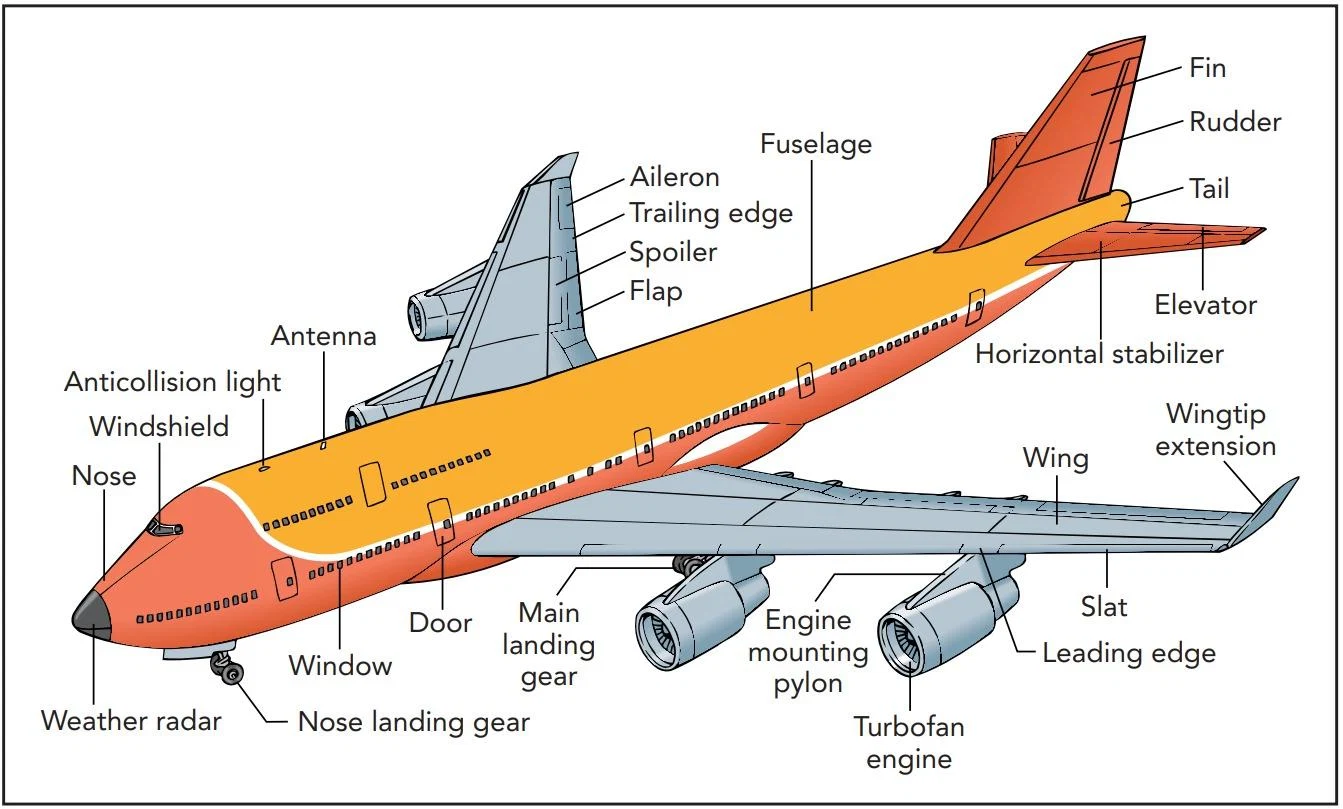 The major components of a conventional fixed-wing aircraft include:
- Fuselage.
- Wings.
- Empennage.
- Landing gear.
- Power plant.
A. Fuselage
The fuselage is the main body of an aircraft to which major components such as wings, the tail assembly and landing gear are attached.
It forms the central structure of most fixed-wing aircraft.
Functions of the Fuselage
- Accommodates the pilots and other crew members.
- Provides space for passengers.
- Houses cargo and luggage compartments.
- Supports the attachment of wings and tail assemblies.
- Houses aircraft systems and equipment.
- Transfers structural loads between aircraft components.
- Protects occupants and equipment from external environmental conditions.
Main Sections of a Fuselage
|
Section |
Description |
|---|---|
|
Nose section |
Front portion, which may house equipment and, on some aircraft, the cockpit |
|
Cockpit |
Area containing flight controls and instruments used by pilots |
|
Cabin |
Space occupied by passengers or other occupants |
|
Cargo compartment |
Space used to carry goods and baggage |
|
Rear fuselage |
Rear body structure connecting to the tail assembly |
Types of Fuselage Construction
1. Truss Construction
A truss fuselage consists of interconnected structural members arranged to form a framework.
The members may be made from metal tubing or other suitable materials.
It is commonly associated with certain light aircraft and older aircraft designs.
2. Monocoque Construction
Monocoque construction uses an external shell that carries much of the structural load.
The outer skin provides a significant portion of the structure's strength.
3. Semi-Monocoque Construction
Semi-monocoque construction combines an external skin with internal reinforcing members such as frames, bulkheads, stringers and longerons.
It is widely used in modern aircraft.
Advantages of Semi-Monocoque Construction
- Provides good strength relative to weight.
- Distributes loads through several structural members.
- Can provide useful interior space.
- Supports the construction of streamlined aircraft bodies.
B. Wings
A wing is an aerodynamic structure designed to generate lift as an aircraft moves through the air.
Wings are among the most important components of fixed-wing aircraft.
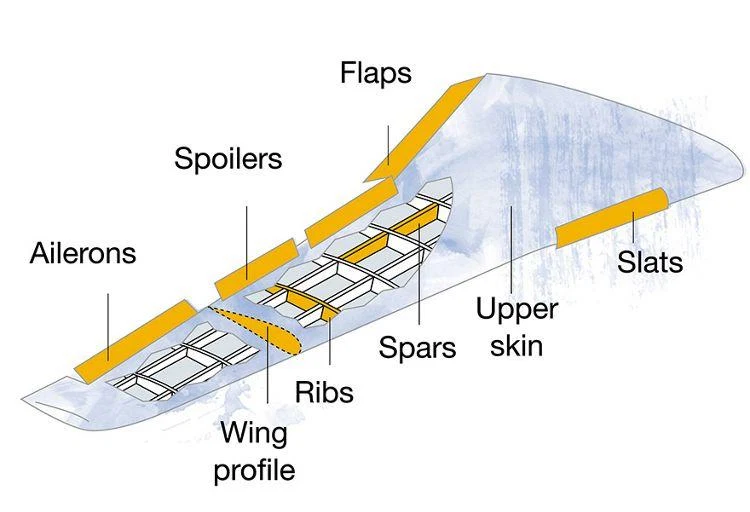 Functions of Aircraft Wings
- Generate lift during flight.
- Support aircraft weight through aerodynamic forces.
- Provide attachment points for certain control surfaces.
- May contain fuel tanks.
- Help maintain lateral stability through their design.
- May support engines or other equipment.
Main Parts of an Aircraft Wing
1. Wing Root
The section where a wing joins the fuselage.
2. Wing Tip
The outermost end of a wing.
3. Leading Edge
The front edge of the wing that first meets the airflow during normal forward flight.
4. Trailing Edge
The rear edge of a wing where the airflow from the upper and lower surfaces passes downstream.
5. Ailerons
Movable control surfaces, usually located towards the outer trailing edges of the wings, used primarily to control roll.
6. Flaps
Movable high-lift devices usually located on the inner trailing edges of the wings.
They increase wing lift capability at lower speeds and commonly increase drag when extended.
7. Spoilers
Movable panels on the wing surface that reduce lift and increase drag when deployed.
They may assist with descent, roll control and braking after landing.
C. Empennage
The empennage is the tail assembly of an aircraft.
It normally consists of horizontal and vertical stabilising surfaces and their associated control surfaces.
Functions of the Empennage
- Provides directional stability.
- Provides longitudinal stability.
- Supports control of pitching movement.
- Supports control of yawing movement.
- Helps the aircraft maintain controlled flight.
Main Parts of the Empennage
|
Component |
Function |
|---|---|
|
Vertical stabiliser |
Provides directional stability |
|
Rudder |
Controls yaw |
|
Horizontal stabiliser |
Provides longitudinal stability |
|
Elevator |
Controls pitch |
Pitch is the rotation of an aircraft about its lateral axis, causing the nose to move upwards or downwards.
Yaw is the rotation about its vertical axis, causing the nose to move to the left or right.
D. Landing Gear
Landing gear is the system of wheels, supporting structures and related components used to support an aircraft while it is on the ground.
Some aircraft use floats, skis or other landing arrangements instead of conventional wheels.
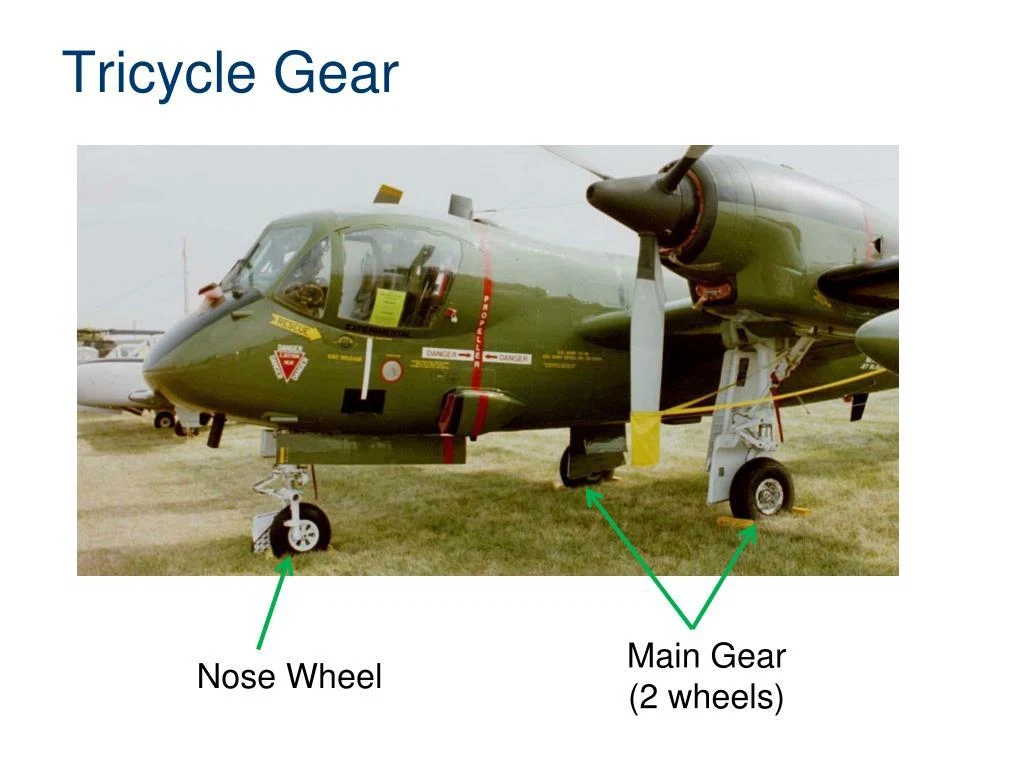 Tricycle landing gear
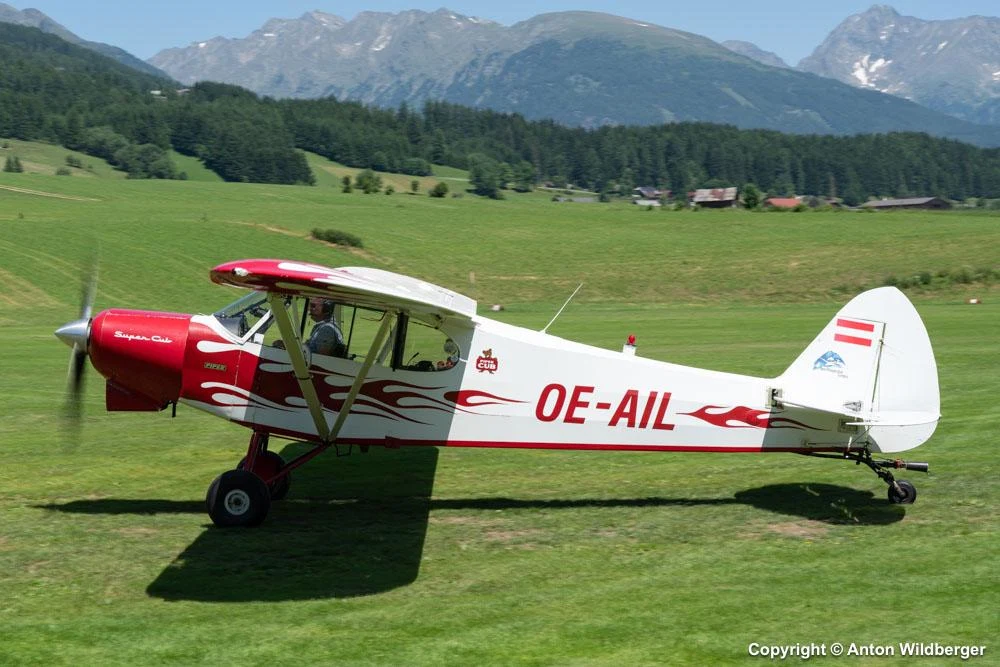 Conventional landing gear
Functions of Landing Gear
- Supports the aircraft on the ground.
- Absorbs landing impact loads.
- Enables ground movement.
- Provides wheel braking on appropriately equipped aircraft.
- Supports directional control during taxiing through steering systems where fitted.
Types of Landing Gear
1. Tricycle Landing Gear
Consists of two main landing gear assemblies and a nose wheel assembly.
It is common in many modern aeroplanes.
2. Conventional Landing Gear
Consists of two main wheels positioned ahead of the centre of gravity and a tailwheel or tail skid.
It is also called a tailwheel arrangement.
3. Fixed Landing Gear
Remains extended during flight.
It is mechanically simpler but normally produces more aerodynamic drag.
4. Retractable Landing Gear
Can be raised into the aircraft structure after take-off and lowered before landing.
It helps reduce drag during flight.
E. Power Plant
The power plant is the system responsible for generating power for aircraft propulsion.
Depending on aircraft design, it may include an engine, propeller, associated controls and supporting systems.
Functions of the Power Plant
- Produces power for propulsion.
- Enables the aircraft to accelerate.
- Supports take-off and climbing.
- Helps maintain the required flight speed.
- May provide power for onboard electrical or mechanical systems.
Common Aircraft Propulsion Systems
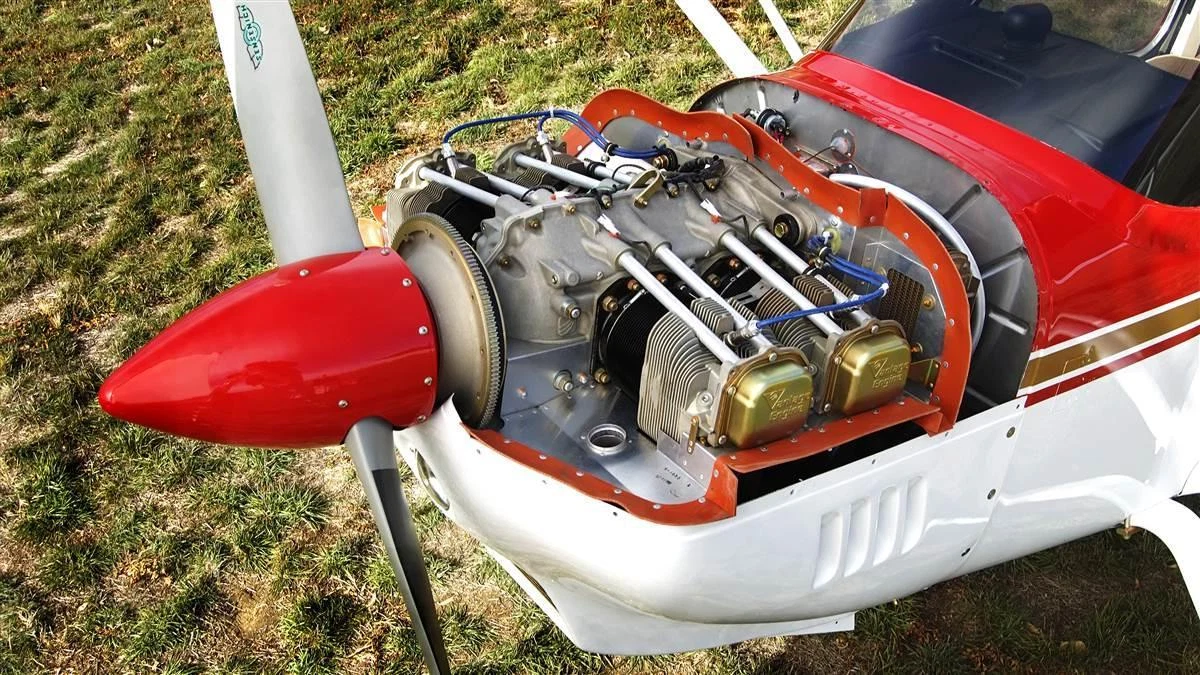 Piston engine and propeller
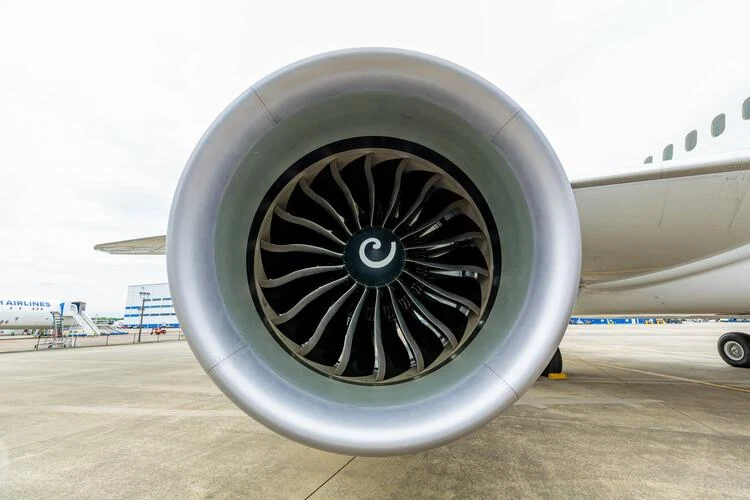 Turbofan engine
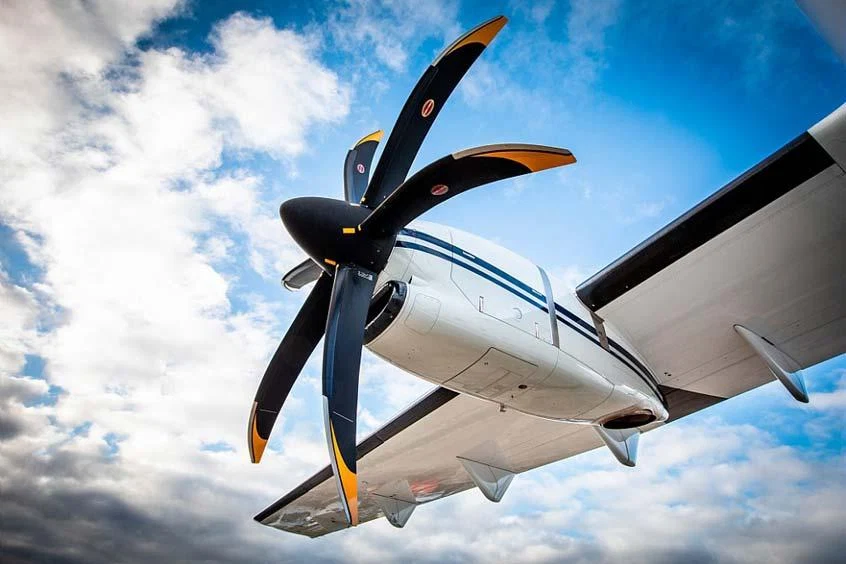 Turboprop engine
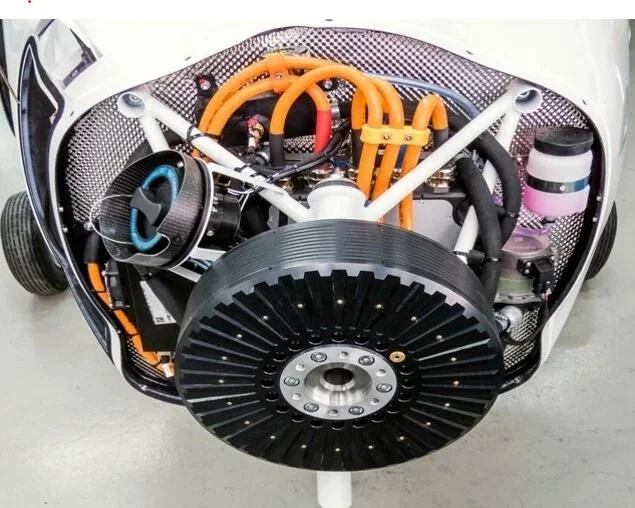 Electric propulsion
2.1.3 Major Parts of a Rotary-Wing Aircraft
A rotary-wing aircraft produces lift primarily through rotating blades.
A helicopter is a common example.
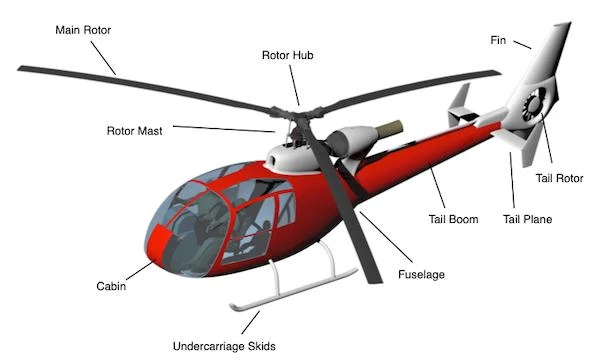 Main Helicopter Components
A. Main Rotor
The main rotor consists of rotating blades attached to a rotor hub and driven or turned through the rotor system.
Functions:
- Produces lift.
- Provides control forces for movement.
- Supports hovering and manoeuvring.
- Enables vertical take-off and landing.
B. Tail Rotor
A tail rotor is a smaller rotor normally located near the tail of a conventional single-main-rotor helicopter.
Functions:
- Helps counteract the torque produced by the main rotor.
- Provides yaw control.
- Helps maintain directional control while hovering.
Some helicopters use alternative anti-torque arrangements and do not have a conventional tail rotor.
C. Fuselage
The fuselage houses the cockpit, occupants, cargo and aircraft systems.
It provides structural support for the helicopter's major components.
D. Tail Boom
The tail boom extends from the rear fuselage and supports the tail rotor or other tail assembly components on many helicopter designs.
E. Landing Skids or Wheels
The landing system supports the helicopter on the ground.
Skids are common on some light helicopters, while larger helicopters may use wheeled landing gear.
F. Power Plant
Helicopters may use piston engines or gas-turbine engines.
The power plant provides mechanical power to drive the rotor system.
2.1.4 Differences Between Fixed-Wing and Rotary-Wing Aircraft
|
Fixed-wing aircraft |
Rotary-wing aircraft |
|---|---|
|
Use fixed wings to produce lift |
Use rotating blades to produce lift |
|
Generally require forward airflow over their wings |
Can generate lift while hovering |
|
Many require a runway for take-off and landing |
Many can take off and land vertically |
|
Commonly used for longer-distance transport |
Useful for rescue and access to confined landing areas |
|
Examples include aeroplanes and gliders |
Examples include helicopters and autogyros |
2.1.5 Aircraft Flight Control Surfaces
Flight control surfaces are movable aerodynamic parts used to change or control aircraft movement.
|
Control surface |
Main movement controlled |
|---|---|
|
Ailerons |
Roll |
|
Elevator |
Pitch |
|
Rudder |
Yaw |
|
Flaps |
Increase low-speed lift capability and drag |
|
Spoilers |
Reduce lift and increase drag |
Three Main Aircraft Rotational Movements
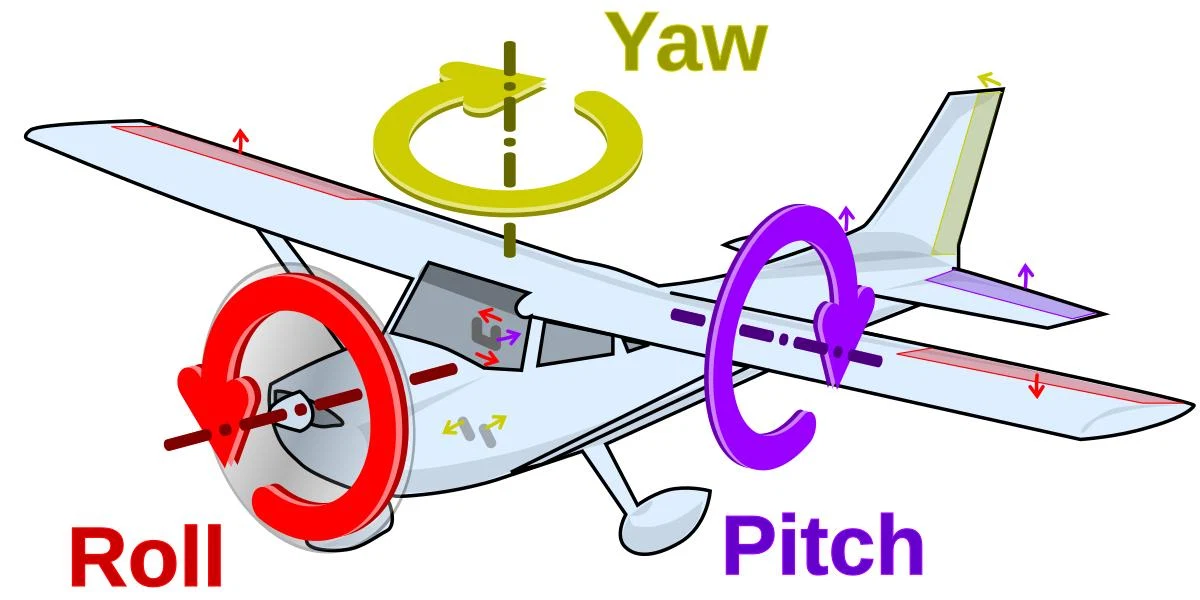 1. Roll
Roll is the rotation of the aircraft about its longitudinal axis.
It causes one wing to move upwards while the other moves downwards.
2. Pitch
Pitch is rotation about the lateral axis.
It changes the nose-up or nose-down attitude.
3. Yaw
Yaw is rotation about the vertical axis.
It changes the direction in which the nose points to the left or right.
2.1.6 Practical Activity: Construction of a Model Fixed-Wing Aircraft
Objective: To identify and demonstrate the functions of major aircraft components.
Materials Required
- Cardboard.
- Paper.
- Pencil.
- Ruler.
- Adhesive tape.
- Glue.
- Child-safe cutting tools.
- Coloured pencils.
Procedure
- Sketch the outline of a simple aeroplane.
- Cut a cardboard shape to represent the fuselage.
- Make two symmetrical wings.
- Attach the wings to the fuselage.
- Construct a horizontal stabiliser.
- Construct a vertical stabiliser.
- Attach the tail components.
- Use suitable lightweight materials to represent the landing gear.
- Label each major component.
- Present the model to the class and explain the function of each part.
Precautions
- Use cutting tools under appropriate supervision.
- Keep sharp tools safely stored.
- Avoid handling hot glue without supervision.
- Keep the working area clean.
- Do not test the model near electrical equipment or moving vehicles.
Expected Result: A model showing the fuselage, wings, empennage and landing gear.
Revision Exercise 2.1
- Define an aircraft component.
- Name five major parts of a fixed-wing aircraft.
- Explain six functions of the fuselage.
- Differentiate between monocoque and semi-monocoque construction.
- State five functions of aircraft wings.
- Differentiate between ailerons and flaps.
- Name four components of the empennage.
- Explain the importance of landing gear.
- Differentiate between fixed and retractable landing gear.
- State the functions of the main rotor and tail rotor.
- Compare fixed-wing and rotary-wing aircraft.
- Draw and label a conventional fixed-wing aircraft.
- Explain pitch, roll and yaw.
- Describe how to construct a simple aircraft model.