
Suggested duration: 24 lessons
Introduction
All elements are made up of atoms. Understanding the structure of atoms is essential because it helps explain the properties of elements, chemical bonding and the formation of compounds.
Atoms contain smaller particles arranged in a characteristic structure. The arrangement of electrons plays an important role in chemical behaviour.
Specific Learning Outcomes
By the end of the sub-strand, the learner should be able to describe the structure of the atom, calculate relative atomic masses from isotopic abundances, write electron arrangements using s and p notation and appreciate the importance of atomic structure.
Key Inquiry Question
How are electrons arranged in an atom?
1.2.1 Meaning of an Atom
An atom is the smallest unit of a chemical element that retains its chemical identity.
Atoms are made up of three principal subatomic particles:
- Protons.
- Neutrons.
- Electrons.
Protons and neutrons are located in the nucleus, while electrons occupy regions around the nucleus described by orbitals.
1.2.2 Subatomic Particles
|
Particle |
Symbol |
Relative charge |
Approximate relative mass |
Location |
|---|---|---|---|---|
|
Proton |
p⁺ |
+1 |
1 |
Nucleus |
|
Neutron |
n |
0 |
1 |
Nucleus |
|
Electron |
e⁻ |
−1 |
1/1836 |
Orbitals around nucleus |
Protons
Protons are positively charged particles found in the nucleus.
The number of protons determines the identity of an element.
For example, every carbon atom contains six protons.
Neutrons
Neutrons are electrically neutral particles found in the nucleus.
Atoms of the same element may have different numbers of neutrons.
Electrons
Electrons are negatively charged particles found in regions surrounding the nucleus.
Their arrangement influences chemical bonding and reactivity.
Aspect Ratio: 16:9.
Placement: After Section 1.2.2.
1.2.3 Atomic Number
The atomic number, represented by , is the number of protons in the nucleus of an atom.
For a neutral atom:
Example
Sodium has atomic number 11.
Therefore, a neutral sodium atom contains:
- 11 protons.
- 11 electrons.
1.2.4 Mass Number
The mass number, represented by , is the total number of protons and neutrons in the nucleus.
Where:
- = mass number.
- = atomic number.
- = number of neutrons.
Therefore:
Worked Example 1.1
An atom has atomic number 17 and mass number 35.
Determine the numbers of protons, neutrons and electrons.
Protons:
Neutrons:
Electrons:
For a neutral atom:
e⁻=17
Answer: 17 protons, 18 neutrons and 17 electrons.
1.2.5 Nuclide Notation
Atoms can be represented using the notation:
Where is the chemical symbol.
For example:
This represents sodium with:
- Atomic number = 11.
- Mass number = 23.
- Protons = 11.
- Neutrons = 12.
- Electrons = 11 if neutral.
Practice Table
|
Atom |
Atomic number |
Mass number |
Protons |
Neutrons |
Electrons (neutral) |
|---|---|---|---|---|---|
|
Carbon-12 |
6 |
12 |
6 |
6 |
6 |
|
Oxygen-16 |
8 |
16 |
8 |
8 |
8 |
|
Sodium-23 |
11 |
23 |
11 |
12 |
11 |
|
Chlorine-35 |
17 |
35 |
17 |
18 |
17 |
|
Calcium-40 |
20 |
40 |
20 |
20 |
20 |
1.2.6 Development of Atomic Models
Scientific understanding of the atom developed as experiments provided new evidence.
Dalton's Atomic Model
John Dalton proposed that matter is made up of atoms and that chemical reactions involve the rearrangement of atoms.
His model represented atoms as solid particles.
Although important historically, the model could not explain electrons, nuclei or isotopes.
Thomson's Atomic Model
J. J. Thomson identified the electron.
His model represented negatively charged electrons embedded in a positively charged region.
This became known as the plum pudding model.
Rutherford's Nuclear Model
Ernest Rutherford and his collaborators provided evidence that an atom contains a small, dense, positively charged nucleus.
The observations implied that much of the atom's volume is relatively empty.
Bohr's Atomic Model
Niels Bohr proposed that electrons in hydrogen occupy certain allowed energy levels.
This model helped explain the hydrogen emission spectrum but has limitations for more complex atoms.
Modern Quantum Model
The modern model describes electrons using orbitals, which represent the probability distribution of electron positions.
Electrons do not travel in simple fixed planetary paths around the nucleus.
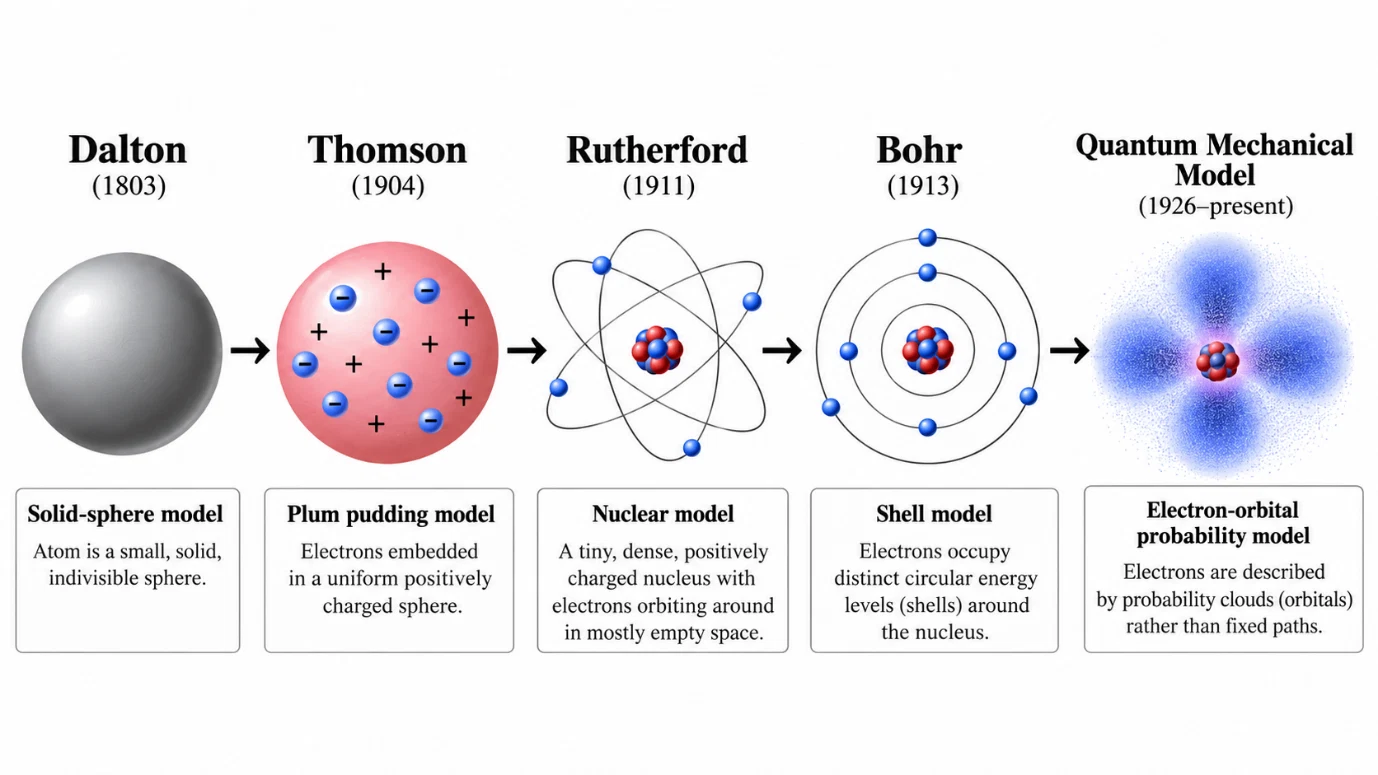
Figure 1.6: Development of Atomic Models
1.2.7 Rutherford's Gold Foil Experiment
Rutherford's nuclear model was supported by observations from the alpha-particle scattering experiment.
General Arrangement
A beam of alpha particles was directed towards a very thin gold foil.
A detection arrangement was used to observe how the particles were deflected.
Main Observations
- Most alpha particles passed through with little or no deflection.
- Some particles were deflected through noticeable angles.
- A very small number were deflected through large angles.
Conclusions
Most of the atom's volume is relatively empty.
The positive charge and most of the atomic mass are concentrated in a very small nucleus.
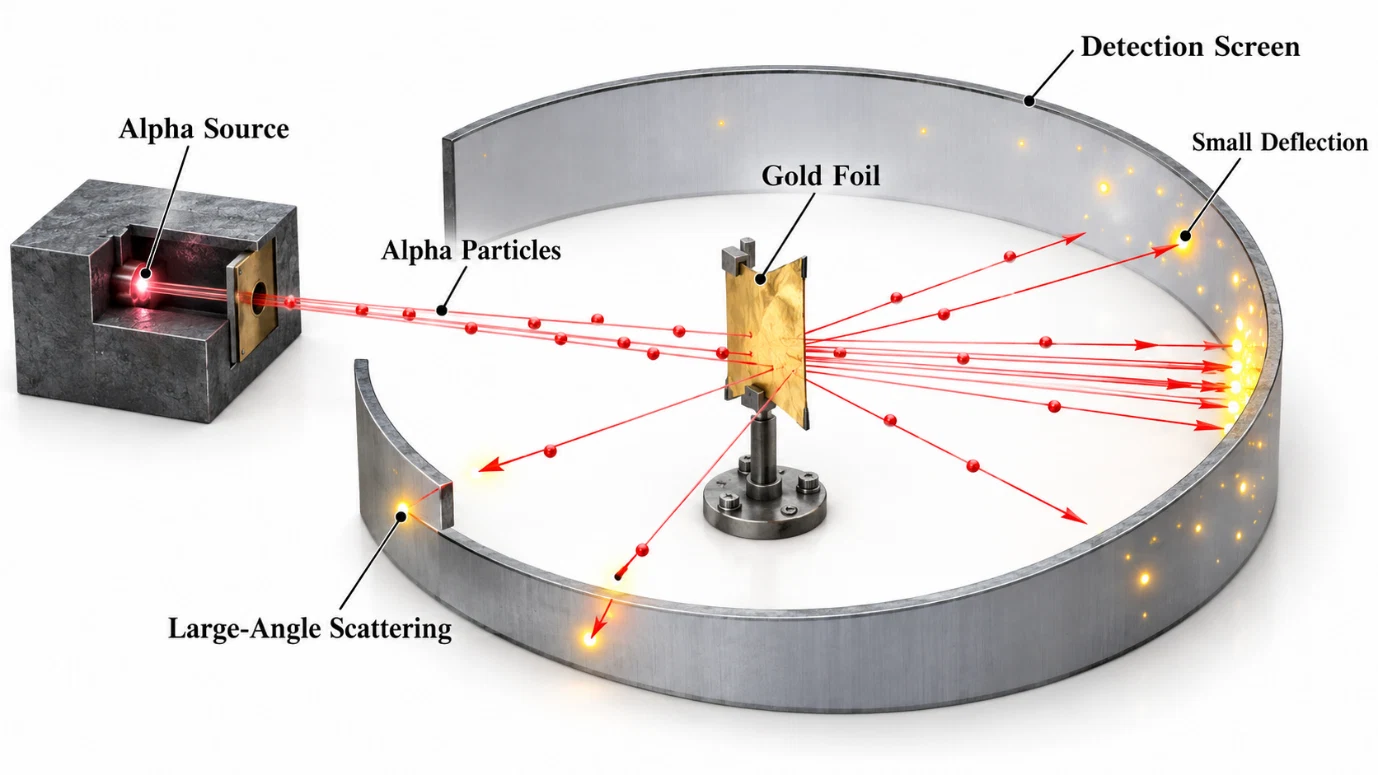
Figure 1.7: Rutherford Gold Foil Experiment
1.2.8 Isotopes
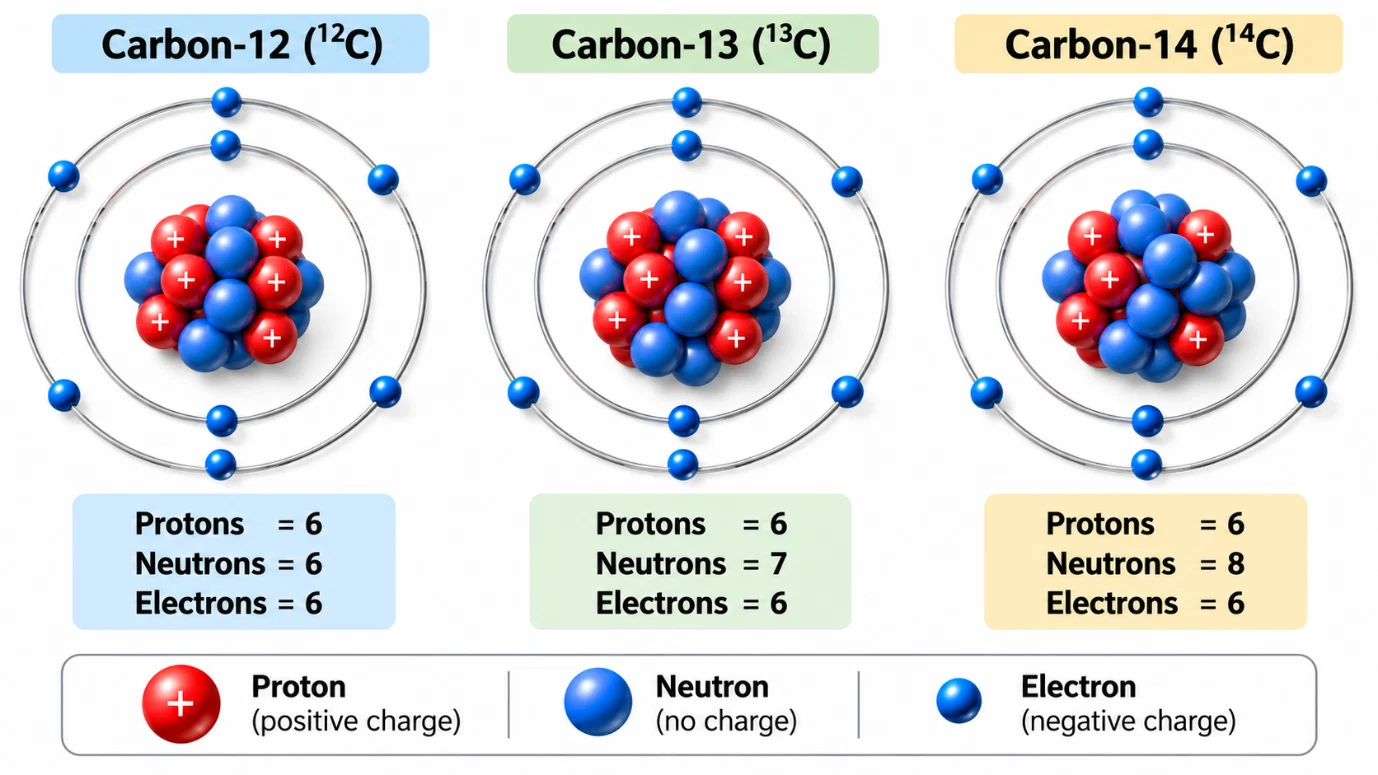
Isotopes are atoms of the same element that have the same number of protons but different numbers of neutrons.
They have the same atomic number but different mass numbers.
Example: Carbon Isotopes
Carbon has several isotopes, including:
|
Isotope |
Protons |
Neutrons |
Electrons (neutral) |
|---|---|---|---|
|
Carbon-12 |
6 |
6 |
6 |
|
Carbon-13 |
6 |
7 |
6 |
|
Carbon-14 |
6 |
8 |
6 |
Properties of Isotopes
Isotopes of the same element have very similar chemical properties because their electron arrangements are similar.
However, their masses and some physical or nuclear properties differ.
Some isotopes are stable; others are radioactive.
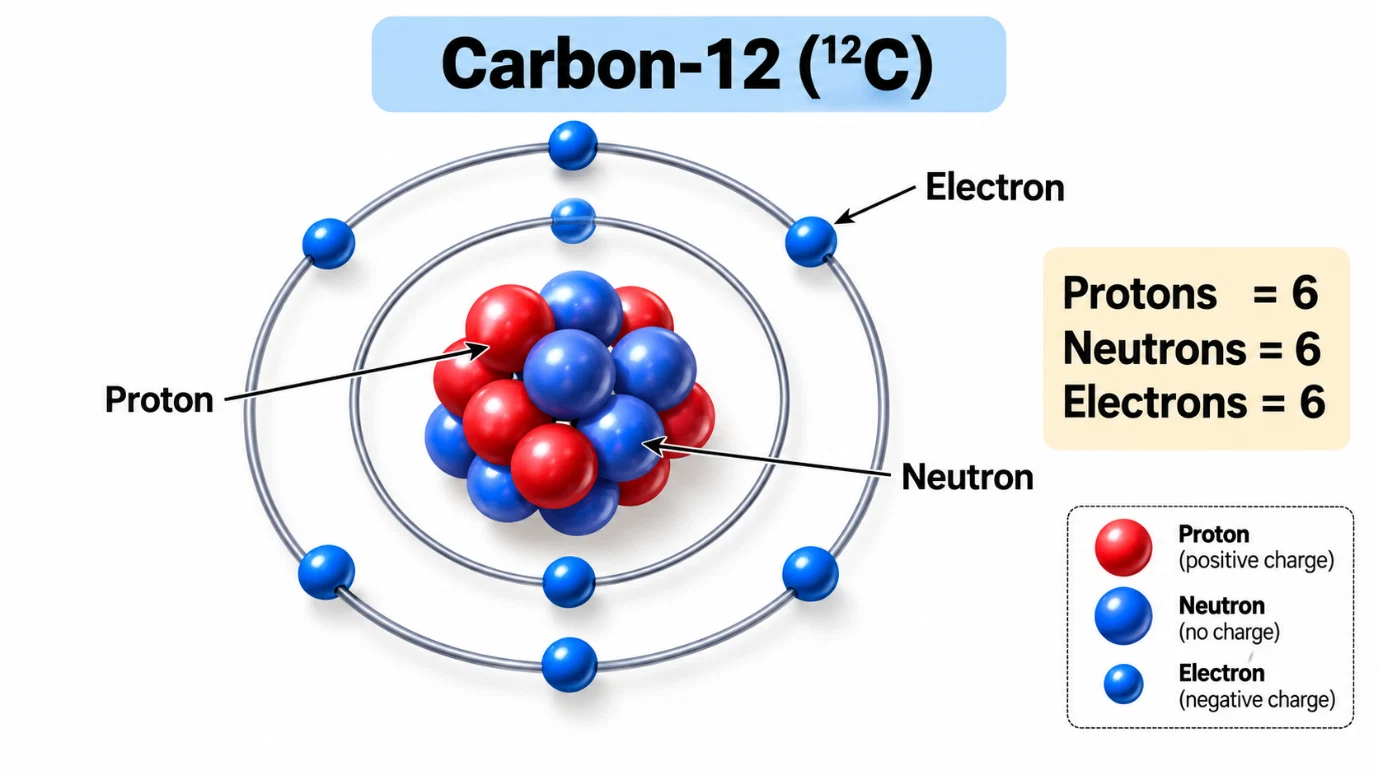
Figure 1.8: Isotopes of Carbon
1.2.9 Relative Atomic Mass
The relative atomic mass, , is the weighted mean mass of atoms of an element relative to one-twelfth of the mass of a carbon-12 atom.
It accounts for the relative abundances of naturally occurring isotopes.
Formula
For two isotopes:
Where are the isotope masses and are their percentage abundances.
For school-level exercises, mass numbers may be used as approximate isotope masses when the question specifies this simplification.
Worked Example 1.2: Chlorine
Chlorine consists of approximately 75% chlorine-35 and 25% chlorine-37 for this exercise.
Calculate the approximate relative atomic mass.
Worked Example 1.3: Magnesium
A hypothetical sample contains:
- 79% magnesium-24.
- 10% magnesium-25.
- 11% magnesium-26.
Calculate the approximate relative atomic mass.
1.2.10 Energy Levels
Electrons occupy allowed energy states around the nucleus.
The main energy levels are identified by principal quantum numbers:
The maximum theoretical number of electrons in a main energy level is:
|
Energy level |
Maximum electrons | |
|---|---|---|
|
First |
1 |
2 |
|
Second |
2 |
8 |
|
Third |
3 |
18 |
|
Fourth |
4 |
32 |
These are maximum capacities, not the order in which orbitals fill.
1.2.11 Atomic Orbitals
An atomic orbital describes the spatial distribution of an electron in an atom.
Each orbital can accommodate a maximum of two electrons with opposite spins.
s Orbitals
An s orbital has spherical symmetry.
Each s subshell contains one orbital.
Maximum electrons:
p Orbitals
A p subshell contains three orbitals.
They are commonly represented as , and .
Each orbital can accommodate two electrons.
Therefore, a p subshell can accommodate:
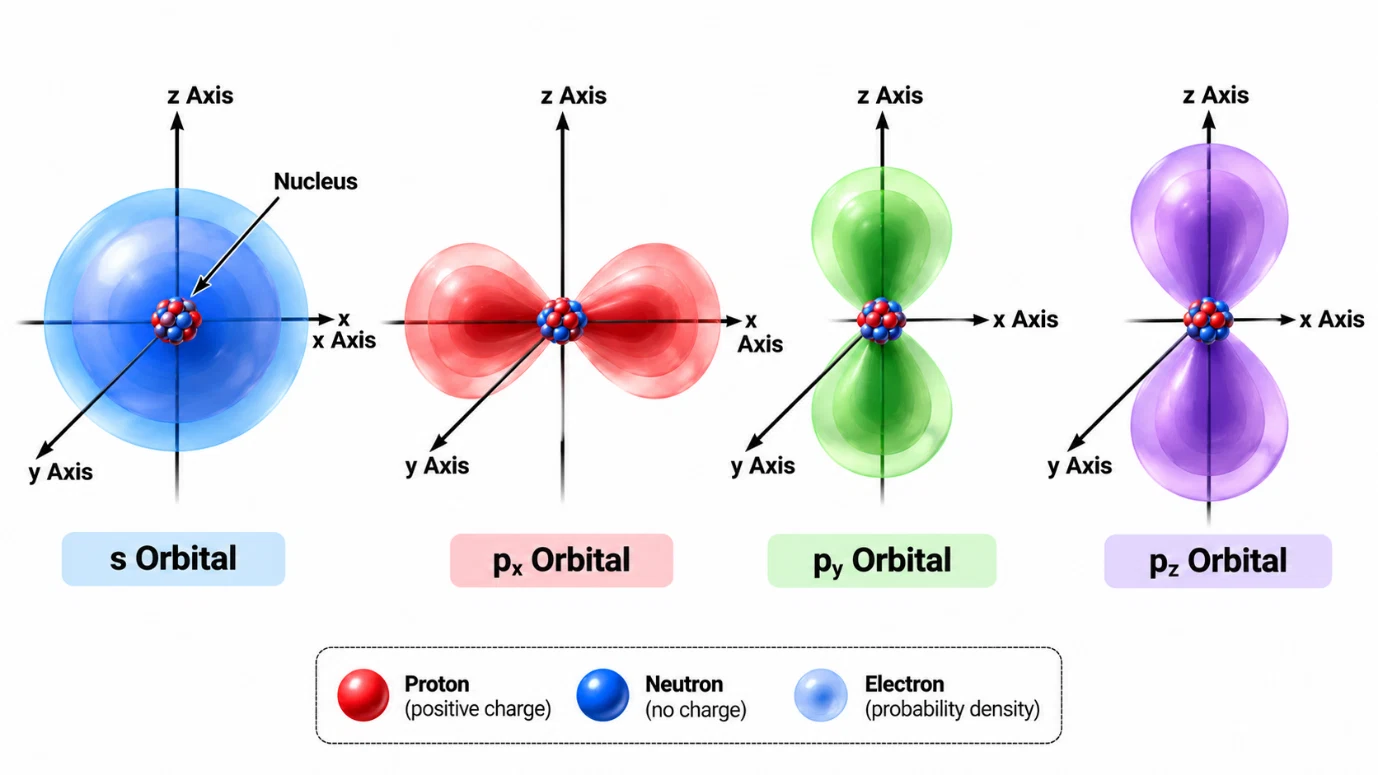
Figure 1.9: Shapes of s and p Orbitals
1.2.12 Electron Configuration
Electron configuration is the arrangement of electrons among the orbitals of an atom or ion.
Electron configurations are written using numbers and letters.
For example:
The number before the letter indicates the main energy level.
The letter indicates the subshell.
The superscript indicates the number of electrons in that subshell.
1.2.13 Rules Governing Electron Arrangement
Aufbau Principle
Electrons occupy available orbitals in order of increasing energy for the relevant atom.
For the first 20 neutral elements, the commonly used filling sequence is:
Pauli Exclusion Principle
An atomic orbital can contain at most two electrons, and the electrons must have opposite spins.
Hund's Rule
When orbitals of equal energy are available within a subshell, electrons occupy them singly with parallel spins before pairing occurs.
Orbital Box Representation
An electron is represented using an arrow:
Two paired electrons are represented as:
For a p subshell containing three electrons:
For a p subshell containing four electrons:
1.2.14 Electron Configurations of the First 20 Elements
|
Atomic no. |
Element |
Symbol |
Electron configuration |
|---|---|---|---|
|
1 |
Hydrogen |
H |
1s¹ |
|
2 |
Helium |
He |
1s² |
|
3 |
Lithium |
Li |
1s² 2s¹ |
|
4 |
Beryllium |
Be |
1s² 2s² |
|
5 |
Boron |
B |
1s² 2s² 2p¹ |
|
6 |
Carbon |
C |
1s² 2s² 2p² |
|
7 |
Nitrogen |
N |
1s² 2s² 2p³ |
|
8 |
Oxygen |
O |
1s² 2s² 2p⁴ |
|
9 |
Fluorine |
F |
1s² 2s² 2p⁵ |
|
10 |
Neon |
Ne |
1s² 2s² 2p⁶ |
|
11 |
Sodium |
Na |
1s² 2s² 2p⁶ 3s¹ |
|
12 |
Magnesium |
Mg |
1s² 2s² 2p⁶ 3s² |
|
13 |
Aluminium |
Al |
1s² 2s² 2p⁶ 3s² 3p¹ |
|
14 |
Silicon |
Si |
1s² 2s² 2p⁶ 3s² 3p² |
|
15 |
Phosphorus |
P |
1s² 2s² 2p⁶ 3s² 3p³ |
|
16 |
Sulfur |
S |
1s² 2s² 2p⁶ 3s² 3p⁴ |
|
17 |
Chlorine |
Cl |
1s² 2s² 2p⁶ 3s² 3p⁵ |
|
18 |
Argon |
Ar |
1s² 2s² 2p⁶ 3s² 3p⁶ |
|
19 |
Potassium |
K |
1s² 2s² 2p⁶ 3s² 3p⁶ 4s¹ |
|
20 |
Calcium |
Ca |
1s² 2s² 2p⁶ 3s² 3p⁶ 4s² |
Worked Example 1.4: Oxygen
Atomic number = 8.
Oxygen has eight electrons in a neutral atom.
Fill the orbitals:
Remaining electrons:
Therefore:
Worked Example 1.5: Calcium
Atomic number = 20.
Distribute 20 electrons:
Check:
The electron configuration is correct.
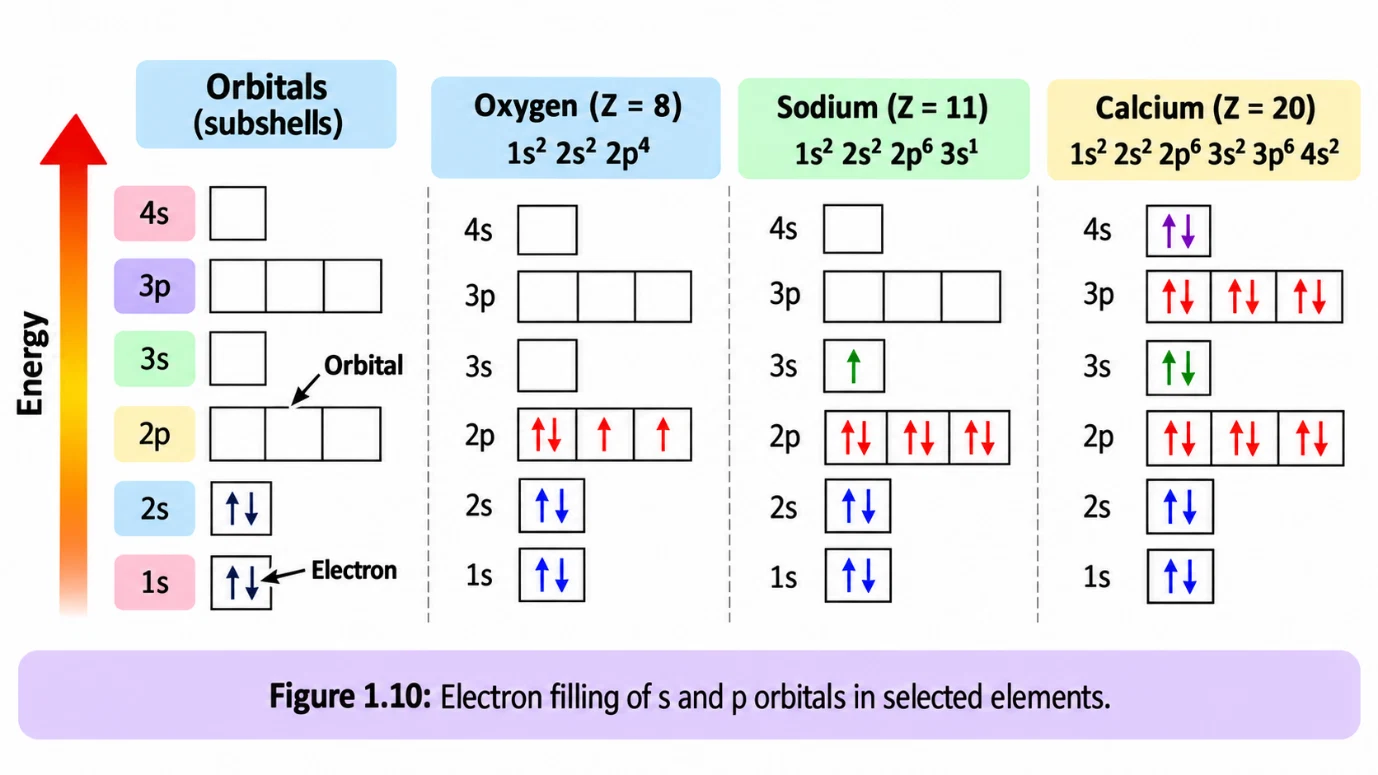
Figure 1.10: Orbital Filling for the First 20 Elements
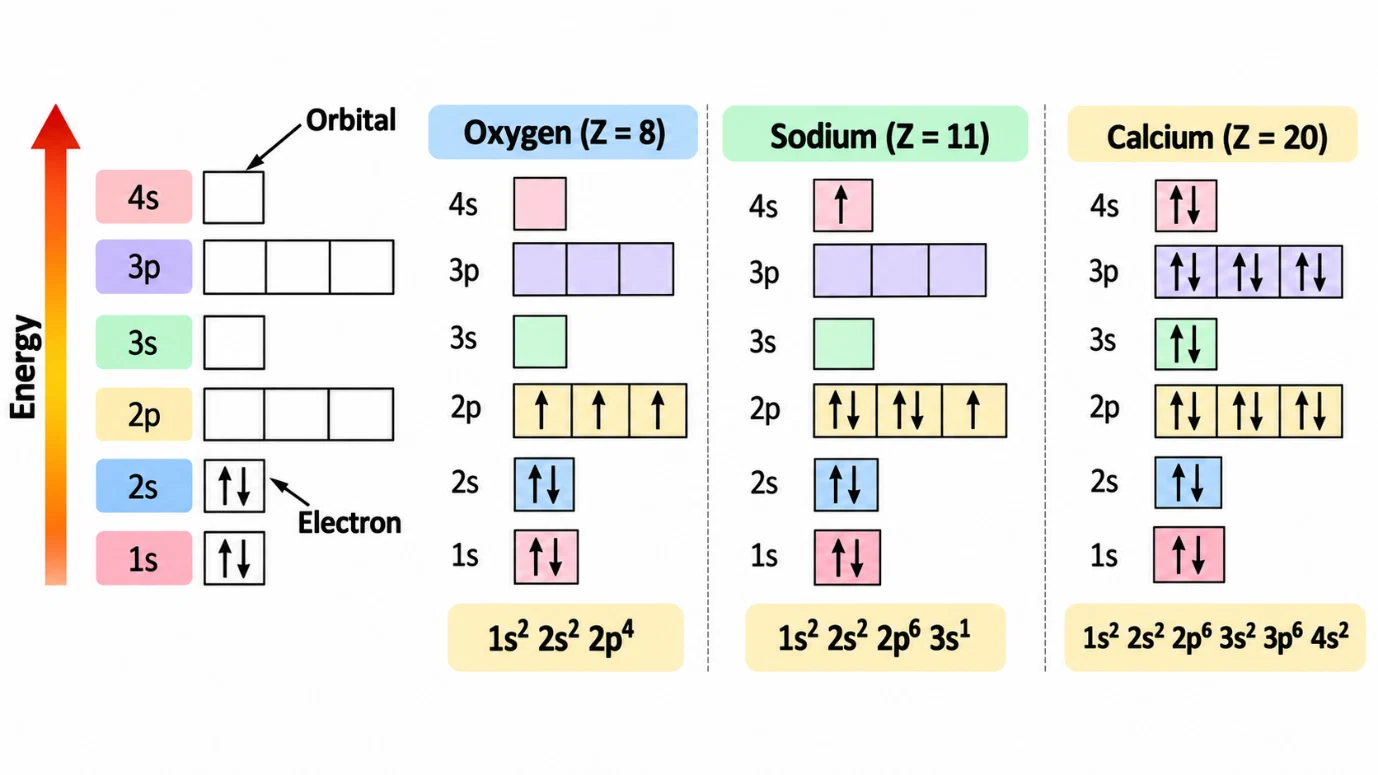
Practical Activity 1.2: Modelling Electron Arrangements
Aim: To construct models showing the electron arrangements of selected elements.
Materials: Cardboard, coloured paper, reusable counters, marker pens and appropriate digital simulations.
Procedure:
- Select an element among the first 20.
- Identify its atomic number.
- Determine the number of electrons in a neutral atom.
- Arrange counters into the appropriate orbitals.
- Write its electron configuration.
- Compare your model with the accepted configuration.
- Explain how the electron arrangement relates to the element's position in the periodic table.
Safety and environmental consideration: Use safe, reusable materials and avoid unnecessary waste.
Summary of Sub-strand 1.2
Atoms contain protons, neutrons and electrons.
Atomic number equals the number of protons, while mass number is the sum of protons and neutrons.
Isotopes are atoms of the same element with different neutron numbers.
Relative atomic mass is a weighted mean based on isotopic abundances.
Electrons occupy orbitals according to appropriate quantum rules. The configurations of the first 20 elements use s and p subshell notation, including the filling of 4s in potassium and calcium.
Revision Questions
- Define an atom.
- State the charges and relative masses of the three subatomic particles.
- Distinguish between atomic number and mass number.
- Calculate the neutrons in phosphorus-31, atomic number 15.
- Define isotopes.
- Explain why isotopes have similar chemical properties.
- Calculate the approximate relative atomic mass of an element with 60% isotope-10 and 40% isotope-11.
- Differentiate between energy levels and orbitals.
- Explain the Aufbau principle.
- State Hund's rule.
- Write the electron configuration of nitrogen.
- Write the electron configuration of magnesium.
- Write the electron configuration of chlorine.
- Draw orbital-box diagrams for oxygen and carbon.
- Explain two conclusions drawn from Rutherford's alpha-particle scattering experiment.
Selected Revision Answers
Question 4
Question 7
Question 11
Question 12
Question 13