
Introduction
Atoms combine to form molecules, compounds and extended structures. The attractive forces responsible for holding particles together are known as chemical bonds.
Chemical bonding explains important properties of substances, including their melting points, solubility, electrical conductivity, hardness and physical states.
The structure of a substance often determines how it can be used in everyday life.
Specific Learning Outcomes
By the end of the sub-strand, learners should be able to illustrate different types of bonding, investigate the relationship between bonding and physical properties, explain how chemical structures influence uses and appreciate the importance of chemical bonding.
Key Inquiry Question
How do chemical bonds influence the properties of substances?
1.4.1 Meaning of Chemical Bonding
A chemical bond is an attractive interaction that holds atoms or ions together in a chemical structure.
Chemical bonds arise through electrostatic interactions involving positively charged nuclei and negatively charged electrons.
Important types of bonding at this level include:
- Ionic bonding.
- Covalent bonding.
- Dative covalent bonding.
- Metallic bonding.
The curriculum also addresses intermolecular interactions, including hydrogen bonding and van der Waals forces.
1.4.2 Valence Electrons
Valence electrons are electrons involved in the chemical bonding behaviour of an atom.
For many main-group elements, they occupy the outermost principal energy level.
Example: Sodium
Electron configuration:
Sodium has one outer electron.
Example: Chlorine
Electron configuration:
Chlorine has seven electrons in its outermost energy level.
1.4.3 Octet and Duplet Rules
The octet rule is an introductory explanation stating that many main-group atoms tend to form chemical arrangements associated with eight electrons in their outer shell.
The duplet rule applies to stable arrangements associated with two electrons in the first energy level.
These rules are useful for simple compounds but do not explain every molecule or chemical structure.
1.4.4 Ionic Bonding
Ionic bonding is the electrostatic attraction between oppositely charged ions.
It commonly occurs in compounds formed between metals and non-metals.
Formation of Sodium Chloride
Sodium loses an electron:
Na → Na⁺+e⁻
Chlorine gains an electron:
Cl+e⁻ → Cl⁻
The resulting ions attract one another electrostatically.
The compound has the formula:
In solid sodium chloride, the ions form a giant ionic lattice rather than existing as isolated NaCl molecules.
Formation of Magnesium Oxide
Magnesium loses two electrons:
Mg → Mg²⁺+2e⁻
Oxygen gains two electrons:
O+2e⁻ → O²⁻
The ions combine in a 1:1 ratio.
Properties of Ionic Compounds
- They commonly form crystalline solids.
- Many have high melting and boiling points.
- They generally do not conduct electricity as solids.
- They conduct electricity when molten because ions can move.
- Their aqueous solutions conduct electricity when sufficient mobile ions are present.
- Many ionic substances dissolve in water, but solubility varies widely.
Explanation of Electrical Conductivity
In solid sodium chloride, ions occupy fixed positions in the lattice and cannot move freely through the material.
When sodium chloride is molten, the ions are mobile and can carry electric charge.
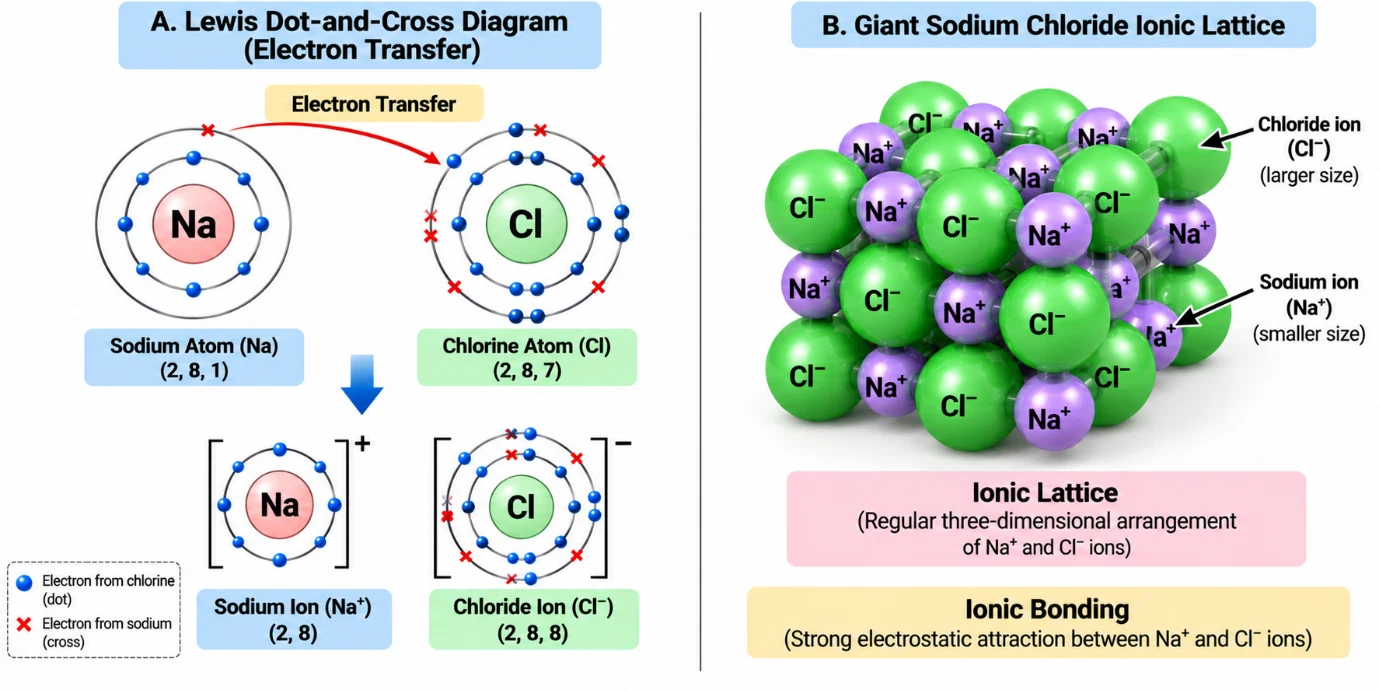
Figure 1.14: Formation and Structure of Sodium Chloride
1.4.5 Covalent Bonding
Covalent bonding involves atoms sharing electron pairs.
Covalent bonds commonly form between non-metal atoms.
The shared electrons are attracted by the nuclei of the bonded atoms.
Hydrogen Molecule
Each hydrogen atom contributes one electron to a shared pair.
The resulting molecule is:
Structural representation:
Chlorine Molecule
Each chlorine atom has seven outer electrons.
Two chlorine atoms share one pair of electrons, forming a single covalent bond.
Oxygen Molecule
Two oxygen atoms share two pairs of electrons.
This forms a double covalent bond.
Nitrogen Molecule
Two nitrogen atoms share three pairs of electrons.
This forms a triple covalent bond.
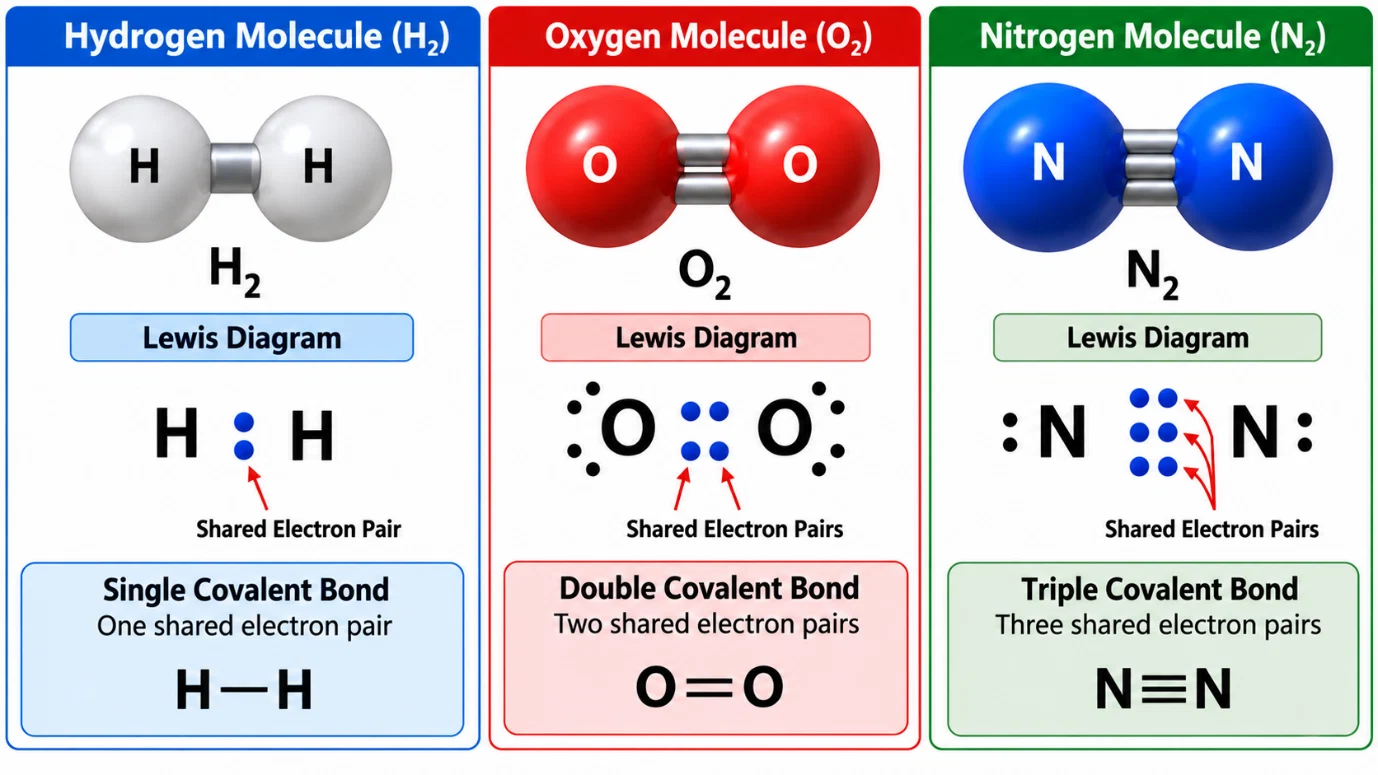
Figure 1.15: Single, Double and Triple Covalent Bonds
1.4.6 Dative Covalent Bonding
A dative covalent bond, also called a coordinate covalent bond, is a covalent bond in which both bonding electrons are initially supplied by the same atom.
Once formed, the bond is not fundamentally different from another covalent bond of the same type.
Example: Formation of Ammonium Ion
Ammonia contains a lone pair on nitrogen.
A hydrogen ion can accept this electron pair.
NH₃+H⁺ → NH₄⁺
The nitrogen atom donates its lone pair to form the additional N–H bond.
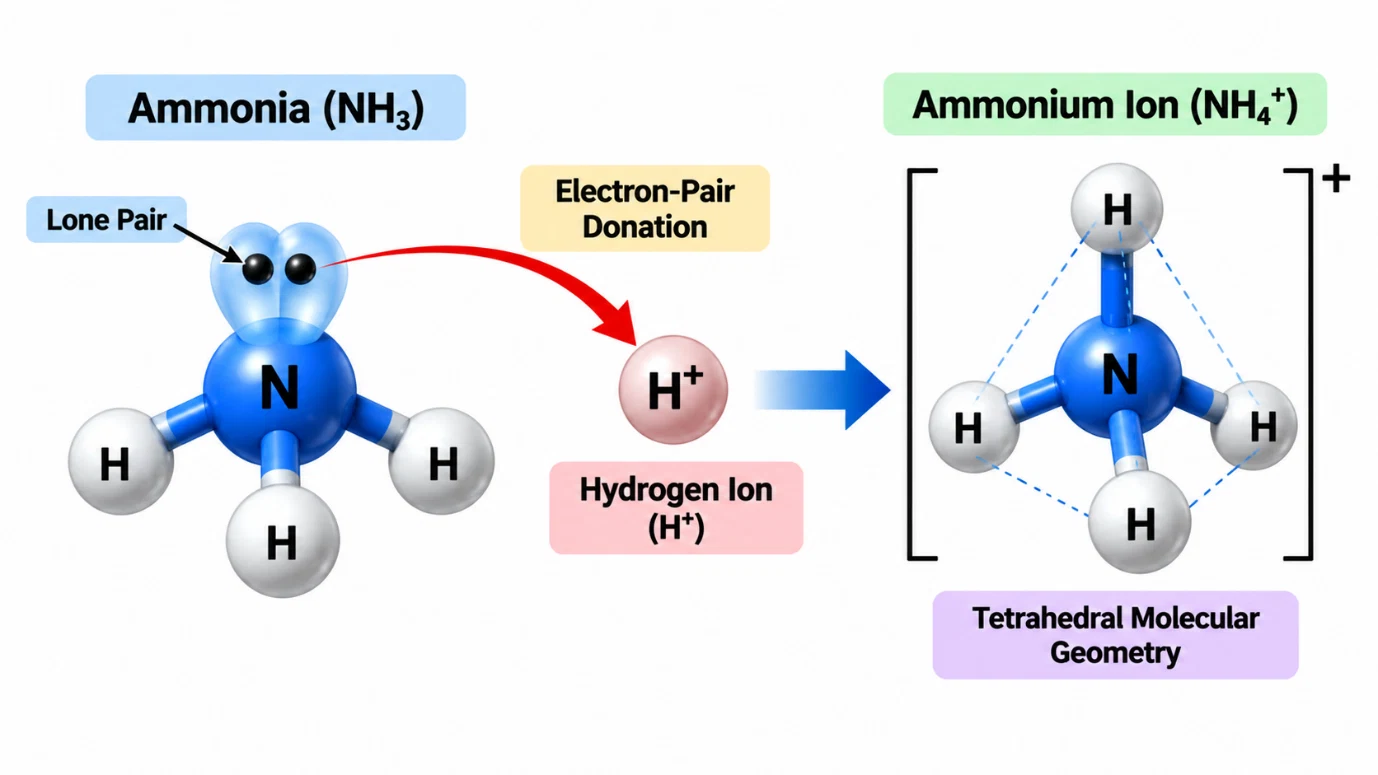
Figure 1.16: Formation of the Ammonium Ion
1.4.7 Metallic Bonding
Metallic bonding is the attraction between positively charged metal ion cores and delocalised electrons in a metallic structure.
The delocalised electrons can move through the metal.
Properties Explained by Metallic Bonding
- Electrical conductivity: Mobile electrons transfer electric charge.
- Thermal conductivity: Energy is transferred through electrons and lattice vibrations.
- Malleability: Metal layers can change relative positions while metallic bonding is maintained.
- Ductility: Many metals can be drawn into wires.
- Metallic lustre: Electrons interact with incident light, contributing to the characteristic shiny appearance.
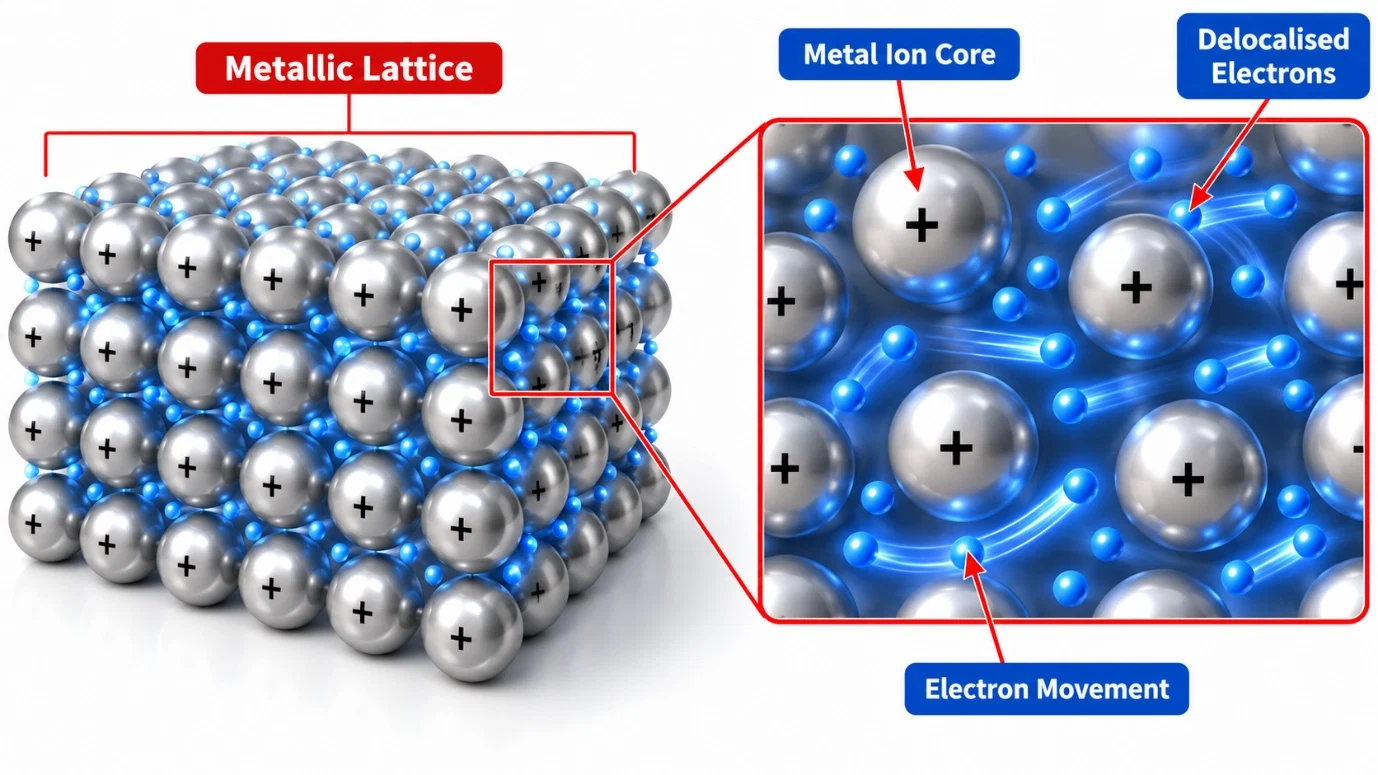
Figure 1.17: Metallic Bonding
1.4.8 Intermolecular Forces
Intermolecular forces are attractive interactions between molecules.
They are generally weaker than the covalent bonds within simple molecules, although their relative strengths vary.
London Dispersion Forces
These arise from fluctuations in electron distributions that produce temporary and induced dipoles.
They occur between all atoms and molecules.
Dipole–Dipole Interactions
These occur between molecules with permanent electric dipoles.
Hydrogen Bonding
Hydrogen bonding is a particularly strong directional intermolecular interaction commonly associated with hydrogen bonded to nitrogen, oxygen or fluorine and interaction with an appropriate electron-rich site.
Water molecules form extensive hydrogen-bonding networks.
This contributes to several unusual properties of water.
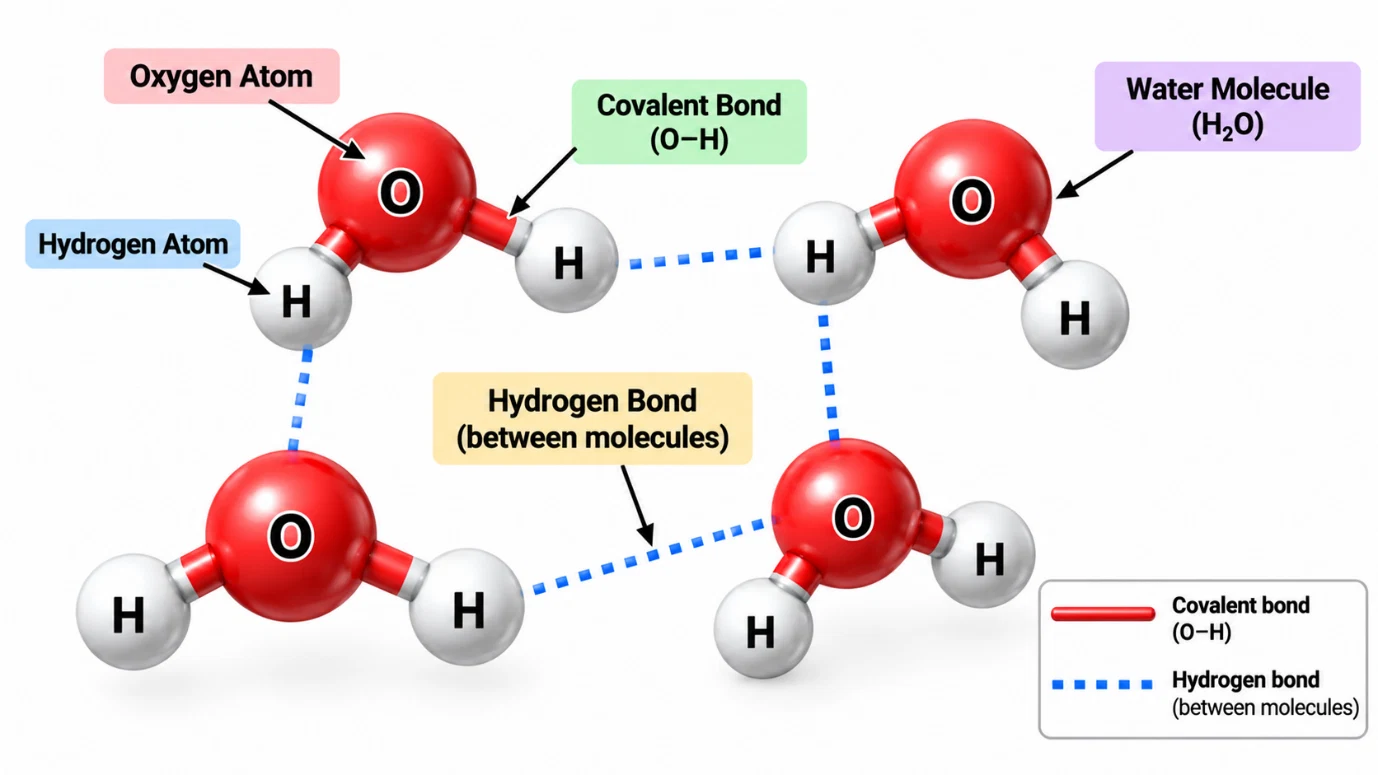
Figure 1.18: Hydrogen Bonding Between Water Molecules
1.4.9 Giant Ionic Structures
Giant ionic structures contain large numbers of oppositely charged ions arranged in regular lattices.
Sodium chloride and magnesium oxide are examples.
Strong electrostatic attractions contribute to relatively high melting points.
However, ionic compounds differ in their exact melting temperatures and solubilities.
1.4.10 Simple Molecular Structures
Simple molecular substances contain discrete molecules.
Examples include methane, carbon dioxide, iodine and water.
- Their melting and boiling points depend strongly on intermolecular forces.
- Many have relatively low melting and boiling points compared with giant ionic or covalent network substances.
- Most do not conduct electricity in their pure molecular form because they lack sufficiently mobile charged particles.
1.4.11 Giant Covalent Structures
Giant covalent substances contain extended networks of covalently bonded atoms.
Diamond
Each carbon atom is bonded to four other carbon atoms in a tetrahedral arrangement.
Diamond is extremely hard and generally does not conduct electricity.
Its properties make it useful in certain cutting and abrasive applications.
Graphite
Each carbon atom is bonded to three others in planar hexagonal networks.
Graphite contains delocalised electrons within its layers, enabling electrical conduction.
The layers can slide relative to one another, contributing to its usefulness as a lubricant.
Silicon Dioxide
Silicon dioxide has an extended three-dimensional covalent network.
It has a high melting temperature and is used in glass and ceramic-related applications.
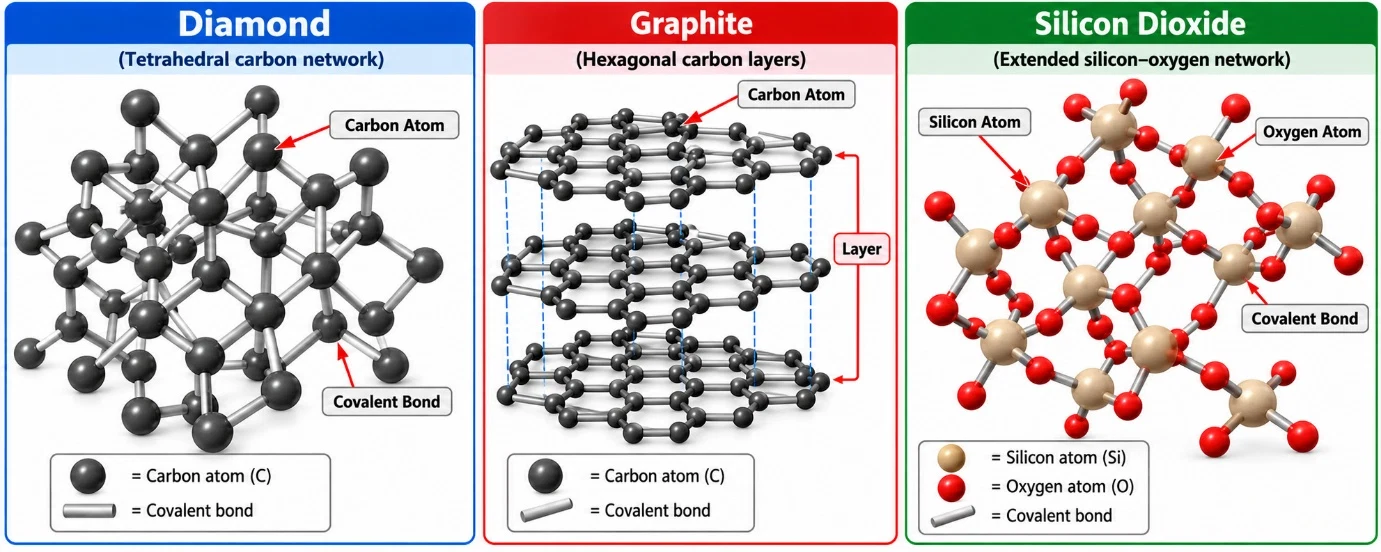
Figure 1.19: Diamond, Graphite and Silicon Dioxide Structures
1.4.12 Relationship Between Bonding, Structure and Properties
|
Structure |
Example |
Melting point |
Electrical conductivity |
Other properties |
|---|---|---|---|---|
|
Giant ionic |
Sodium chloride |
Relatively high |
Conducts when molten or dissolved |
Crystalline, often brittle |
|
Simple molecular |
Methane |
Low |
Generally non-conducting |
Weak intermolecular attractions |
|
Giant covalent |
Diamond |
Very high thermal stability |
Non-conducting |
Extremely hard |
|
Layered covalent |
Graphite |
Very high sublimation temperature |
Conducting along layers |
Soft, slippery layers |
|
Metallic |
Aluminium |
Relatively high compared with many molecular substances |
Good conductor |
Malleable and ductile |
1.4.13 Experimental Investigation of Physical Properties
Learners may compare safe, teacher-approved samples to investigate how structure influences properties.
Suitable observations include:
- Solubility in water.
- Electrical conductivity of appropriate solid samples.
- Conductivity of safe prepared solutions.
- Appearance.
- Hardness, using suitable classroom methods.
High-temperature testing or other potentially hazardous procedures require proper equipment and supervision.
Practical Activity 1.4: Comparing Conductivity
Aim: To compare the electrical conductivity of selected materials.
Suggested materials: Graphite sample, suitable metal sample, dry salt sample, an approved dilute salt solution and a low-voltage conductivity tester.
Procedure:
- Assemble the approved low-voltage testing equipment.
- Test each selected material.
- Record whether the tester indicates conduction.
- Compare solid salt with an appropriate salt solution.
- Explain the observations using the availability of mobile charge carriers.
Expected Observations: A suitable metal conducts, graphite can conduct, dry sodium chloride does not conduct appreciably, and an aqueous sodium chloride solution conducts.
Practical Activity 1.5: Constructing Bonding Models
Use reusable locally available materials to construct models of:
- Sodium chloride ionic lattice.
- Diamond.
- Graphite.
- Silicon dioxide.
Explain the bonding and structure of each.
Summary of Sub-strand 1.4
Chemical bonding determines how atoms and ions form stable chemical structures.
Ionic bonding involves attraction between oppositely charged ions.
Covalent bonding involves shared electron pairs.
Metallic bonding involves positive metal ion cores and delocalised electrons.
Intermolecular forces influence the properties of molecular substances.
The physical properties of materials can be explained by their bonding and structure.
Revision Questions
- Define chemical bonding.
- Explain how sodium chloride is formed.
- State four properties of ionic compounds.
- Draw a Lewis diagram for hydrogen chloride.
- Differentiate between single and double covalent bonds.
- Explain dative covalent bonding using ammonium ion.
- Describe metallic bonding.
- Explain why metals conduct electricity.
- Describe hydrogen bonding in water.
- Explain why diamond is hard.
- Explain why graphite conducts electricity.
- Compare simple molecular and giant covalent structures.
- Explain why molten sodium chloride conducts electricity but solid sodium chloride does not.
- Identify three uses of substances based on their bonding and structure.