
1. Introduction to creation
Creation refers to the act of bringing something into existence.
According to the Bible, God is the creator of heaven, earth and everything found in the universe.
The Bible teaches that God created the world through His power and wisdom.
The creation accounts are found in the book of Genesis, which is the first book of the Bible.
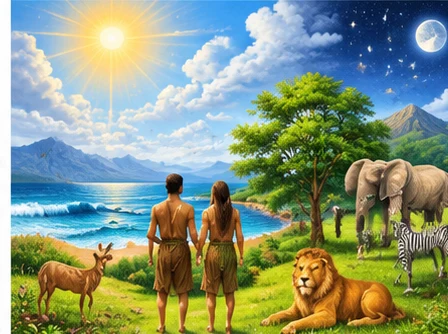
An illustrative representation of the biblical account of creation.
There are two main accounts of creation:
- The first account of creation in Genesis 1:1–2:4a.
- The second account of creation in Genesis 2:4b–25.
These accounts explain God's work of creation and the special place of human beings in His creation.
2. Meaning of important terms
Creation: The act of bringing something into existence.
Creator: The one who brings something into existence.
Universe: The whole system of existence, including the heavens and earth.
Environment: Everything surrounding living organisms, including land, water, air, plants and animals.
Human beings: People created by God and given responsibilities within creation.
Dominion: Authority or responsibility to govern and manage something.
Image of God: The special status of human beings as created in God's image, reflecting qualities such as moral responsibility, reasoning and the ability to relate with God and others.
3. The first account of creation
The first creation account is recorded in Genesis 1:1–2:4a.
It explains how God created the universe in six days and rested on the seventh day.
The account demonstrates God's power, wisdom, order and goodness.
The events of the first account of creation
Day 1: Creation of light
God created light and separated it from darkness.
He called the light day and the darkness night.
This established the distinction between day and night.
Day 2: Creation of the sky
God created the expanse separating the waters.
The expanse was called the sky or heavens.
Day 3: Creation of dry land, seas and vegetation
God gathered the waters together so that dry land appeared.
He called the dry land earth and the gathered waters seas.
God commanded the earth to produce vegetation, including plants, trees and seed-bearing crops.
Day 4: Creation of the heavenly bodies
God created the sun, moon and stars.
They were placed in the heavens to provide light and help mark days, seasons and years.
Day 5: Creation of water creatures and birds
God created creatures living in water and birds that fly in the sky.
He blessed them and commanded them to multiply.
Day 6: Creation of land animals and human beings
God created land animals, including livestock and wild animals.
He then created human beings in His image, male and female.
He blessed them and gave them responsibility over other living things.
Day 7: God rested
God completed His work of creation and rested on the seventh day.
He blessed the seventh day and made it holy.
<caption>Summary of the first creation account</caption>
|
Day |
God's work of creation |
|---|---|
|
First |
Light and separation of light from darkness |
|
Second |
Sky and separation of waters |
|
Third |
Dry land, seas and vegetation |
|
Fourth |
Sun, moon and stars |
|
Fifth |
Water creatures and birds |
|
Sixth |
Land animals and human beings |
|
Seventh |
God rested and blessed the day |
4. Lessons from the first creation account
A. God is powerful
God created the universe through His power. Nothing was beyond His ability.
B. God is orderly
God created the universe in an organised manner. Each part of creation had a purpose.
C. God is wise
The different parts of creation work together to support life.
D. Human beings are special
Human beings were created in God's image and given responsibilities over creation.
E. Creation is good
God saw that His creation was good. This teaches Christians to appreciate and protect the environment.
F. God values rest
God rested on the seventh day after completing His work. This teaches the importance of rest after work.
5. The second account of creation
The second account of creation is found in Genesis 2:4b–25.
It gives more attention to the creation of human beings, the Garden of Eden and the relationship between human beings and other creatures.
The account explains the following events.
A. Creation of man
God formed man from the dust of the ground.
He breathed into his nostrils the breath of life, and man became a living being.
This demonstrates that human life comes from God.
B. Creation of the Garden of Eden
God planted a garden in Eden and placed the man there.
The garden contained different trees that were beautiful and provided food.
Two important trees mentioned were:
- The tree of life.
- The tree of the knowledge of good and evil.
C. Responsibility given to man
God placed the man in the Garden of Eden to cultivate it and take care of it.
This teaches that human beings have a responsibility to work and protect the environment.
D. Instructions about the tree of knowledge
God instructed the man that he could eat from the trees in the garden except the tree of the knowledge of good and evil.
This demonstrated the importance of obedience to God's instructions.
E. Creation of animals
God formed animals and birds and brought them to the man.
The man gave names to the animals.
This demonstrates the special relationship between human beings and other creatures.
F. Creation of woman
God observed that it was not good for the man to be alone.
He caused the man to fall into a deep sleep and took one of his ribs or sides.
God formed a woman from it and brought her to the man.
The man recognised her as a suitable companion.
G. Institution of marriage
The account explains that a man leaves his parents and is united with his wife, and the two become one flesh.
This introduces the biblical understanding of marriage and companionship.
6. Lessons from the second creation account
- God is the source of human life.
- Human beings have responsibilities towards the environment.
- Work is an important part of human life.
- Human beings should obey God's instructions.
- People need companionship and relationships.
- Men and women have a special relationship within God's creation.
- God provides for the needs of human beings.
- Human beings should appreciate God's creation.
7. Similarities between the two creation accounts
Although the accounts present creation differently, they communicate related teachings.
A. God is the creator
Both accounts identify God as the creator of the universe and everything in it.
B. Human beings were created by God
Both accounts explain that human life originated from God.
C. Plants and animals are part of God's creation
Both accounts recognise the importance of plants and animals.
D. Human beings have special responsibilities
Both accounts give human beings a special place within creation.
E. God provides for human needs
The accounts show that God provided the environment and resources needed for life.
F. Creation has a purpose
The accounts demonstrate that creation is not meaningless. God created different things to serve particular purposes.
8. Differences between the two creation accounts
|
First creation account |
Second creation account |
|---|---|
|
Found in Genesis 1:1–2:4a. |
Found in Genesis 2:4b–25. |
|
Describes creation over six days followed by rest. |
Concentrates on human creation and life in Eden. |
|
Begins with the creation of light. |
Begins its detailed human-centred account with the formation of man. |
|
Gives a broad description of the universe. |
Gives greater attention to the Garden of Eden. |
|
Describes the creation of male and female together. |
Describes the creation of man followed by woman. |
|
Emphasises God's orderly creation. |
Emphasises human responsibility and relationships. |
|
Describes creation of land animals before human beings. |
Gives a detailed account of animals being brought to the man. |
9. Attributes of God revealed in the creation accounts
An attribute is a quality or characteristic that describes someone.
The creation accounts reveal several attributes of God.
A. God is omnipotent
Omnipotent means all-powerful.
God demonstrated His power by creating the universe.
B. God is wise
God created different things with specific purposes.
The natural environment demonstrates order and design.
C. God is loving
God created a world that provides for the needs of human beings and other living things.
D. God is orderly
The first account presents creation in an organised sequence.
E. God is good
God repeatedly described His creation as good.
F. God is the provider
God provided food, water, land and other resources to support life.
G. God is sovereign
God has authority over all creation.
10. How Christians can appreciate God's creation
Christians can demonstrate appreciation for God's creation through responsible actions.
- Planting and protecting trees.
- Conserving water.
- Protecting wild animals.
- Avoiding unnecessary destruction of forests.
- Keeping the environment clean.
- Preventing pollution.
- Using natural resources responsibly.
- Caring for domestic animals.
- Protecting natural habitats.
- Participating in community environmental activities.
11. Practical activities
Activity 1: Nature walk
Visit the school compound or surrounding area and identify different features of God's creation.
Record examples of plants, animals, soil, water and other natural features.
Activity 2: Comparing the creation accounts
Read Genesis 1:1–2:4a and Genesis 2:4b–25.
Identify similarities and differences between the accounts.
Activity 3: Environmental conservation
Participate in planting trees or cleaning the school environment.
Discuss how the activity demonstrates appreciation for God's creation.
Activity 4: Composing a song
Compose a song praising God for His wonderful creation.
12. Summary
The Bible contains two accounts of creation in Genesis 1 and 2.
The first account explains the creation of the universe in six days and God's rest on the seventh day.
The second account gives more attention to human beings, the Garden of Eden and human relationships.
Both accounts teach that God is the creator and that human beings have a responsibility to appreciate and protect His creation.
13. Revision questions and answers
Q1. What is creation?
Creation is the act of bringing something into existence.
Q2. Where are the two biblical accounts of creation found?
Genesis 1:1–2:4a and Genesis 2:4b–25.
Q3. What did God create on the first day?
God created light and separated it from darkness.
Q4. What did God create on the sixth day?
God created land animals and human beings.
Q5. What happened on the seventh day?
God rested from His work of creation and blessed the day.
Q6. State four similarities between the creation accounts.
- Both identify God as creator.
- Both describe the creation of human beings.
- Both recognise plants and animals as God's creation.
- Both show that human beings have responsibilities.
Q7. Give four attributes of God revealed in creation.
Power, wisdom, goodness and love.
Q8. How did God create man according to Genesis 2?
God formed man from the dust of the ground and breathed into his nostrils the breath of life.
Q9. Why did God create woman?
God observed that it was not good for man to be alone and created woman as a suitable companion.
Q10. State five ways Christians can appreciate God's creation.
Planting trees, protecting animals, conserving water, preventing pollution and keeping the environment clean.