
1. Introduction
Plants are important components of God's creation.
They provide food, medicine, shelter, timber, fuel and other useful products.
They also help maintain environmental balance by absorbing carbon dioxide, releasing oxygen and protecting the soil.
The Bible teaches that human beings have a responsibility to cultivate and care for plants.
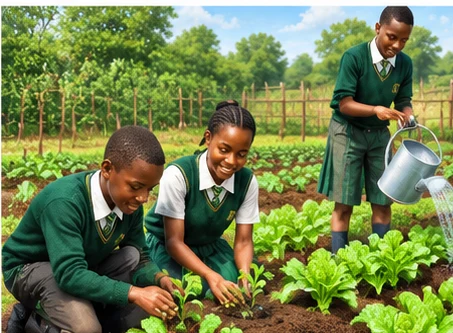
Learners planting and watering seedlings as part of their responsibility over plants.
Christians should therefore use plants responsibly and protect vegetation in their surroundings.
2. Meaning of important terms
Plant: A living organism that generally produces its own food through photosynthesis.
Vegetation: Plant life growing in a particular area.
Cultivation: Preparing land and growing crops.
Deforestation: Clearing or removing large areas of forest.
Afforestation: Establishing forests by planting trees in areas that were not previously forested.
Reforestation: Replanting trees in areas where forests have been cleared or destroyed.
Income-generating crop: A crop grown mainly to earn money through its sale.
Ecosystem: A community of living organisms interacting with one another and their physical environment.
3. Biblical responsibilities given to human beings over plants
The Bible gives several teachings about plants and their importance.
A. Genesis 1:29
God provided seed-bearing plants and fruit-bearing trees as food for human beings.
Lessons:
- Plants are important sources of food.
- Human beings should appreciate plants.
- Plants should be used responsibly.
- People should avoid unnecessary destruction of vegetation.
- Food resources should be protected.
B. Genesis 2:15
God placed man in the Garden of Eden to cultivate it and take care of it.
Lessons:
- Human beings should cultivate plants.
- People have a responsibility to protect vegetation.
- Work is important in caring for God's creation.
- Gardens should be maintained responsibly.
- Environmental conservation is part of Christian responsibility.
C. Psalm 104:14
This passage explains that God provides grass for animals and plants for human beings to cultivate and obtain food.
Lessons:
- Plants support human and animal life.
- Vegetation is part of God's provision.
- Agriculture is an important human activity.
- People should use plants responsibly.
- Environmental protection supports food production.
4. Responsibilities of human beings over plants
A. Planting trees
People should plant trees to increase vegetation and conserve the environment.
B. Watering plants
Crops and other plants require adequate water for growth.
C. Applying manure and suitable fertilizers
Plants require nutrients for healthy growth.
Organic manure and appropriate fertilizers help maintain soil fertility.
D. Controlling weeds
Weeds compete with crops for water, nutrients, light and space.
They should be controlled using suitable methods.
E. Protecting plants against pests and diseases
Plants should be inspected regularly and protected using appropriate control measures.
F. Avoiding unnecessary tree cutting
Trees should not be destroyed carelessly because they provide important environmental and economic benefits.
G. Preventing bush burning
Uncontrolled fires can destroy vegetation, kill useful organisms and damage soil.
H. Preventing overgrazing
Excessive grazing can destroy vegetation and expose soil to erosion.
I. Protecting indigenous plants
Indigenous plants should be conserved because they are adapted to local environmental conditions.
J. Using plants sustainably
People should harvest plants in ways that allow them to regenerate.
5. Ways of conserving plants in the environment
- Planting trees.
- Establishing school gardens.
- Practising agroforestry.
- Avoiding unnecessary deforestation.
- Controlling bush fires.
- Protecting indigenous vegetation.
- Practising soil conservation.
- Using water responsibly.
- Controlling pests and diseases.
- Avoiding pollution.
- Replanting harvested trees where appropriate.
- Protecting natural forests.
6. Economic importance of plants
Plants contribute greatly to economic development.
A. Food production
Plants provide food such as maize, beans, vegetables, fruits and potatoes.
These crops support household food security.
B. Source of income
Farmers sell crops to earn money.
Examples include coffee, tea, flowers, vegetables, fruits and sugarcane.
C. Source of medicine
Some plants provide materials used in traditional and modern medicine.
Examples include aloe vera and neem.
D. Source of timber
Trees provide timber used in construction and furniture making.
E. Source of fuel
Wood and charcoal are used as sources of energy in some households.
F. Employment creation
Crop farming, forestry, horticulture and agro-processing create employment opportunities.
G. Source of raw materials
Plants provide raw materials for industries.
Examples include cotton for textiles and sugarcane for sugar production.
H. Supporting tourism
Forests, gardens and beautiful natural vegetation attract tourists.
I. Soil conservation
Plant roots help hold soil particles together and reduce soil erosion.
J. Environmental protection
Trees absorb carbon dioxide, release oxygen and provide shade.
7. Income-generating crops
Income-generating crops are crops grown mainly for sale to earn money.
They provide opportunities for farmers and households to improve their income.
Examples include:
|
Crop |
Economic use |
|---|---|
|
Coffee |
Produces beans for processing and sale |
|
Tea |
Produces leaves for processing |
|
Avocado |
Fruits sold for income |
|
Tomatoes |
Sold for food and income |
|
Onions |
Sold in local markets |
|
Passion fruit |
Sold fresh or processed |
|
Kale |
Sold as a vegetable |
|
Sugarcane |
Used in sugar production |
|
French beans |
Sold locally and for export |
|
Macadamia |
Nuts processed and sold |
8. Factors to consider when selecting an income-generating crop
A. Climate
The crop should be suitable for the area's rainfall and temperature conditions.
B. Soil type
The soil should support healthy growth of the selected crop.
C. Market availability
There should be potential buyers for the harvested produce.
D. Water availability
The crop should be suitable for the amount of water available.
E. Cost of production
The farmer should consider the cost of seeds, labour, fertilizers and other inputs.
F. Time to maturity
Some crops mature quickly, while others take several months or years.
G. Available land
The selected crop should suit the size and conditions of the available land.
H. Pest and disease resistance
Crops that can withstand common local pests and diseases may be easier to manage.
9. Establishing an income-generating crop at home or school
The following steps can be followed when establishing a crop.
Step 1: Select a suitable crop
Choose a crop that can grow successfully in the available conditions.
Step 2: Select a suitable site
Choose a location with appropriate soil, sunlight and water availability.
Step 3: Prepare the planting area
Clear unwanted vegetation and prepare the soil appropriately.
Step 4: Obtain planting materials
Acquire suitable seeds, seedlings or other planting materials.
Step 5: Plant the crop
Plant using the recommended spacing and planting depth.
Step 6: Water the crop
Provide sufficient water according to its requirements.
Step 7: Control weeds
Remove weeds to reduce competition for nutrients and water.
Step 8: Apply suitable manure or fertilizers
Provide nutrients needed for healthy plant growth.
Step 9: Control pests and diseases
Inspect the crop regularly and use appropriate control measures.
Step 10: Harvest the crop
Harvest at the correct stage of maturity.
Step 11: Market the produce
Sell the harvested produce to generate income.
10. How responsible use of plants contributes to economic growth
- Increases agricultural production.
- Provides raw materials for industries.
- Creates employment.
- Generates income for farmers.
- Supports food processing industries.
- Encourages agricultural exports.
- Promotes tourism.
- Supports the development of rural communities.
- Provides materials for construction.
- Encourages entrepreneurship.
11. Practical activities
Activity 1: Nature walk
Identify different plants in the school compound.
Draw or list the plants and explain their uses.
Activity 2: Interviewing a resource person
Interview an environmentalist or forestry officer about the economic benefits of plants.
Activity 3: Establishing an income-generating crop
Select a suitable crop and establish it at home or school.
Maintain the crop until harvesting.
Activity 4: Environmental conservation
Participate in a tree-planting exercise.
12. Summary
God created plants to provide food and other useful products.
Human beings have a responsibility to cultivate, protect and use plants responsibly.
Plants contribute to economic development through food production, employment, medicine, timber, fuel and industrial raw materials.
Christians should conserve vegetation and support sustainable agricultural activities.
13. Revision questions and answers
Q1. What is an income-generating crop?
It is a crop grown mainly to earn money through its sale.
Q2. State four biblical responsibilities given to human beings over plants.
- Cultivating plants.
- Protecting vegetation.
- Planting trees.
- Using plants responsibly.
Q3. Give five economic benefits of plants.
Food production, income generation, medicine, timber and employment creation.
Q4. Name five income-generating crops grown in Kenya.
Coffee, tea, avocado, tomatoes and sugarcane.
Q5. Identify five factors to consider when selecting an income-generating crop.
Climate, soil type, market availability, water availability and cost of production.
Q6. Explain three ways of conserving plants.
Planting trees, controlling bush fires and avoiding unnecessary deforestation.
Q7. What does Genesis 2:15 teach about plants?
It teaches that human beings should cultivate and take care of the environment.
Q8. Explain how plants contribute to employment creation.
They provide employment in farming, forestry, processing, transportation and marketing.
Q9. State four ways plants support environmental conservation.
They reduce soil erosion, absorb carbon dioxide, provide habitats and release oxygen.
Q10. Describe four activities involved in establishing an income-generating crop.
Selecting the crop, preparing the land, planting and maintaining the crop until harvesting.