
1. Introduction to Christian marriage and family
Marriage and family are important institutions in Christian teaching.
The Bible presents marriage as a sacred relationship established by God.
A family provides an environment where people experience love, care, protection, guidance and belonging.
Christian marriage encourages commitment, faithfulness, mutual respect and responsibility.
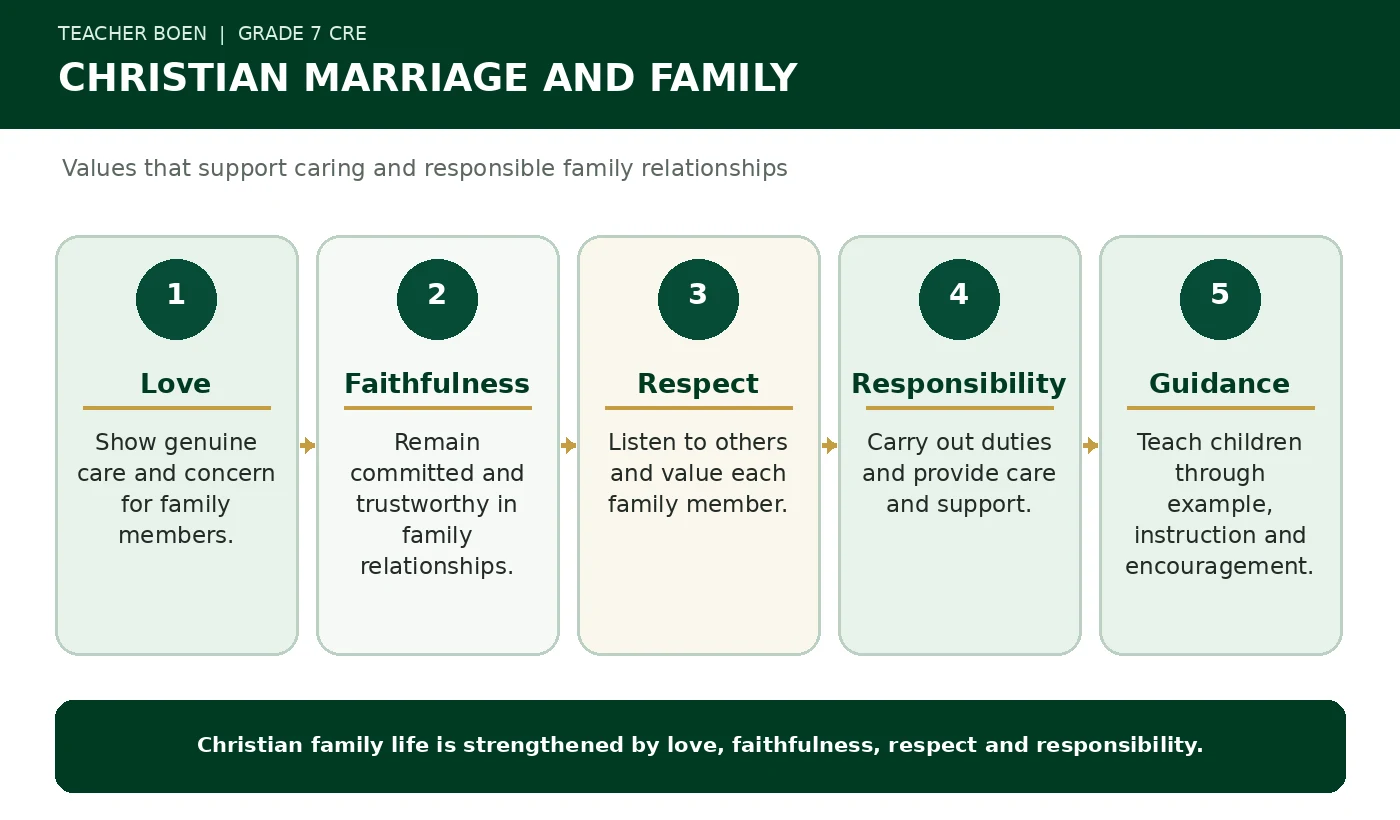
Values that help families build loving and responsible relationships.
The family plays an important role in teaching children moral and religious values.
A stable family contributes to peaceful communities and society.
2. Meaning of important terms
Marriage: A committed union between a man and a woman according to the Christian understanding presented in the curriculum.
Family: A group of people related through marriage, birth, adoption or other recognised family relationships.
Sacred institution: An institution regarded as holy and established according to God's purpose.
Companionship: A relationship in which people provide friendship, support and company to one another.
Faithfulness: Remaining loyal and committed to one's responsibilities and relationships.
Commitment: A firm decision to remain dedicated to an obligation or relationship.
Stability: A condition of being secure, peaceful and dependable.
3. Biblical teachings about marriage
The Bible provides guidance on marriage and family life.
A. Genesis 2:23–24
This passage describes the creation of woman and the relationship between a man and his wife.
The man recognises the woman as part of himself.
The passage explains that a man leaves his parents and is united with his wife, and the two become one flesh.
Lessons:
- Marriage involves companionship.
- Marriage creates a committed relationship.
- Husbands and wives should value one another.
- Marriage involves unity.
- Couples should establish responsible family relationships.
B. Ephesians 5:22–33
Paul explains the responsibilities of husbands and wives.
The passage uses the relationship between Christ and the Church to explain the importance of love, commitment and respect in marriage.
Husbands are instructed to love their wives as Christ loved the Church.
The passage also teaches respect within marriage.
Lessons:
- Marriage should be based on love.
- Couples should respect one another.
- Partners should remain faithful.
- Husbands should demonstrate care and sacrifice.
- Marriage requires commitment.
- Couples should support one another.
- Marriage should reflect love and responsibility.
The passage should not be used to justify violence, coercion or abuse. Christian marriage should protect the dignity and safety of both partners.
4. Biblical teachings about the family
A. Exodus 20:12
This commandment instructs children to honour their fathers and mothers.
Lessons:
- Children should respect their parents.
- Families should promote mutual respect.
- Parents should provide positive guidance.
- Children should appreciate parental care.
B. Psalm 127:3–5
This passage describes children as a gift from God.
It encourages parents to appreciate and care for their children.
Lessons:
- Children should be valued.
- Parents have responsibilities towards their children.
- Families should provide care and protection.
- Children should be guided positively.
C. Ephesians 6:4
Paul instructs fathers not to provoke their children but to bring them up with the training and instruction of the Lord.
Lessons:
- Parents should guide children responsibly.
- Children should be raised with Christian values.
- Parents should avoid unnecessary harshness.
- Discipline should be accompanied by love.
- Parents should provide positive examples.
5. Importance of marriage in society
- It provides companionship.
- It promotes commitment and faithfulness.
- It provides an environment for raising children.
- It encourages mutual support.
- It promotes family stability.
- It provides opportunities for shared responsibilities.
- It strengthens relationships between families.
- It contributes to social stability.
- It encourages responsible parenthood.
- It provides an environment for teaching values.
6. Importance of the family
The family plays several important roles in society.
A. Providing basic needs
Families provide food, clothing, shelter and other necessities.
B. Offering protection
Family members protect one another from danger and provide support during difficult situations.
C. Providing education
Parents and guardians teach children basic knowledge and important life skills.
D. Promoting moral values
Children learn honesty, respect, responsibility and kindness through family guidance.
E. Providing emotional support
Family members offer love, encouragement and comfort.
F. Promoting religious development
Families may participate in prayer, Bible reading and other religious activities.
G. Socialisation
Children learn how to interact with other people through family relationships.
H. Providing financial support
Adults in families work to meet household needs.
I. Encouraging discipline
Families guide children to develop responsible behaviour.
J. Promoting unity
Family members learn to cooperate and support one another.
7. Values needed to maintain stable Christian families
A. Love
Family members should demonstrate care and concern for one another.
B. Respect
Members should appreciate each other's dignity and opinions.
C. Honesty
Honesty builds trust within the family.
D. Faithfulness
Marriage partners should remain committed to their relationship.
E. Forgiveness
Family members should learn to forgive one another.
F. Patience
Patience helps people manage disagreements peacefully.
G. Responsibility
Each family member should fulfil appropriate duties.
H. Cooperation
Members should work together to meet family needs.
I. Communication
Open communication helps family members understand one another.
J. Prayer
Family prayer encourages spiritual unity and dependence on God.
K. Self-control
Family members should manage anger and avoid harmful behaviour.
L. Kindness
Kindness promotes peaceful and caring relationships.
8. Roles and responsibilities of family members
Responsibilities of parents and guardians
- Providing basic needs.
- Protecting children.
- Offering guidance.
- Providing education.
- Teaching moral values.
- Demonstrating good behaviour.
- Providing emotional support.
- Correcting children responsibly.
Responsibilities of children
- Respecting parents and guardians.
- Following rightful instructions.
- Assisting with household duties.
- Studying responsibly.
- Caring for younger siblings where appropriate.
- Respecting family property.
- Participating in family activities.
Responsibilities of all family members
- Respecting one another.
- Sharing responsibilities.
- Communicating peacefully.
- Supporting one another.
- Avoiding violence.
- Practising honesty.
- Participating in appropriate family activities.
9. Values needed by young people before marriage
The church encourages young people to develop values that prepare them for responsible relationships and future family life.
These values include:
- Chastity.
- Self-control.
- Respect.
- Honesty.
- Faithfulness.
- Patience.
- Responsibility.
- Humility.
- Kindness.
- Commitment.
- Forgiveness.
- Good communication.
10. How the church promotes values among young people before marriage
A. Teaching biblical principles
Churches teach young people about Christian marriage, sexual purity and responsible relationships.
B. Organising youth fellowships
Youth fellowships provide opportunities for learning, worship and positive interaction.
C. Providing counselling
Religious leaders and trained counsellors offer guidance on relationships and personal development.
D. Organising seminars
Churches organise seminars on family life, marriage preparation and moral responsibility.
E. Providing mentorship
Mature Christians guide young people through positive examples and advice.
F. Promoting self-discipline
Church teachings encourage young people to practise self-control and responsible behaviour.
G. Encouraging community service
Young people participate in activities that promote kindness, responsibility and service.
H. Organising Bible study
Bible study helps young people understand God's teachings about relationships and family life.
11. Characteristics of a stable Christian family
- Members demonstrate love.
- Parents provide appropriate guidance.
- Children respect their parents.
- Members communicate openly.
- Family responsibilities are shared.
- Disagreements are resolved peacefully.
- Members support one another.
- The family practises honesty.
- Members demonstrate forgiveness.
- Family members participate in spiritual activities.
12. Effects of unstable family relationships
- Emotional distress among family members.
- Poor communication.
- Increased conflicts.
- Lack of trust.
- Poor academic performance among affected children.
- Insecurity among family members.
- Financial difficulties.
- Poor moral guidance.
- Social isolation.
- Reduced family cooperation.
13. Ways of promoting stable families
- Practising love and respect.
- Communicating openly.
- Sharing responsibilities.
- Practising forgiveness.
- Providing guidance to children.
- Managing family finances responsibly.
- Seeking counselling when necessary.
- Participating in family prayers.
- Avoiding violence and abuse.
- Supporting one another during difficult situations.
14. Practical activities
Activity 1: Bible study
Read Genesis 2:23–24, Ephesians 5:22–33, Exodus 20:12 and Ephesians 6:4.
Identify the teachings about marriage and family.
Activity 2: Interview
Interview a religious leader about how the church promotes values among young people before marriage.
Activity 3: Role-play
Demonstrate a family resolving a disagreement through communication and forgiveness.
Activity 4: Preparing a family values chart
Prepare a chart showing values needed to maintain a stable Christian family.
15. Summary
The Bible presents marriage as a sacred and committed relationship.
Christian marriage should be based on love, faithfulness, respect and responsibility.
The family provides protection, education, guidance and emotional support.
The church promotes family stability by teaching biblical values, offering counselling and guiding young people.
16. Revision questions and answers
Q1. What is marriage according to Christian teaching?
It is a committed union between a man and a woman established according to Christian principles.
Q2. What does Genesis 2:23–24 teach about marriage?
It teaches that a man is united with his wife and the two become one flesh.
Q3. State five values needed to maintain stable Christian families.
Love, respect, honesty, faithfulness and forgiveness.
Q4. Identify five roles of parents in a family.
Providing basic needs, protection, education, guidance and emotional support.
Q5. State five responsibilities of children in a family.
Respecting parents, following rightful instructions, studying responsibly, assisting with household duties and caring for family property.
Q6. How does the church promote values among young people before marriage?
Through Bible teaching, counselling, youth fellowships, seminars and mentorship.
Q7. Explain four ways of promoting family stability.
Communication, sharing responsibilities, forgiveness and mutual respect.
Q8. What does Psalm 127:3–5 teach about children?
It teaches that children are a gift from God and should be valued.
Q9. State four teachings from Ephesians 6:4.
Parents should guide children, teach them God's ways, avoid provoking them unnecessarily and provide responsible discipline.
Q10. Why is the family important in society?
It provides care, protection, education, socialisation and moral guidance.