
1. Introduction to social media
Social media refers to digital platforms that allow people to communicate, share information, create content and interact with others through the internet.
Social media has become an important part of modern communication.
Young people use social media for education, entertainment, communication and sharing ideas.
However, irresponsible use can expose users to cyberbullying, misinformation, fraud, inappropriate content and privacy risks.
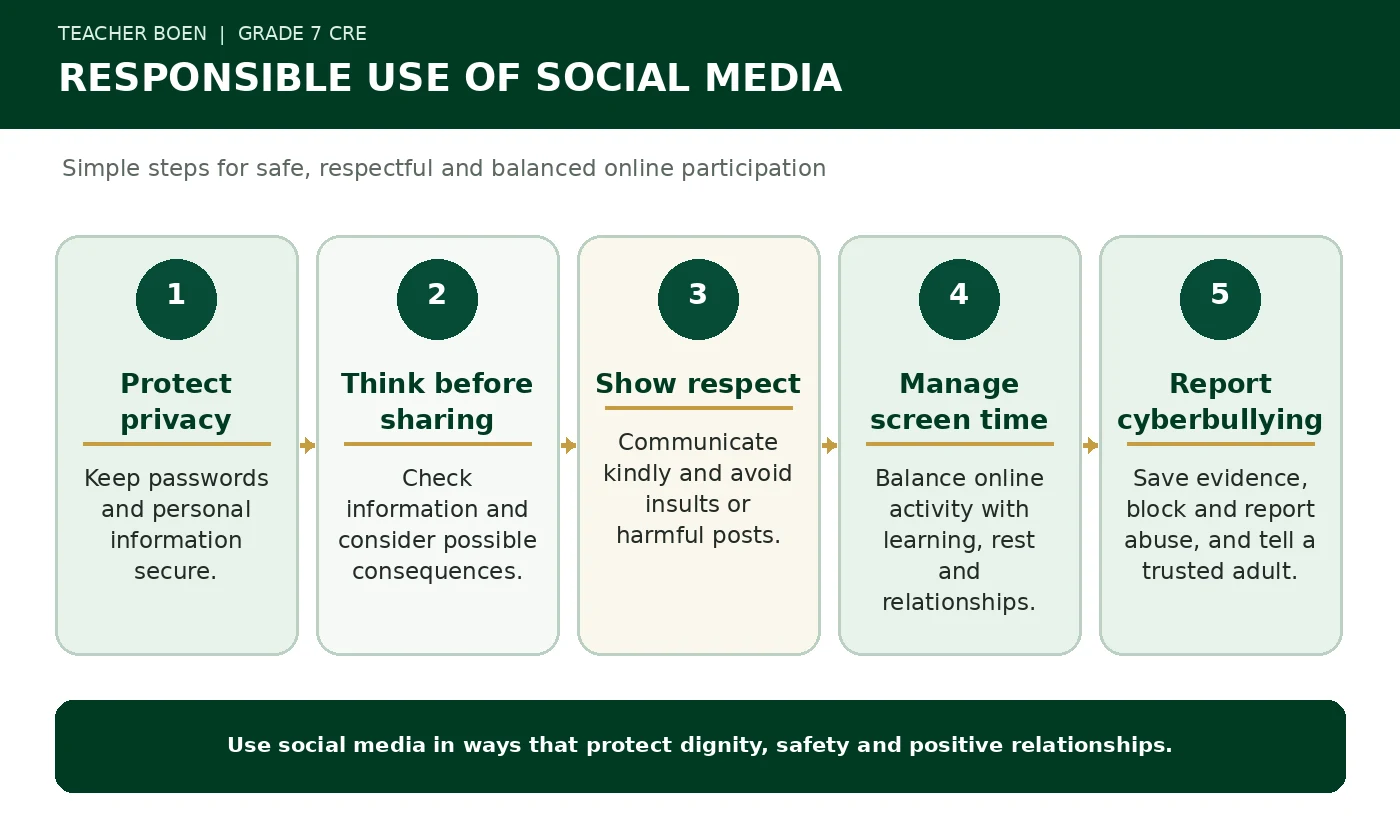
Guidelines for safe, respectful and responsible social media use.
Christian teachings encourage people to use technology responsibly and demonstrate respect, honesty and self-control.
2. Meaning of important terms
Social media: Digital platforms that allow users to create, share and interact with content and other users.
Platform: An online service or application that provides opportunities for communication and interaction.
Cyberbullying: The use of digital technology to harass, threaten, embarrass or intimidate another person.
Privacy: The right to keep personal information and activities protected from unwanted access.
Digital footprint: The record of information and activities a person leaves behind when using digital platforms.
Misinformation: False or inaccurate information shared without necessarily intending to deceive.
Disinformation: False information deliberately created or shared to mislead people.
Online stranger: A person a user has not met or does not personally know but interacts with through the internet.
Responsible use: Using technology safely, respectfully and appropriately.
3. Examples of social media platforms used by young people
Different social media platforms serve different purposes.
How to Group Video Chat With Up to Eight People in WhatsApp - MacRumors
Used for messaging, voice calls, video calls and sharing information.
Orchestre Les Cigales Paris - Live Band - Mariage - Événementiel
YouTube
Used for watching and sharing educational videos, music and entertainment.
ZEPHYR 西风-首页
TikTok
Used for creating and watching short videos.
File:Instagram icon.png - Wikimedia Commons
Used for sharing photographs, videos and messages.
Promo
Used for connecting with people, sharing information and participating in groups.
File:Snapchat logo (2019).png - Wikimedia Commons
Snapchat
Used for sharing photographs, videos and messages.
Why Twitter Changed Its Logo — The old logo was iconic, with over 15 years of history. | by Oodles Technologies | Medium
X
Used for sharing updates, opinions and news.
4. Uses of social media
Social media can benefit individuals and communities when used responsibly.
A. Communication
People use social media to communicate with family members, friends and colleagues.
B. Education
Learners can access educational videos, tutorials, learning materials and academic discussions.
C. Sharing information
People share useful information about health, education, agriculture and community activities.
D. Entertainment
Social media provides music, videos, games and other forms of entertainment.
E. Business promotion
Businesses use social media to advertise products and communicate with customers.
F. Religious education
Churches share sermons, Bible teachings, worship programmes and Christian messages.
G. Creativity
Young people can create videos, photographs, artwork and educational content.
H. Community awareness
Social media can help people share information about environmental conservation, health campaigns and community events.
I. Collaboration
People can work together on projects and educational activities.
J. Emergency communication
Important information can be shared quickly during emergencies.
5. Ways of using social media responsibly
A. Sharing appropriate information
Users should share information that is useful, respectful and suitable for the intended audience.
B. Protecting personal information
Users should avoid sharing private details such as home addresses, passwords and personal identification information.
C. Respecting others
People should communicate politely and avoid insults, threats and abusive language.
D. Verifying information
Users should check whether information is reliable before sharing it.
E. Managing time
Young people should balance social media use with schoolwork, family responsibilities and other activities.
F. Using appropriate privacy settings
Privacy settings help users control who can view their information and interact with them.
G. Avoiding strangers
Young people should be cautious when interacting with people they do not know.
They should never arrange private meetings with online strangers without appropriate adult guidance and safety arrangements.
H. Respecting copyright
Users should acknowledge the work of other people when sharing their photographs, videos and written materials.
I. Avoiding harmful content
Young people should avoid content that promotes violence, exploitation, discrimination or other harmful activities.
J. Seeking guidance
Learners should consult parents, guardians and teachers when they encounter disturbing online experiences.
6. Ways in which social media is misused
A. Cyberbullying
Some people use social media to insult, threaten or embarrass others.
B. Spreading false information
Users may share unverified news, rumours and misleading information.
C. Sharing inappropriate content
Some users share material that is unsuitable for children and young people.
D. Online fraud
Criminals may use social media to deceive people and obtain money or personal information.
E. Identity theft
Some people create fake accounts or impersonate other users.
F. Excessive use
Spending too much time on social media may interfere with studies, sleep and other responsibilities.
G. Violation of privacy
Sharing another person's photographs, messages or private information without permission can cause harm.
H. Online exploitation
Some individuals misuse social media to manipulate or exploit young people.
I. Hate speech
Some users post messages that encourage discrimination, hostility or hatred.
J. Plagiarism
Copying other people's work and presenting it as one's own is an irresponsible use of online information.
K. Dangerous online challenges
Some online trends encourage activities that can expose participants to injury or other harm.
7. Dangers of chatting or meeting online strangers
Young people should be careful when interacting with people they only know through social media.
Some online strangers may pretend to be someone else.
Potential dangers include:
- Online fraud.
- Identity theft.
- Manipulation.
- Cyberbullying.
- Sexual exploitation.
- Theft of personal information.
- Threats and intimidation.
- Exposure to inappropriate content.
- False promises and deception.
- Physical danger from unsafe meetings.
8. Precautions when using social media
- Do not share passwords.
- Avoid posting your home address.
- Do not share private family information.
- Avoid communicating with suspicious strangers.
- Use appropriate privacy settings.
- Do not click suspicious links.
- Verify information before sharing it.
- Avoid posting photographs without permission.
- Report abusive accounts.
- Avoid sharing sensitive personal details.
- Use strong passwords.
- Seek adult guidance when necessary.
- Do not arrange secret meetings with online contacts.
- Avoid harmful online challenges.
- Balance online activities with other responsibilities.
9. Meaning of cyberbullying
Cyberbullying is the use of digital communication tools to repeatedly harass, threaten, embarrass or intimidate another person.
It may happen through:
- Social media posts.
- Text messages.
- Online groups.
- Comments.
- Shared photographs.
- Digital videos.
- Online games.
10. Examples of cyberbullying
A. Sending insulting messages
A person sends offensive messages to another person repeatedly.
B. Sharing embarrassing photographs
Someone shares another person's private or embarrassing photographs without permission.
C. Spreading rumours
False stories are shared online to damage someone's reputation.
D. Threatening people
Someone sends threatening messages to frighten another person.
E. Excluding someone deliberately
A person is deliberately humiliated or targeted through online groups.
F. Creating fake accounts
Someone creates a false account to impersonate or embarrass another person.
11. Effects of cyberbullying
A. Emotional distress
Victims may experience sadness, fear, embarrassment and anxiety.
B. Loss of confidence
Cyberbullying can damage a person's self-esteem.
C. Poor academic performance
Affected learners may struggle to concentrate on schoolwork.
D. Social isolation
Victims may withdraw from friends and other social activities.
E. Family conflicts
Cyberbullying may cause disagreements and distress within families.
F. Fear of using technology
Victims may become afraid of participating in online activities.
G. Damage to reputation
False information and embarrassing content may harm a person's reputation.
12. How to respond to cyberbullying
- Do not retaliate with abusive messages.
- Save evidence of the bullying.
- Take screenshots of relevant messages.
- Block the person responsible where appropriate.
- Report the abusive account to the platform.
- Inform a trusted parent or guardian.
- Report the matter to a teacher or school authority if it involves learners.
- Seek counselling or emotional support where necessary.
- Avoid spreading the abusive material further.
- Seek assistance from appropriate authorities if threats, exploitation or serious harm are involved.
13. Values and life skills needed for responsible social media use
A. Respect
Treat other users with dignity.
B. Honesty
Avoid spreading false information or creating fake identities.
C. Self-control
Manage the time spent online and avoid inappropriate content.
D. Responsibility
Accept accountability for online actions.
E. Empathy
Consider how online messages may affect other people.
F. Wisdom
Think carefully before posting or sharing information.
G. Integrity
Maintain good moral principles even when interacting anonymously.
H. Courage
Report harmful behaviour and refuse negative online pressure.
I. Critical thinking
Evaluate online information before accepting or sharing it.
J. Communication skills
Express ideas clearly and respectfully.
14. Christian values when using social media
Christian teachings encourage believers to use technology in ways that promote love and respect.
A. Love
Use social media to encourage and support others.
B. Honesty
Share truthful information.
C. Kindness
Avoid insulting or humiliating other people.
D. Self-control
Avoid spending excessive time online.
E. Responsibility
Use technology for appropriate purposes.
F. Respect
Respect other people's privacy and dignity.
G. Forgiveness
Avoid holding grudges and spreading revenge messages.
H. Humility
Avoid using social media to boast or belittle others.
15. Practical activities
Activity 1: Identifying platforms
List social media platforms commonly used by young people.
Explain the purpose of each platform.
Activity 2: Cyberbullying role-play
Demonstrate how a learner should respond when they receive abusive messages online.
Activity 3: Preparing a poster
Prepare a poster encouraging responsible social media use.
Activity 4: Personal reflection
Write a journal explaining how you can apply Christian values when using social media.
16. Summary
Social media allows people to communicate, share information and access educational materials.
Examples include WhatsApp, YouTube, TikTok, Instagram, Facebook, Snapchat and X.
However, irresponsible use can lead to cyberbullying, fraud, misinformation and privacy violations.
Christians should use social media responsibly by demonstrating honesty, respect, kindness and self-control.
17. Revision questions and answers
Q1. What is social media?
Social media refers to digital platforms that allow people to communicate, share information and interact online.
Q2. Name five social media platforms.
WhatsApp, YouTube, TikTok, Instagram and Facebook.
Q3. State five uses of social media.
Communication, education, entertainment, business promotion and information sharing.
Q4. Identify five ways social media can be misused.
Cyberbullying, fraud, spreading false information, identity theft and sharing inappropriate content.
Q5. What is cyberbullying?
It is the use of digital technology to harass, threaten, embarrass or intimidate another person.
Q6. State five effects of cyberbullying.
Emotional distress, low self-esteem, social isolation, poor academic performance and fear.
Q7. Give five precautions when using social media.
Protect passwords, avoid sharing personal information, verify information, use privacy settings and avoid suspicious links.
Q8. Explain five ways of responding to cyberbullying.
Save evidence, block the offender, report the account, inform a trusted adult and avoid retaliation.
Q9. State five values needed for responsible social media use.
Respect, honesty, self-control, responsibility and empathy.
Q10. Why should young people be cautious when interacting with online strangers?
Some strangers may engage in fraud, manipulation, cyberbullying or exploitation.