
Learning Outcomes
By the end of this sub-strand, the learner should be able to:
- a) Explain the importance of bookkeeping in entrepreneurship
- b) Classify business transactions in bookkeeping
- c) Prepare simple financial statements for a business
- d) Keep financial records for effective decision making
a) Explain the Importance of Bookkeeping in Entrepreneurship
Bookkeeping is the systematic recording and organizing of financial transactions in a business. It is the foundation of the accounting process.
Key Bookkeeping Terms:
|
Term |
Definition |
|---|---|
|
Transaction |
Any business activity that involves the exchange of money or money's worth. |
|
Asset |
Resources owned by a business that have value (e.g., cash, equipment, inventory, buildings). |
|
Liability |
Debts or obligations owed by the business to others (e.g., bank loans, money owed to suppliers). |
|
Capital |
The owner's investment or equity in the business. Capital = Assets - Liabilities |
|
Revenue / Income |
Money earned by the business from selling goods or services. |
|
Expense |
Costs incurred in running the business (e.g., rent, salaries, electricity). |
|
Profit |
The financial gain when revenue exceeds expenses. Profit = Revenue - Expenses |
|
Loss |
The financial deficit when expenses exceed revenue. |
Importance of Bookkeeping:
|
Importance |
Explanation |
|---|---|
|
Accurate Budgeting |
Knowing past income and expenses allows an entrepreneur to create realistic budgets for the future. |
|
Tax Preparation |
Proper records make it easier to calculate and file tax returns accurately, avoiding penalties. |
|
Performance Evaluation |
Bookkeeping reveals whether the business is making a profit or loss, and which products or services are most profitable. |
|
Decision Making |
Financial records provide data for decisions such as whether to expand, hire more staff, or discontinue a product line. |
|
Tracking Cash Flow |
Helps monitor money coming in and going out, ensuring the business can pay its bills on time. |
|
Securing Loans and Investment |
Banks and investors require financial statements to assess the business's health before lending money or investing. |
|
Legal Compliance |
Maintaining proper books of accounts is a legal requirement for registered businesses. |
|
Preventing Fraud and Theft |
Regular record-keeping makes it easier to spot discrepancies and potential theft. |
|
Reporting to Stakeholders |
Provides information to partners, shareholders, and other interested parties. |
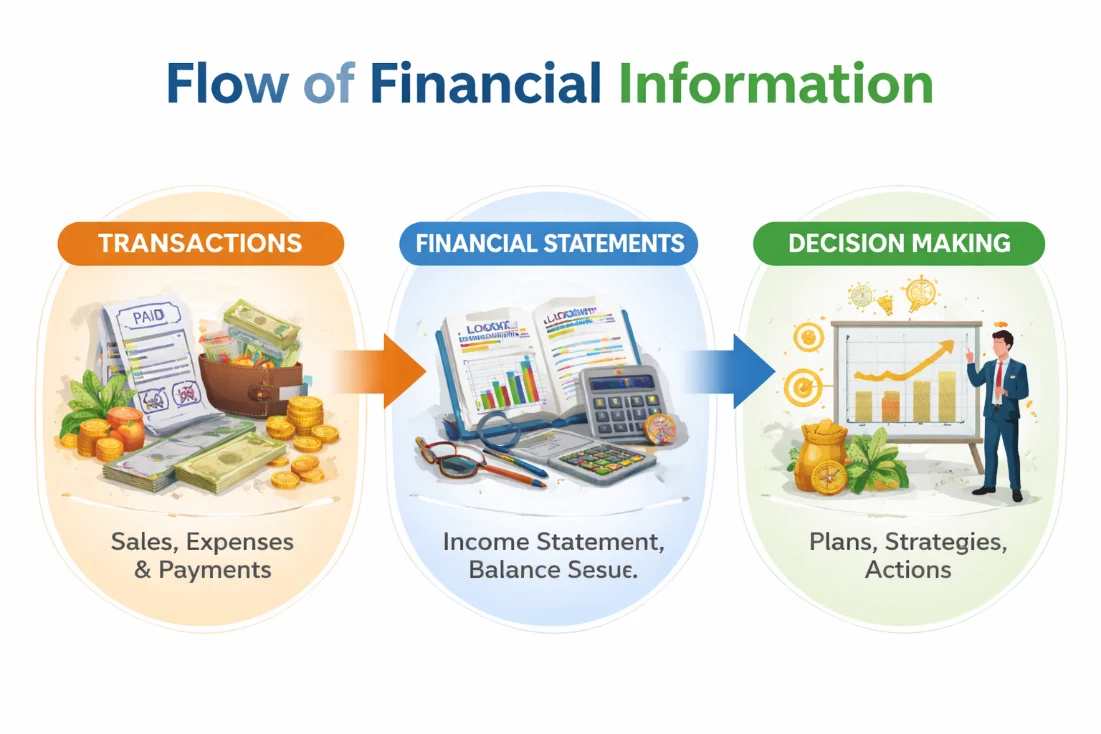
b) Classify Business Transactions in Bookkeeping
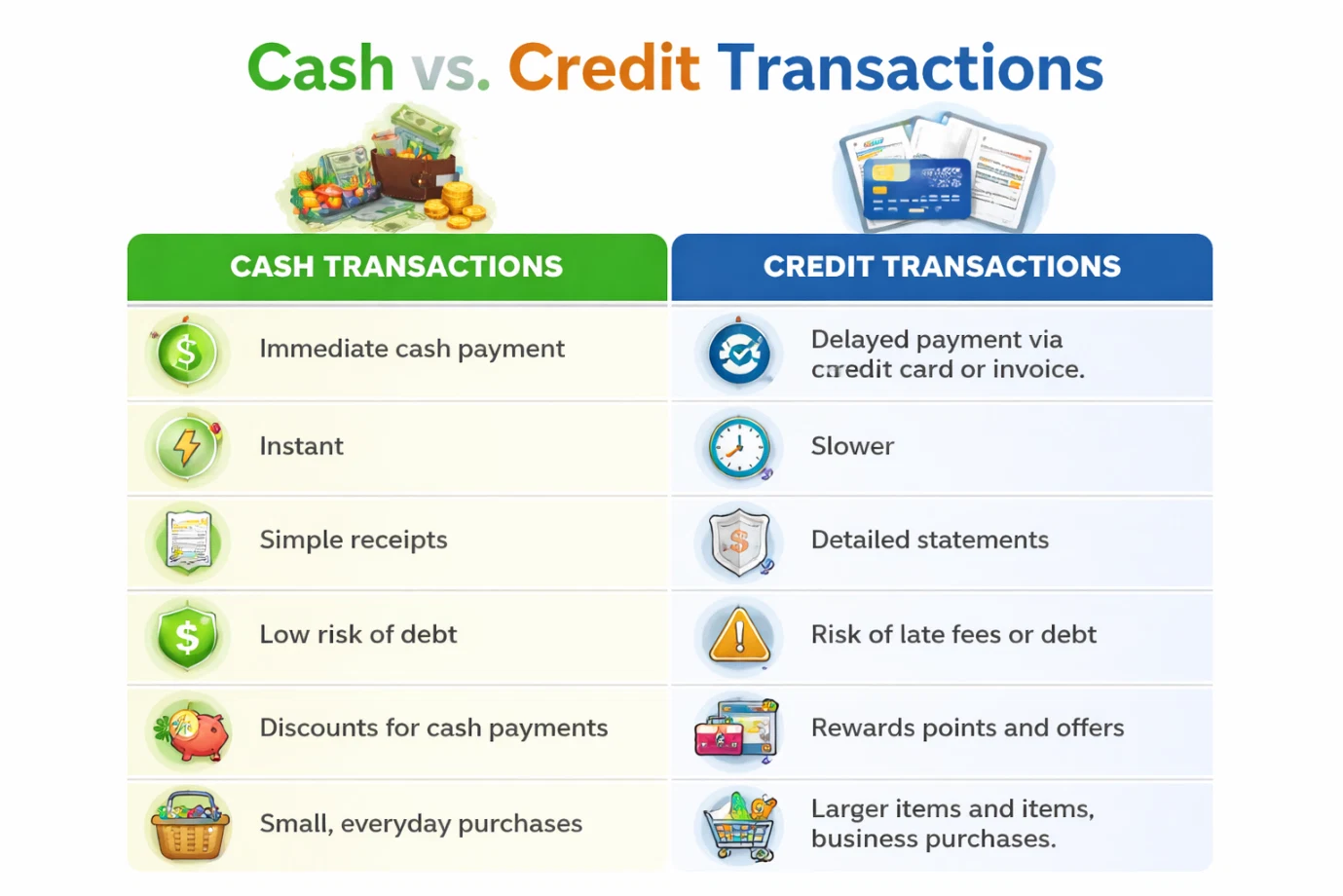
Business transactions can be categorized based on when payment is made.
|
Transaction Type |
Definition |
Characteristics |
Examples |
|---|---|---|---|
|
Cash Transaction |
Payment is made and received immediately at the time of the transaction. |
• Instant settlement |
• Customer pays cash for a haircut at a salon. |
|
Credit Transaction |
Payment is deferred to a later date as agreed by both parties. The seller extends credit to the buyer. |
• Creates a debtor-creditor relationship |
• A restaurant receives a delivery of supplies and agrees to pay the supplier in 30 days. |
Advantages and Disadvantages of Cash Transactions:
|
Advantages |
Disadvantages |
|---|---|
|
Simple and fast to process. |
Carrying large amounts of cash is risky (theft, loss). |
|
Helps with budgeting - you can only spend what you have. |
No automatic record unless you create a receipt. |
|
No debt or interest charges. |
Difficult for large transactions (e.g., buying a car). |
|
Personal information is more protected. |
May not be convenient for online purchases. |
Advantages and Disadvantages of Credit Transactions:
|
Advantages |
Disadvantages |
|---|---|
|
Allows purchase of expensive items over time. |
Creates debt that must be repaid. |
|
Provides a detailed record of transactions (statements). |
May involve interest and fees, increasing the total cost. |
|
Convenient for online and large purchases. |
Risk of defaulting on payments and damaging credit rating. |
|
Can help build a credit history. |
Potential for overspending beyond one's means. |
c) Prepare Simple Financial Statements for a Business
Financial statements summarize the financial activities and position of a business.
1. The Bookkeeping Equation:
ASSETS = LIABILITIES + CAPITAL
This equation must always balance. It shows that everything the business owns (assets) is financed either by borrowing (liabilities) or by the owner's investment (capital).
Example:
A business has cash of Ksh 10,000, equipment worth Ksh 15,000, and owes a supplier Ksh 5,000.
- Assets: Cash (10,000) + Equipment (15,000) = Ksh 25,000
- Liabilities: Creditor = Ksh 5,000
- Capital: Assets - Liabilities = 25,000 - 5,000 = Ksh 20,000
- Check: 25,000 = 5,000 + 20,000 (Balances)
2. Simple Income Statement (Profit and Loss Statement):
This statement shows the business's performance over a period (e.g., a month). It calculates the profit or loss.
Format:
Income Statement for the Month Ended [Date]
Revenue (Sales) XXX
Less: Cost of Goods Sold (XXX)
-----------------------------------------
Gross Profit XXX
Less: Operating Expenses:
- Rent XXX
- Salaries XXX
- Utilities XXX
- Other expenses XXX
Total Operating Expenses (XXX)
-----------------------------------------
Net Profit / (Net Loss) XXX
Example: Mama Mboga's Vegetable Stall - January 2024
|
Item |
Amount (Ksh) |
|---|---|
|
Revenue (Sales of vegetables) |
45,000 |
|
Less: Cost of vegetables purchased |
(25,000) |
|
Gross Profit |
20,000 |
|
Expenses: | |
|
- Transport to market |
2,000 |
|
- Stall rent |
3,000 |
|
- Packaging (plastic bags) |
500 |
|
- County government license |
500 |
|
Total Expenses |
(6,000) |
|
Net Profit |
14,000 |
3. Simple Statement of Financial Position (Balance Sheet):
This statement shows the financial position of the business at a specific point in time. It lists assets, liabilities, and capital.
Format:
Statement of Financial Position as at [Date]
ASSETS
Non-Current Assets (e.g., Equipment) XXX
Current Assets:
- Cash XXX
- Inventory XXX
- Accounts Receivable (Debtors) XXX
Total Assets XXX
LIABILITIES
Current Liabilities:
- Accounts Payable (Creditors) XXX
- Bank Overdraft XXX
Total Liabilities XXX
CAPITAL
Owner's Equity XXX
-----------------------------------------
Total Liabilities + Capital XXX
(Total Assets must equal Total Liabilities + Capital)
Example: Mama Mboga's Vegetable Stall - as at 31st January 2024
|
Item |
Amount (Ksh) |
|---|---|
|
ASSETS | |
|
Equipment (weighing scale, table) |
8,000 |
|
Cash in hand |
14,500 |
|
Inventory (unsold vegetables) |
1,500 |
|
Total Assets |
24,000 |
|
LIABILITIES | |
|
Money owed to supplier (Creditor) |
2,000 |
|
Total Liabilities |
2,000 |
|
CAPITAL | |
|
Owner's Equity (Balancing figure) |
22,000 |
|
Total Liabilities + Capital |
24,000 |
Key Inquiry Question: How do we prepare basic financial statements?
d) Keep Financial Records for Effective Decision Making
Good record-keeping practices ensure that financial information is reliable and useful.
Basic Record-Keeping Practices for a Small Business:
- Keep All Receipts: File every receipt for purchases and keep copies of sales invoices/receipts.
- Record Transactions Daily: Use a simple notebook, spreadsheet, or mobile app to record income and expenses as they occur.
- Separate Business and Personal Finances: Have a separate bank account or cash box for the business.
- Use a Simple Cash Book: A cash book records all cash coming in (receipts) and going out (payments).
Simple Cash Book Format:
|
Date |
Description |
Money In (Receipts) |
Money Out (Payments) |
Balance |
|---|---|---|---|---|
|
1/1 |
Starting Balance |
5,000 | ||
|
2/1 |
Sold goods |
2,500 |
7,500 | |
|
3/1 |
Paid transport |
300 |
7,200 | |
|
4/1 |
Bought supplies |
1,000 |
6,200 | |
|
5/1 |
Sold goods |
3,000 |
9,200 |
- Reconcile Regularly: At the end of each week or month, compare your cash book balance with the actual cash on hand. Investigate any differences.
- Use Technology: Simple mobile apps (like M-Pesa statements, Excel, or specialized small business apps) can simplify record-keeping.
How Records Inform Decision Making:
|
Record |
What It Tells You |
Decision It Informs |
|---|---|---|
|
Daily Sales Log |
Which products sell best on which days. |
What to stock more of; when to offer promotions. |
|
Expense Tracker |
Where money is being spent. |
Where to cut costs; which expenses are necessary. |
|
Cash Book Balance |
How much cash is available. |
Whether you can afford to buy new equipment or stock. |
|
Customer Debt List |
Who owes the business money and how much. |
When to follow up on payments. |
|
Monthly Profit Calculation |
Whether the business is making money. |
Whether to continue, expand, or change strategy. |
Key Inquiry Question: How do financial records help entrepreneurs make decisions?